
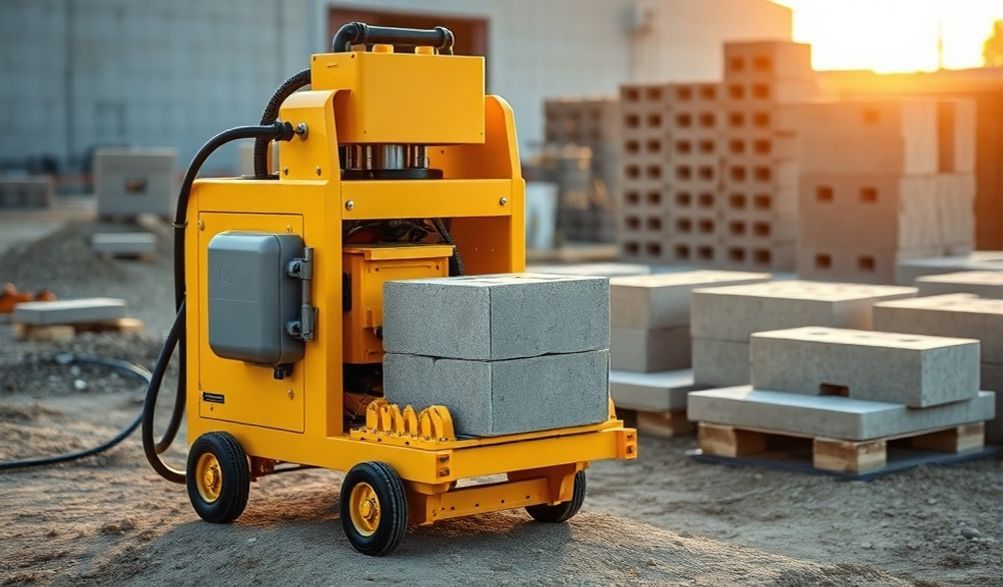
Jagorar Cikakke don Injin Yin Tubali Mai Sauƙi: Haɓaka Samarwa da Ingantacciyar Aiki a Wurin Aiki
Ka yi tunanin kana wani wurin gini mai nisa, mil daga mafi kusa mai kayan aiki. Farashin isar da tubalin siminti ya karu da kashi 30 cikin ɗari saboda tsadar man fetur da wahalar isa wurin. Ko kuma ka yi la’akari da ƙaramin ɗan kwangila wanda ya rasa wani kyakkyawan tayin gyaran shimfidar ƙasa saboda farashin shinge da aka saya ya cinye duk ribar. Ga masu gini, ’yan kwangila, da ’yan kasuwa, waɗannan ba hasashe ba ne—sun zama abin takaici na yau da kullun waɗanda ke matse riba da kuma dagula harkokin kaya.
Idan za ka iya canza albarkatun ƙasa zuwa ingantattun tubalan, bulo, ko kafaffen dutse daidai inda kake buƙatarsu? Wannan shine ainihin alkawarin na’urar yin tubalan da za a iya ɗauka. Ƙarfi ne mai ƙarfi da motsi, wanda aka ƙera don samar da kayan ginin siminti kai tsaye a wurin aiki, ƙaramin masana’anta, ko ma gida.
Wannan cikakken jagora ya yanke ta cikin hayaniyar. An tattara shi daga cikakkun bayanai na masana'antu, ƙwarewar aiki, da la'akari na kasuwanci na zahiri, yana aiki azaman albarkatunku ta hanya ɗaya. Ko kuna neman bayani kan yadda suke aiki, kwatanta zaɓuɓɓukan kasuwanci, ko gano mahimman fasalulluka don siyayya, za mu ba da bayyananniyar da kuke buƙata don yin zuba jari cikin kwarin gwiwa da sanin yakamata.
Menene Injin Yin Tubali Mai Saukewa? Fahimta da Amfaninsa
A zahiri, injin yin tubali mai ɗaukuwa shi ne masana'antar kankare mai motsi. Yana haɗa, matsawa, da kuma gyare-gyaren siminti zuwa siffofi masu daidaito da ƙarfi kamar tubali, bulo, ko kuma fale-falen tituna. Ba kamar tsayayyun masana'antu ba, sifarsa ta musamman ita ce motsi—ana iya jan shi, tura shi, ko ɗora shi a kan tirela, yana kawo samarwa zuwa wurin amfani.
Yaya Ya Bambanta da Tsire-tsire Masu Tsayayye
Fahimtar wannan bambance-bambance yana da muhimmanci. Tsire-tsire masu tsayayye an gina su ne don fitar da adadi mai yawa, ci gaba da fitarwa, sau da yawa suna samar da dubunnan tubalan a cikin sa'a guda. Suna da kafaffen gine-gine waɗanda ke buƙatar babban jari, sarari, da kayan more rayuwa.
Wani na'ura mai ɗaukuwa tana jujjuya wannan tsarin gaba ɗaya.
* Motsi:Yana da ƙafafu, ƙugiya mai jan kaya, ko kuma yana da sauƙin motsawa da injin ɗaukar kaya.
* Ƙananan Fitowa:Ana auna samarwa a cikin ɗaruruwa ko wasu dubunnan tubalan a kowace rana, wanda ya dace da buƙatun da ake buƙata.
* Sauƙi:Saita a kan ƙasa mai daidaito cikin sa'o'i, samar da abin da kuke buƙata, kuma matsawa zuwa wuri na gaba. Wannan saurin motsi shine babban ƙarfinsa.
Aikace-aikace na Farko da Masu Amfani masu Dacewa
Wannan juzu'i yana sa ya zama kayan aiki ga masu amfani iri-iri:
* Kamfanoni na Gina Gidaje Masu Karami da Matsakaita:Samar da tubalan a wurin don ayyukan gidaje, tare da kawar da jigilar kaya da rage satar kayan aiki.
* Gidaje & Ayyukan Ci Gaban Karkara:Yana da kyau don wuraren da ba su da ingantacciyar hanyar hanya ko kuma ba su da masu samar da tubali na gida, yana ba da damar ginin da al'umma ke jagoranta.
* Masu Kwangila na Landscaping & Shinge:Ƙirƙiri pavers na al'ada, duwatsu na gefe, da tubalan bangon riƙewa waɗanda aka keɓance ga kowane ƙira.
* 'Yan Kasuwa da Masana'antun Kanana: Start a block-making business with lower entry costs, supplying local markets.
* Disaster Relief & Humanitarian Agencies: Rapidly deploy to produce building materials for reconstruction efforts.
* DIY Enthusiasts & Homesteaders: For building walls, sheds, or garden features with self-made materials.
Nau'ikan Tubalan Gama-gari da Ake Samarwa
These machines are surprisingly versatile in their output. With interchangeable molds, a single machine can produce:
* Tubalin Ƙofa: Standard for load-bearing and non-load-bearing walls.
* Tsari Mai Ƙarfi: For foundations, pillars, and areas requiring high strength.
* Dutsen Shinge & Tubalin Masu Haɗin Kai:Don hanyoyin mota, hanyoyin tafiya, da baranda.
* Curbs, Kerbstones, and Grass Pavers: For landscaping and civil works.
* Siffofi na Musamman: Some machines offer molds for unique architectural blocks.
Key Advantages of Investing in a Portable Block Maker
The benefits extend far beyond simple mobility. Investing in this technology can fundamentally change your project economics and operational control.
Unmatched Mobility and On-Site Production
This is the cornerstone advantage. By producing directly where materials are needed, you:
* Kawar da Kuɗin Sufuri: No more paying for trucks to haul heavy, finished blocks over long distances.
* Reduce Material Handling: Minimize double-handling and breakage from loading/unloading multiple times.
* Overcome Logistical Hurdles: Access tight or remote sites where delivery of pre-made blocks is impossible or prohibitively expensive.
Significant Cost Reduction
The financial impact is multi-layered:
* Tanadin Kudi na Kaya: As above, transport costs can constitute a major portion of block expenses.
* Lower Material Costs: Source sand and aggregate locally, often at a fraction of the cost of finished goods.
* Reduced Middlemen: Cut out the distributor and retailer markups, capturing more value in your own process.
Flexibility and Customization
Gain unprecedented control over your supply chain:
* Samar da Akan Buƙata: Make blocks as the project progresses, reducing storage needs and capital tied up in inventory.
* Reduce Waste: Only mix and produce what you need for the day or week.
* Customize Easily: Change molds to produce different block sizes, or add pigments to the mix for colored pavers, all without relying on a supplier’s catalog.
Low Operational Overhead
Compared to a stationary plant, the barrier to entry is much lower:
* Capital Investment: Significantly lower initial purchase price.
* Setup & Infrastructure: Requires no permanent foundation or complex electrical/water hookups.
* Space Requirements: Can operate in a small yard or directly on the construction site.
Critical Features to Consider Before You Buy
Choosing the right machine requires matching its specifications to your specific needs. Here’s what demands your careful attention.
Ƙarfin Samarwa (Tubalan A Sa'a/Rana)
Capacity is typically measured in blocks per cycle (e.g., 3-10) and cycles per hour. A machine rated for 500 blocks per 8-hour shift is vastly different from one rated for 2000.
* Match to Scale: A small landscaping business might only need 200-300 pavers a day. A contractor building several houses will need 1000+ blocks daily.
* Consider Growth: It’s often wise to buy a machine with 20-30% more capacity than your current need to accommodate future growth.
Power Source: Manual, Electric, or Diesel
The power source dictates where and how you can operate.
* Manual (Hand-Operated): Lowest cost, no power needed. Ideal for very small-scale, intermittent use. Labor-intensive and lower output.
* Lantarki: The most common for semi-automatic machines. Offers consistent vibration/pressure, quieter operation. Requires a reliable power source or generator.
* Diesel or Diesel-Electric Hybrid: Full independence from the grid. Essential for remote sites. Higher fuel cost and maintenance, but offers maximum mobility and power.
Machine Type & Block Molding Process
The compaction method defines block quality and machine complexity.
* Tsarin Girgiza:
* Girgizar Tebur The mold table vibrates intensely to settle the concrete mix. Common and effective for most block types.
* Press Vibration: Vibration is combined with mechanical or hydraulic pressure from above. Produces denser, higher-strength blocks faster.
* Pressure Type: Machines can be mechanically lever-operated, electro-mechanical, or hydraulic. Hydraulic systems often provide the most consistent pressure and easier operation.
Mobility Features
Not all “portable” machines are equally portable.
* Wheel Type & Axle: Heavy-duty pneumatic tires are best for rough terrain. Check the towing hitch rating.
* Weight & Dimensions: Can it be legally towed by your vehicle? Will it fit through your gate? Verify overall transport dimensions.
* Daidaitawa: Once on site, does it have outriggers or jacks for stable operation?
Sauƙin Aiki da Kulawa
This affects your daily workflow and long-term costs.
* Sauƙin Amfani: Are controls intuitive? Is the mold-changing process straightforward?
* Matsayin Ƙwarewa: Some machines require experienced operators, while others are designed for quick training.
* Kulawa da Kayayyakin Gyara: What daily greasing is required? Are critical spare parts (like vibration motors) readily available from the supplier? A machine with no local service support is a major risk.
A Step-by-Step Guide to Operating Your Portable Block Machine
Once you have your machine, proper operation is key to quality and safety. Here’s a practical overview of the process.
Site Preparation and Safety First
A successful production day starts with preparation.
* Choose Stable Ground: Level, compacted soil or a concrete pad. This ensures machine stability and product uniformity.
* Safety Gear is Non-Negotiable: Always wear steel-toe boots, heavy-duty gloves, safety goggles, and hearing protection (if near a loud engine).
* Organize Your Workspace: Have raw material piles (cement, sand, aggregate) and a clean water source easily accessible. Designate areas for mixing, production, and block curing.
The Production Cycle: From Raw Material to Cured Block
The core process is a consistent cycle:
1. Raw Material Mixing: A consistent mix is critical. A common starting ratio is 1 part cement, 3 parts sand, and 3 parts aggregate (3/8″ or 10mm). Use a mechanical pan mixer for consistency—hand mixing is rarely adequate for machine production. Achieve a semi-dry, “ball-in-hand” consistency.
2. Loading the Hopper: The mixed material is fed into the machine’s feed hopper.
3. Molding/Compaction Process: The operator activates the machine. The hopper feeds a measured amount of mix into the mold cavity. Vibration and pressure compact the mix into a solid form.
4. Ejection and Palletizing: The mold rises, and the freshly formed block is ejected onto a wooden or steel pallet. Pallets are then carefully moved to the curing area.
5. Curing Process Best Practices: Curing is not just drying; it’s a chemical process. For maximum strength:
* Keep blocks under plastic sheeting or in a shaded area for 24-48 hours to retain moisture.
* After initial set, water-cure by sprinkling for 5-7 days. Properly cured blocks can reach their specified strength (often 3-5 MPa for non-load bearing, 7+ MPa for load-bearing).
Jadawalin Kulawa na Yau da Kullum
Preventative care prevents downtime.
* Kullum: Clean the machine thoroughly after use, removing all concrete residue. Check and grease all moving parts and bearings as per the manual.
* Mako-mako: Inspect bolts and nuts for tightness. Check hydraulic hoses and electrical connections for wear.
* Kowane wata: Perform a more detailed inspection of the vibration motors, mold liners, and wear plates. Replace parts showing significant wear.
Choosing the Right Machine for Your Project & Budget
This is where your research culminates in a smart purchasing decision.
Matching Machine Specifications to Project Scope
- DIY/Landscaping (Very Small Scale): A manual or small electric machine producing 200-400 units/day is sufficient.
- Small Housing Project/Startup Business: Look at semi-automatic electric models producing 800-1500 blocks/day.
- Medium-Scale Commercial Production: A robust semi-automatic or fully automatic diesel machine with 2000+ blocks/day capacity is necessary.
Understanding Pricing Tiers
Prices vary dramatically based on features and automation:
* Na'urorin Hannu: $1,000 – $4,000. Basic, labor-driven.
* Matsin Injin Mai Ƙaramin Gudanarwa: $5,000 – $25,000. The sweet spot for most businesses. Electric or diesel, with mechanized vibration and compaction.
* Matsarori Masu Sarrafa Kansu Gabaɗaya: $30,000+. High-output machines with automated pallet circulation and batching. For serious production businesses.
Supplier Vetting Checklist
The supplier is as important as the machine. Ask:
* After-Sales Service & Warranty: What is covered and for how long? Is there a local service technician?
* Training & Support: Do they offer on-site or video training? Is an operational manual provided?
* Samun Kayan Gyara: Can you get a list of common spare parts and their costs? Is inventory held locally?
* Sun Always seek verified customer reviews and ask the supplier for references from past clients in a similar industry. Contact those references.
Cost-Benefit Analysis (ROI) Framework
Justify the investment with simple math:
1. Calculate your current cost per block (purchase price + delivery).
2. Estimate your production cost per block with the machine (cement, aggregate, sand, labor, fuel/power, machine depreciation).
3. Determine your daily/weekly block requirement.
4. The difference between #1 and #2, multiplied by your volume, shows your potential savings. This will reveal your payback period (Investment Cost / Monthly Savings).
Frequently Asked Questions (FAQ) About Portable Block Machines
Q: What is the average production output of a portable block making machine?
A: Output varies widely. Small manual machines may produce 300-500 blocks in an 8-hour day. Semi-automatic models typically range from 800 to 2,500 blocks per day, depending on block size and operator efficiency.
Q: Can I use a portable machine to start a block manufacturing business?
A: Absolutely. It’s a common and lower-risk entry point. Start by supplying your own projects or small local clients. Focus on consistent quality, reliable curing, and good customer service to build your reputation.
Q: What raw materials are required, and what is the ideal mix ratio?
A: You need Portland cement, clean sand, and aggregate (crushed stone, 3/8″ or 5-10mm is typical). A standard starting mix is 1:3:3 (cement:sand:aggregate) by volume. The ideal “semi-dry” mix should hold its shape when squeezed in your hand.
Q: How durable are the blocks produced compared to factory-made ones?
A: With the correct mix design, proper compaction, and—most importantly—adequate curing, on-site blocks can meet or exceed the strength of factory-made blocks. The key is controlling the process meticulously.
Q: What are the most common operational challenges and how do I solve them?
A: Common issues include:
* Blocks breaking during ejection: The mix is too dry. Add slight moisture.
* Blocks lack strength or crumble: Inadequate compaction, wrong mix ratio, or, most commonly, poor curing. Review each step.
* Inconsistent block height: Unstable ground or an uneven feed of raw material into the mold.
Q: Is technical training provided by most manufacturers?
A: Reputable suppliers should provide training, either via detailed manuals, video tutorials, or on-site instruction. Always confirm this before purchasing.
Q: What is the typical lifespan of a well-maintained machine?
A: A quality machine that receives regular maintenance can last 10-15 years or more. Critical wear parts like mold liners and vibration motors will need replacement during this time, but the main frame should endure.
Ƙarshe
Portable block making machines represent a paradigm shift in how we think about construction material supply. They transform logistical challenges into opportunities for savings, control, and flexibility. By bringing production on-site, they empower builders, contractors, and entrepreneurs to take charge of their costs, timelines, and output quality.
The “best” machine isn’t the most expensive or the highest-output model. It is the one that aligns perfectly with your specific project scope, budget constraints, and local operating conditions. It is the machine backed by a supplier who offers robust support and training.
We encourage you to use this guide as a foundational checklist. Move forward by consulting with multiple reputable suppliers, requesting detailed specifications, and—where possible—witnessing a live demonstration. Speak directly to existing customers to get unfiltered feedback. With thorough due diligence, your investment in a portable block maker can become a cornerstone of efficiency and profitability for years to come.
<