
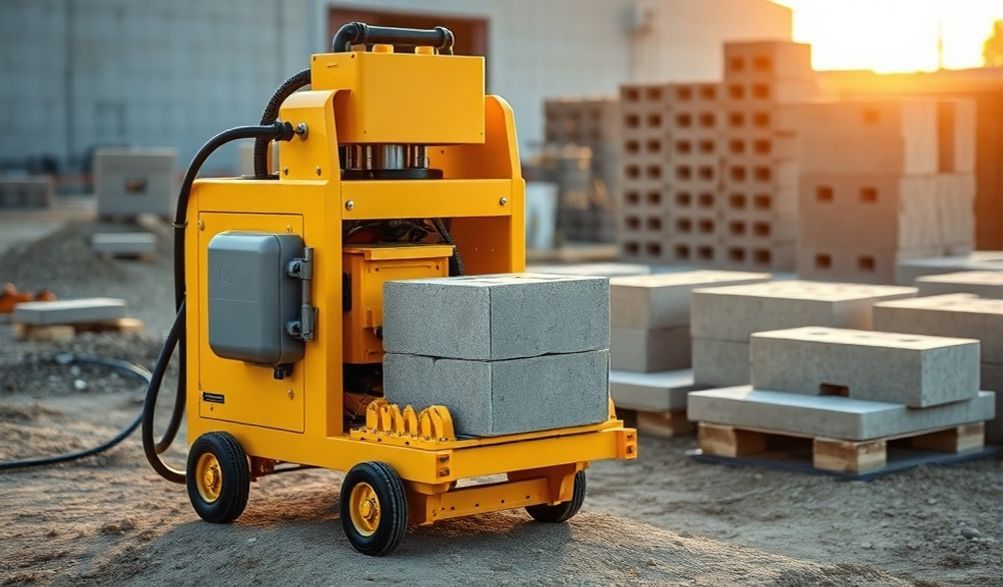
Портативті блок жасау машиналарының жетілдірілген нұсқаулығы: Құрылыс алаңындағы өндірісті және тиімділікті арттыру
Елеуіттік құрылыс алаңында, ең жақын жеткізушіден шақырымдарша алыс тұрдыңыз деп елестетіңіз. Бетон блоктарын жеткізуге арналған баға отын құны мен қол жетімсіздікке байланысты 30%-ға көтерілді. Немесе кішігірім мердігердің, сатып алынған тротуар тақталарының қымбаттығына байланысты тиімді ландшафттық жобадан айырылуын елестетіңіз. Құрылысшылар, мердігерлер және кәсіпкерлер үшін бұл жорамал емес – бұл маржаны қысатын және логистиканы қиындататын күнделікті мәселелер.
Егер сіз шикізаттарды дәл қажетті жерде жоғары сапалы блоктарға, кірпіштерге немесе тротуар тақталарына айналдыра алсаңыз ше? Бұл портативті блок жасау машинасының негізгі уәдесі. Бұл құрылыс алаңында, шағын зауытта, тіпті жеке үй шаруашылығында тікелей бетон құрылыс бөлшектерін өндіруге арналған ықшам, мобильді қуат көзі.
Бұл анықталған нұсқаулық барлық шатастыруларды жояды. Ол салалық сипаттамалардан, операциялық тәжірибеден және практикалық бизнес мәселелерінен құрастырылып, сіздің жалғыз ақпарат көзіңіз болады. Олардың қалай жұмыс істейтінін білгіңіз келсе, коммерциялық нұсқаларды салыстырғыңыз келсе немесе сатып алу үшін негізгі ерекшеліктерді анықтағыңыз келсе, біз сізге сенімді және хабардар инвестиция жасауға керек анықтықты ұсынамыз.
Портативті блок жасау машинасы деген не? Негізгі түсініктер мен қолданылуы
Оның мәні бойынша, портативті блок жасау машинасы - бұл бетон өнімдері үшін жылжымалы зауыт. Ол бетон қоспасын блоктар, кірпіштер немесе тротуар тақталары сияқты дәл, берік пішіндерге араластырады, тығыздайды және қалыптайды. Стационарлық зауыттардан айырмашылығы, оның анықтамалық сипаты - қозғалмалылық; оны арбаға тартуға, итеруге немесе тіркемеге тиеуге болады, өндірісті тұтыну орнына жеткізеді.
Ол Стационарлық Өсімдіктерден Қалай Ерекшеленеді
Бұл айырмашылықты түсіну өте маңызды. Стационарлық зауыттар үлкен, үздіксіз өнім шығаруға арналған, олар сағатына мыңдаған блоктар өндіреді. Олар ірі капитал, кеңістік және инфрақұрылымды қажет ететін тұрақты құрылымдар болып табылады.
Портативті машина бұл модельді басы-аяғымен өзгертеді:
* Қозғалыс:Ол дөңгелектермен, артқа тарту ілгектерімен жабдықталған немесе көтергіш арбамен жылжытуға жеңіл болуы керек.
* Төмен шығуӨндіріс күніне жүздеген немесе бірнеше мың блокпен өлшенеді, бұл сұранысқа байланысты қажеттіліктерге сәйкес келеді.
* Икемділік:Сағаттар ішінде тегіс жерде орнатылып, қажетті нәрселерді өндіріп, келесі алаңға ауысыңыз. Бұл икемділік оның супер күші.
Негізгі қолданбалар мен тамаша пайдаланушылар
This versatility makes it a tool for a wide range of users:
* Шағын және орта құрылыс фирмалары: Produce blocks on-site for housing projects, eliminating transport and reducing pilferage.
* Rural Housing & Development Projects: Ideal for areas with poor road access or no local block suppliers, enabling community-led construction.
* Landscaping & Paving Contractors: Create custom pavers, edging stones, and retaining wall blocks tailored to each design.
* Entrepreneurs & Small-Scale Manufacturers: Start a block-making business with lower entry costs, supplying local markets.
* Disaster Relief & Humanitarian Agencies: Rapidly deploy to produce building materials for reconstruction efforts.
* DIY Enthusiasts & Homesteaders: For building walls, sheds, or garden features with self-made materials.
Өндірілетін жалпы блок түрлері
These machines are surprisingly versatile in their output. With interchangeable molds, a single machine can produce:
* Қуыс блоктар: Standard for load-bearing and non-load-bearing walls.
* Қатты блоктар: For foundations, pillars, and areas requiring high strength.
* Тас тақташалар мен біріктірілген кірпіштер:Жолдарға, жаяу жүру жолдарына және алаңдарға арналған.
* Curbs, Kerbstones, and Grass Pavers: For landscaping and civil works.
* Арнайы пішіндер: Some machines offer molds for unique architectural blocks.
Key Advantages of Investing in a Portable Block Maker
The benefits extend far beyond simple mobility. Investing in this technology can fundamentally change your project economics and operational control.
Unmatched Mobility and On-Site Production
This is the cornerstone advantage. By producing directly where materials are needed, you:
* Eliminate Transport Costs: No more paying for trucks to haul heavy, finished blocks over long distances.
* Reduce Material Handling: Minimize double-handling and breakage from loading/unloading multiple times.
* Overcome Logistical Hurdles: Access tight or remote sites where delivery of pre-made blocks is impossible or prohibitively expensive.
Significant Cost Reduction
The financial impact is multi-layered:
* Logistics Savings: As above, transport costs can constitute a major portion of block expenses.
* Lower Material Costs: Source sand and aggregate locally, often at a fraction of the cost of finished goods.
* Reduced Middlemen: Cut out the distributor and retailer markups, capturing more value in your own process.
Flexibility and Customization
Gain unprecedented control over your supply chain:
* Өнімді сұраныс бойынша шығарыңыз: Make blocks as the project progresses, reducing storage needs and capital tied up in inventory.
* Reduce Waste: Only mix and produce what you need for the day or week.
* Customize Easily: Change molds to produce different block sizes, or add pigments to the mix for colored pavers, all without relying on a supplier’s catalog.
Low Operational Overhead
Compared to a stationary plant, the barrier to entry is much lower:
* Capital Investment: Significantly lower initial purchase price.
* Setup & Infrastructure: Requires no permanent foundation or complex electrical/water hookups.
* Space Requirements: Can operate in a small yard or directly on the construction site.
Critical Features to Consider Before You Buy
Choosing the right machine requires matching its specifications to your specific needs. Here’s what demands your careful attention.
Сағаттық/Тәуліктік өндірістік қуаттылық (Блоктар сағатына/тәулігіне)
Capacity is typically measured in blocks per cycle (e.g., 3-10) and cycles per hour. A machine rated for 500 blocks per 8-hour shift is vastly different from one rated for 2000.
* Match to Scale: A small landscaping business might only need 200-300 pavers a day. A contractor building several houses will need 1000+ blocks daily.
* Consider Growth: It’s often wise to buy a machine with 20-30% more capacity than your current need to accommodate future growth.
Power Source: Manual, Electric, or Diesel
The power source dictates where and how you can operate.
* Manual (Hand-Operated): Lowest cost, no power needed. Ideal for very small-scale, intermittent use. Labor-intensive and lower output.
* Электрлік: The most common for semi-automatic machines. Offers consistent vibration/pressure, quieter operation. Requires a reliable power source or generator.
* Diesel or Diesel-Electric Hybrid: Full independence from the grid. Essential for remote sites. Higher fuel cost and maintenance, but offers maximum mobility and power.
Machine Type & Block Molding Process
The compaction method defines block quality and machine complexity.
* Діріл жүйесі:
* Table Vibration: The mold table vibrates intensely to settle the concrete mix. Common and effective for most block types.
* Press Vibration: Vibration is combined with mechanical or hydraulic pressure from above. Produces denser, higher-strength blocks faster.
* Pressure Type: Machines can be mechanically lever-operated, electro-mechanical, or hydraulic. Hydraulic systems often provide the most consistent pressure and easier operation.
Mobility Features
Not all “portable” machines are equally portable.
* Wheel Type & Axle: Heavy-duty pneumatic tires are best for rough terrain. Check the towing hitch rating.
* Weight & Dimensions: Can it be legally towed by your vehicle? Will it fit through your gate? Verify overall transport dimensions.
* Тұрақтандыру: Once on site, does it have outriggers or jacks for stable operation?
Ease of Operation and Maintenance
This affects your daily workflow and long-term costs.
* Пайдаланушыға ыңғайлылық: Are controls intuitive? Is the mold-changing process straightforward?
* Дағды деңгейі: Some machines require experienced operators, while others are designed for quick training.
* Maintenance & Spare Parts: What daily greasing is required? Are critical spare parts (like vibration motors) readily available from the supplier? A machine with no local service support is a major risk.
A Step-by-Step Guide to Operating Your Portable Block Machine
Once you have your machine, proper operation is key to quality and safety. Here’s a practical overview of the process.
Site Preparation and Safety First
A successful production day starts with preparation.
* Choose Stable Ground: Level, compacted soil or a concrete pad. This ensures machine stability and product uniformity.
* Safety Gear is Non-Negotiable: Always wear steel-toe boots, heavy-duty gloves, safety goggles, and hearing protection (if near a loud engine).
* Organize Your Workspace: Have raw material piles (cement, sand, aggregate) and a clean water source easily accessible. Designate areas for mixing, production, and block curing.
The Production Cycle: From Raw Material to Cured Block
The core process is a consistent cycle:
1. Raw Material Mixing: A consistent mix is critical. A common starting ratio is 1 part cement, 3 parts sand, and 3 parts aggregate (3/8″ or 10mm). Use a mechanical pan mixer for consistency—hand mixing is rarely adequate for machine production. Achieve a semi-dry, “ball-in-hand” consistency.
2. Loading the Hopper: The mixed material is fed into the machine’s feed hopper.
3. Molding/Compaction Process: The operator activates the machine. The hopper feeds a measured amount of mix into the mold cavity. Vibration and pressure compact the mix into a solid form.
4. Ejection and Palletizing: The mold rises, and the freshly formed block is ejected onto a wooden or steel pallet. Pallets are then carefully moved to the curing area.
5. Curing Process Best Practices: Curing is not just drying; it’s a chemical process. For maximum strength:
* Keep blocks under plastic sheeting or in a shaded area for 24-48 hours to retain moisture.
* After initial set, water-cure by sprinkling for 5-7 days. Properly cured blocks can reach their specified strength (often 3-5 MPa for non-load bearing, 7+ MPa for load-bearing).
Routine Maintenance Checklist
Preventative care prevents downtime.
* Күнделікті Clean the machine thoroughly after use, removing all concrete residue. Check and grease all moving parts and bearings as per the manual.
* Апталық: Inspect bolts and nuts for tightness. Check hydraulic hoses and electrical connections for wear.
* Ай сайын: Perform a more detailed inspection of the vibration motors, mold liners, and wear plates. Replace parts showing significant wear.
Choosing the Right Machine for Your Project & Budget
This is where your research culminates in a smart purchasing decision.
Matching Machine Specifications to Project Scope
- DIY/Landscaping (Very Small Scale): A manual or small electric machine producing 200-400 units/day is sufficient.
- Small Housing Project/Startup Business: Look at semi-automatic electric models producing 800-1500 blocks/day.
- Medium-Scale Commercial Production: A robust semi-automatic or fully automatic diesel machine with 2000+ blocks/day capacity is necessary.
Understanding Pricing Tiers
Prices vary dramatically based on features and automation:
* Қол машиналары: $1,000 – $4,000. Basic, labor-driven.
* Жартылай автоматты машиналар: $5,000 – $25,000. The sweet spot for most businesses. Electric or diesel, with mechanized vibration and compaction.
* Толық автоматты машиналар: $30,000+. High-output machines with automated pallet circulation and batching. For serious production businesses.
Supplier Vetting Checklist
The supplier is as important as the machine. Ask:
* After-Sales Service & Warranty: What is covered and for how long? Is there a local service technician?
* Training & Support: Do they offer on-site or video training? Is an operational manual provided?
* Қосалқы бөлшектердің қолжетімділігі: Can you get a list of common spare parts and their costs? Is inventory held locally?
* Абырой: Always seek verified customer reviews and ask the supplier for references from past clients in a similar industry. Contact those references.
Cost-Benefit Analysis (ROI) Framework
Justify the investment with simple math:
1. Calculate your current cost per block (purchase price + delivery).
2. Estimate your production cost per block with the machine (cement, aggregate, sand, labor, fuel/power, machine depreciation).
3. Determine your daily/weekly block requirement.
4. The difference between #1 and #2, multiplied by your volume, shows your potential savings. This will reveal your payback period (Investment Cost / Monthly Savings).
Frequently Asked Questions (FAQ) About Portable Block Machines
Q: What is the average production output of a portable block making machine?
A: Output varies widely. Small manual machines may produce 300-500 blocks in an 8-hour day. Semi-automatic models typically range from 800 to 2,500 blocks per day, depending on block size and operator efficiency.
Q: Can I use a portable machine to start a block manufacturing business?
A: Absolutely. It’s a common and lower-risk entry point. Start by supplying your own projects or small local clients. Focus on consistent quality, reliable curing, and good customer service to build your reputation.
Q: What raw materials are required, and what is the ideal mix ratio?
A: You need Portland cement, clean sand, and aggregate (crushed stone, 3/8″ or 5-10mm is typical). A standard starting mix is 1:3:3 (cement:sand:aggregate) by volume. The ideal “semi-dry” mix should hold its shape when squeezed in your hand.
Q: How durable are the blocks produced compared to factory-made ones?
A: With the correct mix design, proper compaction, and—most importantly—adequate curing, on-site blocks can meet or exceed the strength of factory-made blocks. The key is controlling the process meticulously.
Q: What are the most common operational challenges and how do I solve them?
A: Common issues include:
* Blocks breaking during ejection: The mix is too dry. Add slight moisture.
* Blocks lack strength or crumble: Inadequate compaction, wrong mix ratio, or, most commonly, poor curing. Review each step.
* Inconsistent block height: Unstable ground or an uneven feed of raw material into the mold.
Q: Is technical training provided by most manufacturers?
A: Reputable suppliers should provide training, either via detailed manuals, video tutorials, or on-site instruction. Always confirm this before purchasing.
Q: What is the typical lifespan of a well-maintained machine?
A: A quality machine that receives regular maintenance can last 10-15 years or more. Critical wear parts like mold liners and vibration motors will need replacement during this time, but the main frame should endure.
Қорытынды
Portable block making machines represent a paradigm shift in how we think about construction material supply. They transform logistical challenges into opportunities for savings, control, and flexibility. By bringing production on-site, they empower builders, contractors, and entrepreneurs to take charge of their costs, timelines, and output quality.
The “best” machine isn’t the most expensive or the highest-output model. It is the one that aligns perfectly with your specific project scope, budget constraints, and local operating conditions. It is the machine backed by a supplier who offers robust support and training.
We encourage you to use this guide as a foundational checklist. Move forward by consulting with multiple reputable suppliers, requesting detailed specifications, and—where possible—witnessing a live demonstration. Speak directly to existing customers to get unfiltered feedback. With thorough due diligence, your investment in a portable block maker can become a cornerstone of efficiency and profitability for years to come.
<