
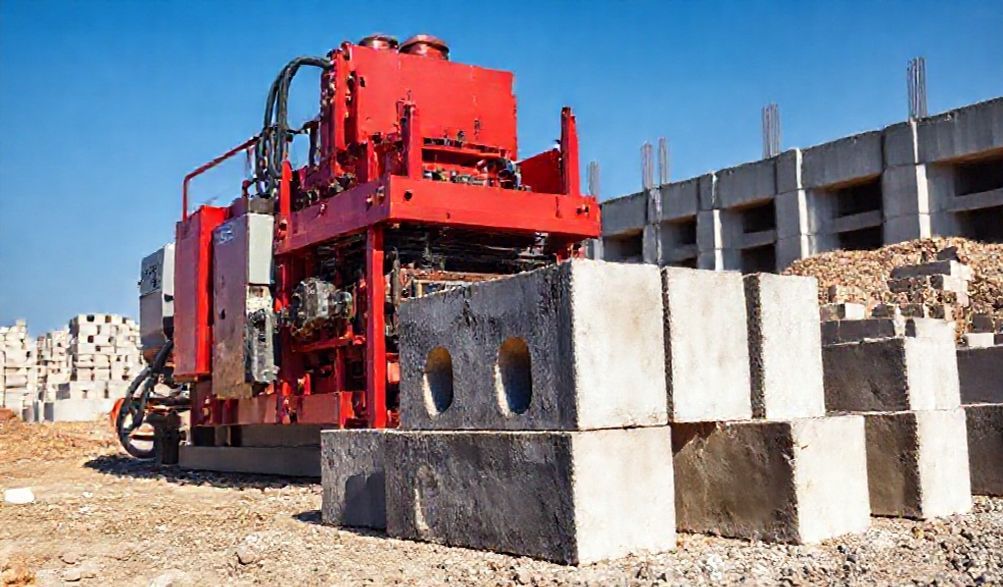
QTJ4-40 블록 머신: 기능, 작동 및 투자에 대한 종합 가이드
소개
소규모 건설 회사, 농촌 개발업자, 기업인들에게 막대한 자본 투자 없이 양질의 건축 자재를 생산할 수 있는 적절한 장비를 찾는 것은 지속적인 과제입니다. 신뢰할 수 있고 비용 효율적이며 조작이 간단한 기계에 대한 필요성이 가장 중요합니다. 관리 가능한 규모로 콘크리트 블록 제조 분야를 탐색하고 있다면, 아마도QTJ4-40 블록 머신.
이 포괄적인 가이드는 최종적인 참고 자료가 되도록 설계되었습니다. 기술 사양, 작동 원리, 실용적인 업계 통찰력을 바탕으로 이 인기 있는 기계를 상세히 분석할 것입니다. 우리의 목표는 판매 브로셔를 넘어서, 여러분이 정보에 입각한 결정을 내리는 데 필요한 명확성을 제공하는 것입니다.
이 글을 마칠 때쯤이면 QTJ4-40의 성능, 이상적인 적용 분야, 운영 현실, 그리고 총 투자 비용과 잠재적 수익에 대한 투명한 정보를 확실히 이해하게 될 것입니다. 여러분의 건축 사업에 이 기계가 적합한 엔진인지 함께 판단해 보시죠.
QTJ4-40 콘크리트 블록 제작기는 무엇인가요?
구체적인 내용으로 들어가기 전에, 이 기계가 무엇이며 블록 생산 장비의 광범위한 생태계 내에서 어디에 위치하는지 이해하는 것이 중요합니다.
핵심 기능과 제품 명명법 설명
모델명 "QTJ4-40"은 블록 기계 분야에서 일반적으로 사용되는 산업 규약을 따릅니다:
* QT:종종 "군천"을 나타내거나 제조업체의 일련 코드를 의미합니다.
* 제이:보통 중국어로 기계를 의미하는 '지(机)'를 나타냅니다.
* 4-40:핵심 사양. 일반적으로 기계가 생산할 수 있는 능력을 의미합니다.4조각표준 중공 블록(400x200x200mm)사이클당.
QTJ4-40의 핵심은 콘크리트 블록 성형 기계입니다. 이 기계의 주요 기능은 반건조 콘크리트 혼합물을 압축하여 정밀하고 고밀도의 형태로 만드는 것입니다. 교체 가능한 금형을 사용하여 다양한 제품을 생산할 수 있습니다:
* 다양한 두께의 홀러우 블록
* 솔리드 블록
* 포장 블록
* 조경용 인터록킹 브릭
기계 유형 및 운영 워크플로우
QTJ4-40은 40톤급으로 분류됩니다.반자동, 알 낳는 이동식 블록 기계이 설명은 그 작동 방식을 이해하는 데 핵심적입니다.
- 반자동코어 압축 및 성형 주기는 (진동 및 유압을 통해) 동력을 공급받지만, 원료 공급과 완성된 블록 제거와 같은 작업은 수동으로 이루어집니다.
- 산란형 모바일:대형 고정식 플랜트와 달리, 이 기계는 바퀴가 달린 섀시에 장착되어 있습니다. 블록을 생산한 후, 약간 앞으로 이동하면서 마치 닭이 알을 낳듯이 블록을 바닥이나 뒤쪽의 양생 팔레트 위에 '깔아' 놓습니다. 이를 통해 콘크리트 바닥이나 준비된 현장에서 직접 연속 생산이 가능합니다.
기본적인 순환적 워크플로는 다음과 같습니다:
1. 급식 The prepared concrete mixture is manually fed into the mold box.
2. 압축: High-frequency vibration compresses the mixture to remove air pockets and achieve density.
3. Mold Lifting: The hydraulic system lifts the mold box vertically, leaving the freshly formed block on the pallet or ground below.
4. Movement: The machine advances to the next position.
5. 치유: The block remains in place to gain initial strength before being moved to a final curing area.
Key Technical Specifications and Features of the QTJ4-40
Understanding the hard data is essential for assessing fit. Here are the core technical aspects that define the QTJ4-40.
Vital Production Metrics
- 생산 능력
- 사이클당: 4 pieces of 400x200x200mm standard hollow blocks.
- Per Shift: A realistic output for an 8-hour shift, accounting for setup, breaks, and material handling, is between 1,500 to 2,500 blocks. Cycle time is approximately 15-20 seconds, but overall output depends heavily on operator efficiency and workflow.
- Block Sizes (via interchangeable molds):
- Common hollow block sizes: 400x200x200mm, 400x150x200mm, 400x100x200mm.
- Solid blocks, pavers (e.g., 200x100x60mm), and interlocking bricks are also possible.
- 전력 요구 사항
- 일반적으로 5V에서 작동합니다.7.5 kW (10 마력) electric motor.
- Standard voltage is 380V/50Hz (3-phase), which is common for industrial equipment globally. Some models may offer other voltage configurations.
Design and Build Features
- 진동 시스템 The QTJ4-40 usually employs a dual-shaft, high-frequency vibration system. This is the heart of the machine. The synchronized vibrations from two motors ensure even compaction throughout the mold, resulting in blocks with consistent density, sharp edges, and high compressive strength.
- 몰드와 팔레트 시스템:
- 곰팡이: Constructed from high-carbon, heat-treated steel for durability and resistance to abrasion. Quality of the mold steel directly impacts block finish and mold lifespan.
- 팔레트: The machine can work with or without steel pallets. Using pallets allows for easier block handling and stacking after the initial set.
- Mobility and Structure: Its defining feature is the robust steel frame on wheels. This “egg-laying” design eliminates the need for a complex conveyor system, simplifying the setup and allowing for true on-site production, which reduces block transportation costs for local projects.
이상적인 응용 분야 및 프로젝트 적합성
A machine is only as good as the job it’s suited for. Let’s connect the specs to real-world scenarios.
Perfect For: Small to Medium-Scale Ventures
The QTJ4-40 shines in environments where flexibility, lower capital cost, and simplicity are valued over sheer, massive output.
- 농촌 및 준도시 주택 프로젝트 Ideal for producing blocks directly on the construction site or for a small local block yard supplying a community.
- Small Construction Companies: Allows a company to vertically integrate, producing their own blocks for specific projects and controlling quality and cost.
- 창업 스타트업: A manageable entry point into the block manufacturing business with a lower financial barrier than fully automatic plants.
- Projects with Moderate, Steady Demand: Well-suited for supplying a local market where daily demand is in the range of a few thousand blocks.
Limitations to Consider
Being honest about limitations prevents costly mistakes. The QTJ4-40 is not a one-size-fits-all solution.
- Output Ceiling: Its production is fundamentally limited by its semi-automatic, single-mold design. It cannot compete with the output of a fully automatic multilayer plant.
- Labor Intensive: Requires a dedicated crew of 2-3 people for efficient operation (feeding, controlling, block handling). Labor costs and management are a significant part of the operational equation.
- Scale Limitation: It is not economically or practically suitable for supplying large-scale city developments or high-volume commercial contracts that require tens of thousands of blocks daily.
Operating the QTJ4-40: A Step-by-Step Overview
Success with this machine hinges on proper operation. Here’s a practical overview of the process.
원자재 준비
The machine can only form blocks as good as the mix you feed it.
- Mix Design: A standard ratio is 1 part cement, 3 parts sand, and 4-5 parts coarse aggregate (e.g., 3/8″ crushed stone). The exact mix should be tested for local materials.
- 수분 함량 This is critical. The mixture must be “semi-dry”—just moist enough to hold its shape when squeezed in your hand, but not wet or sloppy. Too much water weakens the block; too little leads to poor compaction.
- Aggregate Size: Must be clean and well-graded, but not exceed the wall thickness of the hollow blocks to ensure proper filling and strength.
The Production Cycle in Detail
- Mixture Feeding: Operators shovel or pour the prepared mix into the mold box, ensuring it is evenly distributed and slightly overfilled.
- Vibration and Compaction: The operator activates the vibration motors for 3-5 seconds. The mold table vibrates intensely, settling and compacting the mixture. A press head may simultaneously apply slight pressure from above.
- Mold Lifting and Block Ejection: The vibration stops, and the hydraulic system lifts the entire mold box vertically. The compacted block remains perfectly formed on the pallet or ground beneath.
- 경화 과정: The machine moves forward, and the block is left in place.
- Initial Curing (24-48 hours): Blocks must be kept moist and protected from sun and wind, often by covering with plastic sheeting.
- Final Curing: After initial set, blocks are stacked and kept damp for up to 28 days to achieve full design strength.
Essential Safety and Maintenance Protocols
Daily/Pre-Operation Checks:
* Inspect and tighten all bolts, especially on vibration motors and mold.
* Check hydraulic oil levels and look for leaks.
* Lubricate all moving points as per the manual.
Routine Maintenance:
* Weekly: Clean the machine thoroughly, especially the mold and vibration table.
* Monthly: Inspect hydraulic hoses and electrical connections. Check wear on mold liners.
* Annually: Consider a full professional service, including motor bearing checks.
작업자 안전
* Always wear safety glasses, gloves, and steel-toe boots.
* Never place hands in the mold area during the vibration or lifting cycle.
* Ensure the machine is on a level, stable surface before operation.
* Lock out/tag out power before performing any maintenance.
Cost Analysis: Investment and Return on Investment (ROI)
Let’s break down the financials with transparency. Prices vary by region and manufacturer, but the structure remains consistent.
Initial Investment Breakdown
- Machine Cost: The core QTJ4-40 machine typically ranges from $8,000 to $15,000 USD, depending on build quality, brand, and included accessories.
- Additional Essential Costs:
- 곰팡이: $500 – $1,500 per mold (you’ll need at least one to start).
- 팔레트: $20 – $50 each (you may start with 50-100).
- 콘크리트 믹서: A pan or drum mixer is necessary ($1,000 – $3,000).
- 우주 Cost of a leveled concrete floor (at least 20m x 10m for production and curing).
Operational Costs
- 노동 The largest recurring cost. Budget for 2-3 operators.
- 원자재 Cement, sand, and aggregate. This is your Cost of Goods Sold (COGS).
- Utilities: Electricity for the 7.5kW motor and mixer.
- Maintenance Spares: A small ongoing budget for replacement parts like springs, seals, and eventually mold liners.
Calculating Potential Profitability
A simplified model illustrates the potential:
- Cost Per Block: Calculate the total cost of materials (e.g., cement, sand, stone) for one block. Add a pro-rated share of labor, power, and maintenance. Let’s assume a total cost of $0.30 per standard hollow block.
- Selling Price: Research your local market. Let’s assume a conservative selling price of $0.50 per block.
- Gross Profit Per Block: $0.50 – $0.30 = $0.20.
- Daily Gross Profit: At 2,000 blocks/day: 2,000 * $0.20 = $400.
- ROI Timeline: Deduct fixed costs (machine, molds) from daily profit. A $12,000 initial investment would be recouped in approximately 30 productive working days ($12,000 / $400 = 30 days), excluding land and building costs.
Key Factors Affecting ROI: Your actual production efficiency, local material costs, market selling price, and machine uptime will dramatically influence this calculation.
Choosing a Reliable QTJ4-40 Supplier
Your supplier choice is as important as the machine itself. Here’s how to navigate the market.
Manufacturer vs. Local Dealer: Pros and Cons
- Direct from Manufacturer (often overseas):
- 장점: Lower price, direct technical specifications.
- 단점: Potentially complex logistics, unclear after-sales support, language barriers.
- Local Dealer/Distributor:
- 장점: Local spare parts, on-the-ground technical support, easier communication, may handle import logistics.
- 단점: Higher price due to markup.
Key Evaluation Criteria
- 빌드 품질: Ask for detailed photos and specifications. Focus on steel plate thickness, welding quality, and brand of core components (motors, hydraulic pumps).
- 애프터 서비스: Do they offer installation guidance, operational training, and troubleshooting support? Is there a detailed manual in your language?
- 보증 및 예비 부품: What is covered and for how long? Is there a readily available catalog of spare parts?
- Reputation & References: Can they provide contact information for previous customers in your region? Can you visit a working installation?
Red Flags to Avoid
- Too-Good-To-Be-True Pricing: Extremely low prices almost always indicate inferior materials and poor workmanship.
- Lack of Transparency: Unwillingness to provide technical details, company registration, or a physical address.
- Pressure Tactics: High-pressure sales pushing for immediate payment without allowing for due diligence.
- No Service Agreement: A complete lack of discussion about support, training, or warranty.
FAQ Section
Q: What is the production output of the QTJ4-40 per day?
A: Under efficient, steady operation, you can expect between 1,500 to 2,500 standard blocks in an 8-hour shift. The actual number depends on block type, operator skill, and workflow organization.
Q: Can one person operate the QTJ4-40 machine?
A: No, efficient and safe operation is not a one-person job. It realistically requires 2-3 people: one to feed the mixer and manage material, one to operate the machine controls and assist with feeding, and one to handle and stack the freshly made blocks.
Q: What is the difference between the QTJ4-40 and a fully automatic block machine?
A: The key differences are in automation, scale, and cost. The QTJ4-40 is semi-automatic with manual feeding and block handling, has lower output, and requires more labor, but has a much lower capital cost. A fully automatic plant uses computerized controls, robotic handling, and conveyor systems for high-volume, low-labor production at a significantly higher investment.
Q: What kind of after-sales support should I expect?
A: You should expect and demand: a comprehensive operation and maintenance manual, installation drawings/guidance, basic operational training (often via video call), a clear warranty (typically 1 year on main parts), and access to a spare parts catalog.
Q: How long does it take to learn to operate this machine?
A: The basic mechanical operation—feeding, pressing buttons, moving blocks—can be learned in 2-3 days. However, mastering the ideal concrete mix design for your local materials, troubleshooting common issues like block cracking, and optimizing the workflow for maximum output can take several weeks of hands-on, practical experience.
결론
그QTJ4-40 블록 머신 stands as a proven, accessible gateway into concrete block production. It offers a compelling balance of productivity, simplicity, and affordability for small to medium-scale builders and entrepreneurs. Its mobile, semi-automatic design provides the flexibility to produce quality blocks on-site, directly where they are needed.
Remember, the machine is just one component of success. Your diligence in raw material selection, your commitment to proper operation and maintenance, and the soundness of your local market business plan are equally critical. Use this guide as a foundational checklist.
Your Next Step: When you engage with suppliers, ask informed questions based on this overview. Request detailed videos of the machine in operation, ask for customer references, and, if possible, insist on seeing a live demonstration. An informed purchase is the first and most important block in building a successful venture.
<