
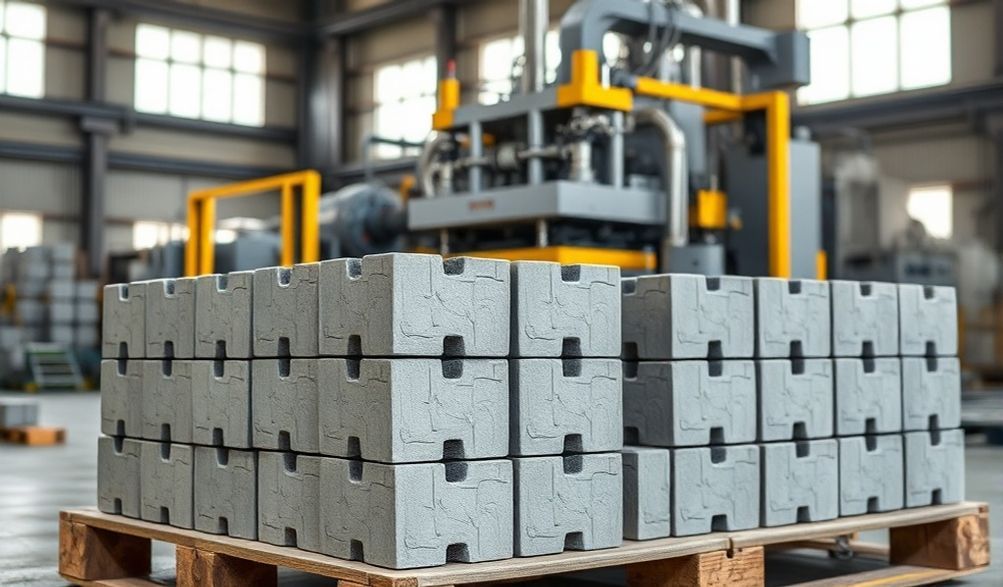
Ultimus Tuus Dux ad Emendum Machinam ad Lateres Concretos Faciendos Venalem (MMXXIV)
Introductio
Luctuosa aedificationis negotia construere vel facultates productionis augere? Recta machina ad lateres concretos faciendos est summa vestra collocatio. Haec est machina operis tui, quae exitum, qualitatem producti, et postremo lucrum definit. Attamen per vastum mercatum machinarum venalium iter facere formidolosa res esse potest, plena technicis verbis et magnis pecuniariis periculis.
Hoc plenum ductorium anni MMXXIV, ex decenniis industriae experientiae hauriens, tibi fida viae tabula erit. Perplexitatem secabimus ut tibi adiutemus intellegere quid exacte in [lacuna] quaerendum sit.Machina ad lateres concretos faciendos vendenda.Disces quomodo machinarum genera propositis tuis accommodes, pretii rationes interprets, fabricantes iudicio acuto diiudices, et communia dispendiosa pericula vites. In fine, instructus eris ad emptionem scienter et confidenter faciendam, quae incrementum tuum in annos venturos alat.
Intellectus Machinarum ad Lateres Concretos Faciendos: Genera et Usus
Priusquam in specificationes et pretia mergimur, fundamentales machinarum categorias comprehendere necesse est. Recta electio a productionis amplitudine, sumptu, et consilio laboris pendet.
Manualis contra Semi-Automaticus contra Plene Automaticus Machinae Laterales
Gradus automationis est primarius discriminator in machinis laterum, qui directe efficit productum, sumptus laboris, et primam collocationem pecuniae.
-
Machinae Manuales ad Lateres Faciendos:
- Operatio:Totus humanis viribus actus. Operatores formam manu implent, concretum comprimunt (saepe per vectem), et laterem ex forma extrahunt.
- Labor & Productio:Laboris intensitas alta, fructus perexiguus (plerumque 100-500 lateres per diem). Idoneum est uni vel duobus operariis.
- Peritus Commendatio:Idonea sunt initiis perexiguis, operibus communitatis, vel in locis remotis ubi vis electrica et pecunia parum suppetunt. Sunt ingressus periculo minimo, sed non ad productionem commercialem magni momenti.
-
Machinae Semi-Automaticae ad Lateres Faciendos:
- Operatio:Mechanizat nucleus compactionis processum (per vibrationem et pressionem hydraulicam) sed requirit manualem subministrationem materiae rudis et ablationem/palettizationem factorum laterum.
- Labor & Productio:Moderatus laboris postulatum (2-4 personae), bonus effectus (1,000 ad 6,000+ caudices per octo horarum vicem, pro exemplari).
- Peritus Commendatio:Locus suavis plerumque pro mediocribus parvisque negotiis (SMEs). Praebent aequilibrium praeclarum inter parsimoniam, auctam productionis rationem, et constantiam qualitatis laterum. Idonea negotiis quae ab operationibus manualibus crescere cupiunt.
-
Machinae Plenae Automatae ad Lateres Faciendos
- Operatio:Omnino automatice per systemata PLC (Programmabilis Logicae Moderatoris) aguntur. Praedita sunt automatice materiae alimonia, formaticio, compaction, curatio, et congeratio. Saepe pars totius lineae productionis sunt.
- Labor & Productio:Labor minimus (ad supervisionem et sustentationem), fructus altissimus (octo milia ad viginti milia et plus caudicum per vicem).
- Peritus Commendatio:Magnis mercatoriis institutis et magnis contractibus destinata. Ingentis pecuniae collocatio excusatur efficacitate incomparabili, minore sumptu per singula, et constantia praestanti. Opus est certa vi electrica et cultiore curatione.
Machinae Stationariae ad Lateres Faciendos contra Machinae Mobiles ad Lateres Faciendos
Haec distinctio ad mobilitatem machinae et ad vestigium institutionis pertinet.
-
Machinae Stationariae ad Lateres Faciendos:
- Haec sunt stabilia instituta, plerumque in solido fundamento concreti in officina aut area dedicata imposita.
- Communiter robustiores, potentiores, et capaciores ad altiores productionis quantitates sunt.
- Applicatio.Perpetuorum manufacturarum plantarum ad mercatum regionalem supplendum electio normata.
-
Machinae Mobiles ad Camentarios Conficiendos (vel "Ovorum Stratrices").
- Hae unitates rotis aut plaustro impositae sunt. Eas directe in solo aut super tabulam concretam lateres gignunt, deinde progrediuntur ad proximam partem deponendam.
- Simpliciores sunt, saepe minus fundamenti requirunt, ac valde portabiles sunt.
- Applicatio.Egregium ad productionem in situ pro magnis constructionibus inceptis (exempli gratia, aedificando insulam habitationis) ubi caudices transportare sumptuosum est. Damna et sumptus transportandi tollunt.
Praeclarae Res: Quid Fabrica Potest?
Facultas mercaturae tuae ad formas ordinarias non circumscribitur. Versatilitas machinae, quae systemate formarum definitur, tuum productorum catalogum determinat.
- Lateres Cavi:Productum constructionis communissimum, excellentem rationem firmitatis ad pondus et insulationem praebens.
- Massa Solida: Used for heavier load-bearing applications and paving.
- Lapides Strati & Pavimenta Internexa: For driveways, walkways, and patios. A high-demand market in landscaping and municipal work.
- Crepido & Margines: Essential for road construction and landscaping projects.
- Formae Propriae: Interlocking blocks for retaining walls, chimney blocks, and decorative landscaping units.
Peritorum Sententia: When evaluating a Machina ad lateres concretos faciendos vendenda., inquire about the mold compatibility and cost. A machine that allows for quick mold changes with a wide range of available mold designs enables you to pivot with market demands and capture diverse revenue streams.
Cogitationes Criticae Antequam Emas
Armed with an understanding of machine types, you must now drill down into the specifics that separate a wise investment from a costly mistake.
Facultas Productionis & Postulata Efficiendi
Don’t just look at the “maximum” output in a brochure. Think practically.
- Cycles per Hour & Blocks per Cycle: Multiply these figures to get the theoretical hourly output. A machine with a 10-second cycle time producing 4 blocks per cycle can theoretically make 1,440 blocks per hour.
- Real-World Calculation: Deduct time for mold changes, maintenance breaks, material loading delays, and operator shifts. A realistic daily output is often 70-80% of the theoretical maximum.
- Matching to Goals: Align the machine’s realistic output with your current orders and projected growth for the next 3-5 years. Buying slightly more capacity than you need today is often smarter than outgrowing a machine too quickly.
Machine Specifications & Technical Details
These are the nuts and bolts that determine performance and longevity.
- Pressio (Tonnagium): Higher compaction pressure (measured in tons) generally produces denser, stronger blocks. For standard hollow blocks, machines range from 50 to 400+ tons.
- Potestatis Postulata: Manuals may need no power, while semi-automatics often use a standard 3-phase motor (e.g., 380V/50Hz or 440V/60Hz). Verify your local power supply.
- Systema Vibratorium: This is critical for compacting the concrete and releasing air bubbles. Look for durable, high-frequency vibrators mounted effectively within the mold table.
- Systema Moderandi: From simple relay logic to touch-screen PLCs. More advanced controls offer precision, diagnostic tools, and easier operation.
- Trust Factor: Always ask about the availability of technical manuals, wiring diagrams, and spare parts lists. A supplier’s reluctance to provide these is a major red flag.
Quality of Construction & Key Components
This is where “you get what you pay for” becomes starkly real.
- Compages & Structura: The frame should be made from heavy-duty, reinforced steel plate to withstand constant vibration and pressure without warping.
- Systema Hydraulicorum: The heart of an automatic machine. Look for reputable component brands (e.g., Bosch Rexroth, Parker, Yuken) and a well-designed, accessible system with proper filtration and cooling.
- Moli: These are high-wear items. They should be made from hardened, high-chrome steel for longevity and precise block dimensions.
- Authoritative Benchmark: Reputable manufacturers will often build to recognized standards (like ISO) and can provide material certificates for critical components. Don’t hesitate to ask for them.
Space, Logistics, and Foundation Needs
A machine isn’t just the machine itself.
- Factory Space: You need space for the machine, raw material storage (aggregates, cement), a mixing area, a curing area, and finished product storage. Include space for forklift movement.
- Fundamentum: Most stationary machines require a solid, level concrete foundation of specified thickness to absorb vibrations. The supplier should provide detailed foundation drawings.
- Logistica: Consider the machine’s shipping dimensions and weight. Do you have access for a delivery truck? Do you need a crane or heavy forklift for unloading and placement?
Navigating the Market: Cost, Suppliers, and Selection
This is the phase where due diligence separates successful buyers from regretful ones.
Concrete Block Making Machine Price Ranges
Prices vary astronomically based on the factors we’ve discussed. Here’s a transparent 2024 overview:
- Machina Manualia: $1,000 – $5,000 USD.
- Semiautomaticae Machinae: $8,000 – $50,000+ USD. A robust, mid-capacity model for SME production typically starts around $15,000-$25,000.
- Fully Automatic Machines / Production Lines: $50,000 – $300,000+ USD. Single-pallet fully automatic machines start around $50k-$80k, while large multi-pallet lines with full automation can reach several hundred thousand.
Critical Expertise Note: The initial purchase price is just one part of the Total Cost of Ownership (TCO). A cheaper, poorly supported machine can cost far more in downtime, repair costs, and lost production than a higher-quality, well-supported alternative.
How to Choose a Reputable Manufacturer or Supplier
Your relationship with the supplier is as important as the machine itself. Use this checklist:
- Company History & Reputation: How long have they been in business? Search for their brand name online alongside keywords like “review,” “problem,” or “service.” A 10+ year track record is a good sign.
- Quality Evidence: Do they have quality management certifications (ISO)? Can they provide test reports or videos of the machine in operation? Will they share material certificates for key parts?
- Structura Subsidii Post-Venditionis: This is non-negotiable. Do they have technical support staff? What is the warranty period and what does it cover? Is there a stock of commonly needed spare parts? Do they offer installation supervision and operator training?
- Transparency & References: A trustworthy supplier will be proud to connect you with previous customers in your region or a similar industry. They should also be open to a factory visit or a live video tour of their production facility.
- Red Flags: Extremely low prices, pressure to pay via insecure methods, vague company addresses, inability to communicate clearly in your language, and no physical contact details.
New vs. Used Concrete Block Making Machines
A used machine can be a great value—or a money pit.
- New Machine Pros: Full warranty, latest technology, customized to your needs, reliable performance from day one.
- Used Machine Pros: Lower upfront cost, potential for faster delivery, depreciation already absorbed.
- Used Machine Inspection Checklist:
- Hours/Cycles: Check the machine’s service hour meter or get an estimate of total production cycles.
- Physical Inspection: Look for cracks in the frame, signs of weld repairs, hydraulic oil leaks, and excessive wear on molds and vibrators.
- Test Run: Semper insist on seeing the machine under power, producing blocks. Listen for unusual noises in the hydraulics or vibrations.
- Documentatio. Request the original manuals, part lists, and maintenance history.
Maximizing Your Investment: Operation and Beyond
Your new machine is the centerpiece, but its success depends on the ecosystem around it.
Essential Auxiliary Equipment
Rarely does a machine work in isolation. Consider these for an efficient line:
- Cementi Mixtorium: A pan mixer or planetary mixer ensures a consistent, homogenous mix, which is vital for block quality.
- Systema Convectorium: Transports mixed concrete to the machine hopper, saving labor and time.
- Palearium Alimentator/Circulatio Systematis: Automatic systems move pallets in and out of the machine, crucial for high-output automation.
- Block Curing System: This can be a simple rack system in a sheltered yard or a sophisticated steam curing chamber for faster strength gain.
- Forklift or Block Clamp: Essential for handling raw materials and moving stacks of finished blocks.
Raw Material Considerations for Optimal Blocks
The machine can only form what you feed it.
- Compositio Mixturae: A proper ratio of cement, sand, aggregate (gravel or crushed stone), and water is critical. The water-cement ratio directly affects strength.
- Aggregate Size: Must be compatible with your mold dimensions—typically between 5mm and 10mm for standard blocks.
- Consistency is Key: Variations in raw material quality or moisture content will lead to inconsistent block density and strength, causing production issues and customer complaints.
Momentum Post-Venditionis Auxilii Momentum
The sale is the beginning of the relationship, not the end.
- Instalatio et Dedication: Professional setup ensures the machine is level, calibrated, and operating safely from the start.
- Exercitatio Universalis: Operators must be trained not just on how to run the machine, but on basic troubleshooting, daily maintenance, and safety protocols.
- Warranty & Long-Term Support: Understand the response time for technical queries. How quickly can they ship a critical spare part? A supplier with a strong support network is investing in your long-term success.
Interrogationes Saepius Petitae (ISP)
Q: What is the average cost of a concrete block making machine for sale?
A: As detailed above, there’s no single “average.” Prices range from around $1,000 for a basic manual model to well over $200,000 for a high-capacity, fully automatic production line. Your final cost depends on automation level, capacity, brand, and included support.
Q: How many blocks can a standard machine produce per day?
A: Output varies dramatically. A semiautomatica machina might produce 2,000 to 6,000 standard hollow blocks in an 8-hour shift. A fully automatic single-pallet machine can produce 8,000 to 15,000, while large multi-pallet lines can exceed 20,000 blocks per day.
Q: Can one machine produce different block types and sizes?
A: Yes, absolutely. This is achieved through interchangeable molds. However, factor in the cost of additional molds and the time required for mold changeover, which can temporarily halt production.
Q: What kind of power supply is needed?
A: It depends entirely on the machine. Small manuals may need none. Semi-automatic and automatic machines almost always require a three-phase industrial power supply (commonly 380V/50Hz or 440V/60Hz). Always confirm the exact voltage and power (kW) requirements with the supplier before purchase.
Q: How do I ensure I’m choosing a trustworthy supplier?
A: Follow the checklist in the guide: verify their business history, ask for quality certifications, demand details on after-sales service and spare parts, and always request customer references or a factory visit. A reputable company will be transparent and eager to prove its credibility.
Conclusio.
Purchasing a Machina ad lateres concretos faciendos vendenda. is a pivotal decision that hinges on careful planning and informed selection. We’ve walked through the essential pillars: defining your production needs and scale, understanding the core differences between manual, semi-automatic, and automatic systems, and prioritizing durable construction and robust after-sales support over price alone.
Remember, this machine is a long-term partner in your business growth. The most cost-effective choice isn’t the cheapest sticker price, but the machine—backed by a reputable supplier—that delivers reliable, efficient production for years with minimal downtime. Thorough research and partnering with experienced, trustworthy experts are the true foundations of your success in the block manufacturing industry.
Ready to take the next step? Browse our curated selection of verified, high-performance concrete block making machines for sale, or contact our team of technical experts today for a free, no-obligation consultation tailored to your project goals.
<