
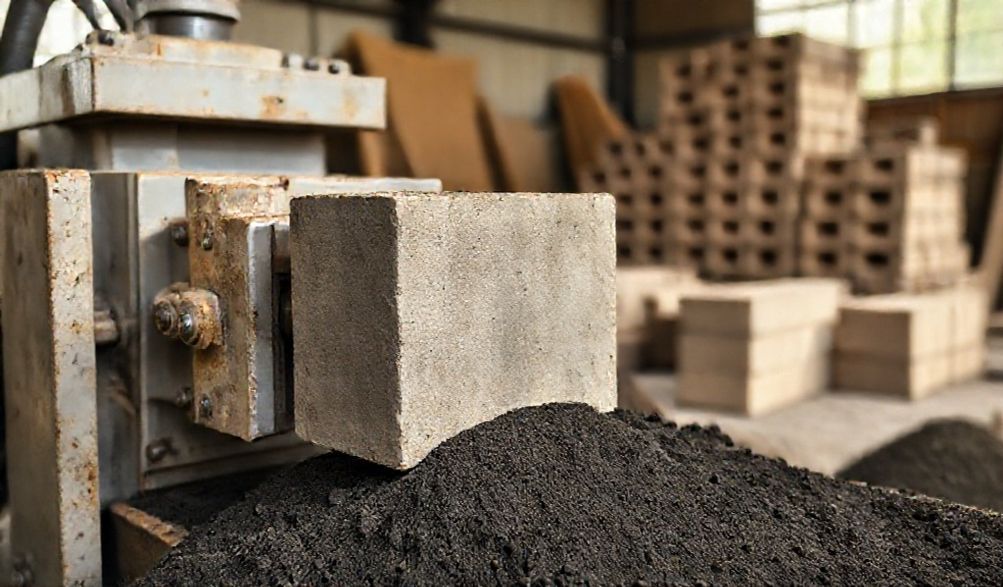
O Guia Definitivo para Máquinas de Tijolos de Terra: Construindo um Futuro Sustentável
Em uma era definida pela urgência climática e uma crise global de habitação, a indústria da construção enfrenta um desafio monumental: como construir abrigos duráveis e acessíveis sem degradar ainda mais nosso planeta. A resposta, ao que parece, pode estar sob nossos pés. Uma técnica de construção antiga está renascendo, impulsionada pela inovação moderna, oferecendo um caminho para um ambiente construído verdadeiramente sustentável. Esse renascimento é alimentado por uma peça tecnológica fundamental: amáquina de blocos de terra.
Também conhecida como prensa de bloco de terra comprimida (BTC) ou máquina de bloco de encaixe, este dispositivo é elegantemente simples em sua missão. Ele transforma terra crua de origem local – frequentemente solo do próprio local que está sendo construído – em blocos de construção densos, uniformes e incrivelmente resistentes. Este processo une a sabedoria atemporal dos materiais com a precisão da engenharia contemporânea.
Este guia foi criado para ser seu recurso definitivo. Seja você um construtor em busca de materiais resilientes, um arquiteto especificando projetos ecológicos, um entusiasta do DIY sonhando com uma casa feita com as próprias mãos ou um empreendedor de olho na economia verde, forneceremos a expertise necessária. Vamos nos aprofundar nas vantagens convincentes da construção com terra, desmistificar a tecnologia por trás das máquinas, oferecer uma estrutura prática para selecionar o equipamento adequado e até mesmo explorar o caso de negócio viável para produção. Nosso objetivo é fornecer a você um conhecimento acionável, fundamentado nas melhores práticas do setor e na aplicação no mundo real, para transformar o potencial da terra em uma realidade tangível.
Por Que Escolher a Construção com Tijolos de Terra? As Vantagens Convincentes
Indo além da teoria, vamos examinar o concreto (ou melhor,umbenefícios concretos que tornam a construção com blocos de terra uma escolha superior para o nosso tempo.
Sustentabilidade e Eco-Amizade Inigualáveis
Em um mundo de orçamentos de carbono e economias circulares, os blocos de terra se destacam como um paradigma da construção de baixo impacto.
- Energia Incorporada Ultrabaixa:Ao contrário dos tijolos queimados ou do cimento Portland, que exigem calor intenso (geralmente proveniente de combustíveis fósseis), os blocos de terra comprimida são criados por meio de pressão mecânica em temperaturas ambientes. O material principal é tipicamente obtido no local ou próximo, reduzindo drasticamente o custo energético do transporte.
- Pegada de Carbono Drasticamente Reduzida:O processo de produção emite CO2 mínimo. Quando estabilizados com cal (que reabsorve CO2 durante a cura) em vez de cimento, os blocos podem até se aproximar da neutralidade de carbono.
- Não Tóxico e Totalmente Reciclável:Blocos de terra são simplesmente terra. Eles não contêm compostos orgânicos voláteis (COVs), promovendo uma qualidade do ar interno superior. Ao final da vida muito longa de um edifício, os blocos podem ser devolvidos à terra ou triturados e reutilizados, criando um ciclo de material verdadeiramente fechado.
Durabilidade e Desempenho Excepcionais
Não se deixe enganar pelo nome "terra". Os blocos de terra comprimida devidamente fabricados são materiais de construção formidáveis, com características de desempenho que rivalizam e, em alguns casos, superam as opções convencionais.
- Alta Resistência à Compressão:Prensas hidráulicas modernas podem produzir blocos com resistências à compressão superiores a 10 MPa (mais de 1.450 psi), tornando-os adequados para paredes estruturais em construções de múltiplos andares.
- Massa Térmica Superior:A Terra tem uma alta capacidade de absorver, armazenar e liberar calor lentamente. Esse efeito de "bateria térmica" regula naturalmente as temperaturas internas, suavizando as variações diárias e reduzindo significativamente a energia necessária para aquecimento e resfriamento.
- Resistência ao Fogo Inerente e Isolamento Acústico:Como material de base mineral, a terra não queima. Ela também oferece excelente massa acústica, bloqueando a transmissão de som para interiores mais silenciosos e tranquilos.
Significante Custo-Efetividade
O argumento econômico para os blocos de terra é poderoso, impactando tanto os orçamentos dos projetos quanto os custos de propriedade de longo prazo.
- Economia Radical de Custos de Materiais:O ingrediente principal — o solo — geralmente é gratuito ou de custo muito baixo. Isso elimina um dos maiores itens de linha em uma construção convencional.
- Custos de Transporte Mais Baixos:A aquisição de materiais localmente minimiza os custos com combustível e frete.
- Potencial do Proprietário-Construtor:A simplicidade do sistema capacita indivíduos e comunidades a se tornarem seus próprios construtores, reduzindo drasticamente os custos de mão de obra e aumentando a equidade.
Understanding Earth Block Machine Technology
To harness these advantages, you need the right tool. Understanding the mechanics and varieties of earth block machines is the first step to successful production.
Core Mechanics: How Does an Earth Block Machine Work?
The principle is straightforward but requires precision. The machine compresses a measured amount of prepared soil mix into a mold under extreme pressure. The process has three key phases:
- Preparação: Soil is screened to remove large debris and homogenized with the correct amount of moisture and any stabilizer (like cement or lime).
- Compressão: The damp mix is fed into a chamber. A ram, powered manually, mechanically, or hydraulically, applies intense, sustained pressure—often measured in tons—to densify the soil particles.
- Ejeção: The newly formed block is ejected from the mold, stable enough to be handled immediately and stacked for curing.
The critical variable is the soil itself. An optimal mix typically contains 15-30% clay (for cohesion), with the balance being sand and silt (for structural skeleton and reduction of shrinkage). Moisture content is also crucial; too little and the block won’t bind, too much and it will deform.
Types of Earth Block Machines: From Manual to Fully Automated
Machines are categorized by their power source and production capacity, allowing you to match the tool to your project’s scale.
- Manual Presses (e.g., Cinva Ram style): These lever-operated machines are perfect for small-scale, DIY, community, or educational projects. They require significant human effort, with an output of 40-80 blocks per person per hour. They are low-cost and highly portable.
- Mechanical/Lever-Operated Presses: These use compound levers or flywheels to generate higher pressure with less operator effort than a basic manual press. They are a solid middle-ground for small business startups or larger owner-builder projects.
- Hydraulic Presses (Mobile and Stationary): This is the industry standard for commercial production. Powered by electric motors, diesel engines, or a tractor’s Power Take-Off (PTO), they deliver high, consistent pressure for maximum block strength and uniformity. Output can range from 300 to over 1,000 blocks per hour. Mobile units can be towed directly to a construction site.
- Interlocking Block Machines: A revolutionary subset, these machines produce blocks with designed top and bottom profiles that key together like Lego® bricks. This interlocking system eliminates the need for wet mortar between courses, speeding up construction, reducing skill requirements, and creating a mechanically bonded wall.
How to Select the Right Earth Block Machine for Your Project
Choosing a machine is a significant investment. A systematic assessment will ensure you get the right tool for your goals.
Assessing Your Project Scale and Requirements
Start by asking these foundational questions:
- What is the scope? A single home, a housing development, a school, or a commercial building?
- What daily output is needed? Calculate your block requirements and build timeline.
- What is the available budget? Include not just the machine, but also soil testing, site prep, and power infrastructure.
- Who will operate it? What is the skill level of the workforce?
Key Machine Specifications and Features to Compare
When evaluating models, scrutinize these specifications:
- Capacidade de Produção: Look at sustained blocks per hour/day, not peak theoretical output.
- Block Size and Shape: Does it produce the block dimensions you need? Are interlocking or special shapes available?
- Fonte de Energia: Electric is clean and quiet but requires a reliable grid. Diesel offers site independence. PTO is ideal for rural/farm use.
- Build Quality & Support: Is it built from heavy-duty steel? Are replacement parts like molds and rams readily available from the manufacturer?
- Ease of Use & Maintenance: How quickly can operators be trained? What does routine maintenance entail?
Sourcing Soil: Testing and Preparation Essentials
This is the most critical step, and where professional expertise is non-negotiable. The machine is just a tool; the quality of the block is determined by the soil.
- Field Tests: Start with simple sediment jar tests and ribbon tests to get a rough idea of clay content and plasticity.
- Laboratory Analysis: For any structural project, send soil samples to a geotechnical lab. A sieve analysis and Atterberg limits test will give you the exact clay/silt/sand ratios and inform stabilization needs.
- Estabilização: For increased strength and water resistance, 3-10% cement or 5-15% lime is often added. The correct stabilizer and percentage depend entirely on your soil chemistry and climate.
The Business Case: Starting an Earth Block Production Enterprise
For the entrepreneur, a CEB machine is not just a construction tool—it’s the heart of a viable green business.
Market Analysis and Opportunity
Demand for sustainable, locally sourced, and healthy building materials is growing exponentially. Your blocks can supply:
* Affordable housing projects and private homes.
* Landscape features: retaining walls, garden beds, outdoor kitchens.
* Commercial buildings seeking green certifications (LEED, Living Building Challenge).
* Disaster-resistant and humanitarian construction.
Financial Planning: Costs, Pricing, and ROI
A clear financial model is key.
- Startup Costs: Machine purchase, land lease/purchase, soil testing lab fees, site preparation (level pad, shelter), and initial raw materials (stabilizer).
- Custos Operacionais: Labor, stabilizer, maintenance, utilities/fuel, and marketing.
- Pricing & ROI: Price your blocks competitively against concrete blocks and fired bricks, highlighting their superior insulation and environmental benefits. Your major cost advantage is in raw materials. With a clear sales volume projection, you can calculate a realistic return on investment, which can be very attractive due to the low variable costs.
Building a Sustainable Operation
Long-term success depends on consistency and quality.
- Secure a reliable, suitable soil source. This is your “inventory.”
- Implement rigorous quality control. Regularly test block compressive strength and absorption rates.
- Develop basic marketing. Create a portfolio of completed projects, offer sample blocks, network with architects and builders, and leverage the powerful story of local, sustainable production.
Best Practices for Operation and Construction
Mastering the process ensures the highest quality blocks and buildings.
Step-by-Step Production Process
- Soil Sourcing & Testing: As outlined above, begin with expert analysis.
- Sieving & Proportioning: Screen soil to remove stones >10mm. Use a mechanical mixer or tractor loader to blend soil with the precise percentage of stabilizer.
- Moistening & Homogenizing: Add water gradually to achieve optimal moisture content (usually “damp crumbly”). The mix must be uniform.
- Compression & Curing: Form blocks with the machine. Curing is critical: Stack blocks under plastic sheeting or in a shaded, covered area for 14-28 days, keeping them damp. This allows the stabilizer to fully hydrate and gain strength.
Building with Earth Blocks: Techniques and Tips
- Foundations: Use a raised, moisture-proof foundation (concrete stem wall or rubble trench) to protect earth block walls from ground moisture and splash-back.
- Laying Techniques: For interlocking blocks, dry-stack course by course, checking for level and plumb. For standard blocks, use a thin slurry mortar made from the same soil mix.
- Waterproofing: The wall’s greatest protection is its “hat and boots”—a good roof with wide overhangs and a solid foundation. Finish walls with a permeable, breathable plaster (lime or earthen) that sheds water while allowing moisture vapor to escape.
FAQ Section
Q: What is the typical compressive strength of a compressed earth block?
A: Strength varies widely based on soil and compression. Unstabilized blocks may range from 2-4 MPa. With proper soil selection and stabilization, strengths of 7-10+ MPa are common and suitable for multi-story, load-bearing walls. For comparison, a standard concrete block is typically around 15 MPa.
Q: Can I use the soil from my own backyard?
A: It’s possible, but not guaranteed. A simple sediment jar test is a necessary first step. However, for any structural project, investing in a professional lab analysis is non-negotiable. It will determine if your soil is suitable or what amendments (like sand or stabilizer) are required to make it so.
Q: How resistant are earth blocks to water and weather?
A: Properly made and protected earth blocks are highly durable, with centuries-old examples worldwide. The key is protection from direct, sustained saturation. With adequate stabilizer content, proper compaction, and most importantly, a good roof overhang and a breathable plaster finish, earth block walls will perform excellently in most climates.
Q: What is the cost difference between an earth block machine and a conventional concrete block machine?
A: For similar output capacities, CEB machines can be comparably priced or sometimes less expensive than concrete block machines. However, the dramatic cost savings are in the raw materials. You are purchasing bags of stabilizer versus all the cement, sand, and aggregate needed for concrete blocks.
Q: Do I need special skills or training to operate a machine?
A: While a basic mechanical aptitude is helpful, these machines are designed to be operated by a trained general laborer. Reputable manufacturers provide comprehensive operational and maintenance training. The greater skill lies in soil science and mix design, which is why starting with small test batches is always recommended before full-scale production.
Conclusão
Earth block construction represents a powerful convergence of ancient wisdom and modern innovation. It offers a proven, practical solution to the intertwined challenges of sustainable development, affordable housing, and energy-efficient building. The máquina de blocos de terra is the catalyst that transforms this potential into widespread reality, enabling durable, beautiful, and healthy structures to rise from local ground.
This technology is not a rustic alternative, but a viable, professional, and responsible choice for the future of construction. It is backed by both millennia of architectural heritage and contemporary engineering precision.
The journey from interest to impact begins with a single step. We encourage you to take that step today. Conduct a soil test on your property, connect with the global community of earth builders online, request a live demonstration from a machine manufacturer, or start planning a small pilot project like a garden wall. The material is waiting, and the tool is ready. The sustainable future of building is, quite literally, at hand.
<