O setor global da construção é perpetuamente impulsionado pela demanda por materiais de construção confiáveis, eficientes e econômicos. Central para esta indústria está o humilde tijolo, um componente fundamental cujo método de produção foi revolucionado por maquinário avançado. Para distribuidores, revendedores e especialistas em aquisições, compreender as complexidades deste equipamento não é apenas um exercício técnico, mas um imperativo comercial crítico.
Um Exame Detalhado dos Sistemas de Fabricação de Tijolos
1.1 O Processo Fundamental de Fabricação: Da Matéria-Prima ao Produto Acabado
A operação de um sistema de fabricação de tijolos é uma sinfonia de engenharia de precisão e ciência dos materiais. Ele transforma matérias-primas básicas em unidades de construção padronizadas e de alta resistência através de um processo meticulosamente orquestrado.
- Preparação e Homogenização de Materiais de PrecisãoA jornada começa com a seleção cuidadosa e a proporção das matérias-primas. A mistura primária normalmente consiste em cimento, vários agregados (como areia, pó de pedra ou cinza volante) e água. A proporção desses componentes é fundamental, ditando a resistência, a textura e a durabilidade do produto final. Em sistemas avançados, alimentadores de pesagem automatizados garantem a consistência de lote para lote. O processo de mistura não se trata apenas de combinar ingredientes, mas de alcançar uma consistência homogênea e semi-seca, onde cada partícula de cimento é uniformemente revestida com o agregado e a umidade é distribuída de maneira uniforme. Essa homogeneidade é o primeiro e mais crucial passo para produzir um tijolo com propriedades estruturais consistentes.
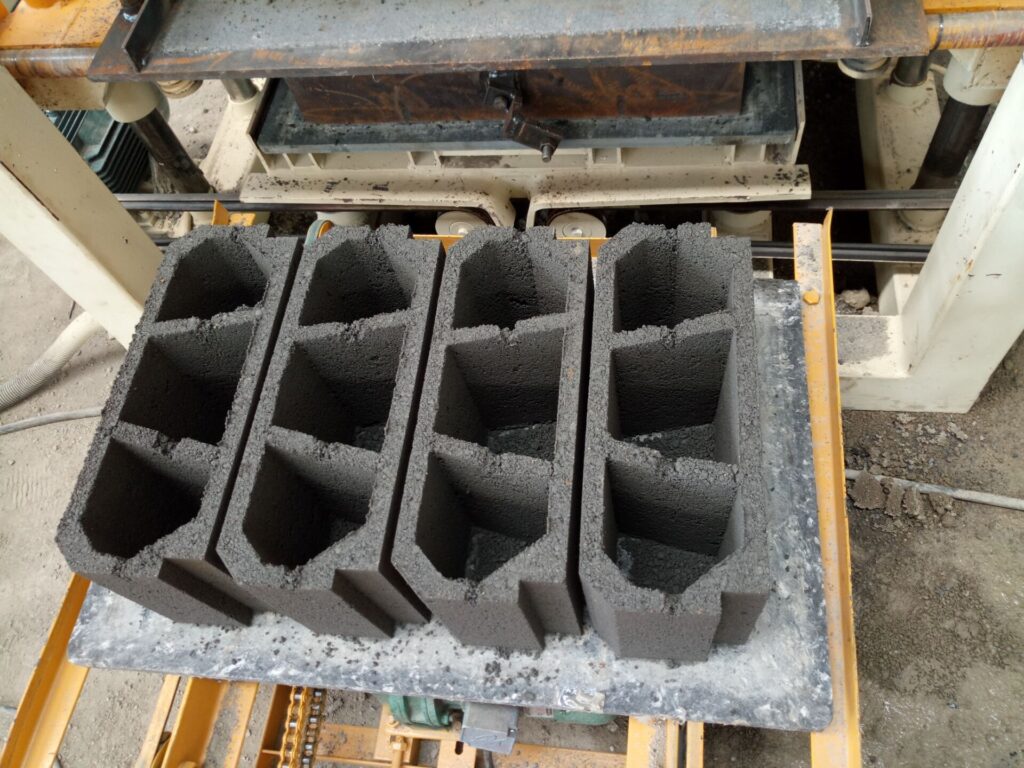
- A Fase Crítica de Preenchimento e Densificação do Molde:A mistura preparada é então transferida para a cavidade do molde. O design e a precisão deste molde são o que definem a forma final do tijolo, seja um bloco retangular padrão, um design de núcleo oco para isolamento, ou uma pedra de pavimentação com padrões intrincados. Em aparelhos sofisticados, o mecanismo de preenchimento garante uma distribuição uniforme do material por todo o molde, evitando inconsistências na densidade. Após o preenchimento, o sistema aplica uma pressão mecânica ou hidráulica imensa. Esta ação não é apenas compressão; é um processo de densificação que expulsa forçosamente o ar retido, alinha a matéria particulada e inicia o processo de ligação inicial, resultando em um tijolo "cru" com integridade suficiente para ser manuseado.
- Cura para o Desenvolvimento da Resistência Máxima e Processamento Final:Uma vez ejetado do molde, o tijolo verde possui sua forma, mas não sua resistência total. O processo de cura é onde ele ganha sua força estrutural. Isso pode ser alcançado através de dois métodos principais. O primeiro é a cura estática, onde os tijolos são empilhados e cobertos com lonas de cura ou colocados em uma câmara onde temperatura e umidade controladas são mantidas por um período específico, permitindo a completa hidratação do cimento. O segundo, usado em alguns sistemas de alta produção, é a cura a vapor em autoclaves, que acelera significativamente o ganho de resistência. Após a cura, as unidades endurecidas são automaticamente classificadas, contadas e empilhadas em paletes por braços robóticos ou sistemas baseados em esteiras, prontas para embalagem, armazenamento e envio.
1.2 Uma Taxonomia de Sistemas de Produção: Compatibilizando Tecnologia com a Necessidade do Mercado
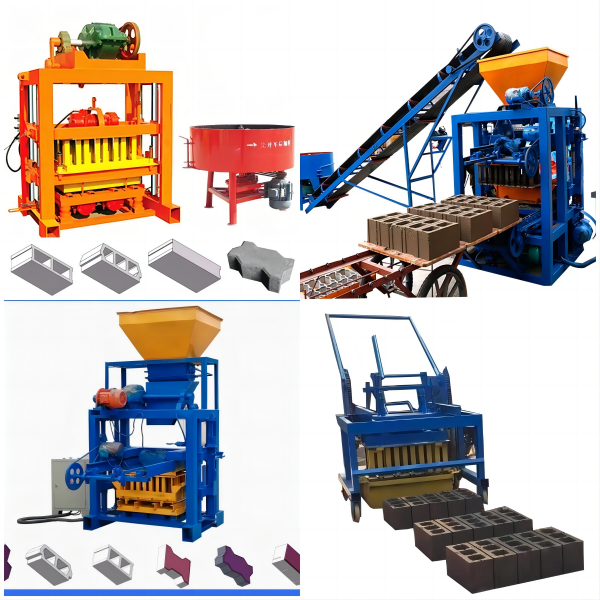
Os sistemas de produção de tijolos são categorizados com base em sua metodologia operacional e grau de automação, cada um atendendo a um segmento distinto do mercado.
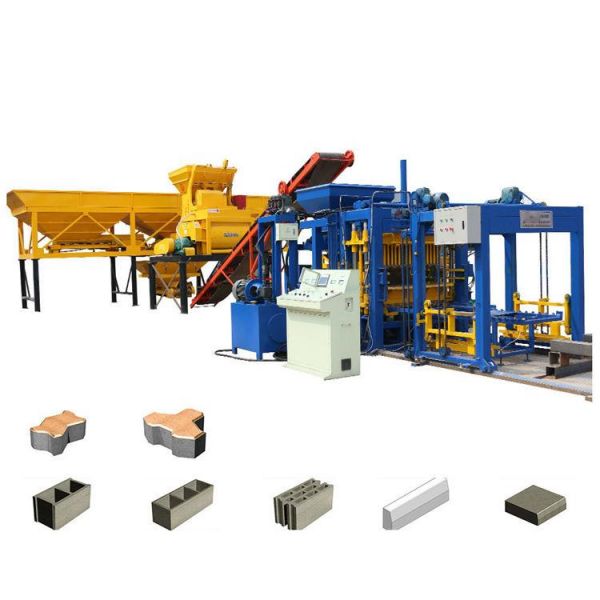
- Linhas de Produção Totalmente Integradas:Estes são os predadores de ápice da fabricação de tijolos, projetados para uma produção massiva e ininterrupta. Eles são caracterizados por um processo contínuo e de circuito fechado, onde a entrada de matéria-prima, a mistura, a moldagem, a cura e o paletização estão todos interconectados e gerenciados por um sistema de controle computadorizado central. A intervenção humana é limitada principalmente ao monitoramento, manutenção e programação. Essas linhas são a escolha ideal para abastecer projetos de infraestrutura de grande escala, distribuidores nacionais e mercados onde volume e qualidade consistente são inegociáveis.
- Unidades de Produção Orientadas ao Ciclo:Esta categoria representa um ponto intermediário robusto, oferecendo alta automação no processo central de compactação, mas exigindo assistência manual para tarefas periféricas. A máquina em si realiza os ciclos de prensagem e moldagem automaticamente, mas pode ser necessário que operadores alimentem a matéria-prima no funil ou transfiram os tijolos recém-moldados para a área de cura. Esta configuração oferece um equilíbrio excelente, proporcionando alta capacidade de produção e notável consistência de qualidade com um investimento de capital significativamente menor do que uma linha totalmente integrada, tornando-a ideal para empresas em crescimento e fornecedores regionais.
- Sistemas de Compressão Manual: These are the most accessible and versatile units, often characterized by their portability and simplicity. Operation is fundamentally manual: an operator fills the mold box, engages a lever or a small hydraulic pump to apply pressure, and then releases the formed brick directly onto the ground or a pallet. While their output per hour is the lowest and they are labor-dependent, their low cost, minimal maintenance, and ability to be deployed on-site with minimal infrastructure make them a powerful tool for small entrepreneurs, community-based projects, and specialized, low-volume production runs.
1.3 Beyond Output: Evaluating Key Performance and Product Parameters
For a commercial buyer, the assessment of a machine goes beyond its brochure specifications. It involves a holistic view of its performance and the quality of the product it yields.
- Output Capacity and Operational Rhythm: The bricks-per-hour figure must be understood in the context of the entire production cycle, including curing time. A machine’s true capacity is its sustained output over an 8-hour or 24-hour shift, not just a peak theoretical number.
- Dimensional Accuracy and Surface Finish: The precision of the mold and the consistency of the pressure application directly impact the brick’s dimensional tolerances and surface quality. High-quality apparatuses produce bricks with sharp edges, smooth surfaces, and uniform dimensions, which simplifies bricklaying and reduces mortar usage.
- Versatility in Raw Material Formulation: A significant advantage of modern systems is their ability to function effectively with a wide range of raw material mixes. This includes the ability to incorporate industrial by-products like slag or fly ash, which can reduce material costs and enhance the product’s environmental profile.
- Durability and Serviceability of the Apparatus: The machine’s construction quality, the grade of steel used in the frame and mold, and the reliability of its hydraulic and control systems determine its operational lifespan and total cost of ownership. Easy access for maintenance and the widespread availability of common spare parts are critical logistical considerations.
1.4 The Strategic Business Case for Advanced Manufacturing Technology
Investing in a modern brick production system is a strategic decision that confers multiple layers of competitive advantage.
- Unmatched Economic Efficiency and Scalability: Automation slashes the per-unit cost of production by maximizing output and minimizing direct labor. This creates a scalable business model where increasing volume does not necessitate a linear increase in operational costs, leading to higher profit margins.
- Guaranteed Product Consistency and Adherence to Standards: Machine-made bricks are uniform. This consistency is vital for builders, as it ensures predictable performance, simplifies construction processes, and guarantees compliance with national and international building codes, a key selling point for discerning clients.
- Empowerment through Product Diversification: With a library of interchangeable molds, a single investment can yield a diverse product catalog. A supplier can quickly switch from producing standard construction bricks to decorative pavers, retaining wall blocks, or specialized landscaping products, allowing them to capture multiple market segments and respond agilely to trends.
- Enhancement of Sustainability Credentials: The controlled production process significantly reduces material waste compared to traditional methods. Furthermore, the ability to use recycled aggregates and supplementary cementitious materials allows businesses to market a “greener” product, appealing to a growing segment of environmentally conscious contractors and developers.
1.5 A Procurement Framework for Commercial Stakeholders
Navigating the procurement process requires a disciplined, strategic approach focused on long-term value.
- Conducting a Comprehensive Market and Feasibility Analysis: Before selecting a machine, one must have a deep understanding of the local demand—preferred brick types, quality expectations, and price sensitivity. The chosen technology must be a precise fit for this market reality.
- Performing a Rigorous Total Cost of Ownership (TCO) Analysis: The purchase price is just the initial outlay. A prudent buyer will model all ongoing costs: energy consumption, labor, preventive maintenance, spare parts, and the cost of capital. This TCO model provides a true picture of the investment’s profitability.
- Vetting the Equipment Provider’s Support Ecosystem: The machine’s value is heavily dependent on the supplier’s support. Key questions must be asked: What is their lead time for critical spare parts? Do they offer comprehensive operator training? Is technical support readily accessible? A machine without reliable support is a liability.
- Validating Machine Performance and Compliance: Insist on seeing the machine in operation, preferably under conditions similar to your own. Request certification of compliance with relevant international safety and performance standards. This due diligence mitigates risk and ensures the equipment is fit for its intended purpose.
Conclusão
The technology behind brick manufacturing represents a mature yet continuously evolving field. For distributors and procurement experts, the selection of appropriate machinery is a cornerstone decision that directly impacts market relevance, operational efficiency, and long-term profitability. The spectrum of available systems—from highly automated production lines to versatile manual presses—ensures that there is a technological solution for every business model and market tier. Success in this arena is not merely about purchasing a machine; it is about strategically investing in a production capability that delivers consistent quality, enables product diversification, and builds a formidable reputation for reliability. In the competitive global construction supply chain, mastery over this technology is synonymous with a sustainable competitive edge.
Perguntas Frequentes (FAQ)
Q1: How does the final product from an automated system differ from one produced by a manual machine?
A: While both can produce structurally sound bricks, the key differences lie in consistency and finish. Automated systems produce bricks with exceptional dimensional uniformity, consistent density, and superior surface finish across thousands of units. Manual machines, while capable, may exhibit slight variations in size, density, and texture from one brick to the next due to the inherent variability in human-operated processes.
Q2: What is the typical lead time from procurement to full operational deployment for a semi-automatic system?
A: Lead times can vary significantly based on the complexity of the system and the manufacturer’s schedule. Generally, for a semi-automatic unit, expect a period of 4 to 8 weeks for manufacturing and shipping. On-site installation, foundation preparation, and operator training can add an additional 1 to 3 weeks before the system is fully operational and producing saleable bricks.
Q3: Can these systems be customized to produce unique or proprietary brick designs?
A: Absolutely. The primary method for defining a brick’s shape is the mold. Reputable equipment providers often offer custom mold design and fabrication services. This allows clients to produce unique, patented brick designs, specialty shapes for architectural projects, or products tailored to specific regional preferences.
Q4: What are the most common maintenance requirements, and what is their typical frequency?
A: Regular maintenance is crucial for longevity. Common tasks include:
- Daily: Cleaning of the mold and hopper, visual inspection for leaks or wear.
- Weekly: Checking and tightening of bolts and nuts, inspecting hydraulic hoses.
- Monthly: Changing hydraulic oil filters, checking and calibrating pressure sensors.
- Annually: A comprehensive inspection of the hydraulic system, electrical components, and structural frame.
Q5: How critical is the quality of raw materials to the machine’s performance and output quality?
A: It is fundamentally critical. The machine is designed to process specific types and sizes of aggregates. Using poorly graded sand, contaminated materials, or an incorrect water-cement ratio can lead to production issues like mold sticking, poor compaction, and low-strength bricks. Consistent, high-quality raw materials are a prerequisite for achieving the machine’s advertised performance and product quality.
Q6: What are the primary power requirements for operating a medium-capacity automated unit?
A: Most medium-to-large industrial units require a three-phase electrical power supply, typically at 380V-440V, with a significant power draw (e.g., 20-50 kW depending on the model). It is essential to have a stable power source and the necessary electrical infrastructure in place. Some systems can also be configured with optional diesel power units for locations with unreliable grid electricity.