
Полное руководство по автоматическим машинам для производства блоков: эффективность переосмыслена
Глобальная строительная отрасль, по прогнозам, достигнет ошеломляющих 15,2 триллиона долларов к 2030 году, чему способствуют неуклонная урбанизация и развитие инфраструктуры. В основе этого роста лежит фундаментальный спрос: потребность в больших объемах, стабильном качестве и экономически эффективных строительных материалах. Для предприятий, производящих бетонные блоки, тротуарную плитку и кирпич, удовлетворение этого спроса вручную уже не является жизнеспособным. Здесь в игру вступает технологический локомотив, преобразующий производство материалов — полностью автоматическая машина для изготовления блоков.
Это руководство предназначено для дальновидных владельцев бизнеса, руководителей предприятий, предпринимателей в сфере строительства и специалистов по закупкам. Если вы оцениваете, какАвтоматические машины для производства блоков работают автоматически.Повышайте производительность, сокращайте операционные расходы и гарантируйте стабильное качество — вы обратились по адресу. Опираясь на проверенные инженерные принципы, операционные данные и лучшие отраслевые практики, это комплексное руководство предоставит вам знания для обоснованных инвестиций. Мы разберем ключевые технологии, оценим преимущества, предложим детальную схему выбора и рассмотрим будущее автоматизированного производства блоков.
Что такое автоматические машины для производства блоков и как они работают?
Автоматическая машина для производства блоков — это не отдельный станок, а сложная интегрированная производственная система. Она представляет собой вершину технологии строительных материалов, предназначенную для преобразования сырья — цемента, заполнителей, песка и воды — в точные, отверждённые бетонные блоки при минимальном участии человека. В отличие от полуавтоматических или ручных машин, требующих значительных трудозатрат на управление и контроль процессов, полностью автоматизированный завод представляет собой замкнутую систему, управляемую компьютерным интеллектом.
Основные компоненты и автоматизированные системы
Понимание устройства машины начинается с её ключевых компонентов, каждый из которых играет важную роль в автоматизированном рабочем процессе.
- Автоматический бетонный узел:Точно взвешивает и дозирует сырье с помощью цифровых датчиков.
- Конвейерные ленты:Беспрепятственно перемещайте материалы между различными этапами производственной линии.
- Пан-миксер:Тщательно смешивает материалы до получения однородной консистенции.
- Полностью автоматическая блочная машина (с ПЛК):Основной блок. Он принимает смесь, распределяет её по формам и использует высокочастотную вибрацию и уплотнение для формирования блоков. Программируемый логический контроллер (ПЛК) является мозгом машины.
- Податчик и циркулятор паллет:Автоматически подает поддоны на машину и перемещает блокированные поддоны в зону отверждения.
- Система лечения:Это может быть стеллажная система на защищенном дворе или сложная климатическая камера, ускоряющая набор прочности бетона.
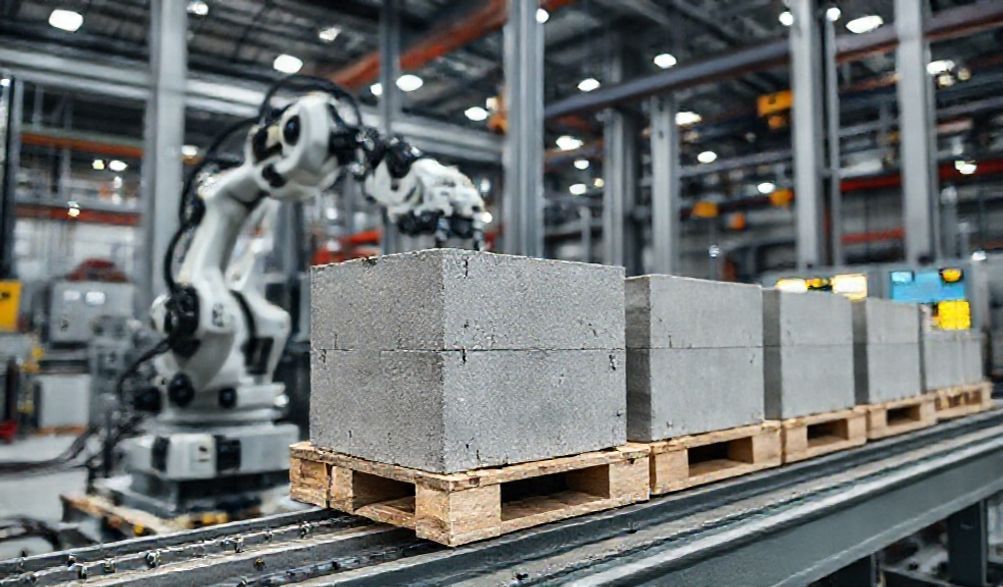
- Автоматический штабелер:Роботизированно собирает затвердевшие блоки с поддонов и укладывает их для хранения или отгрузки.
Полностью автоматизированный производственный цикл
Магия автоматизации заключается в бесшовном, самодостаточном цикле. Вот как это работает:Автоматические машины для производства блоков работают автоматически.завершить процесс:
- Автоматическая подача и дозирование:ПЛК запускает цикл на основе предустановленного рецепта. Бетоносмесительная установка отмеряет и подает точные количества материалов на конвейер.
- Автоматическое смешивание и транспортировка:Материалы подаются в смеситель. После заданного времени перемешивания влажный бетон выгружается на другой конвейер, ведущий к бункеру машины для производства блоков.
- Автоматическое формование и уплотнение:Питатель машины распределяет смесь по формам на поддоне. Форма вибрирует с высокой частотой под гидравлическим давлением, уплотняя смесь в плотный блок.
- Автоматическая обработка поддонов:Свежесформованные блоки на поддоне автоматически выгружаются. Поддонооборотчик перемещает их в зону отверждения, в то время как новый, чистый поддон подаётся в машину — всё это без остановки.
- Автоматическое отверждение и штабелирование:После необходимого периода твердения (на стеллажах или в камере) автоматический распаковщик выгружает блоки. Затем укладчик аккуратно складывает их на деревянные поддоны или непосредственно на грузовик.
Ключевые отличия от полуавтоматических машин
| Признак | Полностью автоматическая машина | Полуавтоматическая машина |
| :— | :— | :— |
| Трудовая зависимость| Очень низкий (2-5 операторов для наблюдения) | Высокий (требуются операторы для подачи, обработки поддонов, штабелирования) |
| Выходная скорость| Очень высокая (от 1 500 до 10 000+ блоков в час) | Умеренная (от 500 до 2 500 блоков в час) |
| Последовательность| Отлично (ПЛК гарантирует идентичность всех параметров) | Хорошо (Зависит от навыков и утомляемости оператора) |
| Первоначальные инвестиции| Выше | Ниже |
| Долгосрочные операционные издержки| Снижение (за счет экономии труда и повышения эффективности) | Повышение (постоянные высокие затраты на труд) |
| Масштабируемость производства | Designed for large-scale, continuous operation | Best for medium-scale or batch production |
Top Benefits of Investing in a Fully Automatic Block Plant
Moving to full automation is a strategic business decision. The benefits translate directly to a stronger competitive edge and improved profitability.
Unmatched Production Efficiency and High Output
These systems are engineered for relentless productivity. By eliminating bottlenecks associated with manual handling, they achieve dramatically reduced cycle times. Plants can operate 20-24 hours a day, producing thousands of uniform blocks per shift. This high-volume capability allows you to fulfill large contracts reliably and scale your business to meet market demand.
Высокое и стабильное качество продукции
Human variability is the enemy of product consistency. Automation eradicates this. Every block is produced under identical conditions of pressure, vibration duration, and mix proportion. This results in uniform dimensions, density, and, critically, compressive strength (e.g., a consistent 5MPa, 7MPa, etc.). Consistent quality builds your brand’s reputation, reduces rejection rates from clients, and ensures compliance with building standards.
Значительное сокращение затрат на рабочую силу и зависимости
This is often the most compelling financial argument. An automatic plant shifts the requirement from a large crew of manual laborers to a small team of skilled machine operators and supervisors. This drastically reduces long-term wage bills, management overhead, and vulnerability to labor shortages. The return on investment (ROI) is realized through these sustained operational savings.
Повышение операционной безопасности
A factory floor with less manual material handling is inherently safer. Automatic systems enclose moving parts and manage the heavy lifting—transporting pallets, moving raw materials, and stacking finished blocks. This significantly reduces the risk of crush injuries, repetitive strain disorders, and accidents common in manual block yards.
Optimized Raw Material Usage and Waste Reduction
Precision is profitable. The automated batching system measures raw materials with exacting accuracy, eliminating the over-pouring common in manual batching. This precise control minimizes waste of costly cement and ensures an optimal mix design every time, directly improving your material cost per block.
Critical Features to Consider When Choosing Your Machine
Selecting the right machine is paramount. Your choice should be dictated by your business goals, not just the machine’s specifications.
Production Capacity and Machine Model
First, define your output needs. Are you supplying a local market or aiming for regional distribution?
* Стационарные установки: High-output models for large, fixed factories.
* Мобильные машины для «откладывания яиц»: Lower-capacity machines that produce and cure blocks in one location before moving to the next. Good for on-site production.
* Ключевой вопрос: What is your target output in blocks per 8-hour shift? Match the machine’s capacity to your current and projected sales.
Block Types, Molds, and Versatility
Your market opportunities expand with product variety. Ensure the machine can produce what you need to sell:
* Standard Products: Hollow blocks, solid blocks, fly ash bricks.
* Landscaping & Pavement: Interlocking pavers, curbstones, grass grid blocks.
* Critical Feature: A quick mold change system is invaluable. It allows you to switch production between different products in minutes, maximizing plant utilization.
The Heart of Automation: Control Systems (PLC & VFD)
The PLC is what makes Автоматические машины для производства блоков работают автоматически. intelligent. Don’t underestimate its importance.
* ПЛК (Программируемый логический контроллер): It stores recipes for different block types, controls every actuator and motor, provides a user-friendly touchscreen interface, and delivers diagnostic data for troubleshooting.
* VFD (Variable Frequency Drive): Controls the speed of motors (like the vibrator). This saves energy, allows fine-tuning of vibration intensity, and reduces mechanical stress on the system.
Robustness and After-Sales Support
The machine must withstand a harsh, dusty, and high-vibration environment.
* Качество сборки: Look for robust steel frames, high-quality hydraulic components, and wear-resistant liners in the mixer and hopper.
* Support Network: The manufacturer should provide comprehensive installation supervision, operator training, a clear warranty, and—most importantly—readily available spare parts. A machine’s downtime is lost revenue.
Optimizing Your Automatic Block Making Operation
Ownership is just the beginning. Optimal operation ensures you reap the full benefits of your investment.
Raw Material Preparation for Best Results
Garbage in, garbage out. The machine can only work with what you feed it.
* Агрегаты: Should be clean, hard, and properly graded. Maximum size must suit your block design (typically 6-10mm). Consistent moisture content is crucial for mix stability.
* Цемент: Use fresh, within-specification cement. Store it properly to prevent setting.
* Проектирование состава смеси. Work with your supplier or a concrete technologist to develop the optimal mix for your target strength and machine parameters. The PLC will then replicate it perfectly every time.
Routine Maintenance Checklist for Longevity
Preventive maintenance is non-negotiable for an automatic system.
* Ежедневно: Clean the mixer, block machine, and conveyors. Check hydraulic oil levels and for leaks. Lubricate all moving points as per the manual.
* Weekly: Inspect molds for wear or damage. Check the tension of conveyor belts and chain drives. Inspect vibration motors and mounts.
* Monthly: Thoroughly clean and inspect the entire pallet circulation system. Check electrical connections and sensor alignments. Filter hydraulic oil if required.
Troubleshooting Common Automated System Alerts
The PLC will alert you to issues. Don’t panic—many are simple.
* “Mix Too Dry/Wet” Alert: Check moisture sensors and calibrate your water metering system.
* “Pallet Misalignment” or “Sensor Fault”: Often just requires cleaning an optical sensor or realigning a pallet on the feeder chain.
* Inconsistent Block Height: This usually points to an issue with the feed shoe or incorrect mix consistency (too dry/wet).
* Golden Rule: For persistent electrical or hydraulic faults, refer to the manual and contact your supplier’s technical support. Do not attempt major repairs without expertise.
The Future of Automation in Block Manufacturing
The evolution continues. The next generation of machines will be smarter and greener.
Integration with Industry 4.0 and IoT
Imagine managing your plant from a smartphone dashboard. The future lies in connectivity:
* Remote Monitoring & Control: View real-time production data, machine status, and output counts from anywhere.
* Predictive Maintenance: Sensors monitor vibration, temperature, and pressure, predicting component failure before it happens, preventing unplanned downtime.
* Production Analytics: Dashboards analyze efficiency, identify bottlenecks, and optimize production schedules based on data.
Sustainable and Green Manufacturing Trends
Automation and sustainability go hand-in-hand.
* Use of Alternative Materials: Modern machines are increasingly compatible with recycled aggregates, industrial by-products like fly ash, and even certain plastic wastes, supporting circular economy goals.
* Energy and Resource Efficiency: New designs focus on lower-power hydraulic systems, heat recovery in curing chambers, and closed-loop water recycling systems to minimize environmental footprint.
Frequently Asked Questions (FAQ)
Q1: What is the typical price range for a fully automatic block making machine?
А: Prices vary significantly based on capacity, brand, and level of sophistication. A basic line might start around $50,000, while large-scale, high-end systems can exceed $500,000. Always request detailed quotations and focus on the total cost of ownership (including installation, energy use, and maintenance), not just the initial purchase price.
Q2: How much manpower is actually required to run an automatic plant?
А: Typically, a single shift can be managed by 2-5 personnel. Their roles include supervising the control panel, loading raw material hoppers (which can also be automated), and managing the output stacking/shipping. This is a fraction of the 15-20+ workers often needed for equivalent output on semi-automatic lines.
Q3: Can these machines produce different block sizes and designs?
А: Absolutely. This is a key advantage. By changing the mold in the machine, you can produce a wide array of products. Advanced PLCs store the settings (pressure, vibration time) for each mold, allowing the system to automatically adjust when you switch production runs.
Q4: What is the average payback period on such an investment?
А: There’s no single answer, as it depends on your local market demand, selling price, production volume, and labor cost savings. However, with efficient operation and good market conditions, many businesses see a full return on investment within 1.5 to 3 years.
Q5: Are automatic machines suitable for starting a new block business?
А: They can be an excellent foundation, ensuring you start with a reputation for high quality and the capacity to scale. However, the significant capital requirement demands a thorough feasibility study. You must have a clear understanding of your market, distribution channels, and working capital needs before making the leap.
Заключение
Automatic block making machines automatically redefine what’s possible in construction material manufacturing. They are the engines of efficiency, transforming raw materials into precise, high-quality building components with remarkable consistency and minimal human input. The investment transcends mere equipment purchase; it is a strategic commitment to scaling your business, competing on quality, and future-proofing your operations against rising costs and market demands.
The path forward is clear. Use the insights from this guide as your foundation. Consult with reputable manufacturers, insist on live demonstrations using materials similar to yours, and analyze your specific production goals. By making an informed decision, you’re not just buying a machine—you’re building the automated, profitable future of your block manufacturing business.
<