Technical and Commercial Analysis of Raw Materials for Brick Machinery
The Material Spectrum: From Traditional Earth to Industrial By-Products
The raw material base for brick making has expanded dramatically, driven by sustainability goals, cost pressures, and technological advancements in machinery. These materials can be broadly categorized as follows:
- Primary Aggregates and Soils
- ดินเหนียว The historic and still prevalent material, valued for its plasticity when wet and strength when fired. For modern press machines, clay must be processed (crushed, screened, and tempered to optimal moisture) to achieve uniform consistency. Its behavior under compression is distinct, often requiring specific press designs to handle its cohesive nature.
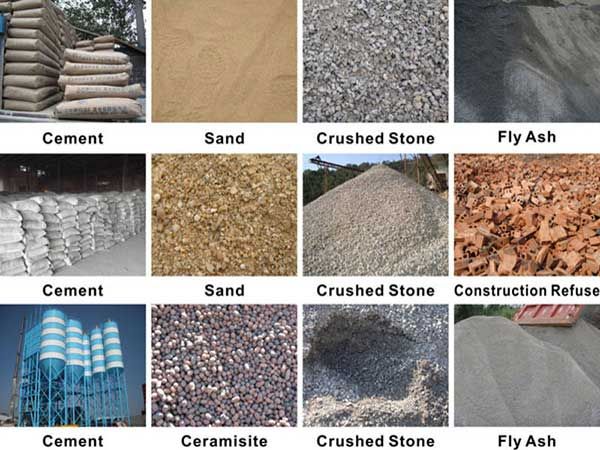
- ทราย A critical component, rarely used alone but as a stabilizer. It reduces shrinkage and cracking in clay or soil-cement bricks by providing internal structure. The grain size and shape (angular vs. rounded) influence compactability and final strength.
- Aggregates (Stone Dust, Quarry Fines, Crushed Rock): These provide the skeletal framework in concrete brick production. Their grading (particle size distribution) is crucial; a well-graded mix packs more efficiently, requiring less binder and yielding a denser, stronger brick. Machinery must be robust enough to handle the abrasive nature of these materials.
- Binders and Stabilizers
- ปูนซีเมนต์ปอร์ตแลนด์: The most common hydraulic binder. When mixed with water, it undergoes a chemical reaction (hydration) that binds aggregates into a solid mass. The cement content (typically 5-15% in stabilized blocks) is a primary cost and strength driver. Machines must ensure thorough mixing and consistent moisture for proper hydration initiation post-compaction.
- มะนาว Used historically and in modern applications, often with cement (lime-cement stabilization). It improves workability and provides some binding action through carbonation (reacting with atmospheric CO₂).
- Bitumen and Chemical Stabilizers: Used in niche applications for water resistance or soil stabilization, these require specialized mixing and often temperature control during processing.
- Supplementary Cementitious Materials (SCMs) and Waste Stream Valorization
- เถ้าลอย A fine powder by-product of coal-fired power plants. It is a pozzolan, meaning it reacts with lime and water to form cementitious compounds. Using fly ash (Class C or F) can reduce cement usage, lower production costs, improve workability, and enhance long-term strength. It requires careful handling due to its fineness and potential variability.
- Ground Granulated Blast-Furnace Slag (GGBS): A by-product of iron production, used as a partial cement replacement. It offers enhanced durability and later-age strength.
- Other Industrial Wastes: Materials like foundry sand, crushed glass (cullet), or certain mine tailings can be incorporated, subject to strict quality control for consistency and absence of harmful contaminants.
Material Science Fundamentals for Machine Operation
The physical behavior of these materials under pressure dictates machine design and setup. Key properties include:
- Particle Size Distribution and Grading
- A balanced mix of coarse, medium, and fine particles is essential. Fines (like clay, silt, fly ash) fill voids between larger particles, leading to maximum dry density and optimal binder efficiency. Poorly graded material results in high porosity, low strength, and inefficient binder use. Machinery often needs integrated screening to ensure consistent feed grading.
- Plasticity and Cohesion
- This is primarily relevant for clay-rich mixes. Plasticity allows the material to deform under pressure without cracking and retain its molded shape. The Atterberg Limits (Liquid and Plastic Limits) are scientific measures of this behavior. A machine processing highly plastic clay must manage stickiness to prevent material adhesion to molds and hoppers, often requiring different tooling surface finishes and release mechanisms compared to non-plastic, sandy mixes.
- Optimum Moisture Content (OMC) and Compaction Relationship
- For any given material blend and compaction energy, there is a specific moisture content that yields the maximum dry density. This is the Optimum Moisture Content (OMC). Operating below OMC leads to poor compaction and weak, friable bricks; operating above causes the material to become spongy, leading to deformation and sticking. Modern machines with feedback controls can adapt to minor variances, but mix preparation must consistently target OMC.
- Abrasion and Corrosiveness
- Materials like crushed granite or slag are highly abrasive, causing accelerated wear on mold liners, feed systems, mixer blades, and conveyor parts. Conversely, some industrial by-products may contain salts or chemicals that promote corrosion. Machine selection must account for material aggressiveness through the specification of wear-resistant steels, hardened components, and protective coatings, impacting both initial cost and lifecycle maintenance planning.
Formulation Engineering: Creating the Optimal Brick Mix
A brick mix is a carefully engineered recipe. The process involves:
- Proportioning for Performance and Economy
- The goal is to meet minimum strength, absorption, and durability standards (e.g., ASTM C90, IS 2185) at the lowest possible cost. This involves iterative testing of different ratios of aggregate, binder, and SCMs. A common strategy is to maximize the use of low-cost local aggregates and industrial by-products while minimizing the percentage of expensive cement, without compromising key performance metrics.
- The Role of Water and Chemical Admixtures
- Water is not just for hydration; it lubricates particles during compaction. Chemical admixtures, though a small percentage, can be transformative. These include:
- Plasticizers/Water Reducers: Allow reduction in water content while maintaining workability, leading to higher strength.
- Set Accelerators/Retarders: Control the setting time, crucial in different climates or for production scheduling.
- เม็ดสี: For colored bricks, requiring high-shear mixing for uniform dispersion.
- Water is not just for hydration; it lubricates particles during compaction. Chemical admixtures, though a small percentage, can be transformative. These include:
- Mix Design Validation through Laboratory Testing
- Before scaling to full production, a proposed mix must undergo rigorous lab testing: Proctor tests for OMC, compressive strength tests on sample bricks, water absorption tests, and freeze-thaw durability tests. This data is critical for providing performance guarantees to end-buyers and for fine-tuning machine parameters.
Strategic Implications for Machinery Selection and Configuration
The choice of raw materials directly dictates the necessary features and auxiliary equipment for a production line.
- Matching Machine Type to Material Characteristics
- High-Plasticity Clays: Often better suited for extrusion-based machines or specific hydraulic presses designed with de-airing chambers and high-pressure augers.
- Concrete/Stabilized Earth Mixes: Excel in hydraulic or vibration-compaction presses where the granular nature of the material benefits from vibratory consolidation.
- Lightweight Aggregate Mixes (e.g., with pumice or expanded clay): Require machines that can achieve adequate compaction without crushing the fragile aggregates.
- Essential Pre-Processing Equipment
- เครื่องบดและตะแกรง: Mandatory for processing raw quarry material or recycled demolition waste into a consistent, graded aggregate.
- เครื่องผสม: The type is critical. Pan mixers or paddle mixers are superior for cohesive, clay-based mixes, while twin-shaft mixers provide intense, rapid mixing for dry-cast concrete, ensuring even coating of aggregates with cement.
- การจัดการวัสดุ Conveyors and hoppers must be designed to handle the specific material—preventing segregation in free-flowing mixes or bridging in cohesive ones.
- Tooling and Wear Part Considerations
- The abrasiveness of the mix determines the required hardness of mold liners (e.g., AR400 or AR500 steel), core rods, and feed shoes. A mix containing fly ash, while less abrasive, may be more prone to causing buildup, requiring tooling with specific surface treatments or release angles.
สรุป
For the industrial equipment distributor, expertise in brick-making materials is a powerful competitive lever. It enables a consultative sales approach that begins with an analysis of the client’s locally available resources and desired product specifications, leading to a tailored recommendation for both machinery and mix design. Understanding the science of particle grading, moisture dynamics, and binder chemistry allows for the configuration of complete, efficient production systems that deliver profitability and product quality. In an era focused on sustainable construction and cost optimization, the ability to integrate industrial by-products like fly ash into viable production formulas is an invaluable service. Ultimately, by mastering the raw material dimension, you position your business not as a mere vendor of presses, but as an essential engineering partner in your clients’ success, fostering resilience and growth in a dynamic global market.
คำถามที่พบบ่อย (FAQ)
Q1: Can a single brick machine effectively process vastly different material types, such as pure clay and a concrete mix?
ก Generally, no. Machines are engineered around core material principles. A machine optimized for stiff, low-moisture concrete mixes uses high vibration and pressure for granular compaction. A machine for plastic clay focuses on de-airing and extrusion through a die. While some versatile hydraulic presses can handle a range of stabilized soils, switching between extremely different material families (e.g., clay to concrete) typically requires significant reconfiguration, different tooling, and often different mixing systems, making it impractical for frequent changes.
Q2: What are the key cost-benefit trade-offs when using industrial by-products like fly ash?
ก
- ประโยชน์: Significant reduction in material cost (fly ash is often low-cost or free); lower cement requirement; improved long-term strength and durability; enhanced workability of the mix; sustainable “green” product marketing angle.
- Considerations/Trade-offs: Potential variability in the chemical composition of the by-product, requiring strict quality control; may necessitate additional storage and handling infrastructure due to fineness; sometimes slower early strength gain, which can affect early handling and curing logistics. A thorough testing program is essential to lock in consistent performance.
Q3: How does material choice influence the energy consumption of the brick-making process?
ก Material choice has a profound impact. Fired clay bricks require immense thermal energy in kilns. In contrast, cement-stabilized or concrete bricks cure at ambient temperature, saving that energy but incurring the embodied energy of cement production. Mixes with high SCM content reduce this cement-related energy. Within the press itself, a well-graded mix at OMC compacts more efficiently, using less mechanical energy than a poorly graded or dry mix to achieve the same density.
Q4: What are the most critical tests a client should run on their local materials before finalizing a machinery purchase?
ก Three tests are paramount:
- Sieve Analysis/Gradation Test: To understand particle size distribution and optimize the mix design.
- Proctor Compaction Test: To scientifically determine the Optimum Moisture Content (OMC) and Maximum Dry Density for the specific blend.
- Chemical Analysis (for soils/by-products): To check for harmful levels of sulfates, organic matter, or salts that can cause long-term durability issues like efflorescence or reinforcement corrosion.
These tests provide the foundational data needed to correctly specify machine type, mixer capacity, and curing requirements.
Q5: How important is moisture control, and what systems can be integrated into a production line to manage it?
ก Moisture control is arguably the most critical factor in day-to-day consistent production. Variations of even 1-2% from OMC can ruin product quality. Integrated systems include:
- Automated Water Metering Systems: Precisely inject water into the mixer based on the weight of dry materials.
- Moisture Sensors: In-line sensors can provide real-time feedback to the water system, adjusting for natural moisture in aggregates.
- Covered Aggregate Storage: To prevent rain from altering moisture content.
- Curing Chambers: To control humidity and temperature after forming, ensuring proper curing of cement bricks.