
I. ทำความเข้าใจเทคโนโลยี: หลักการและกลไก
แนวคิดหลักของบล็อกประสาน
อิฐประสาน หรือที่รู้จักกันในชื่อบล็อกดินอัดแน่น (CEBs) หรือบล็อกประสานเสริมแรง เป็นหน่วยก่อสร้างที่ออกแบบด้วยระบบร่องและปุ่มนูน ต่างจากอิฐทั่วไปที่พึ่งพาปูนก่อประสานทั้งหมด อิฐเหล่านี้จะล็อกกันทางกลไก สร้างโครงสร้างที่มั่นคงและสานประสานกัน การออกแบบนี้เปลี่ยนแปลงกระบวนการก่ออิฐโดยพื้นฐาน มอบความแข็งแรงเชิงโครงสร้างและความรวดเร็วในการทำงานที่เพิ่มขึ้น
บทบาทของระบบไฮดรอลิกในการผลิต
คำนำหน้า "ไฮดรอลิก" เป็นกุญแจสำคัญต่อประสิทธิภาพและคุณภาพผลผลิตของเครื่องจักร เครื่องจักรเหล่านี้ใช้ระบบไฮดรอลิกความดันสูงเพื่ออัดวัสดุดิบให้กลายเป็นบล็อกที่มีความหนาแน่นและสม่ำเสมอ
- กระบวนการบีบอัด:ไฮดรอลิกแรมใช้แรงดันมหาศาลที่ควบคุมได้ (โดยทั่วไปอยู่ในช่วง 20 ถึง 50+ ตัน) กับส่วนผสมที่วัดปริมาณแล้วของดิน ซีเมนต์ และสารปรับเสถียรอื่นๆ ที่บรรจุอยู่ในแม่พิมพ์
- ข้อดีของแรงไฮดรอลิก:วิธีนี้ช่วยให้มั่นใจได้ถึงความหนาแน่นของอิฐที่สม่ำเสมอ ความแข็งแรงในการรับแรงอัดสูง และความแม่นยำของขนาดในทุกๆ หน่วย ระบบไฮดรอลิกช่วยให้สามารถปรับแรงดันได้ ทำให้ผู้ปฏิบัติงานสามารถผลิตอิฐที่มีความแข็งแรงแตกต่างกันได้จากเครื่องจักรเดียวกัน โดยเพียงแค่ปรับเปลี่ยนการตั้งค่าแรงดัน
ค. ส่วนประกอบหลักของเครื่องจักรและหน้าที่ของมัน
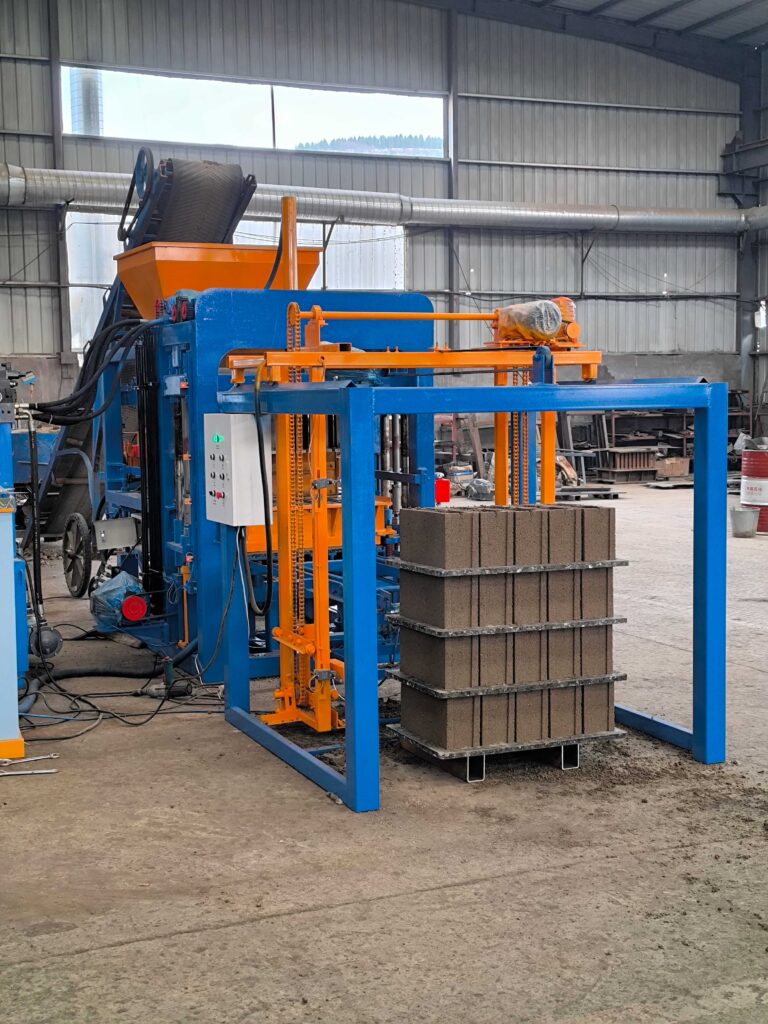
เครื่องจักรมาตรฐานประกอบด้วยระบบย่อยที่สำคัญหลายระบบ:
- หน่วยจ่ายพลังงานไฮดรอลิก (HPU)หัวใจของเครื่องจักรประกอบด้วยมอเตอร์ไฟฟ้า ปั๊มไฮดรอลิก วาล์ว และถังเก็บของเหลว ซึ่งสร้างแรงที่จำเป็น
- โครงสร้างหลักและเฟรมเวิร์ก:โครงเหล็กที่แข็งแกร่ง ทนทานต่อการสั่นสะเทือน รองรับการทำงานภายใต้แรงดันสูงอย่างต่อเนื่อง
- ระบบการขึ้นรูปแม่พิมพ์ที่เปลี่ยนแทนกันได้ซึ่งกำหนดรูปร่าง ขนาด และรูปแบบการเชื่อมต่อของอิฐ (เช่น รูปทรงรังผึ้ง รูปทรงสี่เหลี่ยมขนมเปียกปูน)
- ถังบรรจุอาหารและระบบการส่งวัสดุรับประกันการไหลของวัตถุดิบที่สม่ำเสมอและควบคุมได้เข้าสู่โพรงแม่พิมพ์
- แผงควบคุมบรรจุระบบควบคุมไฟฟ้า ซึ่งสามารถมีได้ตั้งแต่ระบบคันโยกแบบธรรมดาไปจนถึงระบบควบคุมแบบโปรแกรมได้ (PLCs) สำหรับควบคุมวงจรอัตโนมัติ
II. กระบวนการปฏิบัติงาน: จากวัตถุดิบสู่ผลิตภัณฑ์สำเร็จรูป
A. การคัดเลือกและเตรียมวัตถุดิบ
คุณภาพของผลิตภัณฑ์สำเร็จรูปขึ้นอยู่กับวัตถุดิบที่นำเข้ามาอย่างมาก ดินที่เหมาะสม (ดินลูกรัง ดินร่วนปนทราย) จะถูกร่อนและผสมกับสารเพิ่มความเสถียร เช่น ปูนซีเมนต์ปอร์ตแลนด์หรือปูนขาว ในปริมาณเล็กน้อย (5-10%) โดยควบคุมปริมาณความชื้นอย่างเข้มงวดเพื่อให้ได้การอัดแน่นที่เหมาะสมที่สุด
บ. วงจรการผลิต
- การให้อาหารส่วนผสมที่เตรียมไว้ถูกบรรจุลงในถังบรรจุ
- ไส้ A mechanism transfers a precise volume of material into the mold.
- การบดอัด: The hydraulic ram descends, applying high pressure to compress the material within the mold.
- การดีดตัวออก The newly formed, solid brick is pushed out of the mold onto a pallet or conveyor.
- การบ่ม Bricks are stacked and kept moist for 14-28 days to allow the stabilizer (cement) to fully hydrate and achieve its designed strength. This process is simpler than for traditional bricks, as no kiln firing is required.
C. Versatility in Output
Modern machines offer remarkable versatility through quick-change molds. A single machine can produce a wide range of products:
- Standard interlocking bricks for walls
- Interlocking pavers for landscaping and driveways
- Specialty blocks for curves, corners, and columns
- Solid blocks for high-load applications
III. Compelling Advantages for the Market and End-Users
A. Economic and Construction Efficiency
- Reduced Construction Time: The interlocking system eliminates the need for wet mortar in the main joints, speeding up wall erection by 30-50%. This translates to faster project completion and lower labor costs.
- Lower Skilled Labor Dependency: While skilled operators are needed for the machine, the actual laying process is simpler and can be performed by semi-skilled workers after basic training.
- Significant Material Savings: Elimination of mortar saves approximately 15-20% on overall material costs. Furthermore, the use of locally available soil reduces dependence on costly, transported materials like fired clay.
B. Structural and Environmental Benefits
- Superior Strength and Durability: Hydraulically pressed bricks have very high compressive strength and density, resulting in walls that are resistant to weathering, erosion, and, crucially, seismic activity due to their interlocking nature.
- Sustainability Credentials: The production process is energy-efficient (no firing), uses local materials, minimizes waste, and creates structures with excellent thermal mass, reducing energy needs for heating and cooling. This is a powerful selling point in green building markets.
- Disaster Resilience: Structures built with interlocking bricks have demonstrated excellent performance in earthquakes and hurricanes, making them highly relevant for disaster-prone regions and post-disaster reconstruction projects.
C. Business and Investment Merits
- ศักยภาพในการทำกำไรสูง The low production cost per brick versus its market value offers attractive profit margins for block yards and construction firms.
- โอกาสทางธุรกิจ: The technology enables the setup of small to medium-sized brick production businesses, creating local employment.
- Meeting Regulatory Trends: As building codes increasingly emphasize sustainability and resilience, this product is well-positioned to comply with and benefit from such regulations.
IV. Critical Considerations for Dealers and Procurement Professionals
A. Machine Selection Criteria
When evaluating machines for inventory or project use, consider:
- กำลังการผลิต: Cycle time and output per hour (e.g., 500-2000 bricks per 8-hour shift).
- ความดันที่กำหนด Higher tonnage generally produces stronger bricks suitable for multi-story buildings.
- ระดับการทำงานอัตโนมัติ Manual, semi-automatic, or fully automatic models, balancing upfront cost with labor requirements and output consistency.
- Build Quality and After-Sales Support: Robustness of components, availability of spare parts, and the manufacturer’s technical support and training provisions are paramount.
B. Market Analysis and Application Segmentation
Successful distribution requires understanding key application segments:
- ที่อยู่อาศัย Low-cost housing projects, individual homeowner construction.
- Commercial and Institutional Buildings: Schools, clinics, offices.
- Infrastructure and Landscaping: Retaining walls, compound walls, pavements, and parks.
- Humanitarian and Development Projects: A major sector driven by NGOs and government agencies focused on sustainable community development.
C. Developing a Winning Sales and Support Strategy
- Demonstration and Proof: Maintain a demonstration unit and sample walls to showcase the product’s strength and ease of use.
- โปรแกรมการฝึกอบรม Offer training for both machine operation and bricklaying techniques to clients, adding immense value.
- Comprehensive Marketing: Highlight the triple-bottom-line benefits: economic savings, social good (job creation, housing), and environmental stewardship.
สรุป
The hydraulic interlocking brick making machine represents a paradigm shift in construction technology. It is more than just a piece of manufacturing equipment; it is a catalyst for sustainable development, economic opportunity, and resilient building practices. For dealers and distributors, this product line offers a compelling value proposition with strong growth potential across diverse markets, from urban development to rural entrepreneurship and international aid projects. By becoming experts in this technology—understanding its mechanics, advantages, and optimal applications—B2B stakeholders can position themselves as leaders in providing innovative construction solutions. Investing in this technology and its ecosystem is an investment in the future of building, aligning profitability with positive social and environmental impact. The market is ripe for adoption, and the time to build expertise and inventory in this sector is now.
FAQ (Frequently Asked Questions)
Q1: What is the typical compressive strength of bricks produced by these machines?
ก With proper soil mix and cement stabilization (5-10%), hydraulic interlocking bricks routinely achieve compressive strengths between 7 MPa and 15 MPa, often exceeding the strength of conventional fired clay bricks and hollow blocks. Strength can be calibrated by adjusting the hydraulic pressure and stabilizer ratio.
Q2: Can these bricks be used for load-bearing walls in multi-story buildings?
ก Yes, absolutely. The high compressive strength and interlocking design make them entirely suitable for load-bearing construction. It is crucial, however, to follow engineered design specifications for the block mix and wall construction, especially for structures beyond two stories. Many multi-story buildings have been successfully constructed using this technology.
Q3: What kind of soil is NOT suitable for this process?
ก Purely organic topsoil, highly expansive clay (which cracks), and uniformly graded sand are not suitable. The ideal soil has a blend of sand, silt, and a small amount of clay. Most locally available soils can be used, often with simple modification or the addition of correctives like sand or crusher dust.
Q4: Is a foundation different for a building made with interlocking bricks?
ก The foundation principles remain the same: it must be level, stable, and able to carry the building load. A standard concrete strip footing or raft slab is commonly used. The key difference is that the first course of interlocking bricks is typically laid on a bed of mortar on top of the damp-proof course to ensure a perfectly level starting layer.
Q5: How does the cost of setting up a production yard compare to a traditional brick kiln?
ก The capital investment for a hydraulic brick machine and auxiliary equipment is generally significantly lower than establishing a fixed chimney bull’s trench kiln or a modern tunnel kiln. The operational costs are also lower due to minimal energy consumption (only electricity for the machine) and the use of local raw materials. The business model is more decentralized and scalable.
Q6: What is the maintenance requirement for these hydraulic machines?
ก Maintenance is straightforward but essential. It involves regular checks and changes of hydraulic oil, cleaning of filters, lubrication of moving parts, and inspection of hoses and seals. Following the manufacturer’s scheduled maintenance plan ensures long machine life and consistent production quality. Operator training on basic daily checks is highly recommended.
Q7: How do we address customer concerns about the aesthetic of “earth” bricks?
ก Interlocking bricks offer a distinctive, modern aesthetic that is increasingly popular. For clients preferring a different finish, the bricks can be easily plastered, painted, or clad just like any other wall. Additionally, pigments can be integrated into the soil mix during production to create colored bricks, and textured molds can provide surface patterns.
