
I. Pag-unawa sa Teknolohiya: Mga Prinsipyo at Mekanismo
Ang Pangunahing Konsepto ng Interlocking Bricks
Ang mga interlocking brick, na kilala rin bilang compressed earth blocks (CEBs) o stabilized interlocking blocks, ay mga yunit ng masonry na dinisenyo na may sistema ng mga ukit at usli. Hindi tulad ng mga konbensyonal na brick na lubos na umaasa sa mortar para sa pagkakadikit, ang mga brick na ito ay mekanikal na nagsasama-sama, na bumubuo ng isang matatag at magkakabit-kabit na istruktura. Ang disenyong ito ay lubos na nagbabago sa proseso ng paglalagay ng brick, na nag-aalok ng mas matibay na integridad ng istruktura at mas mabilis na paggawa.
B. Ang Tungkulin ng mga Sistemang Haydroliko sa Produksyon
Ang unlaping "hydraulic" ay susi sa kahusayan at kalidad ng output ng makina. Ang mga makina na ito ay gumagamit ng isang high-pressure hydraulic system upang i-compress ang mga hilaw na materyales sa isang siksik at pantay na bloke.
- Ang Proseso ng Pag-compress:Ang isang haydrolik na ram ay naglalapat ng napakalaking, kontroladong presyon (karaniwang mula 20 hanggang 50+ tonelada) sa isang sinukat na timpla ng lupa, semento, at iba pang mga stabilizer na nakalagay sa loob ng isang molde.
- Mga Pakinabang ng Lakas ng Haydroliko:Ang paraang ito ay nagsisiguro ng pare-parehong densidad ng ladrilyo, mataas na lakas ng pagpigil, at tumpak na kawastuhan ng sukat sa bawat yunit. Ang sistemang haydroliko ay nagbibigay-daan para sa nababagong presyon, na nagpapahintulot sa mga operator na makagawa ng mga ladrilyong may iba't ibang lakas mula sa iisang makina sa pamamagitan ng simpleng pagbabago ng mga setting ng presyon.
C. Mga Pangunahing Bahagi ng Makina at Kanilang Mga Tungkulin
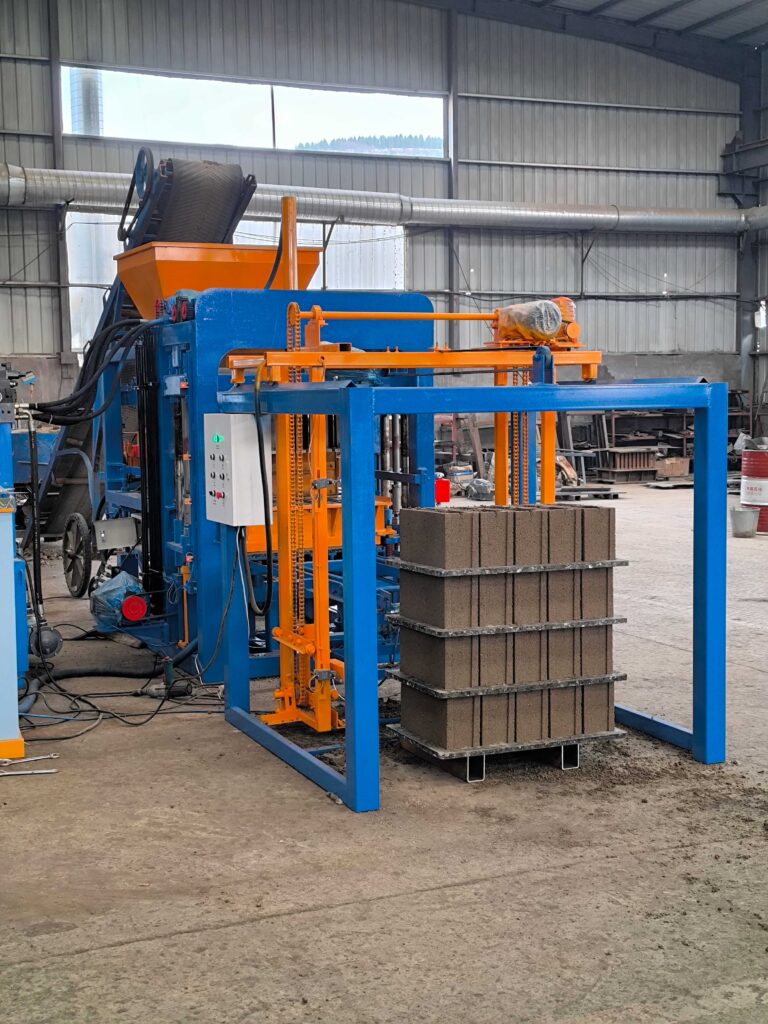
Ang isang karaniwang makina ay binubuo ng ilang mahahalagang subsystem:
- Hydraulic Power Unit (HPU):Ang puso ng makina, na binubuo ng isang de-kuryenteng motor, haydrolik na bomba, mga balbula, at tangke ng likido, na lumilikha ng kinakailangang puwersa.
- Pangunahing Balangkas at Estruktura:Isang matatag, vibration-resistant na balangkas na yari sa bakal na kayang tumagal sa tuloy-tuloy na mataas na presyur na operasyon.
- Sistema ng Paghubog:Mga kahong panghulma na maaaring palitan na tumutukoy sa hugis, sukat, at pattern ng pagkakabit (halimbawa, honeycomb, rhombus) ng ladrilyo.
- Hopper ng Pagpapakain at Sistema ng Paghahatid ng Materyal: Ensures a consistent and measured flow of raw material into the mold cavity.
- Control Panel: Houses electrical controls, which can range from simple manual lever systems to advanced Programmable Logic Controllers (PLCs) for automated cycle control.
II. Operational Workflow: From Raw Material to Finished Product
A. Raw Material Selection and Preparation
The quality of the final product is heavily dependent on input materials. Suitable soils (laterite, sandy loam) are sieved and mixed with a small percentage (5-10%) of stabilizers like Portland cement or lime. The moisture content is critically controlled to achieve optimal compaction.
B. The Production Cycle
- Pagpapakain: The prepared mix is loaded into the hopper.
- Palaman: A mechanism transfers a precise volume of material into the mold.
- Pagpapatigas: The hydraulic ram descends, applying high pressure to compress the material within the mold.
- Pag-eject: The newly formed, solid brick is pushed out of the mold onto a pallet or conveyor.
- Pagpapagaling: Bricks are stacked and kept moist for 14-28 days to allow the stabilizer (cement) to fully hydrate and achieve its designed strength. This process is simpler than for traditional bricks, as no kiln firing is required.
C. Versatility in Output
Modern machines offer remarkable versatility through quick-change molds. A single machine can produce a wide range of products:
- Standard interlocking bricks for walls
- Interlocking pavers for landscaping and driveways
- Specialty blocks for curves, corners, and columns
- Solid blocks for high-load applications
III. Compelling Advantages for the Market and End-Users
A. Economic and Construction Efficiency
- Reduced Construction Time: The interlocking system eliminates the need for wet mortar in the main joints, speeding up wall erection by 30-50%. This translates to faster project completion and lower labor costs.
- Lower Skilled Labor Dependency: While skilled operators are needed for the machine, the actual laying process is simpler and can be performed by semi-skilled workers after basic training.
- Significant Material Savings: Elimination of mortar saves approximately 15-20% on overall material costs. Furthermore, the use of locally available soil reduces dependence on costly, transported materials like fired clay.
B. Structural and Environmental Benefits
- Superior Strength and Durability: Hydraulically pressed bricks have very high compressive strength and density, resulting in walls that are resistant to weathering, erosion, and, crucially, seismic activity due to their interlocking nature.
- Sustainability Credentials: The production process is energy-efficient (no firing), uses local materials, minimizes waste, and creates structures with excellent thermal mass, reducing energy needs for heating and cooling. This is a powerful selling point in green building markets.
- Disaster Resilience: Structures built with interlocking bricks have demonstrated excellent performance in earthquakes and hurricanes, making them highly relevant for disaster-prone regions and post-disaster reconstruction projects.
C. Business and Investment Merits
- Mataas na Potensyal sa Pagkita ng Kita: The low production cost per brick versus its market value offers attractive profit margins for block yards and construction firms.
- Oportunidad sa Negosyo: The technology enables the setup of small to medium-sized brick production businesses, creating local employment.
- Meeting Regulatory Trends: As building codes increasingly emphasize sustainability and resilience, this product is well-positioned to comply with and benefit from such regulations.
IV. Critical Considerations for Dealers and Procurement Professionals
A. Machine Selection Criteria
When evaluating machines for inventory or project use, consider:
- Kapasidad sa Produksiyon: Cycle time and output per hour (e.g., 500-2000 bricks per 8-hour shift).
- Pressure Rating: Higher tonnage generally produces stronger bricks suitable for multi-story buildings.
- Antas ng Automatisasyon: Manual, semi-automatic, or fully automatic models, balancing upfront cost with labor requirements and output consistency.
- Build Quality and After-Sales Support: Robustness of components, availability of spare parts, and the manufacturer’s technical support and training provisions are paramount.
B. Market Analysis and Application Segmentation
Successful distribution requires understanding key application segments:
- Pabahay: Low-cost housing projects, individual homeowner construction.
- Commercial and Institutional Buildings: Schools, clinics, offices.
- Infrastructure and Landscaping: Retaining walls, compound walls, pavements, and parks.
- Humanitarian and Development Projects: A major sector driven by NGOs and government agencies focused on sustainable community development.
C. Developing a Winning Sales and Support Strategy
- Demonstration and Proof: Maintain a demonstration unit and sample walls to showcase the product’s strength and ease of use.
- Training Programs: Offer training for both machine operation and bricklaying techniques to clients, adding immense value.
- Comprehensive Marketing: Highlight the triple-bottom-line benefits: economic savings, social good (job creation, housing), and environmental stewardship.
Konklusyon
The hydraulic interlocking brick making machine represents a paradigm shift in construction technology. It is more than just a piece of manufacturing equipment; it is a catalyst for sustainable development, economic opportunity, and resilient building practices. For dealers and distributors, this product line offers a compelling value proposition with strong growth potential across diverse markets, from urban development to rural entrepreneurship and international aid projects. By becoming experts in this technology—understanding its mechanics, advantages, and optimal applications—B2B stakeholders can position themselves as leaders in providing innovative construction solutions. Investing in this technology and its ecosystem is an investment in the future of building, aligning profitability with positive social and environmental impact. The market is ripe for adoption, and the time to build expertise and inventory in this sector is now.
FAQ (Frequently Asked Questions)
Q1: What is the typical compressive strength of bricks produced by these machines?
Isalin ang teksto sa Filipino. I-output LAMANG ang isinalin na teksto. With proper soil mix and cement stabilization (5-10%), hydraulic interlocking bricks routinely achieve compressive strengths between 7 MPa and 15 MPa, often exceeding the strength of conventional fired clay bricks and hollow blocks. Strength can be calibrated by adjusting the hydraulic pressure and stabilizer ratio.
Q2: Can these bricks be used for load-bearing walls in multi-story buildings?
Isalin ang teksto sa Filipino. I-output LAMANG ang isinalin na teksto. Yes, absolutely. The high compressive strength and interlocking design make them entirely suitable for load-bearing construction. It is crucial, however, to follow engineered design specifications for the block mix and wall construction, especially for structures beyond two stories. Many multi-story buildings have been successfully constructed using this technology.
Q3: What kind of soil is NOT suitable for this process?
Isalin ang teksto sa Filipino. I-output LAMANG ang isinalin na teksto. Purely organic topsoil, highly expansive clay (which cracks), and uniformly graded sand are not suitable. The ideal soil has a blend of sand, silt, and a small amount of clay. Most locally available soils can be used, often with simple modification or the addition of correctives like sand or crusher dust.
Q4: Is a foundation different for a building made with interlocking bricks?
Isalin ang teksto sa Filipino. I-output LAMANG ang isinalin na teksto. The foundation principles remain the same: it must be level, stable, and able to carry the building load. A standard concrete strip footing or raft slab is commonly used. The key difference is that the first course of interlocking bricks is typically laid on a bed of mortar on top of the damp-proof course to ensure a perfectly level starting layer.
Q5: How does the cost of setting up a production yard compare to a traditional brick kiln?
Isalin ang teksto sa Filipino. I-output LAMANG ang isinalin na teksto. The capital investment for a hydraulic brick machine and auxiliary equipment is generally significantly lower than establishing a fixed chimney bull’s trench kiln or a modern tunnel kiln. The operational costs are also lower due to minimal energy consumption (only electricity for the machine) and the use of local raw materials. The business model is more decentralized and scalable.
Q6: What is the maintenance requirement for these hydraulic machines?
Isalin ang teksto sa Filipino. I-output LAMANG ang isinalin na teksto. Maintenance is straightforward but essential. It involves regular checks and changes of hydraulic oil, cleaning of filters, lubrication of moving parts, and inspection of hoses and seals. Following the manufacturer’s scheduled maintenance plan ensures long machine life and consistent production quality. Operator training on basic daily checks is highly recommended.
Q7: How do we address customer concerns about the aesthetic of “earth” bricks?
Isalin ang teksto sa Filipino. I-output LAMANG ang isinalin na teksto. Interlocking bricks offer a distinctive, modern aesthetic that is increasingly popular. For clients preferring a different finish, the bricks can be easily plastered, painted, or clad just like any other wall. Additionally, pigments can be integrated into the soil mix during production to create colored bricks, and textured molds can provide surface patterns.
