
I. Texnologiyani Tushunish: Tamoyillar va Mexanizmlar
A. Qoplamali g'ishtlarning asosiy tushunchasi
Interlocking g'ishtlar, shuningdek, siqilgan tuproq bloklari (CEBs) yoki barqarorlashtirilgan interlocking bloklar sifatida ham tanilgan, ular o'zaro tishli va chiqintili tizimga ega bo'lgan devor qurilish birliklaridir. Oddiy g'ishtlardan farqli o'laroq, ular bir-biriga faqat ohak orqali emas, balki mexanik ravishda bir-biriga qulflash orqali bog'lanadi, bu esa barqaror va o'zaro to'qilgan tuzilmani hosil qiladi. Ushbu dizayn g'isht qo'yish jarayonini tubdan o'zgartiradi, yaxshilangan tuzilma mustahkamligi va tezlikni ta'minlaydi.
B. Ishlab chiqarishda gidravlik tizimlarning roli
"Gidravlik" prefiksi mashinaning samaradorligi va chiqish sifatining kalitidir. Ushbu mashinalar xom ashyoni zich, bir xil blokka siqish uchun yuqori bosimli gidravlik tizimdan foydalanadi.
- Siqish Jarayoni:Gidravlik press, odatda 20 dan 50+ tonnagacha bo'lgan katta, nazorat qilinadigan bosimni, qoliplash ichida o'lchangan tuproq, sement va boshqa barqarorlashtiruvchi moddalar aralashmasiga qo'llaydi.
- Gidravlik kuchning afzalliklari:Ushbu usul har bir g'ishtning zichligini izchil, yuqori siqilish kuchini va aniq o'lchovlarini ta'minlaydi. Gidravlik tizim bosimni sozlash imkonini beradi, bu esa operatorlarga bosim sozlamalarini o'zgartirish orqali bir xil mashinadan turli kuchdagi g'ishtlar ishlab chiqarish imkoniyatini yaratadi.
C. Mashina Asosiy Komponentlari va Ularining Vazifalari
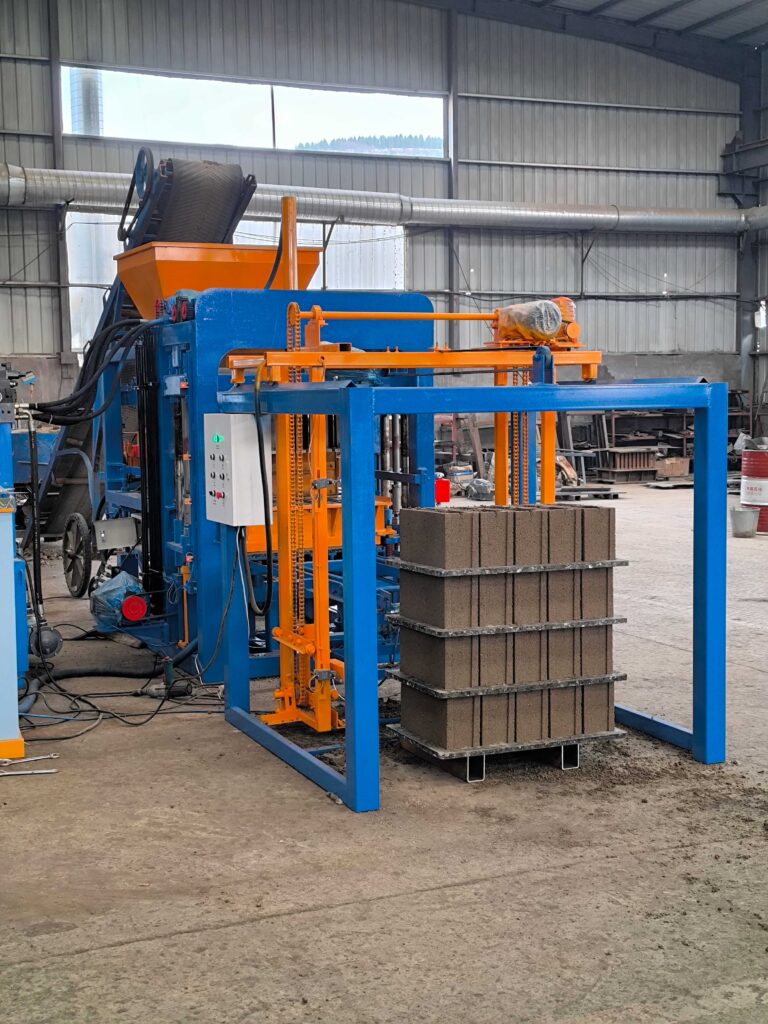
Standart mashina bir necha muhim tizimlardan iborat:
- Gidravlik quvvat bloki (HPU):Mashinaning yurak qismi, bu elektr motor, gidravlik nasos, klapanlar va suyuqlik rezervuaridan iborat bo'lib, zarur kuchni ishlab chiqaradi.
- Asosiy Ramka va Tuzilma:Mustahkam, tebranishga chidamli po'lat ramka, uzluksiz yuqori bosimli ishlashga bardosh bera oladi.
- Qolip Tizimi:Brikaning shakli, o‘lchami va o‘zaro bog‘lanish naqshini (masalan, asalari, romb) belgilaydigan almashtiriladigan qoliplar qutilari.
- Озиқ-овқат бункер ва материалларни етказиш тизими:Qolip bo'shlig'iga xom ashyoning izchil va o'lchangan oqimini ta'minlaydi.
- Boshqaruv paneli:Uy elektr boshqaruvlarini o'z ichiga oladi, ular oddiy qo'l dastgohli dasturlardan tortib, avtomatlashtirilgan tsikl boshqaruvi uchun ilg'or Dasturiy Mantiqiy Boshqaruvchilargacha (PLC) bo'lishi mumkin.
II. Operatsion ish jarayoni: Xom ashyodan tayyor mahsulotgacha
A. Xom ashyoni tanlash va tayyorlash
Yakuniy mahsulot sifati asosan boshlang'ich materiallarga bog'liq. Mos tuproqlar (laterit, qumli loam) elanib, kichik foizda (5-10%) Portland sementi yoki ohak kabi stabilizatorlar bilan aralashtiriladi. Optimal zichlikka erishish uchun namlik darajasi qat'iy nazorat qilinadi.
B. Ishlab chiqarish tsikli
- Oziqlantirish:Tayyorlangan aralash bunkerga yuklanadi.
- To'ldirish:Mexanizm qolipga aniq hajmdagi materialni o'tkazadi.
- Siqish:Gidravlik qo'chqor tushib, materialni qolip ichida siqish uchun yuqori bosim qo'llaydi.
- Ejektsiya:Yangi hosil qilingan qattiq g'isht qolipdan taglik yoki konveyerga suriladi.
- Davolash:G'ishtlar to'planib, 14-28 kun davomida nam holda saqlanadi, bu stabilizator (sement)ning to'liq namlanishi va loyihalashtirilgan quvvatiga erishishiga imkon beradi. Bu jarayon an'anaviy g'ishtlarnikiga qaraganda soddaroq, chunki o'choqda pishirish talab qilinmaydi.
C. Chiqishdagi ko‘p qirralilik
Zamonaviy mashinalar tez almashtiriladigan qoliplar orqali ajoyib ko‘p qirralilikni taklif qiladi. Bitta mashina turli xil mahsulotlarni ishlab chiqarishi mumkin:
- Devorlar uchun standart o‘zaro bog‘lanuvchi g‘ishtlar
- Obodonlashtirish va avtomobil yo‘llari uchun bog‘lovchi plitkalar
- Egri, burchak va ustunlar uchun maxsus bloklar
- Solid blocks for high-load applications
III. Compelling Advantages for the Market and End-Users
A. Economic and Construction Efficiency
- Reduced Construction Time: The interlocking system eliminates the need for wet mortar in the main joints, speeding up wall erection by 30-50%. This translates to faster project completion and lower labor costs.
- Lower Skilled Labor Dependency: While skilled operators are needed for the machine, the actual laying process is simpler and can be performed by semi-skilled workers after basic training.
- Significant Material Savings: Elimination of mortar saves approximately 15-20% on overall material costs. Furthermore, the use of locally available soil reduces dependence on costly, transported materials like fired clay.
B. Structural and Environmental Benefits
- Superior Strength and Durability: Hydraulically pressed bricks have very high compressive strength and density, resulting in walls that are resistant to weathering, erosion, and, crucially, seismic activity due to their interlocking nature.
- Sustainability Credentials: The production process is energy-efficient (no firing), uses local materials, minimizes waste, and creates structures with excellent thermal mass, reducing energy needs for heating and cooling. This is a powerful selling point in green building markets.
- Disaster Resilience: Structures built with interlocking bricks have demonstrated excellent performance in earthquakes and hurricanes, making them highly relevant for disaster-prone regions and post-disaster reconstruction projects.
C. Business and Investment Merits
- Yuqori Foyda Potentsiali: The low production cost per brick versus its market value offers attractive profit margins for block yards and construction firms.
- Tadbirkorlik imkoniyati: The technology enables the setup of small to medium-sized brick production businesses, creating local employment.
- Meeting Regulatory Trends: As building codes increasingly emphasize sustainability and resilience, this product is well-positioned to comply with and benefit from such regulations.
IV. Critical Considerations for Dealers and Procurement Professionals
A. Machine Selection Criteria
When evaluating machines for inventory or project use, consider:
- Ishlab chiqarish quvvati: Cycle time and output per hour (e.g., 500-2000 bricks per 8-hour shift).
- Bosim darajasi: Higher tonnage generally produces stronger bricks suitable for multi-story buildings.
- Avtomatlashtirish darajasi: Manual, semi-automatic, or fully automatic models, balancing upfront cost with labor requirements and output consistency.
- Build Quality and After-Sales Support: Robustness of components, availability of spare parts, and the manufacturer’s technical support and training provisions are paramount.
B. Market Analysis and Application Segmentation
Successful distribution requires understanding key application segments:
- Turar-joy binolari: Low-cost housing projects, individual homeowner construction.
- Commercial and Institutional Buildings: Schools, clinics, offices.
- Infrastructure and Landscaping: Retaining walls, compound walls, pavements, and parks.
- Humanitarian and Development Projects: A major sector driven by NGOs and government agencies focused on sustainable community development.
C. Developing a Winning Sales and Support Strategy
- Demonstration and Proof: Maintain a demonstration unit and sample walls to showcase the product’s strength and ease of use.
- Training Programs: Offer training for both machine operation and bricklaying techniques to clients, adding immense value.
- Comprehensive Marketing: Highlight the triple-bottom-line benefits: economic savings, social good (job creation, housing), and environmental stewardship.
Xulosa
The hydraulic interlocking brick making machine represents a paradigm shift in construction technology. It is more than just a piece of manufacturing equipment; it is a catalyst for sustainable development, economic opportunity, and resilient building practices. For dealers and distributors, this product line offers a compelling value proposition with strong growth potential across diverse markets, from urban development to rural entrepreneurship and international aid projects. By becoming experts in this technology—understanding its mechanics, advantages, and optimal applications—B2B stakeholders can position themselves as leaders in providing innovative construction solutions. Investing in this technology and its ecosystem is an investment in the future of building, aligning profitability with positive social and environmental impact. The market is ripe for adoption, and the time to build expertise and inventory in this sector is now.
FAQ (Frequently Asked Questions)
Q1: What is the typical compressive strength of bricks produced by these machines?
A: With proper soil mix and cement stabilization (5-10%), hydraulic interlocking bricks routinely achieve compressive strengths between 7 MPa and 15 MPa, often exceeding the strength of conventional fired clay bricks and hollow blocks. Strength can be calibrated by adjusting the hydraulic pressure and stabilizer ratio.
Q2: Can these bricks be used for load-bearing walls in multi-story buildings?
A: Yes, absolutely. The high compressive strength and interlocking design make them entirely suitable for load-bearing construction. It is crucial, however, to follow engineered design specifications for the block mix and wall construction, especially for structures beyond two stories. Many multi-story buildings have been successfully constructed using this technology.
Q3: What kind of soil is NOT suitable for this process?
A: Purely organic topsoil, highly expansive clay (which cracks), and uniformly graded sand are not suitable. The ideal soil has a blend of sand, silt, and a small amount of clay. Most locally available soils can be used, often with simple modification or the addition of correctives like sand or crusher dust.
Q4: Is a foundation different for a building made with interlocking bricks?
A: The foundation principles remain the same: it must be level, stable, and able to carry the building load. A standard concrete strip footing or raft slab is commonly used. The key difference is that the first course of interlocking bricks is typically laid on a bed of mortar on top of the damp-proof course to ensure a perfectly level starting layer.
Q5: How does the cost of setting up a production yard compare to a traditional brick kiln?
A: The capital investment for a hydraulic brick machine and auxiliary equipment is generally significantly lower than establishing a fixed chimney bull’s trench kiln or a modern tunnel kiln. The operational costs are also lower due to minimal energy consumption (only electricity for the machine) and the use of local raw materials. The business model is more decentralized and scalable.
Q6: What is the maintenance requirement for these hydraulic machines?
A: Maintenance is straightforward but essential. It involves regular checks and changes of hydraulic oil, cleaning of filters, lubrication of moving parts, and inspection of hoses and seals. Following the manufacturer’s scheduled maintenance plan ensures long machine life and consistent production quality. Operator training on basic daily checks is highly recommended.
Q7: How do we address customer concerns about the aesthetic of “earth” bricks?
A: Interlocking bricks offer a distinctive, modern aesthetic that is increasingly popular. For clients preferring a different finish, the bricks can be easily plastered, painted, or clad just like any other wall. Additionally, pigments can be integrated into the soil mix during production to create colored bricks, and textured molds can provide surface patterns.
