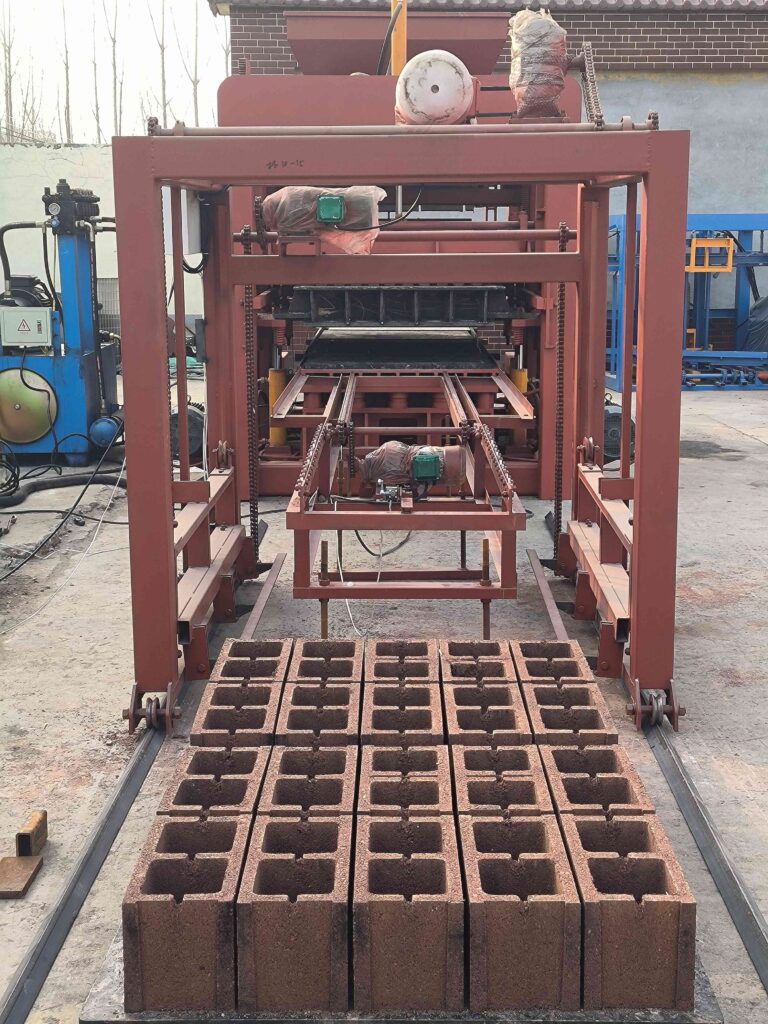
Introducción a la Tecnología de Producción de Alto Volumen
En el competitivo panorama de la fabricación de materiales de construcción, la eficiencia y la producción son los determinantes fundamentales del liderazgo de mercado. La máquina automática para fabricar bloques de ladrillo de 10 cavidades representa una clase específica de equipos industriales diseñada para productores que buscan una participación dominante en el mercado. Esta configuración, caracterizada por su capacidad de moldear diez unidades por ciclo de máquina, se erige como la solución óptima para negocios que escalan desde operaciones semiautomáticas más pequeñas o para plantas establecidas que buscan expandir significativamente su capacidad de producción.
Análisis Integral del Sistema de Producción de 10 Cavidades
1.1 Arquitectura de Ingeniería y Flujo de Trabajo Operativo
La máquina de 10 cavidades no es simplemente una versión más grande de sus contrapartes; es una integración sofisticada de sistemas mecánicos, hidráulicos y de control diseñada para operación sincronizada y de alta velocidad.
- Proceso de Moldeo de Cavidades Múltiples Sincronizado:El núcleo de la máquina es un conjunto de moldes robusto y mecanizado con precisión que contiene diez cavidades individuales. Durante cada ciclo de producción, un volumen medido de concreto se distribuye simultáneamente en todas las diez cámaras. Se aplica una combinación de vibración de alta frecuencia y una inmensa presión hidráulica—que a menudo supera las 200 toneladas de fuerza total—de manera uniforme en toda la mesa de moldes. Esto garantiza que cada uno de los diez bloques que se están formando experimente una energía de compactación idéntica, lo que resulta en una consistencia excepcional de lote a lote. El diseño del molde a menudo incorpora mecanismos de liberación rápida y placas de montaje estandarizadas para facilitar cambios rápidos de producto.
- Manejo Integrado de Materiales y Logística:Para mantener la alta tasa de producción de un sistema de 10 cavidades, la máquina normalmente es alimentada por una planta automatizada de dosificación y mezcla. Un transportador continuo suministra un flujo constante de concreto mezclado a la tolva de alimentación de la máquina. Luego, una cargadora de cubo automatizada o un transportador distribuye el material con precisión a través de las diez cavidades. Una vez que los bloques son compactados, un sistema automatizado de ciclo de paletas coloca paletas vacías en posición. Toda la unidad de bloque y paleta es luego expulsada y transferida mediante un transportador cruzado a un apilador o a un sistema de curado automatizado, creando un flujo de producción continuo e ininterrumpido.
- Sistemas Avanzados de Control y Monitoreo:La operación está gobernada por un Controlador Lógico Programable (PLC) con una Interfaz Hombre-Máquina (HMI) fácil de usar. Este sistema permite a los operadores configurar y monitorear todos los parámetros críticos, incluidos la duración de la vibración, la presión hidráulica, la profundidad de alimentación y el tiempo del ciclo. Los sistemas modernos están equipados con sensores IoT que monitorean la salud de la máquina, rastrean los datos de producción en tiempo real e incluso pueden generar alertas de mantenimiento predictivo. Este nivel de control es esencial para maximizar el tiempo de actividad y garantizar que cada una de las diez cavidades produzca un bloque perfecto en cada ciclo.
1.2 Economía de la Producción y Especificaciones de Salida
La especificación de "10 cavidades" se traduce directamente en un modelo económico convincente basado en una eficiencia de producción incomparable.
- Cuantificando la Capacidad de ProducciónEl rendimiento de una máquina de 10 cavidades es función de su tiempo de ciclo. Un ciclo estándar, que incluye alimentación, compactación y transferencia de paletas, puede ser tan corto como de 15 a 20 segundos. Esto se traduce en una tasa de producción teórica de 180 a 240 ciclos por hora, generando1,800 a 2,400 ladrillos por horaEn un turno estándar de 8 horas, esto equivale a 14,400 – 19,200 unidades, lo que permite producir más de 50,000 unidades en una operación de tres turnos. Este volumen es suficiente para abastecer grandes proyectos de vivienda o servir como fuente principal para una red de distribución regional.
- Ventaja Comparativa Sobre Máquinas de Cavidad InferiorEn comparación con un sistema de 4 cavidades, una máquina de 10 cavidades no solo ofrece un 150% más de producción. Debido a las eficiencias de ingeniería en el ciclo, el costo de producción por unidad suele ser entre un 15 y un 25% menor. Los costos fijos de operación (supervisión, energía para el sistema de control, gastos generales de la instalación) se distribuyen entre una cantidad mucho mayor de unidades, lo que mejora drásticamente la rentabilidad a gran escala.
- Product Range and Versatility: While optimized for high-volume production, these machines are highly versatile. With interchangeable mold sets, a single 10-cavity machine can produce a wide array of products, including 10 solid bricks, 5 hollow blocks (using a split-cavity design), or a combination of different paving stones per cycle. This allows manufacturers to batch-produce different products efficiently without lengthy machine downtime for reconfiguration.
1.3 Strategic Market Applications and Business Implications
The acquisition of a 10-cavity automatic machine is a strategic decision that aligns with specific business growth objectives.
- Capturing Large-Scale Contractual Projects: This level of production is essential for reliably supplying bricks for large-scale infrastructure projects, government housing initiatives, and major commercial developments. The ability to guarantee consistent, high-volume supply is a key competitive differentiator that allows businesses to bid on and secure these lucrative contracts.
- Establishing Regional Distribution Dominance: A company operating a 10-cavity machine can transition from being a local supplier to a regional powerhouse. The volume produced allows for the establishment of a robust supply chain, feeding multiple distributors and retail outlets across a wider geographic area.
- Economic of Scale for Export-Oriented Businesses: For manufacturers located near ports or in economic zones, the high output makes exporting bricks to international markets economically viable. The consistent quality ensured by the automated process is critical for meeting international standards and competing in global tenders.
1.4 Investment Analysis and Total Cost of Ownership
The financial commitment for a 10-cavity system is substantial, and its justification lies in a detailed analysis of its return on investment.
- Desembolso de Capital Inicial: The procurement cost for a quality 10-cavity automatic machine typically falls within the range of $150,000 to $300,000. This variance depends on the level of automation, the sophistication of the control system, the quality of components (e.g., German or Japanese hydraulics), and the inclusion of auxiliary equipment like an automated pallet feeder or built-in curing system.
- Infrastructure and Installation Costs: Housing and operating this industrial asset requires significant infrastructure. This includes a reinforced concrete foundation, a spacious production shed, a three-phase high-voltage power connection (often 380V/50Hz or 440V/60Hz), and a reliable water supply. These costs can add 20-40% to the initial machine investment.
- Operational Expenditure (OPEX) Breakdown:
- Trabajo: Requires only 2-3 operators per shift for monitoring and basic management.
- Poder: High consumption during vibration and compression; can range from $800 to $2,000 per month.
- Maintenance: Regular upkeep of hydraulic systems, vibrator motors, and wear parts like mold liners is critical. An annual maintenance budget of 3-5% of the machine’s initial cost is prudent.
- Materias Primas: The consumption is massive, necessitating bulk purchasing of cement and aggregates to keep material costs low.
- Return on Investment (ROI) Projection: Assuming a stable market, a well-utilized 10-cavity machine can achieve an ROI within 18 to 30 months. The payback period is highly sensitive to local brick prices, capacity utilization, and the cost efficiency of raw material sourcing.
Conclusión
The 10-cavity automatic brick block making machine is unequivocally an engine for industrial-scale growth. It represents a definitive step up in the production hierarchy, designed for businesses that have outgrown smaller systems and are poised to capture significant market share. The decision to invest in such a system must be underpinned by a clear strategic vision, access to capital, and a robust market analysis that confirms the demand for its massive output. For the distributor, this machine represents a high-value product for a discerning clientele; for the manufacturer, it is the key to unlocking new levels of production capacity, operational efficiency, and market influence. In the quest for dominance in the building materials sector, the 10-cavity automatic machine is not just an option—it is a strategic imperative.
Frequently Asked Questions (FAQ)
Q1: What is the actual, realistic daily output we can expect from a 10-cavity machine, accounting for breaks and maintenance?
A: While theoretical output can exceed 50,000 bricks in 24 hours, a more realistic and sustainable output in a well-managed 20-hour operation (allowing for shift changes and preventive maintenance) is between 35,000 and 42,000 bricks per day. This factors in minor stoppages, mold cleaning, and routine checks.
Q2: How complex is the operation, and what level of technical skill is required for the workforce?
A: The operation via the HMI is designed to be user-friendly. However, troubleshooting and maintenance require skilled technicians. A team should include at least one person proficient in industrial hydraulics, basic PLC operation, and mechanical systems. Comprehensive training from the supplier is non-negotiable.
Q3: With 10 cavities, how do you ensure consistent quality across all bricks in every cycle?
A: Consistency is achieved through the machine’s design: a single, powerful vibration system serving the entire mold table, a centralized hydraulic system ensuring uniform pressure distribution, and an automated feed system that distributes material evenly. Regular calibration and maintenance of these systems are key to maintaining this consistency.
Q4: What are the most common maintenance challenges with a high-output machine like this?
A: The primary wear points are the mold liners, the vibrator motors, and the hydraulic seals and hoses. A strict preventive maintenance schedule is vital. Keeping a inventory of critical spare parts—especially specific mold liners and hydraulic seals—can drastically reduce unplanned downtime.
Q5: Can the machine be customized for a specific, non-standard brick or block design?
A: Yes, most manufacturers offer custom mold design and fabrication services. The lead time and cost for a custom 10-cavity mold will be higher than for standard designs, but it enables producers to create unique products for niche markets or specific architectural requirements.
Q6: How does the power consumption of a 10-cavity machine compare to running two smaller 5-cavity machines?
A: A single 10-cavity machine is generally more energy-efficient than two 5-cavity machines producing the same output. This is because it utilizes one central power unit, one control system, and one frame, reducing the “fixed” energy overhead. The efficiency gain can be in the range of 15-20% in terms of energy per brick produced.