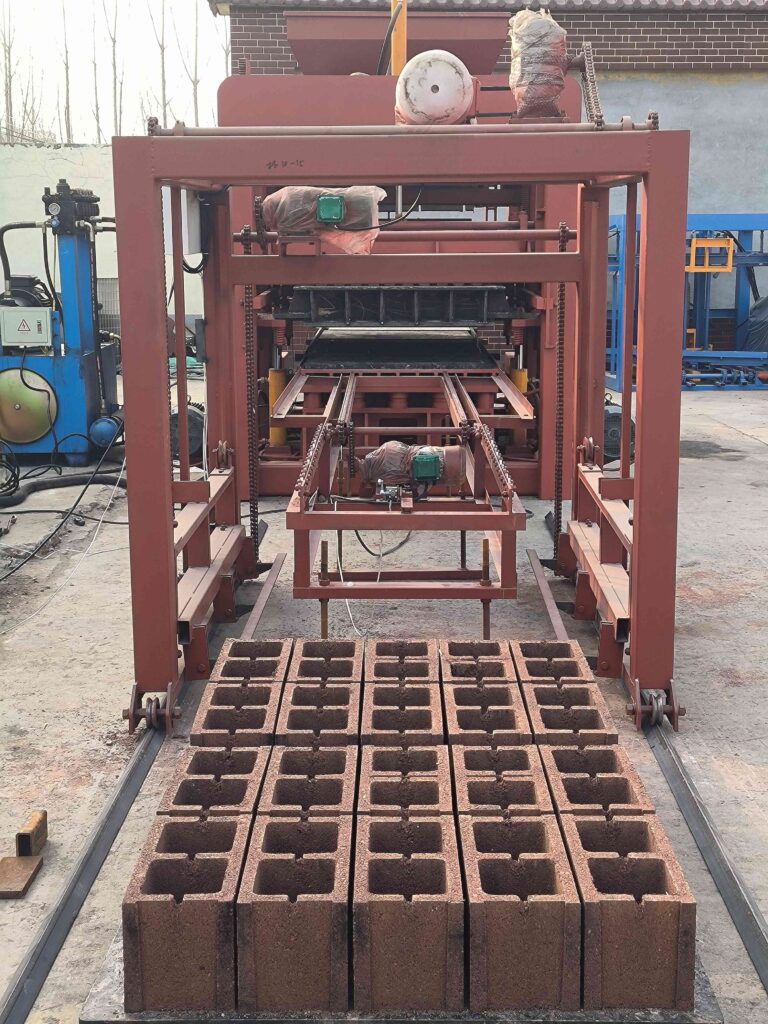
Entwodiksyon nan Teknoloji Pwodiksyon Volim Wo
Nan konpetisyon nan sektè fabrikasyon materyèl konstriksyon an, efikasite ak pwodiksyon se faktè kle ki detèmine lidèchip sou mache a. Machin otomatik pou fè brik ak blòk ki gen 10 kavite a reprezante yon klas espesifik ekipman endistriyèl ki fèt espesyalman pou pwodiktè ki vize dominasyon sou mache a. Konfigirasyon sa a, ki karakterize pa kapasite li pou moule dis inite chak fwa machin nan fè yon sik, se solisyon ki pi apwopriye pou antrepriz ki ap agrandi operasyon yo apre yo te itilize machin semi-otomatik pi piti, oswa pou faktori ki deja etabli ki ap chèche ogmante kapasite pwodiksyon yo anpil.
Analiz Konplè Sistèm Pwodiksyon 10-Kavite
1.1 Achitekti Enjenieri ak Wòl Operasyonèl
Machin 10-kav la pa senpleman yon vèsyon pi gwo nan lòt machin yo; li se yon entegrasyon sofistike nan sistèm mekanik, idwolik ak kontwòl ki fèt pou opere nan yon vitès segondè ak senkronize.
- Pwosesis Moulaj Multi-Kavite Senkronize:Nwayo a nan machin nan se yon asanblaj mòd solid, fèt ak presizyon, ki gen dis kavite endividyèl. Pandan chak sik pwodiksyon, yon volim beton mezire distribiye an menm tan nan tout dis chanm yo. Yon konbinezon de vibrasyon gwo frekans ak presyon idwolik entans—souvan depase 200 tòn fòs total—aplike inifòmman atravè tout tab mòd la. Sa asire ke chak nan dis blòk yo fòme yo resevwa menm enèji konpak, sa ki lakòz yon konsistans eksepsyonèl ant lot. Konsepsyon mòd la souvan enkòpore mekanis lage rapid ak plak moute estanda pou fasilite chanjman pwodwi rapid.
- Manadjman Materyèl ak Lojistik Entegre:Pou kenbe gwo pousantaj pwodiksyon yon sistèm 10 kavite, machin nan nòmalman apwovizyone pa yon enstalasyon otomatize pou dosaj ak melanj. Yon konvwayè kontinyèl bay yon kouran melanj konkrè ki stab nan tremye machin nan. Apre sa, yon lòdè otomatize ak bokit oswa yon konvwayè distribye materyèl la jisteman nan dis kavite yo. Yon fwa blòk yo konpakte, yon sistèm otomatize pou sikile pale vide mete yo nan pozisyon. Apre sa, tout asanblaj blòk ak pale yo ekspilsyon e transfere atravè yon konvwayè transvèsal nan yon anpile oswa yon sistèm otomatize pou gerizon, sa ki kreye yon koule pwodiksyon san entèripsyon ki san kouti.
- Sistèm Kontwòl ak Siveyans Avanse:Operasyon an dirije pa yon Kontwolè Lojik Pwogramab (PLC) ak yon Entèfas Itilizatè-Machin (HMI) ki fasil pou itilize. Sistèm sa a pèmèt operatè yo mete ak kontwole tout paramèt enpòtan, tankou dire vibwasyon, presyon idwolik, pwofondite avansman, ak tan sik. Sistèm modèn yo ekipe ak detektè IoT ki kontwole sante machin nan, swiv done pwodiksyon an tan reyèl, epi yo ka menm jenere alèt antretyen prediktif. Nivo kontwòl sa a esansyèl pou maksimize tan fonksyonèl ak asire chak youn nan dis kavite yo pwodui yon blok pafè chak sik.
1.2 Ekonomi Pwodiksyon ak Espesifikasyon Pwodiksyon
Espesifikasyon "10 kavite" a tradui dirèkteman nan yon modèl ekonomik konvenkan ki baze sou efikasite pwodiksyon san parèy.
- Kantifye Kapasite Pwodiksyon:Pwodiksyon yon machin 10-kavite depann de tan sik li yo. Yon sik estanda, ki gen ladan manje, konpaksyon, ak transfè palèt, ka kout tankou 15-20 segonn. Sa tradui nan yon pousantaj pwodiksyon teyorik de 180-240 sik pa èdtan, ki bay1,800 a 2,400 brikèt pa èdtanNan yon chan nòmal 8 èdtan, sa a ekivalan a 14,400 – 19,200 inite, ki fè li kapab pwodwi plis pase 50,000 inite nan yon operasyon twa chan. Volim sa a ase pou founi gwo pwojè lojman oswa sèvi kòm sous prensipal pou yon rezo distribisyon rejyonal.
- Avantaj Konparatif sou Machin ki Gen Mwens KavitKonpare ak yon sistèm 4-kavite, yon machin 10-kavite pa senpleman ofri 150% plis pwodiksyon. Akòz efikasite enjenieri nan sik la, pri pwodiksyon pou chak inite souvan 15-25% pi ba. Depans fiks operasyon yo (sipèvizyon, kouran pou sistèm kontwòl la, depans jeneral etablisman an) distribye sou yon pi gwo kantite inite, sa ki amelyore konsiderableman pwofitabilite a gwo echèl.
- Seri Pwodwi ak Adaptabilite:Pandan yo optimize pou pwodiksyon gwo kantite, machin sa yo trè adaptab. Avèk seri mwazi entèchanjab, yon sèl machin 10-kavite ka pwodwi yon pakèt pwodwi, tankou 10 brik solid, 5 blòk kre (lè yo sèvi ak yon konsepsyon kavite divize), oswa yon konbinezon de wòch pave diferan chak fwa. Sa pèmèt manifaktirè yo pwodwi an pil diferan pwodwi avèk efikasite san yo pa gen anpil tan pèdi pou rekonfigirasyon machin nan.
1.3 Aplikasyon Estratejik sou Mache ak Enplikasyon Biznis yo
Akirizisyon yon machin otomatik 10 kavite se yon desizyon estratejik ki aliyen ak objektif kwasans biznis espesifik yo.
- Capturing Large-Scale Contractual Projects: This level of production is essential for reliably supplying bricks for large-scale infrastructure projects, government housing initiatives, and major commercial developments. The ability to guarantee consistent, high-volume supply is a key competitive differentiator that allows businesses to bid on and secure these lucrative contracts.
- Establishing Regional Distribution Dominance: A company operating a 10-cavity machine can transition from being a local supplier to a regional powerhouse. The volume produced allows for the establishment of a robust supply chain, feeding multiple distributors and retail outlets across a wider geographic area.
- Economic of Scale for Export-Oriented Businesses: For manufacturers located near ports or in economic zones, the high output makes exporting bricks to international markets economically viable. The consistent quality ensured by the automated process is critical for meeting international standards and competing in global tenders.
1.4 Investment Analysis and Total Cost of Ownership
The financial commitment for a 10-cavity system is substantial, and its justification lies in a detailed analysis of its return on investment.
- Depans Kapital Inisyal: The procurement cost for a quality 10-cavity automatic machine typically falls within the range of $150,000 to $300,000. This variance depends on the level of automation, the sophistication of the control system, the quality of components (e.g., German or Japanese hydraulics), and the inclusion of auxiliary equipment like an automated pallet feeder or built-in curing system.
- Infrastructure and Installation Costs: Housing and operating this industrial asset requires significant infrastructure. This includes a reinforced concrete foundation, a spacious production shed, a three-phase high-voltage power connection (often 380V/50Hz or 440V/60Hz), and a reliable water supply. These costs can add 20-40% to the initial machine investment.
- Operational Expenditure (OPEX) Breakdown:
- Travay Requires only 2-3 operators per shift for monitoring and basic management.
- Pouvwa High consumption during vibration and compression; can range from $800 to $2,000 per month.
- Maintenance: Regular upkeep of hydraulic systems, vibrator motors, and wear parts like mold liners is critical. An annual maintenance budget of 3-5% of the machine’s initial cost is prudent.
- Matyè Premye: The consumption is massive, necessitating bulk purchasing of cement and aggregates to keep material costs low.
- Return on Investment (ROI) Projection: Assuming a stable market, a well-utilized 10-cavity machine can achieve an ROI within 18 to 30 months. The payback period is highly sensitive to local brick prices, capacity utilization, and the cost efficiency of raw material sourcing.
Konklizyon
The 10-cavity automatic brick block making machine is unequivocally an engine for industrial-scale growth. It represents a definitive step up in the production hierarchy, designed for businesses that have outgrown smaller systems and are poised to capture significant market share. The decision to invest in such a system must be underpinned by a clear strategic vision, access to capital, and a robust market analysis that confirms the demand for its massive output. For the distributor, this machine represents a high-value product for a discerning clientele; for the manufacturer, it is the key to unlocking new levels of production capacity, operational efficiency, and market influence. In the quest for dominance in the building materials sector, the 10-cavity automatic machine is not just an option—it is a strategic imperative.
Kesyon yo poze souvan (FAQ)
Q1: What is the actual, realistic daily output we can expect from a 10-cavity machine, accounting for breaks and maintenance?
A: While theoretical output can exceed 50,000 bricks in 24 hours, a more realistic and sustainable output in a well-managed 20-hour operation (allowing for shift changes and preventive maintenance) is between 35,000 and 42,000 bricks per day. This factors in minor stoppages, mold cleaning, and routine checks.
Q2: How complex is the operation, and what level of technical skill is required for the workforce?
A: The operation via the HMI is designed to be user-friendly. However, troubleshooting and maintenance require skilled technicians. A team should include at least one person proficient in industrial hydraulics, basic PLC operation, and mechanical systems. Comprehensive training from the supplier is non-negotiable.
Q3: With 10 cavities, how do you ensure consistent quality across all bricks in every cycle?
A: Consistency is achieved through the machine’s design: a single, powerful vibration system serving the entire mold table, a centralized hydraulic system ensuring uniform pressure distribution, and an automated feed system that distributes material evenly. Regular calibration and maintenance of these systems are key to maintaining this consistency.
Q4: What are the most common maintenance challenges with a high-output machine like this?
A: The primary wear points are the mold liners, the vibrator motors, and the hydraulic seals and hoses. A strict preventive maintenance schedule is vital. Keeping a inventory of critical spare parts—especially specific mold liners and hydraulic seals—can drastically reduce unplanned downtime.
Q5: Can the machine be customized for a specific, non-standard brick or block design?
A: Yes, most manufacturers offer custom mold design and fabrication services. The lead time and cost for a custom 10-cavity mold will be higher than for standard designs, but it enables producers to create unique products for niche markets or specific architectural requirements.
Q6: How does the power consumption of a 10-cavity machine compare to running two smaller 5-cavity machines?
A: A single 10-cavity machine is generally more energy-efficient than two 5-cavity machines producing the same output. This is because it utilizes one central power unit, one control system, and one frame, reducing the “fixed” energy overhead. The efficiency gain can be in the range of 15-20% in terms of energy per brick produced.