Giới thiệu Công nghệ Sản xuất Khối lượng Lớn
Trong bối cảnh cạnh tranh của ngành sản xuất vật liệu xây dựng, hiệu suất và sản lượng là những yếu tố quyết định tối quan trọng đối với vị thế dẫn đầu thị trường. Máy làm gạch block tự động 10 khuôn đại diện cho một phân khúc thiết bị công nghiệp chuyên biệt, được thiết kế dành cho các nhà sản xuất nhắm tới thị phần chi phối. Cấu hình này, với đặc điểm có thể đúc mười đơn vị sản phẩm mỗi chu kỳ máy, được xem là giải pháp tối ưu cho các doanh nghiệp đang mở rộng quy mô từ hoạt động bán tự động quy mô nhỏ hơn, hoặc cho các nhà máy đã hoạt động ổn định muốn tăng đáng kể năng lực sản xuất.
Phân Tích Toàn Diện Hệ Thống Sản Xuất 10 Khuôn
1.1 Kiến trúc Kỹ thuật và Quy trình Vận hành
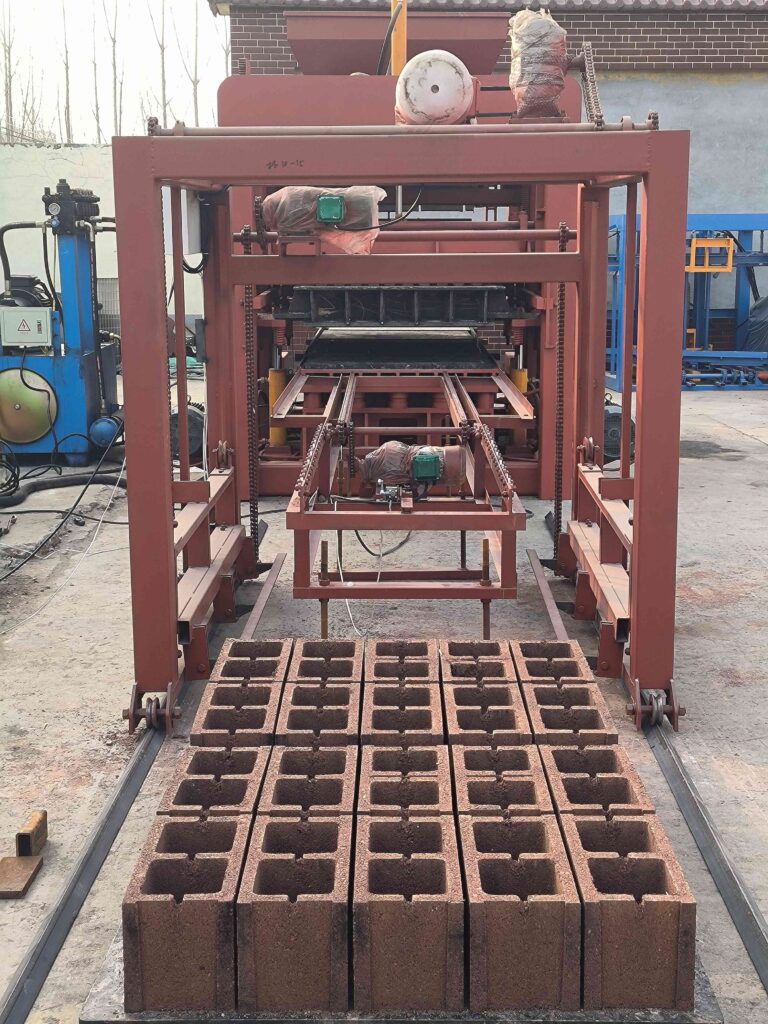
Máy 10 khuôn không đơn thuần là phiên bản phóng to của các máy cùng loại; nó là sự tích hợp tinh vi của các hệ thống cơ khí, thủy lực và điều khiển được thiết kế để vận hành đồng bộ ở tốc độ cao.
- Quy Trình Đúc Khuôn Đa Hốc Đồng Bộ:Lõi của máy là một cụm khuôn gia công chính xác, chắc chắn, chứa mười khoang riêng biệt. Trong mỗi chu kỳ sản xuất, một lượng bê tông được định sẵn được phân phối đồng thời vào cả mười buồng. Một sự kết hợp giữa rung tần số cao và áp lực thủy lực khổng lồ—thường vượt quá 200 tấn lực tổng cộng—được áp dụng đồng đều trên toàn bộ bàn khuôn. Điều này đảm bảo rằng mỗi trong số mười khối đang được định hình đều chịu năng lượng đầm nén giống hệt nhau, mang lại sự đồng nhất đặc biệt giữa các lô sản phẩm. Thiết kế khuôn thường tích hợp cơ chế nhả nhanh và các tấm gắn tiêu chuẩn hóa để tạo điều kiện thay đổi sản phẩm nhanh chóng.
- Integrated Material Handling and Logistics: To sustain the high production rate of a 10-cavity system, the machine is typically fed by an automated batching and mixing plant. A continuous conveyor supplies a steady stream of mixed concrete to the machine’s feed hopper. An automated bucket loader or conveyor then precisely distributes the material across the ten cavities. Once the blocks are compacted, an automated pallet cycling system moves empty pallets into position. The entire block and pallet assembly is then ejected and transferred via a cross-conveyor to a stacker or an automated curing system, creating a seamless, uninterrupted production flow.
- Advanced Control and Monitoring Systems: Operation is governed by a Programmable Logic Controller (PLC) with a user-friendly Human-Machine Interface (HMI). This system allows operators to set and monitor all critical parameters, including vibration duration, hydraulic pressure, feed depth, and cycle time. Modern systems are equipped with IoT sensors that monitor machine health, track production data in real-time, and can even generate predictive maintenance alerts. This level of control is essential for maximizing uptime and ensuring every one of the ten cavities produces a perfect block every cycle.
1.2 Production Economics and Output Specifications
The “10-cavity” specification directly translates into a compelling economic model based on unparalleled output efficiency.
- Quantifying Production Capacity: The output of a 10-cavity machine is a function of its cycle time. A standard cycle, including feeding, compaction, and pallet transfer, can be as short as 15-20 seconds. This translates to a theoretical production rate of 180-240 cycles per hour, yielding 1,800 to 2,400 bricks per hour. In a standard 8-hour shift, this equates to 14,400 – 19,200 units, making it capable of producing over 50,000 units in a three-shift operation. This volume is sufficient to supply major housing projects or serve as a primary source for a regional distribution network.
- Comparative Advantage Over Lower-Cavity Machines: Compared to a 4-cavity system, a 10-cavity machine does not simply offer 150% more output. Due to engineering efficiencies in the cycle, the per-unit production cost is often 15-25% lower. The fixed costs of operation (supervision, power for the control system, facility overhead) are distributed across a much larger number of units, dramatically improving profitability at scale.
- Product Range and Versatility: While optimized for high-volume production, these machines are highly versatile. With interchangeable mold sets, a single 10-cavity machine can produce a wide array of products, including 10 solid bricks, 5 hollow blocks (using a split-cavity design), or a combination of different paving stones per cycle. This allows manufacturers to batch-produce different products efficiently without lengthy machine downtime for reconfiguration.
1.3 Strategic Market Applications and Business Implications
The acquisition of a 10-cavity automatic machine is a strategic decision that aligns with specific business growth objectives.
- Capturing Large-Scale Contractual Projects: This level of production is essential for reliably supplying bricks for large-scale infrastructure projects, government housing initiatives, and major commercial developments. The ability to guarantee consistent, high-volume supply is a key competitive differentiator that allows businesses to bid on and secure these lucrative contracts.
- Establishing Regional Distribution Dominance: A company operating a 10-cavity machine can transition from being a local supplier to a regional powerhouse. The volume produced allows for the establishment of a robust supply chain, feeding multiple distributors and retail outlets across a wider geographic area.
- Economic of Scale for Export-Oriented Businesses: For manufacturers located near ports or in economic zones, the high output makes exporting bricks to international markets economically viable. The consistent quality ensured by the automated process is critical for meeting international standards and competing in global tenders.
1.4 Investment Analysis and Total Cost of Ownership
The financial commitment for a 10-cavity system is substantial, and its justification lies in a detailed analysis of its return on investment.
- Vốn đầu tư ban đầu: The procurement cost for a quality 10-cavity automatic machine typically falls within the range of $150,000 to $300,000. This variance depends on the level of automation, the sophistication of the control system, the quality of components (e.g., German or Japanese hydraulics), and the inclusion of auxiliary equipment like an automated pallet feeder or built-in curing system.
- Infrastructure and Installation Costs: Housing and operating this industrial asset requires significant infrastructure. This includes a reinforced concrete foundation, a spacious production shed, a three-phase high-voltage power connection (often 380V/50Hz or 440V/60Hz), and a reliable water supply. These costs can add 20-40% to the initial machine investment.
- Operational Expenditure (OPEX) Breakdown:
- Lao động Requires only 2-3 operators per shift for monitoring and basic management.
- Quyền lực: High consumption during vibration and compression; can range from $800 to $2,000 per month.
- Maintenance: Regular upkeep of hydraulic systems, vibrator motors, and wear parts like mold liners is critical. An annual maintenance budget of 3-5% of the machine’s initial cost is prudent.
- Nguyên liệu thô: The consumption is massive, necessitating bulk purchasing of cement and aggregates to keep material costs low.
- Return on Investment (ROI) Projection: Assuming a stable market, a well-utilized 10-cavity machine can achieve an ROI within 18 to 30 months. The payback period is highly sensitive to local brick prices, capacity utilization, and the cost efficiency of raw material sourcing.
Conclusion
The 10-cavity automatic brick block making machine is unequivocally an engine for industrial-scale growth. It represents a definitive step up in the production hierarchy, designed for businesses that have outgrown smaller systems and are poised to capture significant market share. The decision to invest in such a system must be underpinned by a clear strategic vision, access to capital, and a robust market analysis that confirms the demand for its massive output. For the distributor, this machine represents a high-value product for a discerning clientele; for the manufacturer, it is the key to unlocking new levels of production capacity, operational efficiency, and market influence. In the quest for dominance in the building materials sector, the 10-cavity automatic machine is not just an option—it is a strategic imperative.
Các Câu Hỏi Thường Gặp (FAQ)
Q1: What is the actual, realistic daily output we can expect from a 10-cavity machine, accounting for breaks and maintenance?
A: While theoretical output can exceed 50,000 bricks in 24 hours, a more realistic and sustainable output in a well-managed 20-hour operation (allowing for shift changes and preventive maintenance) is between 35,000 and 42,000 bricks per day. This factors in minor stoppages, mold cleaning, and routine checks.
Q2: How complex is the operation, and what level of technical skill is required for the workforce?
A: The operation via the HMI is designed to be user-friendly. However, troubleshooting and maintenance require skilled technicians. A team should include at least one person proficient in industrial hydraulics, basic PLC operation, and mechanical systems. Comprehensive training from the supplier is non-negotiable.
Q3: With 10 cavities, how do you ensure consistent quality across all bricks in every cycle?
A: Consistency is achieved through the machine’s design: a single, powerful vibration system serving the entire mold table, a centralized hydraulic system ensuring uniform pressure distribution, and an automated feed system that distributes material evenly. Regular calibration and maintenance of these systems are key to maintaining this consistency.
Q4: What are the most common maintenance challenges with a high-output machine like this?
A: The primary wear points are the mold liners, the vibrator motors, and the hydraulic seals and hoses. A strict preventive maintenance schedule is vital. Keeping a inventory of critical spare parts—especially specific mold liners and hydraulic seals—can drastically reduce unplanned downtime.
Q5: Can the machine be customized for a specific, non-standard brick or block design?
A: Yes, most manufacturers offer custom mold design and fabrication services. The lead time and cost for a custom 10-cavity mold will be higher than for standard designs, but it enables producers to create unique products for niche markets or specific architectural requirements.
Q6: How does the power consumption of a 10-cavity machine compare to running two smaller 5-cavity machines?
A: A single 10-cavity machine is generally more energy-efficient than two 5-cavity machines producing the same output. This is because it utilizes one central power unit, one control system, and one frame, reducing the “fixed” energy overhead. The efficiency gain can be in the range of 15-20% in terms of energy per brick produced.