
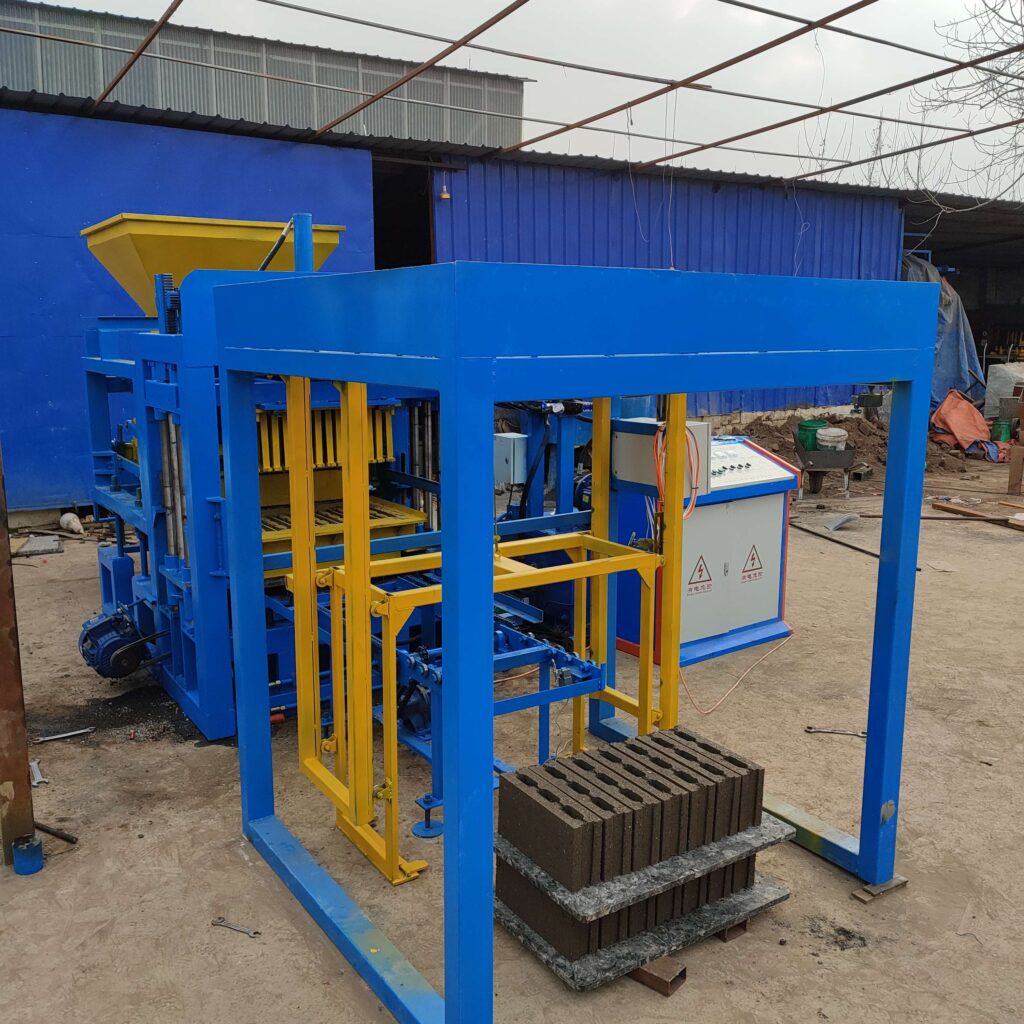
1 La philosophie de production centrale : Densification et Moulage
Au cœur de son fonctionnement, une machine à fabriquer des blocs de construction repose sur le principe de la compression d'un mélange granulaire en une masse dense et solide de forme et de dimensions prédéterminées. La qualité du produit fini dépend directement de la composition des matières premières, de la force de compactage appliquée et de la précision du moule.
- Le Rôle Crucial du Mélange des Matières Premières :Contrairement aux procédés qui reposent sur la liaison chimique par cuisson, ces machines utilisent généralement un mélange de béton « semi-sec ». La composition standard comprend un liant (généralement du ciment ou de la chaux), des granulats (tels que du sable, de la poussière de pierre ou du gravier) et d'éventuels ajouts cimentaires supplémentaires (comme des cendres volantes ou du laitier). La teneur en humidité de ce mélange est rigoureusement contrôlée : trop peu d'eau empêche l'activation du liant, tandis qu'un excès provoque la déformation du bloc après son éjection. Le mélange optimal atteint une compacité maximale sans adhérer au moule.
- La Dynamique de Compactage : Pression et VibrationLe cœur du fonctionnement de la machine réside dans son système de compactage. Les machines haut de gamme utilisent un double mécanisme : une puissante pression hydraulique exercée par le haut et des vibrations haute fréquence provenant de la table de moulage. La pression compacte le mélange, éliminant les vides et augmentant la densité, tandis que les vibrations fluidifient la matière, lui permettant de s'écouler uniformément dans chaque recoin de la cavité du moule. Cette combinaison est cruciale pour produire des blocs aux arêtes nettes, à la densité homogène et dotés d'une forte « résistance verte » immédiate, ce qui permet de les manipuler directement après leur production.
1.2 Le spectre de l'automatisation : des systèmes manuels aux systèmes entièrement intégrés
Le terme « machine à fabriquer des blocs de construction » couvre une large gamme technologique, chaque niveau répondant à différentes capacités de capital et objectifs de production.
- Machines manuelles et semi-automatiques :Ce sont les points d'entrée de la technologie. Une machine manuelle nécessite qu'un opérateur actionne un mécanisme de presse à levier, produisant un bloc à la fois. Les versions semi-automatiques utilisent une presse hydraulique activée par l'opérateur, mais l'alimentation et le retrait des blocs peuvent encore être manuels. Elles se caractérisent par un faible investissement initial et conviennent aux projets à très petite échelle ou communautaires, mais elles souffrent d'une faible production, d'une forte intensité de main-d'œuvre et d'une qualité de produit inconstante.
- Machines entièrement automatiques :Voici la norme de l'industrie pour la production commerciale. Ces systèmes sont des unités intégrées où un Automate Programmable Industriel (API) orchestre l'ensemble du cycle : dosage et mélange automatiques des matériaux, alimentation du mélange vers la trémie par convoyeur, remplissage précis du moule, compactage et vibration simultanés, éjection du bloc fini et transfert automatisé vers une zone d'empilage ou de cure. L'intervention humaine se limite à la surveillance et à la maintenance, permettant une production pouvant atteindre des milliers de blocs par poste avec une constance remarquable.
- Usines de production entièrement intégrées :Au sommet de l'automatisation se trouvent les usines complètes. Celles-ci intègrent non seulement la machine à fabriquer les blocs, mais tous les systèmes auxiliaires. Cela comprend des silos automatisés pour le ciment et les cendres volantes, des convoyeurs à bande pour les granulats, des systèmes informatisés de dosage, des mélangeurs industriels, des palettiseurs robotisés qui empilent les blocs sur des chariots de cure, et des chambres de cure automatisées qui contrôlent la température et l'humidité pour un gain de résistance accéléré. Ces usines représentent l'apogée de l'efficacité, de la production et du contrôle de la qualité.
L'Univers des Produits : Polyvalence dans la Construction de Solutions
La véritable valeur de ces machines réside dans leur capacité à produire un portefeuille diversifié de produits de construction, simplement en changeant le moule. Cette polyvalence permet aux fabricants de desservir simultanément plusieurs segments de marché.
2.1 Blocs pleins et creux standard
The workhorses of the industry, used in everything from load-bearing walls in low-rise buildings to infill walls in framed structures. Hollow blocks reduce weight and material cost while providing inherent insulation.
2.2 Pavers and Landscape Products
These include interlocking concrete pavers for roads, driveways, and walkways, as well as retaining wall blocks and landscaping bricks. This segment often commands higher profit margins and requires machines capable of high-vibration and high-pressure for dense, durable, and aesthetically pleasing products.
2.3 Specialized Masonry Units
- Blocs d'emboîtement : Designed with profiled edges that lock together without mortar, enabling rapid, dry-stack construction for walls with excellent seismic resistance.
- Cellular Lightweight Blocks: Produced using a specialized mix that includes a foaming agent, these blocks are lightweight, offering superior thermal and acoustic insulation. Their production requires specific machine adaptations.
- Curved and Architectural Blocks: For aesthetic applications, machines can be fitted with molds to produce blocks for decorative walls, arches, and other architectural features.
Strategic Imperatives for Distribution and Procurement
3.1 Quantifying the Value Proposition for End-Users
For your clients, the investment in a block brick building machine is justified by a clear and compelling financial and operational calculus.
- Unmatched Economic Velocity: The production capacity of an automatic machine can be 10 to 50 times that of a manual operation. This high-volume output enables manufacturers to secure large contracts, achieve economies of scale, and realize a rapid return on investment. The reduction in labor costs further accelerates the payback period.
- Assured Quality and Regulatory Compliance: Machine-made blocks guarantee dimensional consistency, which translates to faster bricklaying, reduced mortar consumption, and lower skilled labor requirements. The controlled production process ensures that every batch meets or exceeds the compressive strength standards mandated by national building codes, a critical factor for structural integrity and market acceptance.
- Operational Independence and Supply Chain Resilience: By establishing their own production facility, construction companies or entrepreneurs gain independence from volatile market prices and unreliable supply chains for bricks. They can produce on-demand, reducing inventory costs and ensuring a consistent supply for their projects.
3.2 Critical Technical Evaluation for Procurement
Selecting the right machine requires a meticulous assessment of technical specifications against market demands.
- Production Capacity Analysis: Move beyond simple “blocks per hour” claims. Evaluate the cycle time for the specific block type the client intends to produce most frequently. Calculate the potential output in cubic meters of concrete per day, as this is a more universal metric for comparing different machines and product mixes.
- Core System Robustness: Scrutinize the heart of the machine. The hydraulic system should be powerful, reliable, and energy-efficient (preferably with variable frequency drives). The vibration system should have multiple, balanced motors capable of delivering high-frequency vibrations for optimal compaction. The mold frame and pressing head must be constructed from high-grade, wear-resistant steel to maintain precision over thousands of cycles.
- After-Sales Ecosystem: The machine’s value is inextricably linked to the support behind it. A supplier must offer comprehensive training, a readily available inventory of critical spare parts (mold liners, hydraulic seals, vibration motors), and access to responsive technical support, ideally with remote diagnostics capabilities. The availability of detailed technical documentation is non-negotiable.
Conclusion: Positioning at the Forefront of Industrialized Construction
The block brick building machine is far more than a piece of factory equipment; it is the cornerstone of a more efficient, resilient, and accessible model of construction. It democratizes the production of high-quality building materials, empowering local businesses and driving regional development. For the astute distributor and procurement specialist, this technology represents a dynamic and high-growth market segment.
Success in this field demands a strategic partnership with manufacturers who demonstrate unwavering commitment to engineering excellence and customer success. By providing your clients with not just a machine, but a comprehensive business solution—including technical guidance on mix design, plant layout, and market strategy—you elevate your role from a vendor to an indispensable partner in their growth. The future of construction is prefabricated, standardized, and locally produced, and the block brick building machine is the vehicle to that future.
Foire aux questions (FAQ)
Q1: What is the fundamental difference between a block making machine and a brick making machine?
A: The terms are often used interchangeably, but a key distinction lies in the product size and the machine’s power. “Block making machines” are generally heavier, more powerful units designed to produce larger concrete masonry units (CMUs), like hollow blocks, which are typically 8x8x16 inches in nominal size. “Brick making machines” may refer to equipment producing smaller, solid units akin to traditional clay bricks. However, most modern automatic machines are versatile and can produce both, depending on the mold installed.
Q2: How long does it take for machine-made blocks to cure and gain full strength?
A: While blocks gain enough “green strength” from high-pressure compaction to be handled within minutes, they require a curing period to achieve their specified compressive strength. With proper water curing or steam curing, blocks can achieve over 70% of their final strength within 3-7 days. Full strength (100%) is typically attained after 28 days, in line with standard concrete curing practices.
Q3: Can these machines use local soil or clay as a primary raw material?
A: While specialized machines exist for compressed earth blocks (CEBs), the vast majority of commercial block brick building machines are designed for a concrete-based mix requiring cement as a binder. Local soil can sometimes be incorporated as a partial aggregate replacement, but its properties must be tested. The standard and most reliable raw materials remain cement, sand, and stone aggregates.
Q4: What is the single most important factor for achieving high-quality blocks?
A: Consistency. This applies to three areas: a consistent and well-graded raw material mix, a consistent moisture content in that mix, and a consistent compaction force and vibration time from the machine. Any variation in these parameters will directly lead to variations in the block’s weight, density, strength, and appearance.
Q5: What level of technical expertise is required to operate and maintain an automatic machine?
A: For daily operation, a competent operator with basic literacy and mechanical aptitude can be trained to run the machine via the user-friendly PLC interface. However, for maintenance and troubleshooting, a more skilled technician is required. The machine supplier should provide training covering daily operation, routine maintenance (greasing, cleaning, inspection), and basic electrical and hydraulic troubleshooting.
Q6: How should a client prepare their site for installing a medium-to-large automatic machine?
A: Site preparation is critical for stability and performance. Key requirements include:
- A Level, Reinforced Concrete Foundation: Designed to absorb the dynamic loads and vibrations of the machine.
- Adequate Space: A covered production area for the machine and auxiliary equipment (mixer, conveyor, curing racks).
- Robust Utilities: A stable and powerful three-phase electrical connection and a reliable source of clean water for the mixing process.
- Raw Material Storage: Designated, organized areas for storing cement (in silos or a dry place), aggregates, and other materials.
