
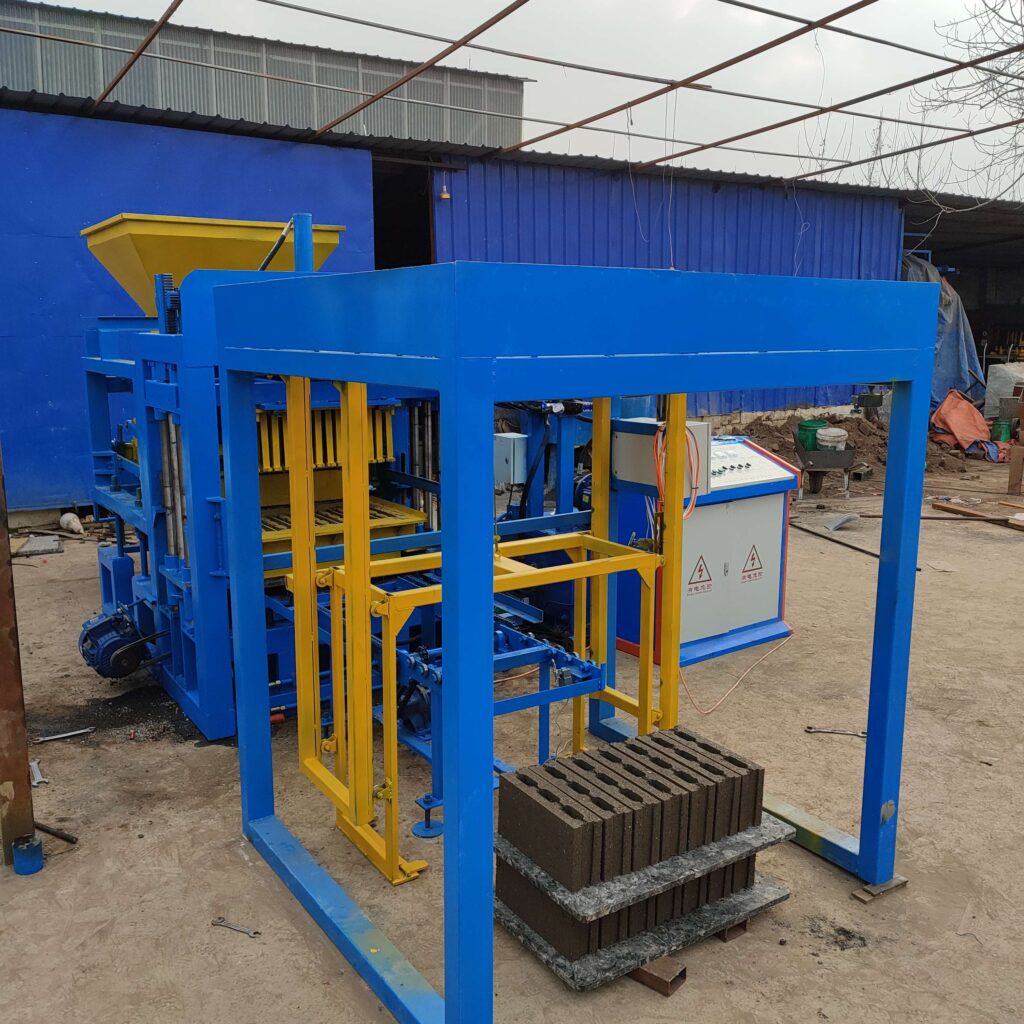
Yadro Ishlab Chiqarish Falsafasi: Zichlashtirish va Shakllantirish
Uning mohiyatida, blok g'isht qilish mashinasi mayda zarrali aralashmani oldindan belgilangan shakl va o'lchamdagi zich, qattiq massaga siqish printsipida ishlaydi. Yakuniy mahsulotning sifati xom ashyo tarkibi, qo'llanilgan siqish kuchi va qolipning aniqligiga bevosita bog'liqdir.
- Xomashyo Aralashmasining Muhim Rolı:Ushbu mashinalar odatda "yarim quruq" beton aralashmasidan foydalanadi, bunda kimyoviy bog'lanishni pishirish orqali amalga oshiriladigan jarayonlardan farqli ravishda ishlaydi. Standart tarkibga bog'lovchi modda (odatda sement yoki ohak), to'ldirgichlar (masalan, qum, tosh changi yoki shag'al) va qo'shimcha sementli materiallar (masalan, uchqun kul yagi yagi shlak) kiradi. Aralashmadagi namlik miqdari ehtiyotkorlik bilan nazorat qilinadi—suvning kam miqdori bog'lovchini faollashtirmaydi, ortiqcha miqdori esa blokni chiqarilgandan keyin deformatsiyalanishiga olib keladi. Optimal aralashma qoliplarga yopishmasdan maksimal zichlikka erishishni ta'minlaydi.
- Siqish Dinamikasi: Bosim va Vibratsiya:Mashinaning ishlash prinsipining yadrosi uning siqish tizimidadir. Yuqori darajadagi modellar ikki mexanizmli: yuqoridan kuchli gidravlik bosim va qolip stolining yuqori chastotali tebranishi. Bosim aralashmani siqib, bo'shliqlarni yo'q qiladi va zichlikni oshiradi, shu bilan birga tebranish materialni suyuqlashtiradi, uni qolip bo'shlig'ining har bir burchagiga muammosiz oqishi uchun imkon yaratadi. Bu kombinatsiya o'tkir qirrali, bir xil zichlikdagi va ishlab chiqarilgandan so'ng darhol yuqori "yashil mustahkamlikka" ega bo'lgan bloklarni ishlab chiqarish uchun juda muhimdir, bu esa ularni ishlab chiqarilgandan keyin darhol qayta ishlash imkonini beradi.
1.2 Avtomatlashtirish Spektrumi: Qo‘lda Boshqaruvdan To‘liq Integratsiyalangan Tizimlargacha
"Blok g'isht qurilish mashinasi" atamasi keng texnologik diapazonni ifodalaydi, har bir daraja turli kapital imkoniyatlari va ishlab chiqarish maqsadlariga mos keladi.
- Qo'lda va Yarim Avtomat Mashinalar:Bu texnologiyaning kirish nuqtalaridir. Qo'lda boshqariladigan mashina operatorga press mexanizmini harakatga keltirish va bir vaqtning o'zida bitta blok ishlab chiqarish imkonini beradi. Yarim avtomatik versiyalar operator tomonidan faollashtiriladigan gidravlik pressdan foydalanadi, ammo materiallarni yuklash va bloklarni olib tashlash jarayoni hali ham qo'lda amalga oshirilishi mumkin. Ular past boshlang'ich investitsiya bilan tavsiflanadi va juda kichik miqyosdagi yoki jamoat tomonidan boshqariladigan loyihalar uchun mos keladi, ammo ular past mahsulot chiqishi, yuqori mehnat zichligi va mahsulot sifati nomutanosibligi kabi kamchiliklardan aziyat chekadi.
- To'liq avtomatik mashinalar:Bu tijorat ishlab chiqarish uchun sanoat standartidir. Ushbu tizimlar barcha jarayonni boshqaradigan Dasturiy Boshqariladigan Mantiqiy Kontroller (PLC) asosida integratsiyalashgan birliklardir: materiallarni avtomatik ravishda partiyalash va aralashtirish, aralashmani bunkerga konveyer orqali yetkazib berish, qolipni aniq to'ldirish, bir vaqtning o'zida siqish va tebranish, tayyor blokni chiqarish va uni avtomatik ravishda yig'ish yoki quritish maydoniga o'tkazish. Inson aralashuvi faqat monitoring va texnik xizmat ko'rsatish bilan cheklanadi, bu esa har bir smenada minglab bloklarni ajoyib izchillik bilan ishlab chiqarish imkonini beradi.
- To'liq Integratsiyalashgan Ishlab Chiqarish Zavodlari:Avtomatlashtirishning eng yuqori cho‘qqisi to‘liq zavodlardir. Ular nafaqat blok yasash mashinasini, balki barcha yordamchi tizimlarni o‘z ichiga oladi. Bunga sement va uchuvchi kul uchun avtomatlashtirilgan siloslar, agregatlar uchun konveyer tasmalari, kompyuterlashtirilgan dozalash tizimlari, sanoat aralashtirgichlari, bloklarni quritish aravalariga yig‘adigan robotlashtirilgan palletizatorlar va tezlashtirilgan mustahkamlik olish uchun harorat va namlikni nazorat qiladigan avtomatlashtirilgan quritish kameralari kiradi. Ushbu zavodlar samaradorlik, mahsuldorlik va sifat nazoratining eng yuqori darajasini ifodalaydi.
Mahsulotlar Olami: Yechimlarni Qurishda Ko'p Qirralilik
Ushbu mashinalarning haqiqiy qadri, shunchaki qolipni almashtirish orqali qurilish mahsulotlarining xilma-xil portfelini yaratish qobiliyatidadir. Bu ko'p qirralilik ishlab chiqaruvchilarga bir vaqtning o'zida bir nechta bozor segmentlariga xizmat ko'rsatish imkonini beradi.
2.1 Standart qattiq va ichi bo'sh bloklar
Sanoatning asosiy kuchi bo'lgan bu materiallar past qavatli binolardagi yuk ko'taruvchi devorlardan tortib, ramkali konstruksiyalardagi to'ldiruvchi devorlargacha har xil qo'llaniladi. Ichichi bo'sh bloklar og'irlik va material xarajatlarini kamaytirish bilan birga tabiiy izolyatsiya xususiyatini ta'minlaydi.
2.2 Pavers and Landscape Products
These include interlocking concrete pavers for roads, driveways, and walkways, as well as retaining wall blocks and landscaping bricks. This segment often commands higher profit margins and requires machines capable of high-vibration and high-pressure for dense, durable, and aesthetically pleasing products.
2.3 Specialized Masonry Units
- O'zaro bog'langan bloklar: Designed with profiled edges that lock together without mortar, enabling rapid, dry-stack construction for walls with excellent seismic resistance.
- Cellular Lightweight Blocks: Produced using a specialized mix that includes a foaming agent, these blocks are lightweight, offering superior thermal and acoustic insulation. Their production requires specific machine adaptations.
- Curved and Architectural Blocks: For aesthetic applications, machines can be fitted with molds to produce blocks for decorative walls, arches, and other architectural features.
Strategic Imperatives for Distribution and Procurement
3.1 Quantifying the Value Proposition for End-Users
For your clients, the investment in a block brick building machine is justified by a clear and compelling financial and operational calculus.
- Unmatched Economic Velocity: The production capacity of an automatic machine can be 10 to 50 times that of a manual operation. This high-volume output enables manufacturers to secure large contracts, achieve economies of scale, and realize a rapid return on investment. The reduction in labor costs further accelerates the payback period.
- Assured Quality and Regulatory Compliance: Machine-made blocks guarantee dimensional consistency, which translates to faster bricklaying, reduced mortar consumption, and lower skilled labor requirements. The controlled production process ensures that every batch meets or exceeds the compressive strength standards mandated by national building codes, a critical factor for structural integrity and market acceptance.
- Operational Independence and Supply Chain Resilience: By establishing their own production facility, construction companies or entrepreneurs gain independence from volatile market prices and unreliable supply chains for bricks. They can produce on-demand, reducing inventory costs and ensuring a consistent supply for their projects.
3.2 Critical Technical Evaluation for Procurement
Selecting the right machine requires a meticulous assessment of technical specifications against market demands.
- Production Capacity Analysis: Move beyond simple “blocks per hour” claims. Evaluate the cycle time for the specific block type the client intends to produce most frequently. Calculate the potential output in cubic meters of concrete per day, as this is a more universal metric for comparing different machines and product mixes.
- Core System Robustness: Scrutinize the heart of the machine. The hydraulic system should be powerful, reliable, and energy-efficient (preferably with variable frequency drives). The vibration system should have multiple, balanced motors capable of delivering high-frequency vibrations for optimal compaction. The mold frame and pressing head must be constructed from high-grade, wear-resistant steel to maintain precision over thousands of cycles.
- After-Sales Ecosystem: The machine’s value is inextricably linked to the support behind it. A supplier must offer comprehensive training, a readily available inventory of critical spare parts (mold liners, hydraulic seals, vibration motors), and access to responsive technical support, ideally with remote diagnostics capabilities. The availability of detailed technical documentation is non-negotiable.
Conclusion: Positioning at the Forefront of Industrialized Construction
The block brick building machine is far more than a piece of factory equipment; it is the cornerstone of a more efficient, resilient, and accessible model of construction. It democratizes the production of high-quality building materials, empowering local businesses and driving regional development. For the astute distributor and procurement specialist, this technology represents a dynamic and high-growth market segment.
Success in this field demands a strategic partnership with manufacturers who demonstrate unwavering commitment to engineering excellence and customer success. By providing your clients with not just a machine, but a comprehensive business solution—including technical guidance on mix design, plant layout, and market strategy—you elevate your role from a vendor to an indispensable partner in their growth. The future of construction is prefabricated, standardized, and locally produced, and the block brick building machine is the vehicle to that future.
Tez-tez so'raladigan savollar (FAQ)
Q1: What is the fundamental difference between a block making machine and a brick making machine?
A: The terms are often used interchangeably, but a key distinction lies in the product size and the machine’s power. “Block making machines” are generally heavier, more powerful units designed to produce larger concrete masonry units (CMUs), like hollow blocks, which are typically 8x8x16 inches in nominal size. “Brick making machines” may refer to equipment producing smaller, solid units akin to traditional clay bricks. However, most modern automatic machines are versatile and can produce both, depending on the mold installed.
Q2: How long does it take for machine-made blocks to cure and gain full strength?
A: While blocks gain enough “green strength” from high-pressure compaction to be handled within minutes, they require a curing period to achieve their specified compressive strength. With proper water curing or steam curing, blocks can achieve over 70% of their final strength within 3-7 days. Full strength (100%) is typically attained after 28 days, in line with standard concrete curing practices.
Q3: Can these machines use local soil or clay as a primary raw material?
A: While specialized machines exist for compressed earth blocks (CEBs), the vast majority of commercial block brick building machines are designed for a concrete-based mix requiring cement as a binder. Local soil can sometimes be incorporated as a partial aggregate replacement, but its properties must be tested. The standard and most reliable raw materials remain cement, sand, and stone aggregates.
Q4: What is the single most important factor for achieving high-quality blocks?
A: Consistency. This applies to three areas: a consistent and well-graded raw material mix, a consistent moisture content in that mix, and a consistent compaction force and vibration time from the machine. Any variation in these parameters will directly lead to variations in the block’s weight, density, strength, and appearance.
Q5: What level of technical expertise is required to operate and maintain an automatic machine?
A: For daily operation, a competent operator with basic literacy and mechanical aptitude can be trained to run the machine via the user-friendly PLC interface. However, for maintenance and troubleshooting, a more skilled technician is required. The machine supplier should provide training covering daily operation, routine maintenance (greasing, cleaning, inspection), and basic electrical and hydraulic troubleshooting.
Q6: How should a client prepare their site for installing a medium-to-large automatic machine?
A: Site preparation is critical for stability and performance. Key requirements include:
- A Level, Reinforced Concrete Foundation: Designed to absorb the dynamic loads and vibrations of the machine.
- Adequate Space: A covered production area for the machine and auxiliary equipment (mixer, conveyor, curing racks).
- Robust Utilities: A stable and powerful three-phase electrical connection and a reliable source of clean water for the mixing process.
- Raw Material Storage: Designated, organized areas for storing cement (in silos or a dry place), aggregates, and other materials.
