
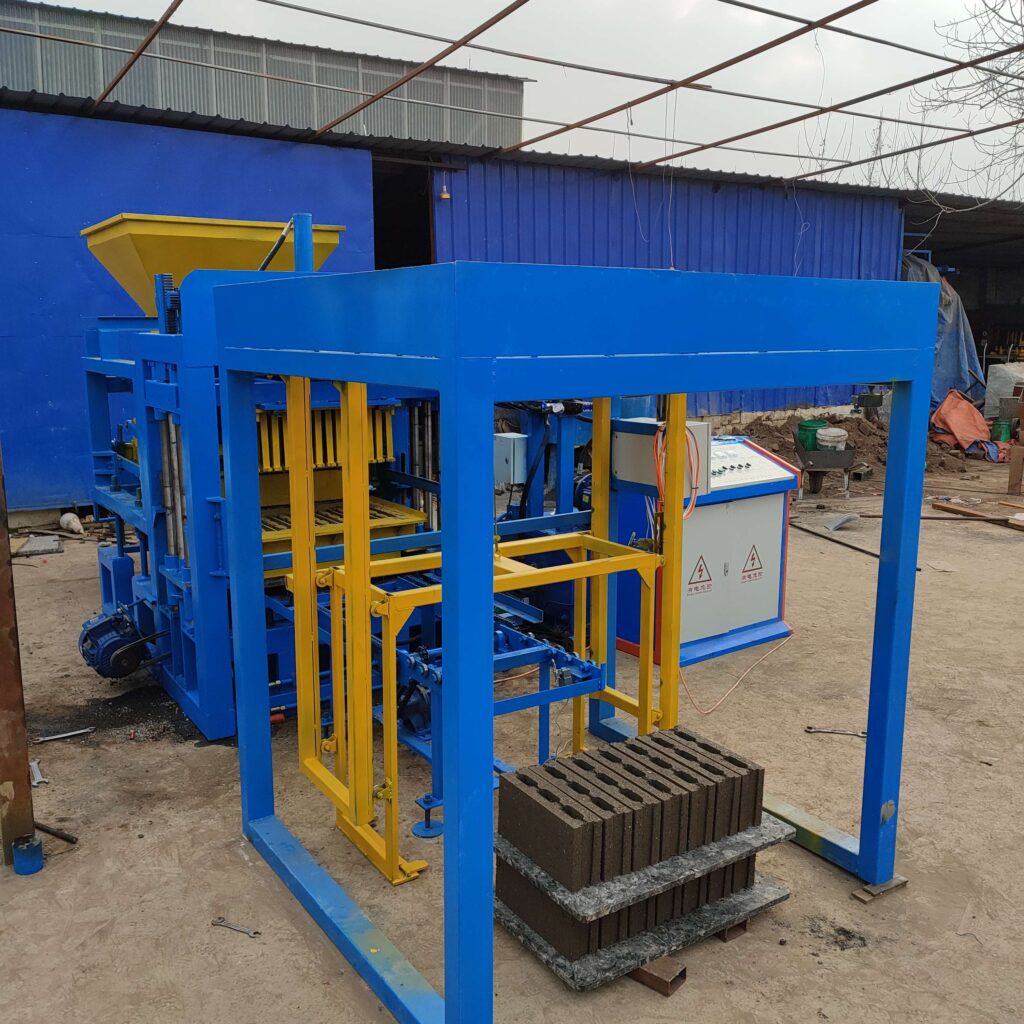
핵심 생산 철학: 고밀화 및 성형
본질적으로, 블록 벽돌 제조 기계는 입자 상태의 혼합물을 미리 정해진 모양과 크기의 밀집된 고체 덩어리로 압축하는 원리로 작동합니다. 최종 제품의 품질은 원료 구성, 가해지는 압축력, 그리고 금형의 정밀도에 직접적으로 좌우됩니다.
- 원료 배합의 중요성화재를 통한 화학적 결합에 의존하는 공정과 달리, 이들 기계는 일반적으로 "반건조" 콘크리트 혼합물을 사용합니다. 표준 구성은 결합재(보통 시멘트나 석회), 골재(모래, 돌가루 또는 자갈 등), 그리고 잠재적인 보충 시멘트 재료(플라이애시나 슬래그 같은)를 포함합니다. 이 혼합물의 수분 함량은 세심하게 조절됩니다—물이 너무 적으면 결합재가 활성화되지 않고, 너무 많으면 블록이 성형 후 변형됩니다. 최적의 혼합은 금형에 달라붙지 않으면서 최대의 다짐성을 달성합니다.
- 압축 역학: 압력과 진동기계 작동의 핵심은 압축 시스템에 있습니다. 고급 기계는 이중 메커니즘을 사용하는데, 상부에서 강력한 유압과 몰드 테이블에서의 고주파 진동을 동시에 적용합니다. 압력은 혼합물을 다져 공극을 제거하고 밀도를 높이는 반면, 진동은 재료를 유동화시켜 몰드 캐비티의 모든 구석으로 원활하게 흐르게 합니다. 이 조합은 날카로운 모서리, 균일한 밀도, 그리고 생산 직후 바로 취급할 수 있는 높은 초기 "생강도"를 가진 블록을 생산하는 데 결정적입니다.
1.2 자동화의 스펙트럼: 수동에서 완전 통합 시스템까지
"블록 벽돌 건축 기계"라는 용어는 넓은 기술적 범위를 설명하며, 각 계층은 서로 다른 자본 규모와 생산 목표에 맞춰져 있습니다.
- 수동 및 반자동 기계:이것이 해당 기술의 진입점입니다. 수동 기계는 작업자가 프레스 메커니즘을 조작하여 한 번에 하나의 블록을 생산합니다. 반자동 버전은 작업자가 작동하는 유압 프레스를 사용하지만, 공급과 블록 제거는 여전히 수동일 수 있습니다. 이들은 초기 투자 비용이 낮고 소규모 또는 지역사회 주도 프로젝트에 적합하지만, 낮은 생산량, 높은 노동 강도, 그리고 일관되지 않은 제품 품질이라는 단점이 있습니다.
- 완전 자동 기계:이것은 상업적 생산을 위한 업계 표준입니다. 이러한 시스템은 프로그램 가능 논리 컨트롤러(PLC)가 전체 사이클을 조율하는 통합 장치로, 자동 재료 배합 및 혼합, 호퍼로의 컨베이어 기반 혼합물 공급, 금형의 정밀 충전, 동시 다짐 및 진동, 완성된 블록의 배출, 적층 또는 양생 영역으로의 자동 이송을 포함합니다. 인적 개입은 모니터링과 유지보수로 제한되어, 교대당 수천 개의 블록을 생산할 수 있으며 놀라운 일관성을 보입니다.
- 완전 통합 생산 공장:자동화의 정점에는 완전 자동화 공장이 있습니다. 이 공장들은 단순히 블록 성형기를 포함하는 것을 넘어, 모든 부대 시스템을 통합합니다. 여기에는 시멘트와 플라이 애시를 위한 자동화 실로, 골재를 위한 컨베이어 벨트, 컴퓨터화된 배칭 시스템, 산업용 믹서, 블록을 양생 카트에 쌓는 로봇 팔레타이저, 그리고 온도와 습도를 제어하여 강도 발현을 가속화하는 자동화 양생실이 포함됩니다. 이러한 공장들은 효율성, 생산량, 품질 관리의 최고점을 보여줍니다.
제품 유니버스: 솔루션 구축의 다재다능함
이러한 기계의 진정한 가치는 단순히 금형을 교체함으로써 다양한 건설 제품 포트폴리오를 생산할 수 있는 능력에 있습니다. 이러한 다용도성은 제조업체가 여러 시장 부문에 동시에 서비스를 제공할 수 있게 해줍니다.
2.1 표준 고형 및 중공 블록
산업의 주력 제품으로, 저층 건물의 내력벽부터 골조 구조물의 채움벽에 이르기까지 모든 곳에 사용됩니다. 홀록 블록은 무게와 재료 비용을 줄이면서도 고유의 단열 기능을 제공합니다.
2.2 Pavers and Landscape Products
These include interlocking concrete pavers for roads, driveways, and walkways, as well as retaining wall blocks and landscaping bricks. This segment often commands higher profit margins and requires machines capable of high-vibration and high-pressure for dense, durable, and aesthetically pleasing products.
2.3 Specialized Masonry Units
- 인터로킹 블록: Designed with profiled edges that lock together without mortar, enabling rapid, dry-stack construction for walls with excellent seismic resistance.
- Cellular Lightweight Blocks: Produced using a specialized mix that includes a foaming agent, these blocks are lightweight, offering superior thermal and acoustic insulation. Their production requires specific machine adaptations.
- Curved and Architectural Blocks: For aesthetic applications, machines can be fitted with molds to produce blocks for decorative walls, arches, and other architectural features.
Strategic Imperatives for Distribution and Procurement
3.1 Quantifying the Value Proposition for End-Users
For your clients, the investment in a block brick building machine is justified by a clear and compelling financial and operational calculus.
- Unmatched Economic Velocity: The production capacity of an automatic machine can be 10 to 50 times that of a manual operation. This high-volume output enables manufacturers to secure large contracts, achieve economies of scale, and realize a rapid return on investment. The reduction in labor costs further accelerates the payback period.
- Assured Quality and Regulatory Compliance: Machine-made blocks guarantee dimensional consistency, which translates to faster bricklaying, reduced mortar consumption, and lower skilled labor requirements. The controlled production process ensures that every batch meets or exceeds the compressive strength standards mandated by national building codes, a critical factor for structural integrity and market acceptance.
- Operational Independence and Supply Chain Resilience: By establishing their own production facility, construction companies or entrepreneurs gain independence from volatile market prices and unreliable supply chains for bricks. They can produce on-demand, reducing inventory costs and ensuring a consistent supply for their projects.
3.2 Critical Technical Evaluation for Procurement
Selecting the right machine requires a meticulous assessment of technical specifications against market demands.
- Production Capacity Analysis: Move beyond simple “blocks per hour” claims. Evaluate the cycle time for the specific block type the client intends to produce most frequently. Calculate the potential output in cubic meters of concrete per day, as this is a more universal metric for comparing different machines and product mixes.
- Core System Robustness: Scrutinize the heart of the machine. The hydraulic system should be powerful, reliable, and energy-efficient (preferably with variable frequency drives). The vibration system should have multiple, balanced motors capable of delivering high-frequency vibrations for optimal compaction. The mold frame and pressing head must be constructed from high-grade, wear-resistant steel to maintain precision over thousands of cycles.
- After-Sales Ecosystem: The machine’s value is inextricably linked to the support behind it. A supplier must offer comprehensive training, a readily available inventory of critical spare parts (mold liners, hydraulic seals, vibration motors), and access to responsive technical support, ideally with remote diagnostics capabilities. The availability of detailed technical documentation is non-negotiable.
Conclusion: Positioning at the Forefront of Industrialized Construction
The block brick building machine is far more than a piece of factory equipment; it is the cornerstone of a more efficient, resilient, and accessible model of construction. It democratizes the production of high-quality building materials, empowering local businesses and driving regional development. For the astute distributor and procurement specialist, this technology represents a dynamic and high-growth market segment.
Success in this field demands a strategic partnership with manufacturers who demonstrate unwavering commitment to engineering excellence and customer success. By providing your clients with not just a machine, but a comprehensive business solution—including technical guidance on mix design, plant layout, and market strategy—you elevate your role from a vendor to an indispensable partner in their growth. The future of construction is prefabricated, standardized, and locally produced, and the block brick building machine is the vehicle to that future.
자주 묻는 질문 (FAQ)
Q1: What is the fundamental difference between a block making machine and a brick making machine?
A: The terms are often used interchangeably, but a key distinction lies in the product size and the machine’s power. “Block making machines” are generally heavier, more powerful units designed to produce larger concrete masonry units (CMUs), like hollow blocks, which are typically 8x8x16 inches in nominal size. “Brick making machines” may refer to equipment producing smaller, solid units akin to traditional clay bricks. However, most modern automatic machines are versatile and can produce both, depending on the mold installed.
Q2: How long does it take for machine-made blocks to cure and gain full strength?
A: While blocks gain enough “green strength” from high-pressure compaction to be handled within minutes, they require a curing period to achieve their specified compressive strength. With proper water curing or steam curing, blocks can achieve over 70% of their final strength within 3-7 days. Full strength (100%) is typically attained after 28 days, in line with standard concrete curing practices.
Q3: Can these machines use local soil or clay as a primary raw material?
A: While specialized machines exist for compressed earth blocks (CEBs), the vast majority of commercial block brick building machines are designed for a concrete-based mix requiring cement as a binder. Local soil can sometimes be incorporated as a partial aggregate replacement, but its properties must be tested. The standard and most reliable raw materials remain cement, sand, and stone aggregates.
Q4: What is the single most important factor for achieving high-quality blocks?
A: Consistency. This applies to three areas: a consistent and well-graded raw material mix, a consistent moisture content in that mix, and a consistent compaction force and vibration time from the machine. Any variation in these parameters will directly lead to variations in the block’s weight, density, strength, and appearance.
Q5: What level of technical expertise is required to operate and maintain an automatic machine?
A: For daily operation, a competent operator with basic literacy and mechanical aptitude can be trained to run the machine via the user-friendly PLC interface. However, for maintenance and troubleshooting, a more skilled technician is required. The machine supplier should provide training covering daily operation, routine maintenance (greasing, cleaning, inspection), and basic electrical and hydraulic troubleshooting.
Q6: How should a client prepare their site for installing a medium-to-large automatic machine?
A: Site preparation is critical for stability and performance. Key requirements include:
- A Level, Reinforced Concrete Foundation: Designed to absorb the dynamic loads and vibrations of the machine.
- Adequate Space: A covered production area for the machine and auxiliary equipment (mixer, conveyor, curing racks).
- Robust Utilities: A stable and powerful three-phase electrical connection and a reliable source of clean water for the mixing process.
- Raw Material Storage: Designated, organized areas for storing cement (in silos or a dry place), aggregates, and other materials.
