
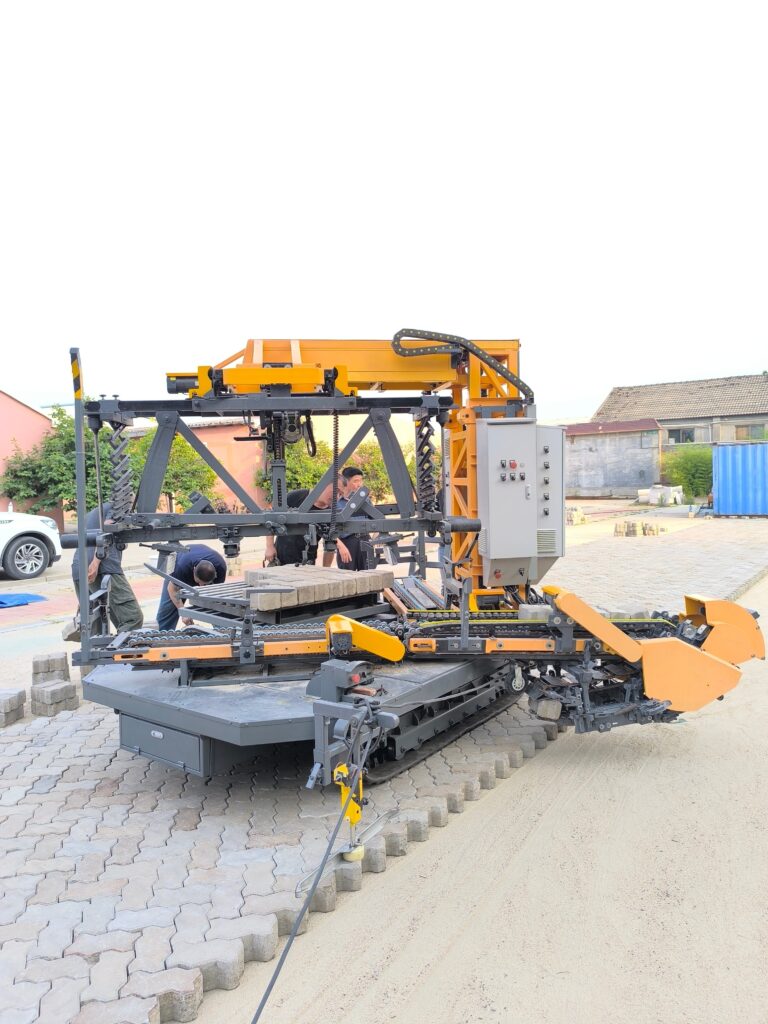
Le Cadre Opérationnel des Machines d'Impression de Briques en Bloc
La machinerie d'impression de briques modulaires est un système intégré conçu pour automatiser le dépôt précis de béton ou de mortier afin de former des éléments de construction couche par couche. Contrairement aux méthodes traditionnelles, ce processus est contrôlé numériquement, offrant une précision et une flexibilité inégalées.
1. Architecture du système central
La machinerie est construite sur une intégration synergique de plusieurs sous-systèmes sophistiqués qui œuvrent de concert pour transformer une conception numérique en une structure physique.
- 3.1. Le contrôle central et l'interface logicielle
Au cœur de chaque système d'impression se trouve une puissante unité de commande numérique par ordinateur (CNC) pilotée par un logiciel spécialisé. Ce logiciel sert de centre de commande, où les modèles numériques (généralement aux formats STL ou G-code) sont importés, mis à l'échelle et découpés en fines couches horizontales. Le logiciel génère ensuite les trajectoires d'outil et les instructions précises pour le mouvement de l'imprimante, le débit de matériau et la vitesse de la buse, garantissant que la sortie physique correspond parfaitement au plan numérique. - 3.2. Le système de manutention et de mélange des matériaux
Un approvisionnement constant et fiable en matériau est primordial. Ce système comprend un silo à haute capacité pour stocker le mélange sec (un mélange spécialisé de ciment, de granulats et d'additifs) et une unité de malaxage intégrée. Le matériau sec est automatiquement transporté vers le mélangeur, où de l'eau et d'autres additifs liquides sont introduits pour créer une pâte homogène et pompable. Des mélangeurs continus sont souvent utilisés pour assurer un flux ininterrompu de matériau, ce qui est essentiel pour des impressions à grande échelle et sans interruption. - 3.3. Le système de positionnement robotique
La tête d'impression est montée sur un système de positionnement robuste qui définit l'espace de travail de la machine. Deux configurations principales dominent le marché :- Systèmes de portique :Ces derniers présentent un cadre rigide qui déplace la tête d'impression le long des axes X, Y et Z au-dessus d'un lit d'impression fixe. Les systèmes à portique sont réputés pour leur stabilité et leur capacité à produire de grandes structures lourdes avec une haute précision.
- Systèmes de bras robotiquesUn bras robotique multi-axes de qualité industrielle offre une plus grande flexibilité et une plus grande enveloppe de travail par rapport à son empreinte au sol. Il peut créer des géométries non planes plus complexes et est souvent utilisé pour des caractéristiques architecturales complexes.
2. Le processus d'impression : du fichier numérique au bloc physique
The actual printing process is a meticulous, layer-by-layer additive manufacturing sequence.
- 3.1. Substrate Preparation and Calibration
Before printing commences, the build platform or print bed must be perfectly leveled. The printing system often performs an automated calibration routine to ensure the first layer adheres correctly. A release agent may be applied to the bed to facilitate easy demolding of the finished product. - 3.2. Material Extrusion and Nozzle Technology
The prepared mix is pumped from the mixer through high-pressure hoses to the print head. The print head is equipped with a extrusion nozzle, whose diameter can often be changed to achieve different print resolutions and bead widths. A precision servo-motor or peristaltic pump controls the extrusion rate, ensuring it is perfectly synchronized with the print head’s movement to deposit a continuous, consistent bead of material. - 3.3. Layer-by-Layer Fabrication and Curing
The printer deposits the first layer according to the toolpath. Subsequent layers are then built upon the previous ones. The specific material mix is engineered to possess thixotropic properties—it flows easily under pressure during extrusion but sets almost immediately afterward to support the weight of the layers above. This inter-layer adhesion is critical for the structural integrity of the final block or brick.
3. Key Technological Features and Innovations
Modern block brick printers incorporate several advanced features that differentiate them from conventional manufacturing equipment.
- 3.1. Real-Time Monitoring and Closed-Loop Control
High-end systems are equipped with an array of sensors that monitor material pressure, flow rate, print head position, and environmental conditions. This data is fed back to the central control system in a closed-loop, allowing for real-time adjustments. If a deviation is detected, the system can automatically compensate, ensuring consistent quality throughout the print job. - 3.2. Multi-Material and Color Printing Capabilities
Some advanced printers are designed with multiple material delivery systems. This allows for the simultaneous printing of different concrete mixes or the incorporation of color pigments into specific layers or sections of the design. This capability opens up new markets in architectural facades and custom decorative elements. - 3.3. Integrated Curing Systems
To accelerate the initial setting and achieve early-age strength, some printing cells are equipped with integrated curing systems. These can include misting nozzles that spray a fine curing compound or controlled environmental chambers that maintain optimal temperature and humidity, reducing the time between printing and handling.
Strategic Commercial Implications for Distributors and Procurement Agents
Adopting or sourcing from block brick printing technology presents a paradigm shift with distinct competitive advantages for your business.
- Unprecedented Design Freedom and Customization: This is the most significant value proposition. You can offer clients fully customized bricks, blocks, and architectural elements with complex geometries, internal channels, and bespoke textures that are impossible or prohibitively expensive to produce with traditional molds. This allows you to move beyond commodity products into high-margin, specialized markets.
- Radical Reduction in Lead Times and On-Demand Production: The digital workflow eliminates the need for expensive and time-consuming mold fabrication. A design can be sent to the printer and produced within hours. This enables a just-in-time manufacturing model, reducing inventory costs and allowing you to respond with agility to client requests and urgent project timelines.
- Minimized Material Waste and Sustainable Operations: Additive manufacturing is inherently a low-waste process. Material is deposited only where needed, drastically reducing scrap compared to subtractive methods. This aligns with the growing global demand for sustainable construction practices and can be a powerful marketing tool.
- Labor Optimization and Reduced Skill Dependency: The printing process is highly automated, requiring minimal human intervention for operation. This reduces dependency on highly skilled laborers for complex forming tasks and mitigates risks associated with labor shortages, while also enhancing overall site safety.
- Supply Chain Consolidation and Localized Production: The compact nature of some printing systems allows for the establishment of small-scale, localized production facilities. This can drastically reduce transportation costs and logistics complexity, enabling you to serve regional markets more efficiently and resiliently.
Conclusion
Block brick printing machinery is not merely an incremental improvement; it is a disruptive force redefining the very nature of masonry unit manufacturing. For forward-thinking distributors and procurement agents, this technology represents a gateway to new business models, elevated product offerings, and a strengthened competitive stance. The ability to provide customized, high-quality, and sustainably produced building components on demand aligns perfectly with the future trajectory of the construction industry. By developing a deep expertise in this field and strategically incorporating printed products into your portfolio, you position your organization not just as a supplier, but as an innovative partner in construction, ready to meet the challenges and opportunities of the 21st century.
Foire aux questions (FAQ)
Q1: What types of materials can be used with these printing machines?
A : The primary material is a specialized cement-based mix, often referred to as a “printable mortar” or “concrete ink.” These mixes are engineered with specific additives to control setting time, workability, and green strength. Research is ongoing into incorporating recycled materials and geopolymers to enhance sustainability.
Q2: What is the typical build volume or maximum product size achievable?
A : Build volumes vary significantly by machine model. Gantry systems can have print envelopes exceeding 10 meters in length and 5 meters in width and height, capable of producing large walls or multiple blocks simultaneously. Robotic arms may have a smaller footprint but a larger spherical work envelope, ideal for complex, free-form structures.
Q3: How does the structural strength of a printed block compare to a traditionally molded one?
A : When using properly formulated materials, printed blocks can achieve compressive strengths comparable to or even exceeding those of traditional high-grade concrete blocks. The layer-by-layer process can create anisotropic strength properties, but this is accounted for in the structural design and mix formulation.
Q4: What is the learning curve for operating this type of machinery?
A : Operating the machine itself is designed to be user-friendly, with intuitive software interfaces. However, the core expertise lies in mastering the digital design (CAD) for printability and understanding the material science behind the mixes. Comprehensive training from the equipment provider is essential, and many operators become proficient within a few weeks.
Q5: Can these machines print entire buildings, or are they just for components?
A : The technology exists on a spectrum. The machinery described here is primarily for manufacturing individual blocks, bricks, and prefabricated panels. Separate, larger-scale “contour crafting” systems are designed to print entire building shells on-site. The block printing approach offers more control and is better suited for integration into standard supply chains.
Q6: What are the primary operational costs associated with running this equipment?
A : The key operational costs include:
- Matériaux bruts : The cost of the specialized printable mix.
- Consommation d'énergie : Significant electricity usage from the robotic system, mixer, and pump.
- Entretien : Regular servicing of the pump, hoses, nozzle, and robotic positioning system.
- Software Licenses: Ongoing subscriptions for the proprietary printing software.
- Main-d'œuvre : Skilled technicians for machine operation and monitoring.
