
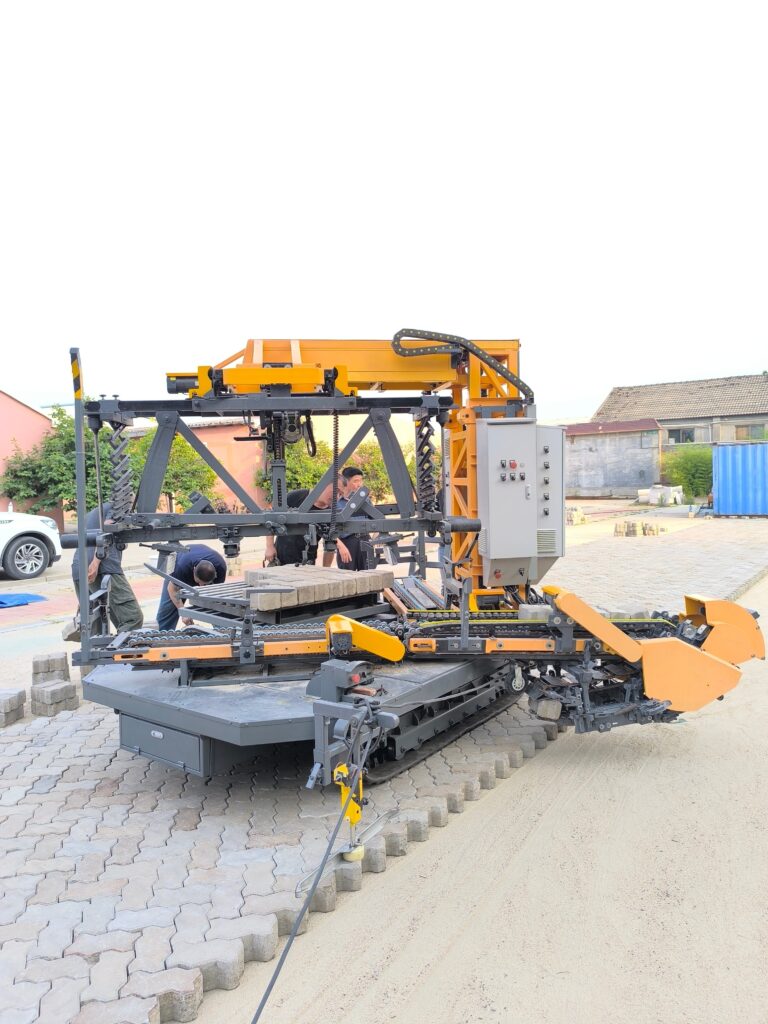
Tsarin Aiki na Injin Bugun Tubalin Block
Injin buga bulo wani tsari ne na hada-hada wanda aka tsara don sarrafa aikin zubar da siminti ko turmi daidai don samar da abubuwan gini a jere. Ba kamar hanyoyin gargajiya ba, wannan tsari yana sarrafa ta hanyar dijital, yana ba da daidaito da sassauci mara misaltuwa.
1. Tsarin Tsarin Tsakiya
Kayan aikin an gina su ne bisa haɗin kai na tsarin ƙananan tsarin da yawa waɗanda ke aiki tare don canza ƙirar dijital zuwa tsarin zahiri.
- 3.1. Tsarin Gudanarwa ta Tsakiya da Mu'amalar Software
A tsakiyar kowane tsarin bugawa akwai ingantaccen na'ura mai sarrafa lambobi ta kwamfuta (CNC) wanda ke aiki ta hanyar software na musamman. Wannan software yana aiki azaman cibiyar umarni, inda ake shigo da samfuran dijital (yawanci a cikin tsarin STL ko G-code), awo, da rarraba su zuwa siraran yadudduka a kwance. Daga nan sai software ya samar da takamaiman hanyoyin kayan aiki da umarni don motsin firinta, yawan kwararar kayan, da saurin bututun fitarwa, yana tabbatar da cewa abin da aka buga ya yi daidai da tsarin dijital. - 3.2. Tsarin Sarrafa Kaya da Hadawa
Samfurin kayan aiki mai dorewa da dogaro yana da muhimmanci. Wannan tsarin ya ƙunshi babban rumbun ajiya don adana busasshen haɗi (iri na musamman da aka haɗa da siminti, tarkace, da kayan ƙara) da na'urar haɗawa mai haɗi. Ana tura busasshen kayan aikin ta atomatik zuwa injin hadawa, inda ruwa da sauran ruwan ƙara suke shiga don samar da manna mai daidaitacce da kuma mai zuga. Ana yawan amfani da masu haɗawa na ci gaba don tabbatar da gudun kayan aikin ba tare da tsayawa ba, wanda ke da muhimmanci ga manyan ayyuka na buga abubuwa ba tare da katsewa ba. - 3.3. Tsarin Matsayin Robotic
Mashin ɗin bugun yana kan tsarin sakawa mai ƙarfi wanda ke tsara iyakar aikin injin ɗin. Tsari mai mahimmanci guda biyu ne suka mamaye kasuwa:- Tsarin GantryWaɗannan sun ƙunshi firam mai tsauri wanda ke motsa kan bugu ta hanyoyin X, Y, da Z akan gadon bugu na tsaye. Tsarin gantry ya shahara saboda kwanciyarsu da ikon samar da manyan gine-gine masu nauyi tare da ingantacciyar daidaito.
- Tsarin Hannun Mutum-mutumiNa'urar hannu robotic mai yawan gatari na masana'antu tana ba da sassauci mai yawa da fa'idar aiki mai girma dangane da sawun ta. Tana iya ƙirƙirar siffofi masu rikitarwa, marasa fadi, kuma galibi ana amfani da ita don abubuwan gine-gine masu sarkakiya.
2. Tsarin Bugawa: Daga Fayil ɗin Dijital zuwa Bulogi na Jiki
The actual printing process is a meticulous, layer-by-layer additive manufacturing sequence.
- 3.1. Substrate Preparation and Calibration
Before printing commences, the build platform or print bed must be perfectly leveled. The printing system often performs an automated calibration routine to ensure the first layer adheres correctly. A release agent may be applied to the bed to facilitate easy demolding of the finished product. - 3.2. Material Extrusion and Nozzle Technology
The prepared mix is pumped from the mixer through high-pressure hoses to the print head. The print head is equipped with a extrusion nozzle, whose diameter can often be changed to achieve different print resolutions and bead widths. A precision servo-motor or peristaltic pump controls the extrusion rate, ensuring it is perfectly synchronized with the print head’s movement to deposit a continuous, consistent bead of material. - 3.3. Layer-by-Layer Fabrication and Curing
The printer deposits the first layer according to the toolpath. Subsequent layers are then built upon the previous ones. The specific material mix is engineered to possess thixotropic properties—it flows easily under pressure during extrusion but sets almost immediately afterward to support the weight of the layers above. This inter-layer adhesion is critical for the structural integrity of the final block or brick.
3. Key Technological Features and Innovations
Modern block brick printers incorporate several advanced features that differentiate them from conventional manufacturing equipment.
- 3.1. Real-Time Monitoring and Closed-Loop Control
High-end systems are equipped with an array of sensors that monitor material pressure, flow rate, print head position, and environmental conditions. This data is fed back to the central control system in a closed-loop, allowing for real-time adjustments. If a deviation is detected, the system can automatically compensate, ensuring consistent quality throughout the print job. - 3.2. Multi-Material and Color Printing Capabilities
Some advanced printers are designed with multiple material delivery systems. This allows for the simultaneous printing of different concrete mixes or the incorporation of color pigments into specific layers or sections of the design. This capability opens up new markets in architectural facades and custom decorative elements. - 3.3. Integrated Curing Systems
To accelerate the initial setting and achieve early-age strength, some printing cells are equipped with integrated curing systems. These can include misting nozzles that spray a fine curing compound or controlled environmental chambers that maintain optimal temperature and humidity, reducing the time between printing and handling.
Strategic Commercial Implications for Distributors and Procurement Agents
Adopting or sourcing from block brick printing technology presents a paradigm shift with distinct competitive advantages for your business.
- Unprecedented Design Freedom and Customization: This is the most significant value proposition. You can offer clients fully customized bricks, blocks, and architectural elements with complex geometries, internal channels, and bespoke textures that are impossible or prohibitively expensive to produce with traditional molds. This allows you to move beyond commodity products into high-margin, specialized markets.
- Radical Reduction in Lead Times and On-Demand Production: The digital workflow eliminates the need for expensive and time-consuming mold fabrication. A design can be sent to the printer and produced within hours. This enables a just-in-time manufacturing model, reducing inventory costs and allowing you to respond with agility to client requests and urgent project timelines.
- Minimized Material Waste and Sustainable Operations: Additive manufacturing is inherently a low-waste process. Material is deposited only where needed, drastically reducing scrap compared to subtractive methods. This aligns with the growing global demand for sustainable construction practices and can be a powerful marketing tool.
- Labor Optimization and Reduced Skill Dependency: The printing process is highly automated, requiring minimal human intervention for operation. This reduces dependency on highly skilled laborers for complex forming tasks and mitigates risks associated with labor shortages, while also enhancing overall site safety.
- Supply Chain Consolidation and Localized Production: The compact nature of some printing systems allows for the establishment of small-scale, localized production facilities. This can drastically reduce transportation costs and logistics complexity, enabling you to serve regional markets more efficiently and resiliently.
Ƙarshe
Block brick printing machinery is not merely an incremental improvement; it is a disruptive force redefining the very nature of masonry unit manufacturing. For forward-thinking distributors and procurement agents, this technology represents a gateway to new business models, elevated product offerings, and a strengthened competitive stance. The ability to provide customized, high-quality, and sustainably produced building components on demand aligns perfectly with the future trajectory of the construction industry. By developing a deep expertise in this field and strategically incorporating printed products into your portfolio, you position your organization not just as a supplier, but as an innovative partner in construction, ready to meet the challenges and opportunities of the 21st century.
Tambayoyin da ake yawan yi (FAQ)
Q1: What types of materials can be used with these printing machines?
A: The primary material is a specialized cement-based mix, often referred to as a “printable mortar” or “concrete ink.” These mixes are engineered with specific additives to control setting time, workability, and green strength. Research is ongoing into incorporating recycled materials and geopolymers to enhance sustainability.
Q2: What is the typical build volume or maximum product size achievable?
A: Build volumes vary significantly by machine model. Gantry systems can have print envelopes exceeding 10 meters in length and 5 meters in width and height, capable of producing large walls or multiple blocks simultaneously. Robotic arms may have a smaller footprint but a larger spherical work envelope, ideal for complex, free-form structures.
Q3: How does the structural strength of a printed block compare to a traditionally molded one?
A: When using properly formulated materials, printed blocks can achieve compressive strengths comparable to or even exceeding those of traditional high-grade concrete blocks. The layer-by-layer process can create anisotropic strength properties, but this is accounted for in the structural design and mix formulation.
Q4: What is the learning curve for operating this type of machinery?
A: Operating the machine itself is designed to be user-friendly, with intuitive software interfaces. However, the core expertise lies in mastering the digital design (CAD) for printability and understanding the material science behind the mixes. Comprehensive training from the equipment provider is essential, and many operators become proficient within a few weeks.
Q5: Can these machines print entire buildings, or are they just for components?
A: The technology exists on a spectrum. The machinery described here is primarily for manufacturing individual blocks, bricks, and prefabricated panels. Separate, larger-scale “contour crafting” systems are designed to print entire building shells on-site. The block printing approach offers more control and is better suited for integration into standard supply chains.
Q6: What are the primary operational costs associated with running this equipment?
A: The key operational costs include:
- Kayan Aiki: The cost of the specialized printable mix.
- Amfani da Makamashi: Significant electricity usage from the robotic system, mixer, and pump.
- Maintenance: Regular servicing of the pump, hoses, nozzle, and robotic positioning system.
- Software Licenses: Ongoing subscriptions for the proprietary printing software.
- Aiki Skilled technicians for machine operation and monitoring.
