
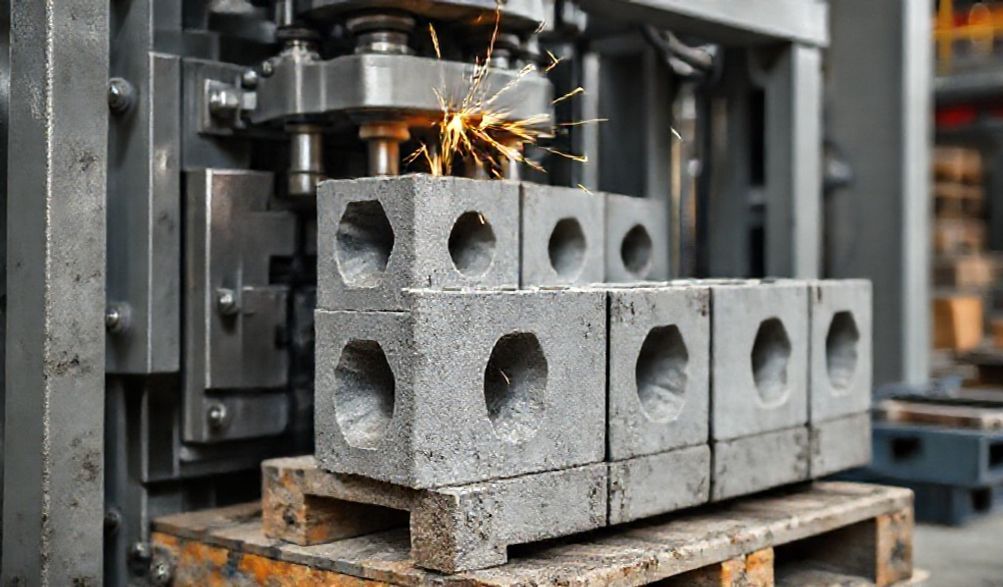
Le Guide Ultime des Machines à Fabriquer les Blocs de Béton Creux : Sélection, Fonctionnement et Coût
Introduction
L'industrie mondiale de la construction est dans une course perpétuelle pour équilibrer coût, rapidité et durabilité. Au cœur de ce défi se trouve un besoin fondamental : des matériaux de construction abordables et fiables. Entrez en scène le modeste bloc de béton creux — une pierre angulaire de la maçonnerie moderne qui offre résistance, efficacité thermique et économie de matériaux. Mais derrière chaque bloc uniforme et de haute qualité se trouve une machine conçue pour la précision et la productivité. Pour les constructeurs, les entrepreneurs et les chefs d'entreprise, choisir la bonne machine à fabriquer des blocs de béton creux n'est pas seulement un achat ; c'est un investissement crucial pour l'avenir de vos projets ou de votre entreprise.
Ce guide définitif est conçu de fond en comble pour être votre ressource de confiance. Nous avons synthétisé les spécifications de l'industrie, les principes fondamentaux du génie mécanique et les meilleures pratiques opérationnelles acquises par l'expérience pour percer le bruit marketing. Les perspectives présentées ici sont tirées de paramètres réels de conception de machines, d'études de cas de lignes de production et de protocoles de maintenance qui définissent la réussite dans la fabrication pour la construction.
Notre objectif est clair : vous doter d'un cadre complet et fiable pour comprendre, choisir et utiliser une machine à fabriquer des blocs de béton creux. Que vous évaluiez un projet à petite échelle ou que vous développiez une usine de grande envergure, ce guide vous aidera à garantir que votre investissement est éclairé, votre production est efficace et vos résultats sont rentables.
Nous allons aborder :
* Les mécanismes fondamentaux et les avantages de la production de blocs creux.
* Une ventilation détaillée des types de machines, de manuelles à entièrement automatiques.
* Caractéristiques essentielles à examiner avant l'achat.
* Meilleures pratiques d'exploitation et de maintenance pour maximiser la durée de vie des machines.
* Une analyse transparente des coûts et du retour sur investissement pour étayer votre planification commerciale.
Comprendre les machines à fabriquer les blocs de béton creux
Avant de plonger dans les spécifications et les fournisseurs, il est crucial de comprendre ce que ces machines font et pourquoi leur produit est si précieux dans la construction contemporaine.
Qu'est-ce qu'une machine à fabriquer des blocs de béton creux?
Une machine à fabriquer des blocs de béton creux est un système mécanisé conçu pour automatiser le moulage du béton en blocs creux standardisés. Elle remplace les méthodes manuelles laborieuses et inconstantes par un procédé qui garantit l'uniformité, la densité et l'intégrité structurelle grâce à une vibration et une pression contrôlées.
Le processus de production central suit généralement les étapes suivantes :
1. Alimentation :Les matières premières (ciment, sable, granulats) sont chargées dans une trémie.
2. Mélange :Les matériaux sont mélangés avec de l'eau pour obtenir un mélange de béton homogène et semi-sec.
3. Moulage:Le mélange est introduit dans une cavité de moule sur une table vibrante.
4. Compactage :Les vibrations à haute fréquence, souvent combinées à une pression hydraulique ou mécanique, éliminent les poches d'air et compactent le béton de manière dense.
5. Éjection et durcissement :Le bloc nouvellement formé est éjecté sur une palette ou au sol pour commencer le processus de durcissement critique, où il acquiert sa résistance.
Pourquoi les blocs creux? Avantages dans la construction moderne
La conception des blocs creux n'est pas arbitraire; elle procure des avantages techniques et économiques tangibles qui expliquent leur popularité.Maçonnerie porteuseet les murs de remplissage.
- Efficacité des matériaux et rentabilitéLes noyaux creux réduisent le volume de béton requis par bloc, ce qui diminue les coûts des matériaux et la charge morte globale d'une structure.
- Isolation thermique et acoustique :Les poches d'air à l'intérieur des blocs créent des barrières naturelles contre la chaleur et le son, contribuant à des bâtiments plus économes en énergie et plus silencieux.
- Efficacité de la construction :Les vides offrent des canaux pratiques pour le passage des conduits électriques, des tuyaux de plomberie et des barres d'armature, ce qui accélère considérablement le processus de construction.
- Charge structurelle réduite :Leur poids plus léger par rapport aux blocs solides permet des conceptions de fondations plus légères et plus économiques.
Composants principaux et leur fonctionnement
Understanding the key components demystifies the machine and aids in troubleshooting and purchasing decisions.
- Trémie et Alimentateur : The entry point for raw materials, often equipped with a measuring system for consistent batch sizes.
- Mélangeur: Blends cement, aggregates, and water to the precise consistency required for optimal compaction.
- Moule (ou Meurt): The heart of the machine. This interchangeable steel box defines the block’s size and shape (e.g., 4″, 6″, 8″ blocks). Its quality dictates block finish and longevity.
- Vibrating Table & Press: A motor generates high-frequency vibration transmitted to the mold. In more advanced machines, a hydraulic press applies simultaneous downward pressure. This synergy is critical for achieving high-density, strong blocks.
- Système de contrôle : Ranges from simple lever-operated mechanisms to programmable logic controllers (PLCs) that automate the entire cycle, ensuring repeatability.
- Alimentateur/Convoyeur à palettes: Supplies pallets for the blocks to be cured on (stationary plants) or moves blocks away from the machine.
Types of Concrete Hollow Block Making Machines
The market offers solutions for every scale of operation. Your choice fundamentally impacts your production capacity, labor needs, and capital investment.
Machines manuelles vs semi-automatiques vs entièrement automatiques
| Caractéristique | Machine manuelle | Machine semi-automatique | Machine entièrement automatique |
| :— | :— | :— | :— |
| Capacité de production | Low (200-500 blocks/day) | Medium (1000-3000 blocks/8hr shift) | High (5000-20,000+ blocks/8hr shift) |
| Exigence de main-d'œuvre | High (4-6 people) | Moderate (2-3 people) | Low (1-2 people for monitoring) |
| Investissement initial | Low | Medium | High |
| Niveau d'automatisation | Human-powered operation, manual mixing. | Mechanized vibration and compaction; manual material feeding and block removal. | Fully automated cycle from feeding to block stacking; PLC-controlled. |
| Ideal Use Case | Very small projects, remote sites with no power. | Small-to-medium businesses, startups, block yards. | Large-scale block manufacturing plants, high-volume infrastructure projects. |
Directives : A startup or small contractor might begin with a robust semi-automatic model to balance cost and output. A large developer or dedicated block supplier would prioritize the productivity and consistency of a fully automatic plant setup.
Machines à fabriquer des blocs stationnaires
These are the workhorses of fixed-location block manufacturing plants.
- Description : Heavy-duty, high-output machines installed on a solid concrete foundation. They produce blocks on pallets, which are then moved to curing racks or chambers via forklift or conveyor systems.
- Avantages :
- Highest production output and consistency.
- Superior block density and finish due to powerful, stable vibratory presssystèmes.
- Can be integrated into automated production lines.
- Inconvénients :
- Requires significant space for the machine, curing area, and storage.
- Higher initial capital investment.
- Requires pallets, which add to operational cost and logistics.
Mobile Block Making Machines (Egg-Laying Type)
These machines bring production directly to the job site.
- Description : As the machine operates, it moves forward on rails or wheels, depositing (“laying”) freshly molded blocks directly onto a level ground surface, much like a chicken laying eggs.
- Avantages :
- Eliminates the need for pallets, reducing a major cost component.
- Ideal for on-site production, cutting transport costs for blocks.
- Generally lower initial purchase price than stationary plants.
- Inconvénients :
- More labor-intensive for block handling and ground preparation.
- Production de sortie is typically lower and more weather-dependent.
- Block quality can be more variable due to less controlled curing conditions.
Key Features to Consider When Buying
Looking beyond the basic type, these features will determine your long-term satisfaction and profitability.
Capacité de production (blocs par heure)
Don’t just look at the peak “blocks per hour” rating. Assess the sustainable 8-hour shift output. Calculate your required capacity based on:
* Project Demand: Average blocks needed per day/week for your contracts.
* Business Plan: Sales targets for a block manufacturing business.
* Croissance future : Consider a machine with 20-30% extra capacity to handle growth without immediate reinvestment.
Block Size and Mold Customization
- Tailles standard : Ensure the machine can produce the most in-demand sizes in your market (e.g., 4″, 6″, 8″ thick blocks).
- Moules interchangeables : The ability to quickly swap molds is essential for product diversification. Check the cost and availability of additional molds for pavers, curbstones, or solid blocks.
- Qualité du moule : Opt for hardened steel molds. They resist wear longer, ensuring consistent block dimensions and a smooth finish over thousands of cycles.
Power Source: Electric, Diesel, or Hybrid?
- Électrique : Cleaner, quieter, and lower operating cost per hour. Requires a stable, high-capacity power grid.
- Diesel: Offers complete independence from the grid, crucial for remote sites or regions with frequent power cuts. Higher fuel and maintenance costs.
- Hybride : Offers flexibility to switch between power sources, providing a valuable backup but at a higher purchase price.
Automation Level and Control System
Higher automation directly impacts:
* Cohérence : PLC systems ensure every block receives identical vibration and pressure.
* Réduction des déchets : Precise material measurement minimizes spillage and rejects.
* Labor Skill Requirement: A fully automatic machine reduces physical labor but requires basic technical skills for monitoring and troubleshooting.
Machine Durability and After-Sales Support
This is the most critical factor for fiabilité in your investment.
- Qualité de construction : Inspect the frame and critical components. Are they made from heavy-duty, reinforced steel? Thin-gauge steel will flex and wear quickly.
- Garantie : A reputable supplier will offer a clear, comprehensive warranty (e.g., 1 year on the machine, 6 months on wear parts).
- Support après-vente : C'est non-négociable. Verify:
- Availability of spare parts locally or via fast shipping.
- Provision of detailed operation and maintenance manuals.
- Access to technical support (phone, online, or in-person).
- A common oversight is choosing a cheap machine from a supplier with no local presence, leading to catastrophic downtime when a simple part fails.
Operating and Maintaining Your Machine for Longevity
Your machine’s performance and lifespan are directly tied to how you operate and care for it.
The Production Process: Step-by-Step
- Préparation des matières premières : Use clean, well-graded aggregates. A common starting mix ratio is 1 part cement : 6 parts sand : 4 parts gravel (aggregate). Water should be added to achieve a semi-dry mix that holds its shape when squeezed.
- Operation Cycle: The operator feeds the mix into the machine, initiates the cycle (vibration + compaction), and the block is ejected onto a pallet or the ground.
- Guérison : This is where blocks gain strength. Keep blocks moist and under cover (e.g., with plastic sheeting) for at least 7 days. Steam curing in a chamber can accelerate this to 24 hours for high-strength blocks.
Essential Safety Protocols
- Formation : Never allow untrained personnel to operate the machine.
- Équipement de protection individuelle (EPI) : Mandatory use of safety glasses, gloves, steel-toe boots, and hearing protection.
- Machine Guards: Ensure all moving parts, especially the vibration mechanism and press, are properly guarded. Lock-out/tag-out procedures must be followed for any maintenance.
Routine Maintenance Checklist
Preventive maintenance is far cheaper than emergency repairs.
- Daily: Clean the machine thoroughly at the end of each shift. Check for loose bolts and nuts. Inspect the hydraulic system for leaks.
- Weekly: Lubricate all moving parts as per the manual. Check the oil level in the vibration motor and hydraulic tank. Inspect mold liners for wear.
- Monthly: Tighten all major structural bolts. Check the alignment of the feeding system and conveyor. Test safety interlocks.
Troubleshooting Common Issues
- Poor Block Strength: Usually caused by incorrect water-cement ratio (too much water), insufficient vibration time, or weak concrete mix. Re-calibrate your mix and compaction cycle.
- Surface Cracks: Often due to improper curing (drying too quickly) or excessive vibration. Ensure blocks are kept moist and adjust vibration duration.
- Machine Jams: Caused by overfilling the mold, overly wet concrete, or foreign objects in the mix. Stop the machine, clear the obstruction, and adjust feeding.
Cost Analysis and Return on Investment (ROI)
A clear financial picture separates a hopeful venture from a viable business.
Breaking Down the Investment Cost
- Machine Price: Ranges from ~$5,000 for a basic manual machine to over $100,000 for a high-end fully automatic line.
- Auxiliary Costs: Don’t forget: cost of additional molds ($500-$2,000 each), installation/commissioning fees, and the initial stockpile of raw materials.
Operational Costs: Raw Materials, Labor, and Power
To find your cost per block, track:
* Material Cost: (Cement + Sand + Aggregate) per block.
* Labor Cost: Wages allocated per block produced.
* Utilities & Depreciation: Power/fuel consumption and machine depreciation per block.
* Exemple : If total costs sum to $0.50 per block and you sell it for $0.80, your gross profit margin is $0.30 per block.
Calculating Your Potential ROI
Use this simplified framework:
ROI Timeframe = Total Investment / (Monthly Profit from Block Sales)
Factors dramatically affecting ROI:
* Local Market Demand & Pricing: What is the selling price in your area?
* Efficacité opérationnelle : Can you achieve the machine’s rated output with minimal downtime?
* Échelle: Higher production spreads fixed costs (like labor) over more blocks, increasing profit margin.
A well-run semi-automatic operation in a market with good demand can often see a full return on investment within 12-24 months.
Foire aux questions (FAQ)
Q1: What is the average production capacity of a standard block making machine?
A : Capacity varies wildly. A small semi-automatic machine may produce 1,000-2,000 blocks in an 8-hour shift, while a large fully automatic plant can produce 10,000+. The key is to discuss “sustainable daily output” with your supplier, not peak theoretical capacity.
Q2: Can I produce different block sizes and designs with one machine?
A : Absolutely, through interchangeable molds. This is a major advantage. However, each mold is a separate purchase, and changing molds requires time (from 30 minutes to a few hours), which temporarily halts production.
Q3: What is the ideal concrete mix ratio for strong hollow blocks?
A : A reliable starting point is a 1:6:4 ratio (Cement: Sand: 3/8″ Gravel). However, the “ideal” ratio depends on the quality and properties of your local sand and aggregates. We strongly recommend conducting trial mixes and compression tests to optimize for your specific materials and machine.
Q4: How much space is required to set up a block manufacturing plant?
A : Consider three zones:
1. Production Shed: To house the machine (~300-500 sq. ft.).
2. Curing Area: A covered, level space 4-5 times larger than the production shed for blocks to gain strength.
3. Raw Material & Finished Block Storage: Additional open or covered space.
A micro plant might need 2,000 sq. ft., while a serious operation requires 10,000+ sq. ft.
Q5: How do I choose a reliable machine supplier?
A : This is the most critical step for your fiabilité and success.
* Check History & Reputation: How long has the company been in business? Search for independent reviews or complaints.
* Request Client References: Ask for contacts of past buyers, preferably in your region, and call them.
* Verify Quality Certifications: Do they have ISO or other relevant manufacturing quality certifications?
* Inspect Warranty & Support Terms: Are they clear, fair, and in writing? Is there a local service agent?
* Visit if Possible: If feasible, visit the supplier’s factory or a client’s working plant to see the machine in action. The quality of assembly and customer service will be evident.
Conclusion
Choosing and operating a concrete hollow block making machine is a significant technical and financial decision. The path to success lies in carefully matching the machine type—be it manual, semi-automatic, or fully automatic—to your specific production needs and budget. Prioritizing build quality, mold versatility, and, above all, the after-sales support from your supplier will protect your investment for years to come.
Remember, understanding the true operational costs, from raw materials to preventive maintenance, is just as important as the purchase price. This guide has provided the factual information and operational framework to ground your research.
Your Call to Action: Use this guide as a checklist when evaluating machines and speaking with suppliers. Demand detailed demonstrations, scrutinize warranty documents, and always start with a solid business and production plan. With thorough preparation, your investment in a concrete hollow block making machine can become a cornerstone of your construction efficiency or business growth.
<