
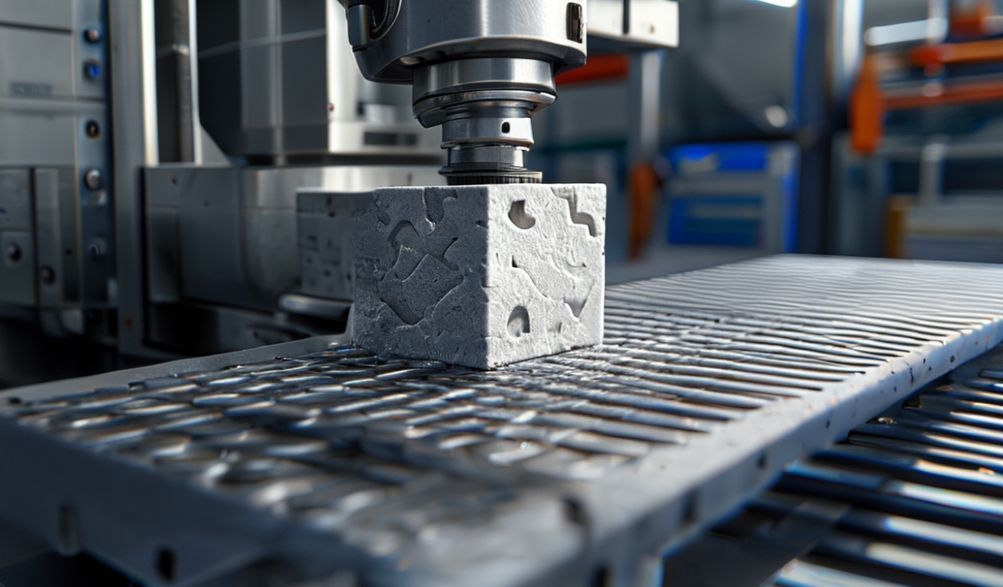
Votre guide complet des machines de fabrication de blocs de béton léger personnalisés
Vous avez du mal avec les coûts d'expédition élevés, la production à forte intensité de main-d'œuvre ou à répondre à des exigences spécifiques de projet pour des blocs légers ? Vous n'êtes pas seul. De nombreux fabricants constatent qu'une machine standard de fabrication de blocs, prête à l'emploi, devient un goulot d'étranglement, incapable de s'adapter à des mélanges de matériaux uniques, des conceptions spécialisées ou des objectifs de production ambitieux. La solution ne réside pas dans une machine générique, mais dans un outil conçu pour votre exploitation exacte : unemachine personnalisée pour la fabrication de blocs de béton légers.
Une machine sur mesure est précisément cela—un équipement industriel conçu de A à Z selon vos besoins de production spécifiques, vos profils de matières premières, vos conceptions de blocs et vos exigences en matière d'automatisation. C'est la différence entre porter un costume prêt-à-porter et un confectionné par un maître tailleur; le premier peut convenir à peu près, mais le second améliore la performance et projette une qualité inégalée.
Ce guide, tiré d'une expérience approfondie de l'industrie, est conçu pour être votre ressource définitive. Nous irons au-delà des brochures commerciales pour fournir des conseils d'experts et exploitables. Notre objectif est d'armer les propriétaires d'entreprise, les chefs de projet et les ingénieurs des connaissances nécessaires pour réaliser un investissement éclairé et en toute confiance. Nous explorerons les avantages transformateurs de la personnalisation, détaillerons les options fondamentales disponibles, décriraons le processus de commande étape par étape, et soulignerons les considérations essentielles pour garantir que votre investissement soit rentable pour les années à venir.
Pourquoi la personnalisation change la donne dans la production de blocs légers
Dans le marché concurrentiel des matériaux de construction, l'efficacité et la différenciation des produits sont primordiales. Une machine standard offre une approche universelle, mais votre entreprise et votre mélange de béton léger sont uniques. La personnalisation comble cet écart, transformant votre chaîne de production d'un centre de coûts en un actif stratégique.
Surmonter les limites des machines standard
Les machines standard sont conçues pour des cas d'utilisation « moyens », ce qui entraîne souvent des frictions opérationnelles importantes.
- Mélanges de matières premières incompatiblesVotre mélange spécifique de ciment, de cendre volante et d'agrégats légers (comme la perlite, la pierre ponce ou la mousse) présente des caractéristiques d'écoulement et de compactage uniques. La fréquence de vibration et la pression d'une machine standard pourraient être optimisées pour le béton ordinaire, ce qui entraînerait un mauvais compactage, une densité incohérente ou une usure excessive lors du traitement de votre mélange plus léger.
- Conception de produit inflexible :Vous avez besoin de créer une forme imbriquée innovante pour les zones sismiques, une taille spéciale pour un système de construction modulaire, ou un bloc de façade texturé ? Les moules standard sont limités. Une machine sur mesure est construite autour de votre moule, garantissant un alignement et un compactage parfaits pour votre design exclusif.
- Décalages de débit :Une machine trop petite crée des goulots d'étranglement dans la production, tandis qu'une machine trop grande représente une dépense en capital gaspillée et des coûts opérationnels plus élevés. Sans personnalisation, vous êtes forcé d'adapter votre entreprise à la capacité de la machine, et non l'inverse.
Principaux avantages d'une machine sur mesure
Investir dans une solution sur mesure aborde ces limitations de front, offrant des avantages tangibles :
- Efficacité et rendement améliorésChaque composant, du cycle de mélangeur au système de retour des palettes, est synchronisé avec vos objectifs de production. Cela élimine les temps d'arrêt, optimise la main-d'œuvre et garantit que vous atteignez vos objectifs de production quotidiens sans avoir à deviner.
- Qualité optimale du produit :Le cœur de la machine – son système de compactage – est conçu pour votre formulation spécifique. Un contrôle précis de l’amplitude des vibrations, de la fréquence et de la pression garantit que chaque bloc présente une densité uniforme, une finition de surface supérieure et atteint la résistance à la compression requise, lot après lot.
- Économies de coûts à long terme :La conception sur mesure réduit les déchets causés par les blocs défectueux, diminue la consommation d'énergie en éliminant les composants surdimensionnés et minimise les temps d'arrêt coûteux dus à l'incompatibilité machine-matériau. C'est un investissement qui porte ses fruits grâce à l'excellence opérationnelle.
- Avantage concurrentiel :Une machine sur mesure vous permet de produire des blocs que d'autres ne peuvent pas fabriquer. Cela vous permet d'obtenir des contrats spécialisés, de commander une prime de prix pour des blocs à haute performance ou architecturalement spécifiques, et de véritablement différencier votre marque sur un marché saturé.
Options de personnalisation de base pour votre machine
Customization is not a vague concept; it’s a series of concrete engineering choices. Understanding these options is the first step in specifying your ideal machine.
Capacité de production et niveau d'automatisation
This is the foundational decision that dictates the machine’s scale and operational philosophy.
- Manuel & Semi-Automatique : Ideal for smaller operations, start-ups, or producing highly specialized, low-volume blocks. Labor-intensive but with a lower initial investment.
- Fully Automatic & PLC-Controlled: The choice for medium to large-scale production. These systems feature automated material batching, mixing, molding, curing, and stacking. A Programmable Logic Controller (PLC) ensures precise, repeatable operations with minimal manual intervention, drastically reducing labor costs and human error.
Mold & Block Design Specifics
This is where your product vision becomes reality. The mold is the soul of your custom machine.
- Size & Shape: Beyond standard CMU sizes, you can specify blocks for insulated concrete forms (ICFs), unique interlocking patterns, landscaping units, or large-format panels.
- Surface Texture: Smooth, split-face, ribbed, or engraved—the mold cavity can be machined to impart the desired aesthetic directly during compaction.
- Mold Material & Precision: High-grade, abrasion-resistant steel with precise CNC machining is critical for block dimensional accuracy, easy demolding, and long mold life, especially with abrasive lightweight aggregates.
Raw Material Processing & Mixing System
Lightweight concrete is sensitive; its preparation cannot be an afterthought.
- Aggregate-Specific Engineering: The feeding system can be customized for different bulk densities. Whether you use expanded clay (LECA), polystyrene beads, or industrial foaming, the machine must handle them without segregation or damage.
- Specialized Mixers: A standard paddle mixer may not suffice. Custom solutions often include high-efficiency pan mixers or forced-action mixers designed to coat lightweight aggregates evenly and create a homogeneous, workable mix without crushing the delicate aggregates.
Machine Specifications & Features
These technical details define the machine’s performance and durability.
- Système de Vibration : The key to compacting lightweight concrete. Options include:
- High-Frequency Vibro-Compaction: Excellent for achieving high-strength, low-void blocks.
- Hydraulic Pressure with Vibration: Provides the necessary “squeeze” for very low-density mixes containing high volumes of foam or lightweight aggregate.
- Mobility & Power Source: Choose between a stationary plant for fixed-location production or a mobile block making machine for on-site manufacturing. Power can be tailored for reliable grid electricity or remote diesel operation.
- Durability Enhancements: Special anti-corrosion coatings, hardened wear plates, and upgraded hydraulic components can be specified for harsh environments or particularly abrasive mixes.
The Step-by-Step Process for Commissioning a Custom Machine
Ordering a custom machine is a collaborative partnership, not a simple purchase. Here’s how a professional engagement unfolds.
Phase 1: In-Depth Needs Analysis
A reputable manufacturer will start by asking detailed questions to understand your business. Be prepared to discuss:
- What is your target daily output in blocks or cubic meters?
- What are the exact specifications of your block (dimensions, weight, density class, minimum compressive strength)?
- What is your precise raw material recipe and source?
- What is your available factory space, power supply, and labor scenario?
- What are your local quality standards or building codes?
Phase 2: Partnering with the Right Manufacturer
This is the most critical step. Your manufacturer’s expertise directly determines your success. Vet them rigorously using the E-E-A-T framework (Experience, Expertise, Authoritativeness, Trustworthiness):
- Expérience : Request and scrutinize case studies or video evidence of previous custom builds, especially for lightweight concrete. A proven track record is non-negotiable.
- Expertise : Evaluate their engineering team. Do they ask insightful technical questions about your mix design? Their knowledge of lightweight concrete technology should be evident.
- Autorité :Recherchezindustry certifications, patents on block-making technology, and genuine client testimonials (ask for references you can contact).
- Fiabilité : Demand transparency. Is the pricing breakdown clear? Are the contract terms, warranty, and payment schedule fair? Most importantly, what is their after-sales service plan? Availability of spare parts and technical support is crucial.
Phase 3: Design, Fabrication, and Testing
Once partnered, the project moves into execution:
- Design & Approval: The manufacturer’s engineers will create CAD drawings and a full specification sheet for your review and approval.
- Fabrication: Specialized components are sourced and the machine is assembled in a controlled factory environment.
- Factory Acceptance Testing (FAT): This is your quality checkpoint. You or your representative should witness the machine undergo rigorous testing, ideally using a sample of your actual raw materials to produce sample blocks. This verifies performance before shipping.
Critical Considerations Before You Invest
Cost-Benefit Analysis: Custom vs. Standard
A custom machine requires a higher upfront investment. The justification is in the Coût total de possession (CTP)etRetour sur investissement (RSI). Factor in:
* Increased Revenue from selling higher-value, differentiated blocks.
* Reduced Operational Costs from lower waste, energy use, and labor.
* Avoided Costs of downtime, rework, and missed opportunities.
While a standard machine has a lower sticker price, a custom machine is often more profitable over a 3–5 year period.
Support technique et service après-vente
Treat this as a non-negotiable clause in any agreement. Ensure the manufacturer provides:
* A comprehensive operator training program at installation.
* Clear documentation (manuals, parts lists, wiring diagrams).
* A reliable supply of wear parts and critical spares.
* Access to remote troubleshooting and a commitment to on-site service if needed.
Future-Proofing Your Investment
Think long-term. Discuss with your manufacturer:
* Évolutivité : Can the machine’s control system or automation be upgraded later to increase output?
* Flexibilité : Is the frame and press strong enough to accommodate future, slightly different mold sizes or a new mix design with minimal modification?
Frequently Asked Questions (FAQ)
Q1: How much more expensive is a customized machine compared to a standard model?
A : There’s no fixed premium, as cost depends entirely on the scope of customization. While the initial price is higher, it’s more accurate to view it as a targeted investment. By solving specific operational inefficiencies, a custom machine often achieves a faster ROI through superior productivity, less waste, and the ability to command higher prices for specialized products.
Q2: What is the typical lead time for building a custom block making machine?
A : For a moderately complex machine, expect a lead time of 8 to 16 weeks from final design approval to factory testing. Highly complex systems can take longer. A professional manufacturer will provide a detailed project timeline with milestones after the needs analysis.
Q3: Can I use recycled materials in a customized lightweight block machine?
A : Absolutely. This is one of the strongest arguments for customization. Machines can be specifically engineered to handle recycled aggregates like processed construction waste, crushed glass, or rubber. The feeding, crushing (if needed), mixing, and compaction systems are all designed to manage the variable particle size and density of recycled content effectively.
Q4: How do I ensure the machine meets the quality standards of my region?
A : This is a key part of the specification process. You must inform the manufacturer of the relevant standards that govern your blocks (e.g., ASTM C90 in North America, EN 771-3 in Europe, or other local codes). A credible manufacturer will design the machine’s process parameters (pressure, vibration) to produce blocks that can be tested and certified to meet these standards. Request this in writing.
Conclusion
Choisir unmachine personnalisée pour la fabrication de blocs de béton légers is a strategic decision that positions your business for growth, quality leadership, and market differentiation. It moves you from adapting your process to a machine’s limitations to having a machine that is a perfect extension of your operational vision.
The journey requires due diligence. Prioritize a manufacturer’s demonstrated experience and engineering expertise in lightweight concrete above all else. The right partnership will yield not just a machine, but a cornerstone of your competitive advantage for the next decade.
Ready to explore specifications for your customized solution? Contact our engineering team for a confidential consultation to discuss your unique production goals.
Want to start your evaluation? Download our free checklist: “10 Essential Questions to Ask Before Ordering a Custom Block Making Machine.”
<