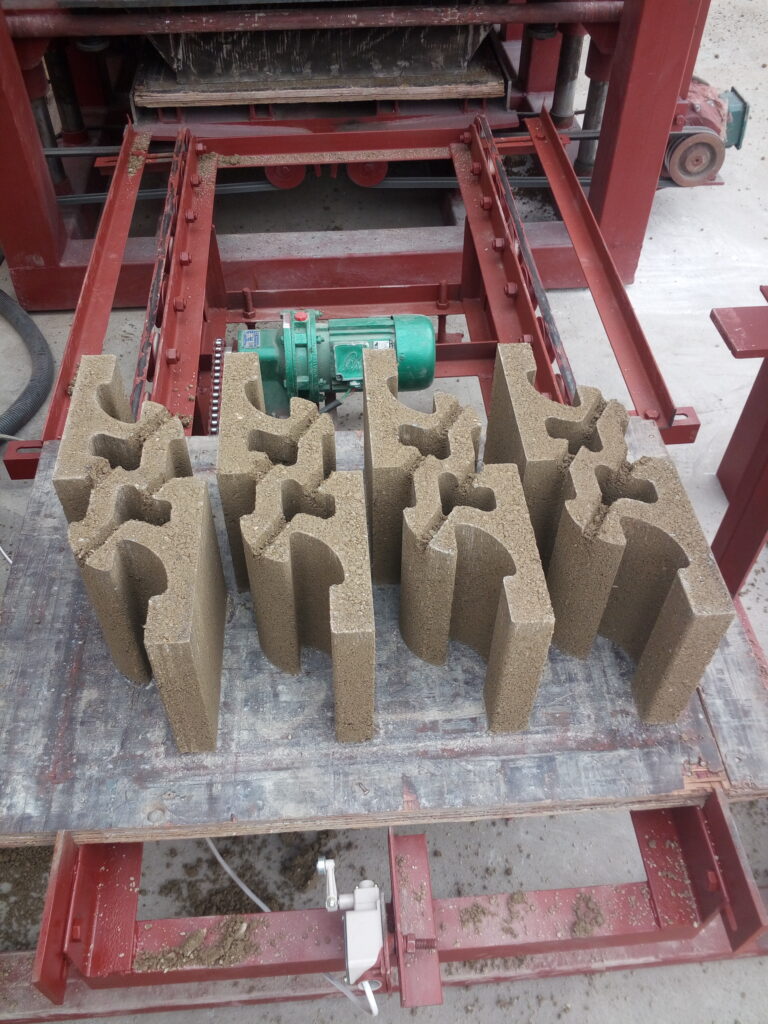
Kayan aikin kera tubalin siminti
Gabatarwa
A cikin masana'antar kayan gini, na'urorin yin bulo na kankare wata muhimmiyar fasaha ce ga samarwa na zamani, mai iya faɗaɗawa da inganci. Ga masu rarrabawa, dillalai, da kwararrun masu saye, fahimtar zurfin wannan rukunin na'urori ya wuce ma'anoni na asali—ya haɗa da ka'idodin aiki, amfani a kasuwa, da fa'idodin dabarun da ke motsa jarin abokan ciniki. Ba kamar tsarin ƙona yumbu na gargajiya ba, na'urorin kankare suna amfani da matsewar ruwa da jijjiga don mayar da danyen aggregates da siminti zuwa ingantattun tubalan gini masu ƙarfi.
Fasahar Aiwatarwa: Ma'ana da Tushen Ka'idoji da Hanyoyin Aiki
Injin yin tubalin siminti na'ura ce ta masana'antu da aka ƙera don samar da tubali masu ƙarfi, marasa rami, masu haɗa juna, da kuma tubalin shimfida wanda galibi ana yin su daga gauraya da aka tara (yashi, tsakuwa, duwatsu da aka niƙa), siminti na Portland, da ruwa. Babban halayenta shi ne amfani da matsewar injiniyoyi—maimakon gasa a cikin wutar tankar—don samun ƙarfin tsari. Tsarin ya dogara ne da haɗaɗɗar ruwa ko girgiza mai ƙarfi na gaurayar siminti mara nauyi ko mai ɗan nauyi, sannan a bar shi a bushe a yanayi don baiwa siminti damar ƙara warkewa.
- Ka'idar Daidaitawar Ruwa
- A cikin tsarin mutane da yawa, akwai matse mai amfani da ruwa. Motar lantarki tana tuka famfo da ke matsa ruwan hydraulic, wanda hakan ke kunna silinda ɗaya ko fiye. Waɗannan silinda suna tuka kan ƙullewa da ƙarfi mai yawa wanda za a iya sarrafa shi (mai auna da ton ko mega-Pascals) kai tsaye kan abin da ke cikin moul. Wannan matsi yana rage sarari tsakanin ɓangarorin, yana samar da matsakaici mai yawa da tsari wanda siminti ke ɗaure ɓangarorin yadda ya kamata. Ikon sarrafa da riƙe wannan matsi daidai yake da mahimmanci don samun daidaito a yawa da ƙarfin samfur.
- Matsayin Girgizawa a cikin Ƙarfafawa
- Yawancin lokaci ana amfani da shi tare da matsi na ruwa, girgiza mai tsananin mita shine babban bambanci daga sauran hanyoyin yin tubali. Masu girgiza da aka dora a kan teburin gyare-gyare ko kai suna ba da kuzari ga hadin siminti. Wannan kuzari na rage gogayya ta ciki na dan lokaci, yana barin kayan da suke cikin kananan kwayoyin su gudana su zauna a cikin sifofi masu rikitarwa na gyare-gyaren, gami da kewaye da sandunan ciki don tubalan marasa ciki. Girgiza tana tabbatar da daidaiton yawa a duk fadin samfur, tana kawar da gurab da kuma samar da saman santsi, wanda ke da mahimmanci ga iyawar daukar nauyi da ingancin kyau.
- Hanyar Magani: Ruwan Sha Maimakon Wuta
- Babban bambance-bambance daga fasahar yumbu da aka gasa shine tsarin warkewa. Turakun siminti suna samun ƙarfi ta hanyar sinadari mai suna hydration, inda siminti yake haɗuwa da ruwa don samar da tsarin crystalline mai tauri. Wannan yana faruwa a yanayin zafi na yau da kullun na wasu kwanaki. Injin yana samar da turakun "kore," waɗanda ake jera su a ajiye su da danshi a ƙarƙashin yanayi mai sarrafawa (sau da yawa ana rufe su da filastik ko a cikin ɗakunan warkewa) don tabbatar da cikakkiyar haɓaka ƙarfi ba tare da buƙatar babban kuzari ba kamar na murhu.
Tsarin Gine-gine da Haɗaɗɗen Abubuwan Tsarin
A modern concrete brick machine is not a standalone press but an integrated system. Its architecture can be broken down into several key subsystems.
- The Power and Actuation System
- This system provides the motive force. It typically comprises a high-torque electric motor, a hydraulic power unit (reservoir, pump, valves, filters), and actuation cylinders. The sophistication of the valve block—often incorporating proportional valves for smooth control—determines the precision of the press cycle. In vibration-centric machines, the system also includes electric or hydraulic vibrator motors with adjustable frequency controllers.
- The Mold and Tooling Assembly
- This is the product-defining subsystem. It consists of a hardened steel mold box that forms the external dimensions, a compaction head (upper mold), and, for hollow products, fixed or retractable core rods. These components are manufactured to exacting tolerances to prevent material leakage (flashing) and ensure easy release. The mold’s design directly dictates the brick’s shape, texture, and structural features (e.g., frog, grip patterns, interlocking keys).
- The Control and Automation Nexus
- Operational intelligence resides in a Programmable Logic Controller (PLC). This industrial computer receives signals from sensors (position, pressure, presence) and executes a pre-programmed logic sequence to control all machine functions: feeder movement, vibration activation, press stroke, and ejection. The Human-Machine Interface (HMI) touchscreen allows operators to input parameters, select product recipes, and monitor real-time diagnostics, making the machine adaptable and transparent in operation.
- Auxiliary Material Handling Systems
- To achieve continuous production, the core press is supported by peripheral equipment. This includes aggregate batchers, pan or twin-shaft mixers for homogeneous blending, conveyor belts for material transfer, and automated pallet circulation systems that move green bricks from the press to curing areas and return empty pallets. The degree of integration of these auxiliaries defines the line’s automation level.
Product Portfolio and Application Scope
The versatility of this machinery is a primary commercial driver. By changing mold sets and adjusting machine parameters, a single system can produce a diverse range of market-ready products.
- Structural Masonry Units
- Tubalin Siminti Na Cako: The industry workhorse for wall construction, offering an optimal balance of strength, weight, and material economy. The machine must ensure perfect formation of the webs and shells around the cores.
- Tubalan Siminti Masu Ƙarfi: Used for foundations, load-bearing piers, and applications requiring maximum compressive strength and density.
- Tubalan Masu Haɗa Kai: Designed for dry-stack or minimal-mortar construction, these require molds with extreme precision to ensure consistent locking geometry, enabling faster build times.
- Paving and Landscape Products
- Concrete Pavers: For driveways, walkways, and patios. Produced at very high pressures for exceptional durability and freeze-thaw resistance. Machines can produce myriad shapes, from simple rectangles to complex interlocking patterns.
- Dutsen Kan Kofa da Gabaɗaya: Specialized long, linear products that require specific mold designs and handling systems.
- Retaining Wall Units: Often larger, sculpted blocks designed for gravity walls, requiring robust machine frames and high-pressure capabilities.
- Specialized and Engineered Products
- Tubalan Masu Sauƙi Utilizing expanded clay or shale aggregates. The machine must be tuned to compact these softer aggregates without crushing them.
- Insulated Concrete Forms (ICFs): Complex blocks with built-in cavities for insulation.
- Architectural Screen Blocks: Decorative units with intricate perforations, showcasing the machine’s ability to handle delicate mold tooling.
Strategic Value Proposition for Stakeholders
For the target audience of distributors and their clients, concrete brick machinery offers a compelling set of advantages.
- Economic and Operational Efficiency
- The process eliminates the fuel cost of kiln firing, one of the largest expenses in clay brick production. With quick cycle times (often seconds per brick) and high levels of automation, the cost-per-unit is highly competitive. The ability to use locally sourced aggregates and industrial by-products like fly ash further reduces material costs and supports circular economy goals.
- Quality, Consistency, and Performance
- Machine-controlled production ensures every unit meets identical specifications for dimensions, density, and strength. This consistency is paramount for modern construction, allowing for predictable structural performance, easier bricklaying, and adherence to international standards (ASTM, EN, ISO). The resulting products offer high compressive strength, excellent fire resistance, and good acoustic insulation properties.
- Sustainability and Environmental Profile
- The technology supports sustainable construction through energy-efficient production (no firing), the potential for high recycled content in aggregates, and the use of supplementary cementitious materials like fly ash. Furthermore, concrete masonry buildings offer significant thermal mass, contributing to energy efficiency in operation.
Ƙarshe
The concrete brick making machine is far more than a simple press; it is the engine of a highly efficient, adaptable, and modern construction materials plant. Its core principles of hydraulic/vibratory compaction and ambient curing represent a technologically and economically superior alternative to traditional fired methods for a vast range of applications. For the strategic distributor, success lies in conveying this machine’s role as a system—integrating mechanical force, electronic control, and material science to produce a diversified portfolio of high-performance building products. By articulating its operational logic, product versatility, and strong value proposition in terms of cost, quality, and sustainability, distributors empower their clients to make transformative investments. These investments not only build profitable businesses but also contribute to meeting the global need for resilient, affordable, and sustainable infrastructure.
Tambayoyin da ake yawan yi (FAQ)
Q1: How does the strength of a machine-made concrete brick compare to a traditional fired clay brick?
A: High-quality concrete bricks produced on modern machinery routinely achieve compressive strengths that meet or exceed those of standard fired clay bricks. While clay bricks excel in certain properties like absorption, well-compacted concrete blocks offer superior consistency, dimensional accuracy, and can be engineered for very high strengths (over 20 MPa or 2900 psi) for specific structural applications. The performance is highly dependent on mix design and machine pressure.
Q2: What are the key infrastructure requirements for installing a concrete brick production line?
A: Major requirements include:
- Sarari: A large, covered area for the production line, raw material storage, and curing yard.
- Ƙarfi: A stable, high-capacity three-phase electrical supply for motors, hydraulic pumps, and controls.
- Foundation: A heavy-duty, level concrete foundation to absorb machine vibrations and ensure alignment.
- Water Supply: A consistent source of clean water for mixing and curing.
- Material Storage: Organized space for aggregates, cement, and pallets.
Q3: Can these machines use recycled materials in the concrete mix?
A: Yes, this is a significant advantage. Properly processed recycled concrete aggregate (RCA), crushed glass (cullet), and post-industrial materials like fly ash can be successfully incorporated into the mix design. This requires careful grading and quality control to ensure the recycled content does not compromise strength or durability, but it offers substantial cost savings and environmental benefits.
Q4: What is the typical lifespan of a concrete brick making machine, and what drives maintenance costs?
A: With proper maintenance, the core structural frame of a quality machine can last 20+ years. The primary maintenance costs and wear are associated with:
- Mold Tooling: The highest wear item, requiring refurbishment or replacement after 1-3 million cycles depending on material abrasiveness.
- Abubuwan Haɗin Gaskiya: Seals, hoses, and pumps require periodic replacement.
- Vibrators and Bearings: In vibration systems, these are subject to high-stress fatigue.
A proactive, scheduled maintenance program is far less costly than reactive repairs following a breakdown.
Q5: How quickly can a production line be reconfigured to make a different type of brick or block?
A: Reconfiguration time, or changeover, varies. For a simple mold change (e.g., from a solid block to a different sized solid block), a well-designed machine with quick-change clamps can be ready in under an hour. Switching to a radically different product (e.g., from standard block to thin pavers) may take several hours, as it involves changing multiple mold components, adjusting feeder settings, and recalibrating press parameters. This flexibility is a key selling point for markets requiring a diverse product mix.