
Panduan Utama Mesin Pembuat Blok Interlocking Beton: Jenis, Keuntungan & Cara Memilih
Pengantar
Industri konstruksi global terus berevolusi, didorong oleh permintaan mendesak akan material yang tidak hanya kuat dan tahan lama, tetapi juga berkelanjutan dan hemat biaya untuk diterapkan. Di tengah perubahan ini, satu solusi secara bertahap semakin populer berkat perpaduan luar biasa antara kesederhanaan dan inovasi: blok beton saling mengunci. Namun, faktor yang benar-benar mengubah permainan bukan hanya blok itu sendiri—melainkan mesin khusus yang memungkinkan produksi efisien di lokasi proyek. Selamat datang di panduan definitif tentangmesin pembuat blok interlocking beton.
Panduan ini dirancang sebagai sumber daya komprehensif dan tidak memihak bagi kontraktor, pembangun, wirausaha ambisius, dan manajer proyek. Dengan menggali pengetahuan industri mendalam, spesifikasi teknis, serta wawasan penerapan praktis, kami akan mengungkap teknologi kuat ini dengan jelas. Tujuan kami tunggal: membekali Anda dengan pemahaman yang jelas tentang jenis mesin, manfaat nyatanya, kriteria seleksi kritis, dan pertimbangan pembelian penting, sehingga Anda dapat mengambil keputusan yang tepat untuk proyek atau bisnis Anda. Ini adalah sumber edukasi yang berfokus pada praktik terbaik dan pengetahuan mendasar, bukan untuk mempromosikan merek tertentu, memastikan Anda menerima informasi objektif yang diperlukan untuk meraih kesuksesan.
Apa itu Mesin Pembuat Blok Interlocking Beton?
Inti dari mesin ini adalah sebuah mesin press yang dirancang dengan presisi untuk mengubah campuran kering agregat, pasir, dan semen menjadi blok bangunan yang kokoh secara struktural dengan fitur unik: mereka saling mengunci tanpa perlu mortar.
Fungsi Inti dan Keluaran Dijelaskan
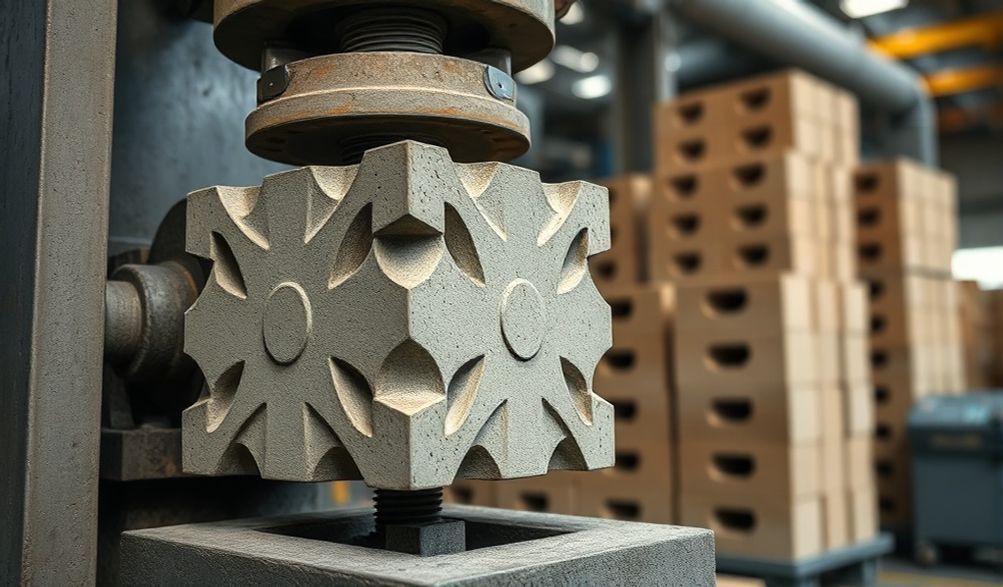
Fungsi utama dari sebuahmesin pembuat blok interlocking betonadalah dengan menerapkan tekanan yang sangat besar pada beton "campuran kering", memadatkannya ke dalam cetakan yang membentuk balok dengan desain lidah-dan-alur, seperti teka-teki, atau geometris yang dipatenkan di bagian atas dan sampingnya. Desain-desain ini merupakan kunci dari sistem tersebut:
- Interlock:Saat diletakkan, tonjolan-tonjolan (bonggol) dari satu balok pas masuk ke dalam lekukan-lekukan (alur) dari balok-balok yang berdekatan.
- Hasilnya:Sebuah lapisan dinding atau perkerasan yang stabil dan terkunci secara mekanis, yang memperoleh kekuatannya dari gesekan dan geometri, mirip seperti puzzle tiga dimensi. Hal ini menghilangkan kebutuhan akan pengikat mortar tradisional.
Prinsip Dasar Cara Kerja
Sementara desainnya bervariasi, proses dasarnya konsisten di sebagian besar mesin dan mengikuti metode cor kering:
- Pemberian Makan:Campuran beton kering siap pakai (dengan kadar air yang cukup untuk hidrasi, tetapi tanpa "slump") dimasukkan ke dalam kotak cetakan atau corong mesin.
- Pemadatan:Campuran tersebut mengalami dua kekuatan utama:
- Getaran:Getaran frekuensi tinggi mengendapkan campuran, menghilangkan kantong udara, dan memastikan sudut cetakan terisi.
- Tekanan Hidrolik:Sebuah hidrolik ram kemudian memberikan tekanan luar biasa (diukur dalam ton) pada campuran, memadatkannya menjadi massa padat berdaya tinggi.
- Pembentukan:Aksi gabungan dari getaran dan tekanan membentuk campuran menjadi bentuk cetakan yang presisi, termasuk pola saling mengunci yang kompleks.
- Pengusiran:Blok yang baru terbentuk diangkat atau didorong keluar dari cetakan ke palet atau tanah, siap untuk proses pengawetan.
Metode "cor kering" ini berbeda dari pengecoran beton basah tradisional, memungkinkan penanganan blok segera dan mempercepat keseluruhan jadwal konstruksi.
Manfaat Utama Penggunaan Blok Interlock dan Mesin Pembuatnya
Berinvestasi dalam teknologi ini bukan hanya tentang membeli mesin; ini tentang membuka serangkaian keuntungan bagi proyek konstruksi atau model bisnis Anda.
Keuntungan Konstruksi dan Kinerja
- Kecepatan Konstruksi yang Tak TertandingiTanpa perlu mencampur, mengoleskan, dan menunggu mortar mengering, produktivitas pemasangan blok dapat meningkat 200–300%. Dinding akan terpasang jauh lebih cepat, mempercepat penyelesaian proyek.
- Efisiensi Biaya yang Signifikan:Penghematan diwujudkan di berbagai lini:
- Tenaga Kerja:Mengurangi kebutuhan akan tukang batu yang sangat terampil.
- Bahan:Penghapusan mortar, pasir, dan semen untuk pemasangan.
- Transportasi:Produksi di lokasi mengurangi biaya dan kerusakan yang terkait dengan pengangkutan balok jadi yang berat dari pabrik yang jauh.
- Daya Tahan dan Kekuatan Unggul:Blok interlocking yang dibuat dengan benar memiliki kekuatan tekan yang sangat tinggi. Kunci mekanisnya menciptakan struktur fleksibel yang dapat menangani gaya geser dan penurunan tanah lebih baik dibandingkan dinding kaku yang diikat dengan mortar, menjadikannya ideal untuk dinding penahan, perkerasan, dan aplikasi penahan beban.
- Inherent Sustainability: This technology supports green building in several ways:
- Material Use: Can incorporate industrial by-products like fly ash or recycled aggregates.
- Permeabilitas: Certain designs allow for grass or water infiltration, reducing runoff.
- Reusability: Blocks can often be disassembled and reused elsewhere.
Operational and Business Advantages
- On-Demand, On-Site Production: Produce blocks exactly where they’re needed, when they’re needed. This provides ultimate control over inventory, quality, and logistics.
- Immense Design Versatility: By simply changing the mold, a single machine can produce a variety of block sizes, shapes (e.g., straight, corner, half), and even surface textures (split-face, rock-face, smooth). Color can be added to the mix or applied to the surface.
- A Tangible Business Opportunity: For entrepreneurs, a single semi-automatic or automatic machine can form the core of a profitable block manufacturing business, supplying blocks for local construction, landscaping, and infrastructure projects.
Types of Concrete Interlocking Block Making Machines
Choosing the right machine starts with understanding the landscape. They are primarily categorized by their operation method, mobility, and output.
Berdasarkan Metode Operasi
- Mesin Manual:
- Cara kerjanya: Operated entirely by human labor using a lever mechanism to apply pressure. Feeding and block removal are manual.
- Terbaik untuk: Very small-scale projects, DIY enthusiasts, community-led building initiatives, or pilot projects. Output is low (e.g., 100-500 blocks per day), but the cost of entry is minimal.
- Mesin Semi-Otomatis:
- Cara kerjanya: The core compaction process (vibration and hydraulics) is powered and automated. Operators manually feed raw material and remove finished blocks, often with the aid of a lever or button.
- Terbaik untuk: Small to medium-sized businesses, contractors with multiple projects, and medium-volume production (e.g., 1,000 – 6,000 blocks per 8-hour shift). They offer an excellent balance between productivity, cost, and flexibility.
- Mesin Sepenuhnya Otomatis:
- Cara kerjanya: These are complete production lines. They feature automated systems for feeding raw material, mixing, conveying, compacting, curing, and even stacking/palletizing finished blocks. Controlled via PLC (Programmable Logic Controller).
- Terbaik untuk: Large-scale commercial block yards and industrial production facilities requiring very high, consistent output (10,000+ blocks per day). They maximize output and minimize labor but require a substantial capital investment.
By Mobility and Setup
- Tanaman Stasioner: These are fixed installations, often the foundation of a block manufacturing factory. They are designed for maximum output and are not intended to be moved frequently.
- Mobile/Portable Machines: Mounted on a trailer or skid frame, these units can be towed or transported directly to a job site. This is a massive advantage for large infrastructure projects (e.g., remote road construction, large retaining walls) where transporting blocks is impractical.
By Block Output Capacity
- Skala kecil: Up to ~2,000 blocks per day. Typically manual or small semi-automatic models.
- Menengah: ~2,000 to 10,000 blocks per day. The domain of robust semi-automatic and smaller fully automatic machines.
- Large-scale Industrial: 10,000+ blocks per day. The exclusive realm of high-end fully automatic production lines and stationary plants.
Critical Factors to Consider When Choosing a Machine
Making the right choice requires a clear-eyed assessment of your needs against the machine’s capabilities. Here’s your practical checklist.
Project & Business Requirements
- Production Volume: Calculate your average daily and peak weekly block requirement. Choose a machine that can meet this with some capacity to spare—running a machine at 100% capacity constantly leads to wear.
- Spesifikasi Blok: List every block type you need (standard, corner, half-block, thickness). Ensure the machine and available molds can produce them all.
- Site & Resource Constraints:
- Ruang Angkasa: Do you have a factory shed or just an open plot? Automatic lines need more covered space.
- Kekuasaan: Is three-phase electrical power available, or do you need a diesel-powered option?
- Tenaga Kerja: What is the skill level of your available workforce? A fully automatic machine may need an electrician/technician, while a semi-automatic needs diligent operators.
Machine Specifications & Features
- Kapasitas Tekanan (Tonase): This is critical for block strength. Higher tonnage (e.g., 150 tons vs. 50 tons) produces denser, stronger blocks suitable for load-bearing walls. For garden walls, lower pressure may suffice.
- Mold Versatility & Changeover: How easy is it to change molds? Quick-change systems save hours of downtime when switching block types. Also, check the cost and availability of additional molds from the supplier.
- Tingkat Otomasi: Honestly evaluate the trade-off. Higher automation means a higher upfront cost but lower long-term labor costs and more consistent output. Can your budget and operational style support it?
- Kualitas Pembuatan: Inspect the robustness of the frame (solid steel is best), the quality of the hydraulic pump and cylinders, and the brand/durability of the vibrator motors. A heavier machine frame generally indicates better stability and longevity.
Supplier and Support Evaluation
This step is as important as evaluating the machine itself. Your relationship with the supplier will define your long-term success.
- Research Manufacturer Reputation: Look for companies with a long track record (10+ years is a good sign). Search for reviews, ask for a client portfolio, and try to speak to existing customers.
- Layanan Purna Jual: Does the supplier offer installation, commissioning, and on-site operator training? What is their spare parts policy? A reliable local agent or service network is invaluable.
- Warranty & Documentation: Scrutinize the warranty terms. Clear, comprehensive operation and maintenance manuals in your language are a must-have.
Praktik Terbaik Operasional dan Tips Perawatan
Owning the machine is half the battle; operating it correctly ensures profitability and longevity. Here’s actionable guidance drawn from field experience.
Persiapan Bahan Baku
The quality of the block is determined here. Ensuring consistent moisture in the mix is often the difference between a perfect block and a cracked one.
- Desain Campuran: A typical mix might be 1 part cement, 3-6 parts well-graded aggregate (e.g., 3/8″ crushed stone), and 2-4 parts sharp sand. The exact ratio depends on desired strength and local materials.
- Kandungan Kelembaban: This is critical. The mix should be damp enough to hold its shape when squeezed in your hand (≈ 5-8% water by weight), but no free water should be visible. Too dry = weak blocks; too wet = blocks stick in the mold.
Routine Machine Operation Checklist
- Pre-Start: Check hydraulic oil levels, ensure all bolts are tight, clean the mold cavity and pallets.
- During Operation: Feed the hopper consistently but don’t overfill. Monitor the block ejection process—any sticking indicates a mold or mix issue. Listen for unusual noises from the hydraulics or vibrators.
- Shutdown: Clear all residual material from the mold and hopper. Park the machine in a safe position.
Essential Maintenance for Longevity
A simple, consistent maintenance routine prevents costly breakdowns.
- Harian: Clean the machine thoroughly. Check for loose parts.
- Mingguan: Lubricate all moving parts as per the manual (pivots, guide rods). Inspect hydraulic hoses for leaks.
- Bulanan: Check and tighten all major bolts and nuts on the frame and vibration table. Change hydraulic oil and filters as recommended by the manufacturer.
Bagian FAQ
Q: What is the typical cost range for an interlocking block machine?
A: The range is vast. A basic manual machine can start from \$3,000 – \$10,000. A quality semi-automatic machine typically ranges from \$15,000 to \$50,000. Fully automatic production lines can range from \$70,000 to well over \$300,000, depending on capacity and sophistication. Always factor in costs for molds, a mixer, and a pallet or curing rack system.
Q: Can these machines use recycled materials like crushed concrete or plastic?
A: Many can, especially robust machines with higher pressure. Crushed concrete is an excellent, sustainable aggregate. Some technologies allow for the inclusion of certain plastic fibers. However, the material must be clean, consistently sized, and its properties understood. Always consult with the machine manufacturer to validate your specific mix design.
Q: How much training is required to operate a semi-automatic machine?
A: Basic operational training is usually sufficient and is often provided by the supplier over a few days. The key is diligent adherence to the operational manual, understanding the raw material mix, and performing routine maintenance. Safety training around moving parts and hydraulics is non-negotiable.
Q: What is the difference between hydraulic and vibration pressure in these machines?
A: They serve complementary roles. Getaran (often from multiple high-frequency vibrators) consolidates the dry mix, causing particles to settle densely into every part of the mold. Tekanan hidrolik then applies a final, static, high-tonnage force that permanently compacts the mix, creating the final bond and achieving the high compressive strength of the block. The best machines effectively combine both.
Q: Are the blocks produced strong enough for load-bearing walls?
A: Absolutely. When produced with the correct cement content, proper mix design, and sufficient machine pressure, interlocking concrete blocks can achieve compressive strengths that meet or exceed ASTM C90 standards for concrete masonry units. For any specific load-bearing structural application, the block specifications should be reviewed and approved by a qualified structural engineer.
Kesimpulan
Selecting the ideal mesin pembuat blok interlocking beton is a strategic decision that hinges on a clear assessment of your project needs, output goals, and operational budget. From manual presses for community projects to fully automated lines driving an industrial business, this technology offers a pathway to faster, more economical, and notably sustainable construction.
We encourage you to use this guide as your foundational framework for evaluation. Let it inform the questions you ask and the specifications you prioritize. Your final step should involve contacting multiple reputable suppliers with your detailed requirements. Request live demonstrations, ask for samples of blocks produced by their machines, and scrutinize their service commitments. By investing time in this due diligence, you’re not just purchasing a piece of equipment—you’re investing in the future efficiency and growth of your construction endeavors or business. This technology is more than a machine; it’s a tool for building modern, resilient infrastructure, one precisely interlocked block at a time.
<