
O Guia Definitivo para Máquinas de Fabricação de Blocos de Concreto Intertravados: Tipos, Vantagens e Como Escolher
Introdução
A indústria global da construção está em constante evolução, impulsionada por uma demanda urgente por materiais que não sejam apenas fortes e duráveis, mas também sustentáveis e economicamente viáveis de implementar. Em meio a essa mudança, uma solução vem ganhando terreno de forma constante devido à sua notável combinação de simplicidade e inovação: o bloco de concreto intertravado. Mas o verdadeiro fator de transformação não é apenas o bloco em si — é a maquinaria especializada que torna possível a produção eficiente no local de obra. Bem-vindo ao guia definitivo sobremáquinas para fazer blocos de concreto intertravados.
Este guia foi elaborado como um recurso abrangente e imparcial para empreiteiros, construtores, empreendedores ambiciosos e gerentes de projeto. Com base em profundo conhecimento do setor, especificações técnicas e insights de aplicação prática, desmistificaremos essa tecnologia poderosa. Nosso objetivo é singular: equipá-lo com uma compreensão clara dos tipos de máquinas, seus benefícios tangíveis, critérios críticos de seleção e considerações essenciais de compra, capacitando-o a tomar uma decisão perfeitamente informada para seu projeto ou negócio. Este é um recurso educacional focado nas melhores práticas e no conhecimento fundamental, não na promoção de qualquer marca específica, garantindo que você receba as informações objetivas necessárias para ter sucesso.
O que é uma Máquina de Fabricação de Blocos de Concreto Intertravados?
Em sua essência, esta máquina é uma prensa de engenharia de precisão projetada para transformar uma mistura seca de agregados, areia e cimento em blocos de construção estruturalmente sólidos, com uma característica única: eles se encaixam sem argamassa.
Função Principal e Saída Explicadas
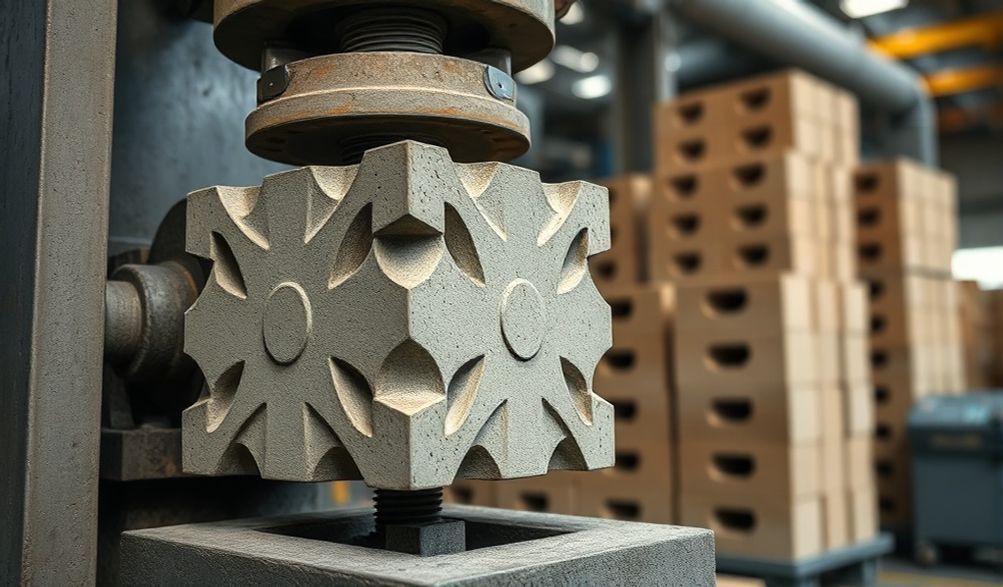
A função principal de ummáquina de fabricação de blocos de concreto intertravadosé aplicar uma pressão imensa a um concreto de “mistura seca”, compactando-o em um molde que forma blocos com desenhos patenteados de macho-e-fêmea, tipo quebra-cabeça ou geométricos em suas partes superiores e laterais. Esses desenhos são a chave do sistema:
- O Intertravamento:Quando colocados, os saliências (botões) de um bloco encaixam-se firmemente nas reentrâncias (ranhuras) dos blocos adjacentes.
- O Resultado:Um curso de parede ou pavimento estável e mecanicamente travado, que deriva sua resistência do atrito e da geometria, muito parecido com um quebra-cabeça tridimensional. Isso elimina a necessidade de ligação com argamassa tradicional.
O Princípio Básico de Funcionamento
Embora os projetos variem, o processo fundamental é consistente na maioria das máquinas e segue um método de fundição a seco:
- Alimentação:Uma mistura de concreto seco preparada (com umidade suficiente apenas para hidratação, mas sem "abatimento") é alimentada na caixa de molde ou tremonha da máquina.
- Compactação:A mistura é submetida a duas forças principais:
- Vibração:A vibração de alta frequência assenta a mistura, remove bolsas de ar e garante que os cantos do molde são preenchidos.
- Pressão Hidráulica:Um martelo hidráulico aplica então uma pressão tremenda (medida em toneladas) à mistura, densificando-a em uma massa sólida e de alta resistência.
- Moldagem:A ação combinada de vibração e pressão molda a mistura na forma precisa do molde, incluindo os complexos padrões de encaixe.
- Ejeção:O bloco recém-formado é levantado ou empurrado para fora do molde sobre um palete ou no chão, pronto para a cura.
Este método de "fundição a seco" é distinto do tradicional vazamento de concreto úmido, permitindo o manuseio imediato dos blocos e cronogramas de construção mais rápidos no geral.
Principais Benefícios do Uso de Blocos de Encaixe e das Máquinas que os Produzem
Investir nesta tecnologia não é apenas comprar uma máquina; é desbloquear uma cascata de vantagens para seus projetos de construção ou modelo de negócios.
Benefícios de Construção e Desempenho
- Velocidade de Construção InigualávelSem a necessidade de misturar, aplicar e esperar a argamassa curar, a produtividade na colocação de blocos pode aumentar em 200-300%. As paredes sobem significativamente mais rápido, acelerando a conclusão do projeto.
- Eficiência de Custos Significativa:A economia é realizada em várias frentes:
- Trabalho:Menor necessidade de pedreiros altamente qualificados.
- Materiais:Eliminação de argamassa, areia e cimento para assentamento.
- Transport: On-site production cuts costs and breakage associated with transporting heavy finished blocks from a distant plant.
- Durabilidade e Resistência Superiores: Properly made interlocking blocks have very high compressive strength. Their mechanical interlock creates a flexible structure that can handle shear forces and settlement better than rigid mortar-bound walls, making them ideal for retaining walls, pavements, and load-bearing applications.
- Inherent Sustainability: This technology supports green building in several ways:
- Material Use: Can incorporate industrial by-products like fly ash or recycled aggregates.
- Permeabilidade: Certain designs allow for grass or water infiltration, reducing runoff.
- Reusability: Blocks can often be disassembled and reused elsewhere.
Operational and Business Advantages
- On-Demand, On-Site Production: Produce blocks exactly where they’re needed, when they’re needed. This provides ultimate control over inventory, quality, and logistics.
- Immense Design Versatility: By simply changing the mold, a single machine can produce a variety of block sizes, shapes (e.g., straight, corner, half), and even surface textures (split-face, rock-face, smooth). Color can be added to the mix or applied to the surface.
- A Tangible Business Opportunity: For entrepreneurs, a single semi-automatic or automatic machine can form the core of a profitable block manufacturing business, supplying blocks for local construction, landscaping, and infrastructure projects.
Types of Concrete Interlocking Block Making Machines
Choosing the right machine starts with understanding the landscape. They are primarily categorized by their operation method, mobility, and output.
Por Método de Operação
- Máquinas Manuais:
- Como funcionam: Operated entirely by human labor using a lever mechanism to apply pressure. Feeding and block removal are manual.
- Melhor para: Very small-scale projects, DIY enthusiasts, community-led building initiatives, or pilot projects. Output is low (e.g., 100-500 blocks per day), but the cost of entry is minimal.
- Máquinas Semiautomáticas:
- Como funcionam: The core compaction process (vibration and hydraulics) is powered and automated. Operators manually feed raw material and remove finished blocks, often with the aid of a lever or button.
- Melhor para: Small to medium-sized businesses, contractors with multiple projects, and medium-volume production (e.g., 1,000 – 6,000 blocks per 8-hour shift). They offer an excellent balance between productivity, cost, and flexibility.
- Máquinas Totalmente Automáticas:
- Como funcionam: These are complete production lines. They feature automated systems for feeding raw material, mixing, conveying, compacting, curing, and even stacking/palletizing finished blocks. Controlled via PLC (Programmable Logic Controller).
- Melhor para: Large-scale commercial block yards and industrial production facilities requiring very high, consistent output (10,000+ blocks per day). They maximize output and minimize labor but require a substantial capital investment.
By Mobility and Setup
- Plantas Estacionárias: These are fixed installations, often the foundation of a block manufacturing factory. They are designed for maximum output and are not intended to be moved frequently.
- Mobile/Portable Machines: Mounted on a trailer or skid frame, these units can be towed or transported directly to a job site. This is a massive advantage for large infrastructure projects (e.g., remote road construction, large retaining walls) where transporting blocks is impractical.
By Block Output Capacity
- Pequena escala: Up to ~2,000 blocks per day. Typically manual or small semi-automatic models.
- Média escala: ~2,000 to 10,000 blocks per day. The domain of robust semi-automatic and smaller fully automatic machines.
- Large-scale Industrial: 10,000+ blocks per day. The exclusive realm of high-end fully automatic production lines and stationary plants.
Critical Factors to Consider When Choosing a Machine
Making the right choice requires a clear-eyed assessment of your needs against the machine’s capabilities. Here’s your practical checklist.
Project & Business Requirements
- Production Volume: Calculate your average daily and peak weekly block requirement. Choose a machine that can meet this with some capacity to spare—running a machine at 100% capacity constantly leads to wear.
- Especificações do Bloco: List every block type you need (standard, corner, half-block, thickness). Ensure the machine and available molds can produce them all.
- Site & Resource Constraints:
- Espaço: Do you have a factory shed or just an open plot? Automatic lines need more covered space.
- Poder: Is three-phase electrical power available, or do you need a diesel-powered option?
- Trabalho: What is the skill level of your available workforce? A fully automatic machine may need an electrician/technician, while a semi-automatic needs diligent operators.
Machine Specifications & Features
- Capacidade de Pressão (Tonelagem): This is critical for block strength. Higher tonnage (e.g., 150 tons vs. 50 tons) produces denser, stronger blocks suitable for load-bearing walls. For garden walls, lower pressure may suffice.
- Mold Versatility & Changeover: How easy is it to change molds? Quick-change systems save hours of downtime when switching block types. Also, check the cost and availability of additional molds from the supplier.
- Nível de Automação: Honestly evaluate the trade-off. Higher automation means a higher upfront cost but lower long-term labor costs and more consistent output. Can your budget and operational style support it?
- Qualidade de Construção: Inspect the robustness of the frame (solid steel is best), the quality of the hydraulic pump and cylinders, and the brand/durability of the vibrator motors. A heavier machine frame generally indicates better stability and longevity.
Supplier and Support Evaluation
This step is as important as evaluating the machine itself. Your relationship with the supplier will define your long-term success.
- Research Manufacturer Reputation: Look for companies with a long track record (10+ years is a good sign). Search for reviews, ask for a client portfolio, and try to speak to existing customers.
- Serviço Pós-Venda: Does the supplier offer installation, commissioning, and on-site operator training? What is their spare parts policy? A reliable local agent or service network is invaluable.
- Warranty & Documentation: Scrutinize the warranty terms. Clear, comprehensive operation and maintenance manuals in your language are a must-have.
Operational Best Practices and Maintenance Tips
Owning the machine is half the battle; operating it correctly ensures profitability and longevity. Here’s actionable guidance drawn from field experience.
Preparação de Matéria-Prima
The quality of the block is determined here. Ensuring consistent moisture in the mix is often the difference between a perfect block and a cracked one.
- Dosagem de Concreto: A typical mix might be 1 part cement, 3-6 parts well-graded aggregate (e.g., 3/8″ crushed stone), and 2-4 parts sharp sand. The exact ratio depends on desired strength and local materials.
- Teor de Umidade: This is critical. The mix should be damp enough to hold its shape when squeezed in your hand (≈ 5-8% water by weight), but no free water should be visible. Too dry = weak blocks; too wet = blocks stick in the mold.
Routine Machine Operation Checklist
- Pre-Start: Check hydraulic oil levels, ensure all bolts are tight, clean the mold cavity and pallets.
- During Operation: Feed the hopper consistently but don’t overfill. Monitor the block ejection process—any sticking indicates a mold or mix issue. Listen for unusual noises from the hydraulics or vibrators.
- Shutdown: Clear all residual material from the mold and hopper. Park the machine in a safe position.
Essential Maintenance for Longevity
A simple, consistent maintenance routine prevents costly breakdowns.
- Daily: Clean the machine thoroughly. Check for loose parts.
- Weekly: Lubricate all moving parts as per the manual (pivots, guide rods). Inspect hydraulic hoses for leaks.
- Monthly: Check and tighten all major bolts and nuts on the frame and vibration table. Change hydraulic oil and filters as recommended by the manufacturer.
Seção de Perguntas Frequentes
Q: What is the typical cost range for an interlocking block machine?
A: The range is vast. A basic manual machine can start from \$3,000 – \$10,000. A quality semi-automatic machine typically ranges from \$15,000 to \$50,000. Fully automatic production lines can range from \$70,000 to well over \$300,000, depending on capacity and sophistication. Always factor in costs for molds, a mixer, and a pallet or curing rack system.
Q: Can these machines use recycled materials like crushed concrete or plastic?
A: Many can, especially robust machines with higher pressure. Crushed concrete is an excellent, sustainable aggregate. Some technologies allow for the inclusion of certain plastic fibers. However, the material must be clean, consistently sized, and its properties understood. Always consult with the machine manufacturer to validate your specific mix design.
Q: How much training is required to operate a semi-automatic machine?
A: Basic operational training is usually sufficient and is often provided by the supplier over a few days. The key is diligent adherence to the operational manual, understanding the raw material mix, and performing routine maintenance. Safety training around moving parts and hydraulics is non-negotiable.
Q: What is the difference between hydraulic and vibration pressure in these machines?
A: They serve complementary roles. Vibração (often from multiple high-frequency vibrators) consolidates the dry mix, causing particles to settle densely into every part of the mold. Pressão hidráulica then applies a final, static, high-tonnage force that permanently compacts the mix, creating the final bond and achieving the high compressive strength of the block. The best machines effectively combine both.
Q: Are the blocks produced strong enough for load-bearing walls?
A: Absolutely. When produced with the correct cement content, proper mix design, and sufficient machine pressure, interlocking concrete blocks can achieve compressive strengths that meet or exceed ASTM C90 standards for concrete masonry units. For any specific load-bearing structural application, the block specifications should be reviewed and approved by a qualified structural engineer.
Conclusão
Selecting the ideal máquina de fabricação de blocos de concreto intertravados is a strategic decision that hinges on a clear assessment of your project needs, output goals, and operational budget. From manual presses for community projects to fully automated lines driving an industrial business, this technology offers a pathway to faster, more economical, and notably sustainable construction.
We encourage you to use this guide as your foundational framework for evaluation. Let it inform the questions you ask and the specifications you prioritize. Your final step should involve contacting multiple reputable suppliers with your detailed requirements. Request live demonstrations, ask for samples of blocks produced by their machines, and scrutinize their service commitments. By investing time in this due diligence, you’re not just purchasing a piece of equipment—you’re investing in the future efficiency and growth of your construction endeavors or business. This technology is more than a machine; it’s a tool for building modern, resilient infrastructure, one precisely interlocked block at a time.
<