
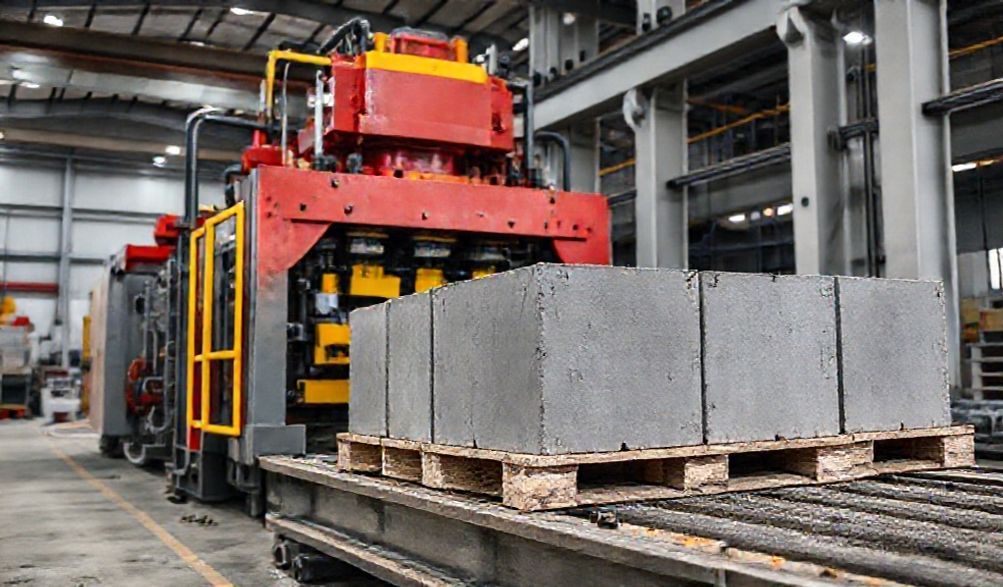
QT4-18 전자동 콘크리트 블록 제작 기계의 궁극적인 가이드
전 세계 건설 산업은 치솟는 수요를 충족할 만큼 빠른 속도로 생산되는 고품질이면서도 저렴한 건축 자재에 대한 필요성이라는 지속적인 과제에 직면해 있습니다. 블록 제조업체에게 이는 숙련된 인력 부족을 헤쳐나가면서도 생산량을 늘리고, 일관성을 유지하며, 비용을 통제해야 하는 엄청난 압박으로 이어집니다. 해결책은 기술 발전에 있습니다. 완전 자동 콘크리트 블록 제조기가 등장하며, 이는 원자재를 정밀하고 대규모로 이익으로 전환하는 혁신적인 장비입니다. 그 중에서도QT4-18 전자동 콘크리트 블록 제조 기계 블록 성형 기계신뢰성과 대량 생산을 위해 설계된 최고 수준의 모델로 두각을 나타냅니다.
이 가이드는 QT4-18에 대한 포괄적이고 전문적인 분석을 제공합니다. 우리는 판매 브로셔를 넘어서, 플랜트 매니저, 사업주, 투자자들이 건전한 투자 결정을 내리는 데 필요한 상세하고 편향되지 않은 정보를 제공할 것입니다. 여러분은 이 장비의 사양, 운영 워크플로우, 실제 비용, 그리고 수익성 있는 구매와 비용이 많이 드는 실수를 구분하는 중요한 요소들에 대해 명확히 이해하게 될 것입니다.
QT4-18 전자동 블록 성형 기계란 무엇인가요?
QT4-18은 본질적으로 콘크리트 블록의 연속적 대량 생산을 위해 설계된 고정식 유압 진동 프레스 기계입니다. 이 기계는 성형 공정을 동기화된 자동화 시스템으로 통합함으로써 수동 또는 반자동 방식에서 크게 도약한 것을 의미합니다. 내구성, 반복성, 그리고 조작의 용이성에 중점을 둔 설계 철학은 현대적 블록 생산 공장의 핵심을 형성합니다.
핵심 기능과 설계 철학
QT4-18은 동기화된 진동과 유압을 사용하여 준비된 콘크리트 혼합물을 정밀한 형태로 다지는 원리로 작동합니다. 이 기계의 견고한 용접 강철 프레임 내부에는 여러 핵심 서브시스템이 조화롭게 연동됩니다.
- 급식 시스템호퍼와 분배기는 콘크리트 혼합물을 금형 캐비티에 정확하게 투입하는 장치입니다.
- 몰딩 시스템(‘심장’):여기에는 블록의 형태를 결정하는 교체 가능한 도구인 몰드 자체와 재료를 다지는 강력한 진동 모터 및 유압 실린더가 포함됩니다.
- 유압 시스템:압축에 필요한 고압력을 제공하고 몰드 테이블 및 스트리퍼 헤드와 같은 다양한 부품의 이동을 담당합니다.
- 팔레트 컨베이어 시스템:강철 또는 목재로 된 팔레트(신선하게 성형된 블록을 운반하는)를 정밀하게 인덱싱된 방식으로 기계를 통해 이동시킵니다.
- PLC 지능형 제어 캐비닛:기계의 "뇌"입니다. 이 프로그래머블 로직 컨트롤러는 전체 사이클을 자동화하고, 작동을 모니터링하며, 운영자를 위한 인터페이스를 제공합니다.
모델명 해독: QT4-18 사양
모델명 "QT4-18"은 그 핵심 성능을 드러내는 코드입니다. 업계 표준 명명법에 따르면:
* "큐티"는 일반적으로 고정식 유압 블록 기계를 나타내는 기계 시리즈를 나타냅니다.
* "4"해당 금형을 사용할 때 한 주기당 생산할 수 있는 표준 크기 벽돌(400mm x 200mm)의 수를 나타냅니다.
* "18" refers to the nominal cycle time in seconds, from feeding to ejection.
Here are the key technical specifications that define its performance:
| 사양 | 상세 내용 |
| :— | :— |
| Production Capacity (Theoretical) | Up to 4,320 blocks per 8-hour shift (based on a 400x200mm block, 18-second cycle) |
| 사이클 타임 | 15-18 seconds (adjustable based on product type) |
| Moulding Pressure | High hydraulic pressure (specific tonnage varies by manufacturer) |
| 전력 소비 | Approximately 30-40 kW (for the main host machine) |
| 진동 시스템 | Dual-axis, high-frequency vibration with hydraulic pressure |
| 제어 시스템 | PLC with color touchscreen interface |
| 기계 무게 | ~6,000 kg (varies with configuration) |
| Overall Dimensions (LxWxH) | ~6.5m x 2.5m x 3.2m (approx.) |
중요 참고사항: The “blocks per shift” figure is a theoretical maximum under ideal conditions. Real-world output depends on raw material quality, product type, and operational efficiency.
주요 기능 및 기술적 장점
Full Automation and PLC Intelligent Control
The term “full automatic” signifies a profound shift in plant operation. While the QT4-18 machine itself automates the moulding process, it is designed to be the centerpiece of a fully automated line. This line can include automatic batching, mixing, conveying, curing, and stacking systems. The PLC control is the cornerstone of this automation.
- Precision & Repeatability: Every cycle is identical, eliminating human error in timing and pressure application.
- 노동력 감소 Typically, only 1-2 workers are needed to monitor the control panel and manage pallets, compared to 5-8 for equivalent semi-automatic output.
- Diagnostics & Safety: The PLC monitors system health, provides fault alarms, and includes safety interlocks to protect both the machine and operators.
High-Pressure Vibration and Superior Block Quality
Block strength and finish are non-negotiable for market acceptance. The QT4-18 employs a dual-compaction strategy:
1. 고주파 진동: Fluidizes the concrete mix, allowing it to flow into every corner of the mould.
2. Simultaneous Hydraulic Pressure: Compacts the vibrated material from the top, removing air pockets and achieving high density.
This combination produces blocks with:
* High compressive strength (readily meeting or exceeding common standards like ASTM C90).
* Excellent dimensional accuracy and sharp edges.
* A smooth, consistent surface finish that requires less plastering.
Versatility in Production: Beyond Standard Bricks
A significant advantage of the QT4-18 is its product flexibility. By simply changing the mould—a task that can often be completed in under an hour—the same machine can produce a diverse product portfolio:
- 홀로우 블록: (e.g., 4″, 5″, 6″, 8″)
- 솔리드 블록
- 포장석 및 인터록킹 블록
- 연석
- Grass Blocks
It is also compatible with a wide range of raw materials, allowing for cost optimization and sustainable practices: Portland cement, sand, gravel/crushed stone, fly ash, slag, and other industrial by-products.
Operational Workflow and Production Line Integration
From Raw Material to Finished Block: A Step-by-Step Process
Understanding the workflow within a typical plant setup clarifies the machine’s role:
- 원자재 준비 Aggregates, cement, and water are batched and mixed in a pan or planetary mixer to achieve a uniform, semi-dry concrete consistency.
- 급식 The mix is conveyed (via belt conveyor or forklift) into the QT4-18’s feed hopper.
- Moulding Cycle: The PLC initiates the automated cycle: the feed box distributes mix into the mould cavity on a pallet; the mould table rises into vibration; hydraulic pressure is applied; the mould descends, and the freshly formed block is stripped onto the pallet.
- Pallet Ejection & Curing: The loaded pallet is pushed onto a roller conveyor, moving to a brick stacker which places blocks onto curing racks. These racks are transferred to a curing chamber (steam or ambient) for strength development.
- Return Cycle: The empty pallet is cleaned and conveyed back to the start of the QT4-18, completing the loop.
Essential Auxiliary Equipment for a Complete Plant
The QT4-18 is the core, but not a standalone solution. For a functional and profitable plant, it must be integrated with auxiliary equipment:
- 콘크리트 믹서: A compulsory partner for consistent mix quality.
- 벨트 컨베이어 For efficient material transport to the hopper.
- Block Stacker: Automatically places green blocks onto curing racks.
- Brick Forklift / Pallet Truck: For moving heavy racks of blocks.
- Pallet Return System: A network of rollers or chains that returns empty pallets.
- 치유 시스템: Can range from simple sheltered yards to automated steam curing rooms.
Investing in the right supporting equipment is as crucial as choosing the main block moulding machine.
Analyzing the Investment: Costs, ROI, and Market Potential
Understanding the Initial Investment and Operating Costs
The price of a QT4-18 is influenced by several factors: the manufacturer’s brand and reputation, the quality of components (e.g., Siemens vs. generic PLCs), the level of automation in the specific configuration, and shipping costs to your location.
Beyond the capital expenditure, responsible planning must account for ongoing operational costs:
* Maintenance: Regular lubrication, inspection, and replacement of wear parts (like mould liners, vibration mounts, and hydraulic seals).
* 에너지 소비 The main machine and entire line’s power draw.
* 노동 Reduced but still present for supervision, maintenance, and handling.
* Raw Materials & Pallets: The recurring cost of goods sold.
Calculating Your Return on Investment (ROI)
A simplified ROI framework can guide your decision:
- Estimate Daily Production: Use a realistic output (e.g., 70% of theoretical max) for your primary product.
- Determine Local Market Price: Research the selling price per block in your region.
- Calculate Cost Per Block: Sum all variable costs (materials, energy, labor, maintenance) per block.
- Analyze Gross Profit: (Selling Price – Cost Per Block) x Daily Production = Estimated Daily Gross Profit.
- Project Payback Period: (Total Plant Investment Cost) / (Estimated Daily Gross Profit x Operating Days/Year).
Key ROI Drivers: The primary financial benefits of the QT4-18 come from its 효율성 (more blocks per hour) and dramatic labor savings. It also reduces waste through consistency and improves your competitive position with higher-quality products.
Critical Factors for Choosing the Right Supplier
Evaluating Manufacturer Expertise and After-Sales Service
The supplier you choose can make or break your project. Prioritize manufacturers with:
* Proven Experience: Look for companies with a decade or more in heavy machinery manufacturing.
* Comprehensive Service: They must offer installation supervision (or detailed guidance), operator training, and readily available technical support.
* 예비 부품 가용성: Ensure they stock and can quickly ship critical wear parts for the block moulding machine.
Quality Benchmarks: What to Look For in the Machinery
During your evaluation, go beyond the sales pitch:
* 빌드 품질: Inspect the thickness of steel plates, the quality of welding, and the robustness of the frame.
* Component Brands: Reputable manufacturers use known brands for critical parts (e.g., Siemens/Delta PLCs, Schneider electrics, Rexroth hydraulics, WEG motors).
* 보증 약관: A clear, comprehensive warranty (typically 1 year for parts) is a sign of confidence.
* 확인: Always ask for customer references and, if feasible, visit an existing plant to see the machine in operation. Videos from the supplier are useful but not a substitute for independent verification.
자주 묻는 질문 (FAQ)
Q1: What is the actual production capacity of the QT4-18 machine per day?
A: While the theoretical capacity is ~4,300 blocks/8 hours, a practical, sustainable output for hollow blocks is between 2,800 and 3,500 blocks, accounting for mould changes, maintenance breaks, and material handling.
Q2: How many workers are needed to operate this full automatic brick making machine?
A: For the core moulding process, 1-2 workers are sufficient to monitor the PLC, manage pallet flow, and perform basic checks. A complete plant with mixing and stacking may require 3-4 personnel per shift.
Q3: What is the difference between the QT4-18 and semi-automatic or manual block machines?
A: Manual machines require constant physical labor for every cycle. Semi-automatic machines mechanize some steps (like vibration) but require manual feeding and block removal. The QT4-18 is fully automatic, running continuous cycles with minimal human intervention, leading to exponentially higher output and consistency.
Q4: Can this machine use fly ash or other industrial waste as raw material?
A: Yes, absolutely. The QT4-18 is well-suited for using fly ash, slag, or even certain types of construction waste. These materials can reduce costs and improve block workability, but mix design ratios must be tested for optimal strength.
Q5: How do I source and change the moulds for different block types?
A: Moulds are purchased from your machine supplier or specialized mould makers to ensure perfect compatibility. Changing a mould involves loosening bolts, removing the old mould, positioning the new one, and re-aligning—a task trained operators can do in 30-60 minutes.
Q6: What kind of foundation and factory space is required for installation?
A: A solid, level concrete foundation (approx. 300mm thick) is mandatory to absorb vibration. The total plant space needed, including area for raw materials, mixing, curing, and block storage, is typically a minimum of 1,500-2,000 square meters for efficient operation.
Q7: What are the most common maintenance points for ensuring long machine life?
A: Daily: Clean the machine and check for loose parts. Weekly: Lubricate all moving joints and check hydraulic oil levels. Periodically: Inspect and replace wear parts—mould liners, conveyor rollers, vibration motor mounts, and hydraulic seals—as needed.
결론
The QT4-18 full automatic concrete block making machine represents a robust, efficient, and intelligent solution for entrepreneurs and companies aiming to establish or upgrade a medium-to-large-scale block production facility. Its blend of high-pressure vibration, PLC automation, and product versatility makes it a powerful engine for profitability.
However, success hinges on more than just purchasing a well-specified machine. It requires thorough due diligence: selecting a reputable supplier with strong after-sales support, carefully planning the integration of all auxiliary equipment, and conducting a realistic analysis of your local market demand and cost structure. View your investment as a complete production line ecosystem, with the QT4-18 as its core.
Call to Action: Before making a decision, consult with multiple suppliers, request detailed quotations that break down every component and cost, and insist on speaking to their existing customers. Arm yourself with information to ensure your investment builds a foundation for long-term success.
<