
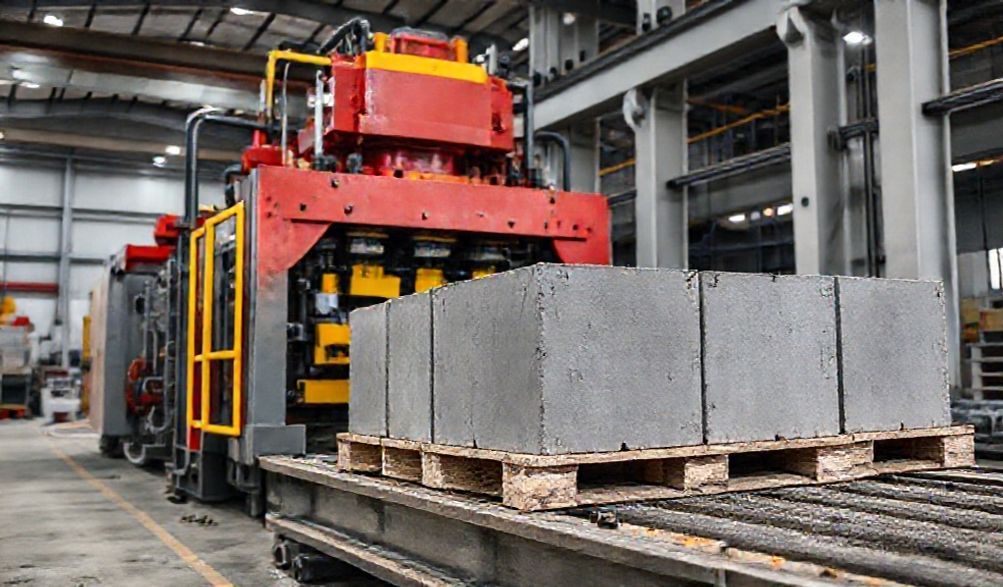
Полное руководство по полностью автоматической машине для производства бетонных блоков QT4-18
Строительная отрасль по всему миру сталкивается с постоянной проблемой: необходимостью в высококачественных, доступных строительных материалах, производимых с такой скоростью, которая удовлетворяла бы растущий спрос. Для производителей блоков это означает огромное давление, связанное с необходимостью увеличения выпуска продукции, поддержания стабильности качества и контроля затрат, и всё это на фоне нехватки квалифицированной рабочей силы. Решение заключается в технологическом прогрессе. Здесь на помощь приходит полностью автоматическая машина для производства бетонных блоков — революционное оборудование, которое превращает сырьё в прибыль с высокой точностью и в больших масштабах. Среди них особенно выделяетсяПолностью автоматическая машина для производства бетонных блоков QT4-18, машина для формования блоковвыделяется как первоклассная модель, созданная для надежности и массового производства.
Это руководство представляет собой всесторонний экспертный анализ модели QT4-18. Мы выйдем за рамки рекламных брошюр, чтобы предоставить руководителям предприятий, владельцам бизнеса и инвесторам подробную, объективную информацию, необходимую для принятия обоснованного инвестиционного решения. Вы получите четкое представление о её технических характеристиках, рабочем процессе, реальной стоимости и ключевых факторах, которые отличают выгодную покупку от дорогостоящей ошибки.
Что такое полностью автоматическая машина для формования блоков QT4-18?
В своей основе QT4-18 представляет собой стационарный гидравлический вибропресс, предназначенный для непрерывного массового производства бетонных блоков. Он знаменует собой значительный скачок от ручных или полуавтоматических методов за счёт интеграции процесса формования в синхронизированную автоматизированную систему. Конструкция машины сосредоточена на долговечности, повторяемости и простоте эксплуатации, составляя сердцевину современного завода по производству блоков.
核心功能与设计理念
QT4-18 работает по принципу уплотнения подготовленной бетонной смеси в точную форму с использованием синхронизированной вибрации и гидравлического давления. Его прочная сварная стальная рама вмещает несколько ключевых подсистем, работающих согласованно:
- Система кормления:Питатель и распределитель, который точно дозирует бетонную смесь в полость формы.
- Система формования («Сердце»):Это включает в себя саму форму — сменный инструмент, определяющий форму блока, — а также мощные вибрационные двигатели и гидравлические цилиндры, уплотняющие материал.
- Гидравлическая система:Обеспечивает необходимое усилие высокого давления для уплотнения и перемещения различных частей, таких как стол пресс-формы и съемная головка.
- Система паллетного конвейера:Перемещает стальные или деревянные поддоны (на которых находятся свежеотформованные блоки) через машину точно и пошагово.
- Шкаф интеллектуального управления ПЛК:«Мозг» машины. Этот программируемый логический контроллер автоматизирует весь цикл, отслеживает операции и предоставляет интерфейс для операторов.
Расшифровка названия модели: QT4-18 Технические характеристики
Название модели "QT4-18" — это код, раскрывающий её ключевые возможности. В соответствии с отраслевой номенклатурой:
* "КТ"обозначает серию машин, обычно представляющую стационарные гидравлические блочные машины.
* «4»Указывает количество стандартных кирпичей (400 мм x 200 мм), которое можно произвести за один цикл при использовании соответствующей формы.
* "18" refers to the nominal cycle time in seconds, from feeding to ejection.
Here are the key technical specifications that define its performance:
| Спецификация | Детали |
| :— | :— |
| Production Capacity (Theoretical) | Up to 4,320 blocks per 8-hour shift (based on a 400x200mm block, 18-second cycle) |
| Время цикла | 15-18 seconds (adjustable based on product type) |
| Moulding Pressure | High hydraulic pressure (specific tonnage varies by manufacturer) |
| Потребление энергии | Approximately 30-40 kW (for the main host machine) |
| Вибросистема | Dual-axis, high-frequency vibration with hydraulic pressure |
| Система управления | PLC with color touchscreen interface |
| Вес машины | ~6,000 kg (varies with configuration) |
| Общие габариты (ДхШхВ) | ~6.5m x 2.5m x 3.2m (approx.) |
Важное примечание: The “blocks per shift” figure is a theoretical maximum under ideal conditions. Real-world output depends on raw material quality, product type, and operational efficiency.
Ключевые особенности и технологические преимущества
Full Automation and PLC Intelligent Control
The term “full automatic” signifies a profound shift in plant operation. While the QT4-18 machine itself automates the moulding process, it is designed to be the centerpiece of a fully automated line. This line can include automatic batching, mixing, conveying, curing, and stacking systems. The PLC control is the cornerstone of this automation.
- Precision & Repeatability: Every cycle is identical, eliminating human error in timing and pressure application.
- Сокращение рабочей силы: Typically, only 1-2 workers are needed to monitor the control panel and manage pallets, compared to 5-8 for equivalent semi-automatic output.
- Diagnostics & Safety: The PLC monitors system health, provides fault alarms, and includes safety interlocks to protect both the machine and operators.
High-Pressure Vibration and Superior Block Quality
Block strength and finish are non-negotiable for market acceptance. The QT4-18 employs a dual-compaction strategy:
1. Высокочастотная вибрация: Fluidizes the concrete mix, allowing it to flow into every corner of the mould.
2. Simultaneous Hydraulic Pressure: Compacts the vibrated material from the top, removing air pockets and achieving high density.
This combination produces blocks with:
* High compressive strength (readily meeting or exceeding common standards like ASTM C90).
* Excellent dimensional accuracy and sharp edges.
* A smooth, consistent surface finish that requires less plastering.
Versatility in Production: Beyond Standard Bricks
A significant advantage of the QT4-18 is its product flexibility. By simply changing the mould—a task that can often be completed in under an hour—the same machine can produce a diverse product portfolio:
- Пустотелые блоки: (e.g., 4″, 5″, 6″, 8″)
- Твердые блоки
- Брусчатка и тротуарная плитка
- Бордюрные камни
- Grass Blocks
It is also compatible with a wide range of raw materials, allowing for cost optimization and sustainable practices: Portland cement, sand, gravel/crushed stone, fly ash, slag, and other industrial by-products.
Operational Workflow and Production Line Integration
From Raw Material to Finished Block: A Step-by-Step Process
Understanding the workflow within a typical plant setup clarifies the machine’s role:
- Подготовка сырья: Aggregates, cement, and water are batched and mixed in a pan or planetary mixer to achieve a uniform, semi-dry concrete consistency.
- Кормление: The mix is conveyed (via belt conveyor or forklift) into the QT4-18’s feed hopper.
- Moulding Cycle: The PLC initiates the automated cycle: the feed box distributes mix into the mould cavity on a pallet; the mould table rises into vibration; hydraulic pressure is applied; the mould descends, and the freshly formed block is stripped onto the pallet.
- Pallet Ejection & Curing: The loaded pallet is pushed onto a roller conveyor, moving to a brick stacker which places blocks onto curing racks. These racks are transferred to a curing chamber (steam or ambient) for strength development.
- Return Cycle: The empty pallet is cleaned and conveyed back to the start of the QT4-18, completing the loop.
Essential Auxiliary Equipment for a Complete Plant
The QT4-18 is the core, but not a standalone solution. For a functional and profitable plant, it must be integrated with auxiliary equipment:
- Бетономешалка: A compulsory partner for consistent mix quality.
- Ленточный конвейер: For efficient material transport to the hopper.
- Block Stacker: Automatically places green blocks onto curing racks.
- Brick Forklift / Pallet Truck: For moving heavy racks of blocks.
- Pallet Return System: A network of rollers or chains that returns empty pallets.
- Система лечения: Can range from simple sheltered yards to automated steam curing rooms.
Investing in the right supporting equipment is as crucial as choosing the main block moulding machine.
Analyzing the Investment: Costs, ROI, and Market Potential
Understanding the Initial Investment and Operating Costs
The price of a QT4-18 is influenced by several factors: the manufacturer’s brand and reputation, the quality of components (e.g., Siemens vs. generic PLCs), the level of automation in the specific configuration, and shipping costs to your location.
Beyond the capital expenditure, responsible planning must account for ongoing operational costs:
* Maintenance: Regular lubrication, inspection, and replacement of wear parts (like mould liners, vibration mounts, and hydraulic seals).
* Потребление энергии The main machine and entire line’s power draw.
* Труд: Reduced but still present for supervision, maintenance, and handling.
* Raw Materials & Pallets: The recurring cost of goods sold.
Calculating Your Return on Investment (ROI)
A simplified ROI framework can guide your decision:
- Estimate Daily Production: Use a realistic output (e.g., 70% of theoretical max) for your primary product.
- Determine Local Market Price: Research the selling price per block in your region.
- Calculate Cost Per Block: Sum all variable costs (materials, energy, labor, maintenance) per block.
- Analyze Gross Profit: (Selling Price – Cost Per Block) x Daily Production = Estimated Daily Gross Profit.
- Project Payback Period: (Total Plant Investment Cost) / (Estimated Daily Gross Profit x Operating Days/Year).
Key ROI Drivers: The primary financial benefits of the QT4-18 come from its эффективность (more blocks per hour) and dramatic labor savings. It also reduces waste through consistency and improves your competitive position with higher-quality products.
Critical Factors for Choosing the Right Supplier
Evaluating Manufacturer Expertise and After-Sales Service
The supplier you choose can make or break your project. Prioritize manufacturers with:
* Proven Experience: Look for companies with a decade or more in heavy machinery manufacturing.
* Comprehensive Service: They must offer installation supervision (or detailed guidance), operator training, and readily available technical support.
* Наличие запасных частей: Ensure they stock and can quickly ship critical wear parts for the block moulding machine.
Quality Benchmarks: What to Look For in the Machinery
During your evaluation, go beyond the sales pitch:
* Качество сборки: Inspect the thickness of steel plates, the quality of welding, and the robustness of the frame.
* Компонентные бренды: Reputable manufacturers use known brands for critical parts (e.g., Siemens/Delta PLCs, Schneider electrics, Rexroth hydraulics, WEG motors).
* Условия гарантии: A clear, comprehensive warranty (typically 1 year for parts) is a sign of confidence.
* Проверка: Always ask for customer references and, if feasible, visit an existing plant to see the machine in operation. Videos from the supplier are useful but not a substitute for independent verification.
Frequently Asked Questions (FAQ)
Q1: What is the actual production capacity of the QT4-18 machine per day?
A: While the theoretical capacity is ~4,300 blocks/8 hours, a practical, sustainable output for hollow blocks is between 2,800 and 3,500 blocks, accounting for mould changes, maintenance breaks, and material handling.
Q2: How many workers are needed to operate this full automatic brick making machine?
A: For the core moulding process, 1-2 workers are sufficient to monitor the PLC, manage pallet flow, and perform basic checks. A complete plant with mixing and stacking may require 3-4 personnel per shift.
Q3: What is the difference between the QT4-18 and semi-automatic or manual block machines?
A: Manual machines require constant physical labor for every cycle. Semi-automatic machines mechanize some steps (like vibration) but require manual feeding and block removal. The QT4-18 is fully automatic, running continuous cycles with minimal human intervention, leading to exponentially higher output and consistency.
Q4: Can this machine use fly ash or other industrial waste as raw material?
A: Yes, absolutely. The QT4-18 is well-suited for using fly ash, slag, or even certain types of construction waste. These materials can reduce costs and improve block workability, but mix design ratios must be tested for optimal strength.
Q5: How do I source and change the moulds for different block types?
A: Moulds are purchased from your machine supplier or specialized mould makers to ensure perfect compatibility. Changing a mould involves loosening bolts, removing the old mould, positioning the new one, and re-aligning—a task trained operators can do in 30-60 minutes.
Q6: What kind of foundation and factory space is required for installation?
A: A solid, level concrete foundation (approx. 300mm thick) is mandatory to absorb vibration. The total plant space needed, including area for raw materials, mixing, curing, and block storage, is typically a minimum of 1,500-2,000 square meters for efficient operation.
Q7: What are the most common maintenance points for ensuring long machine life?
A: Daily: Clean the machine and check for loose parts. Weekly: Lubricate all moving joints and check hydraulic oil levels. Periodically: Inspect and replace wear parts—mould liners, conveyor rollers, vibration motor mounts, and hydraulic seals—as needed.
Заключение
The QT4-18 full automatic concrete block making machine represents a robust, efficient, and intelligent solution for entrepreneurs and companies aiming to establish or upgrade a medium-to-large-scale block production facility. Its blend of high-pressure vibration, PLC automation, and product versatility makes it a powerful engine for profitability.
However, success hinges on more than just purchasing a well-specified machine. It requires thorough due diligence: selecting a reputable supplier with strong after-sales support, carefully planning the integration of all auxiliary equipment, and conducting a realistic analysis of your local market demand and cost structure. View your investment as a complete production line ecosystem, with the QT4-18 as its core.
Call to Action: Before making a decision, consult with multiple suppliers, request detailed quotations that break down every component and cost, and insist on speaking to their existing customers. Arm yourself with information to ensure your investment builds a foundation for long-term success.
<