Gabay sa Mga Antas ng Automasyon sa Kagamitan sa Paggawa ng Brik
Panimula
Sa larangan ng mga kagamitan sa paggawa ng ladrilyo, ang pagkakaiba sa pagitan ng awtomatiko at manwal na makina ay kumakatawan sa higit pa sa isang simpleng pagpili ng istilo ng pagpapatakbo; ito ang humuhubog sa buong modelo ng negosyo, kakayahang mag-scale, at posisyon sa merkado ng isang pasilidad ng produksyon.
Pagpapakahulugan sa Spektrum: Mula sa Sistemang Pinatatakbo ng Tao hanggang sa Ganap na Awtonomong Sistema
Ang pag-uuri ng makinarya para sa ladrilyo ay pinakamainam na maunawaan bilang isang tuloy-tuloy na proseso ng awtomasyon, kung saan ang paglahok ng tao ay unti-unting napapalitan ng mga mekanikal at elektronikong sistema.
- Manual na Makina ng Bricks: Paggawa ng Tao bilang Pangunahing Tagapagpapagalaw
- Ang mga ito ay pangunahing mga aparatong mekanikal na lubos na umaasa sa pisikal na lakas at kontrol ng tao sa bawat yugto ng operasyon. Ang operator ang may pananagutan sa manwal na paglalagay ng hilaw na materyal sa hulma, pagpapagana ng isang lever o mekanismo ng flywheel para mag-aplay ng puwersa ng pagpiga, at pagkatapos ay manwal na pagkuha ng nabuong ladrilyo at paglalagay nito para sa pagpapatibay. Ang makina mismo ay walang independiyenteng pinagmumulan ng kapangyarihan para sa mga pangunahing tungkulin nito. Ang buong ritmo ng proseso, pagkakapare-pareho ng kalidad, at output ay direktang nakadepende sa kasanayan, lakas, at tibay ng operator.
- Semi-Automatic Brick Machines: Ang Hybrid na Punto ng Pagbabago
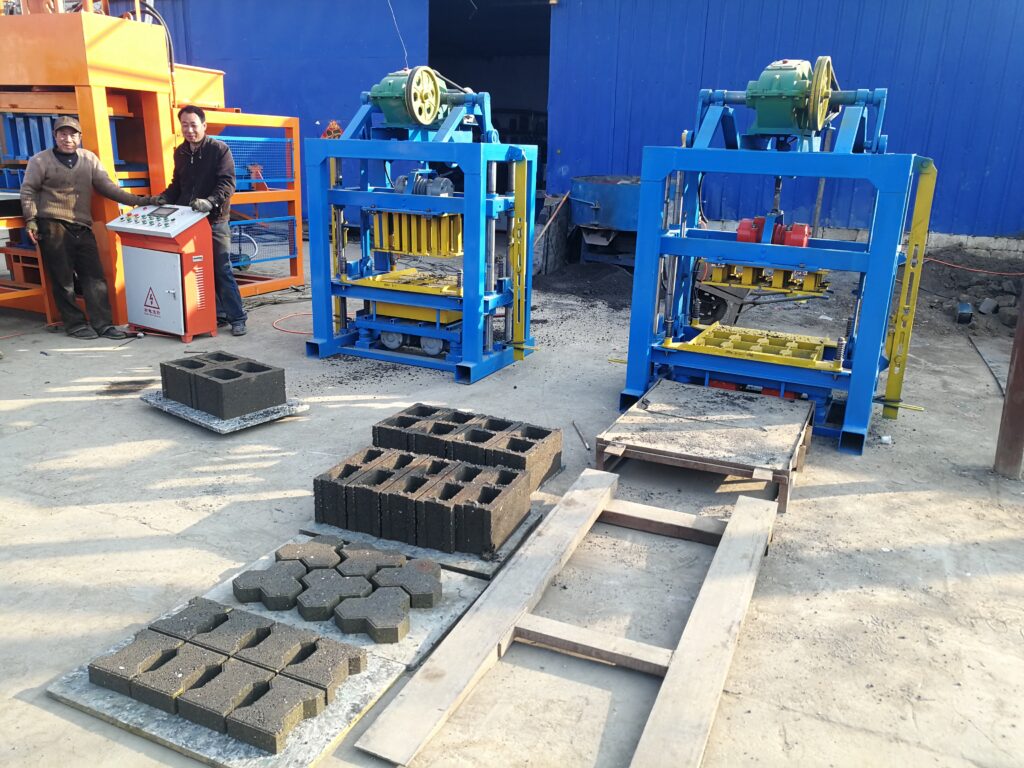
- Ang kategoryang ito ay naglalahad ng mekanisadong kapangyarihan sa pinaka-pagod na bahagi ng ikot—ang pagpiga—karaniwan sa pamamagitan ng isang de-kuryenteng motor na nagpapatakbo ng isang haydrolik na bomba o mekanikal na pindot. Ang papel ng operator ay nagbabago mula sa pagbibigay ng puwersa tungo sa pamamahala ng proseso. Sila ang manu-manong naglalagay ng materyal sa makina (o sa isang maliit na imbakan) at kadalasang nagsisimula ng siklo ng pagpiga sa pamamagitan ng isang buton o lever. Ang makina ang awtomatikong magsasagawa ng pagkakapatong at paglabas ng mga ladrilyo. Nananatiling mahalaga ang operator sa paghawak ng materyales, paglalagay ng paleta (kung ginagamit), at pag-aalis ng mga ladrilyo. Ang antas na ito ay nag-aalok ng balanse, binabawasan ang pisikal na pagod habang pinapanatili ang mas mababang gastos kumpara sa ganap na awtomasyon.
- Ganap na Awtomatikong Makina ng Bricks: Integradong Sistema ng Awtomasyon
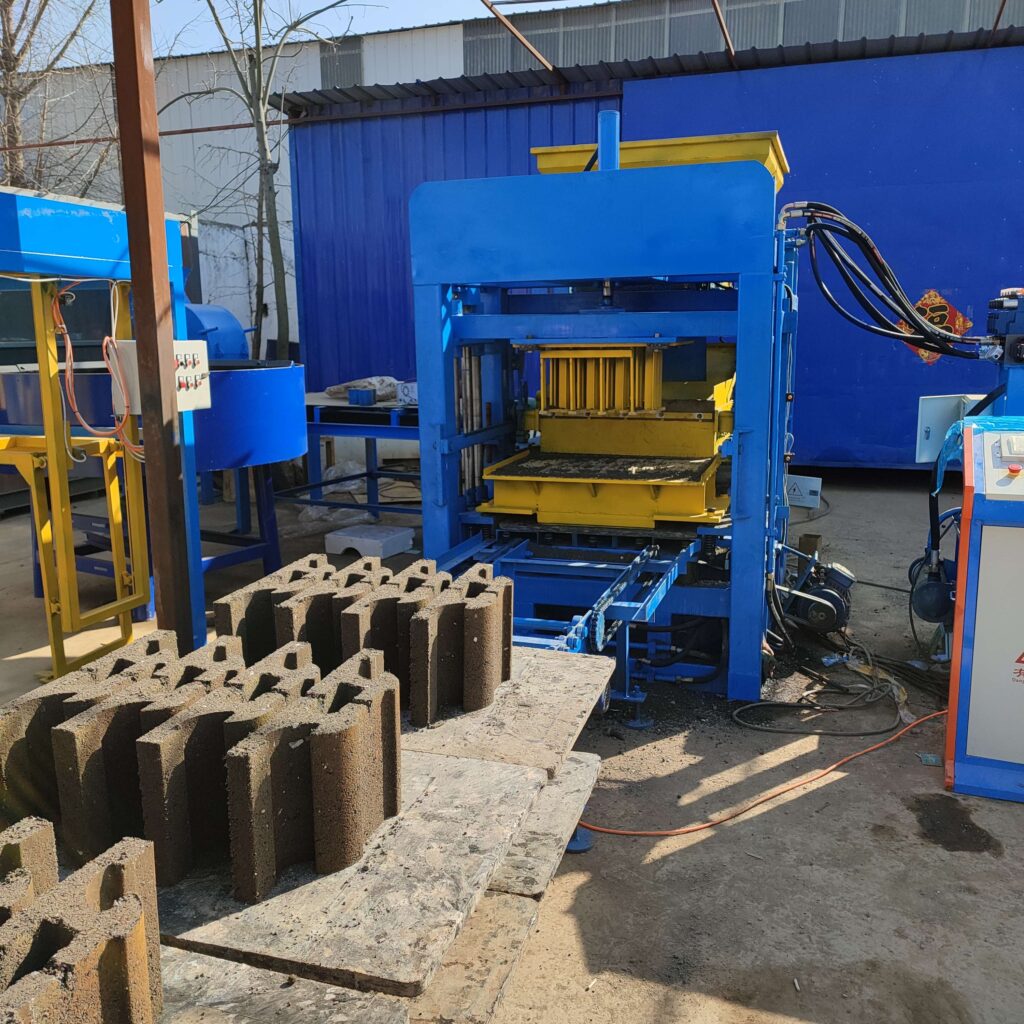
- Ito ay mga kumpletong sistema ng produksyon kung saan ang paglahok ng tao ay limitado sa pangangasiwa, pagsubaybay, at karaniwang pagpapanatili. Pinagsasama-sama nila ang ilang mga awtomatikong subsystem.
- Awomatikong Pagpapakain ng Materyal:Mula sa isang malaking overhead hopper sa pamamagitan ng mga conveyor o feeder.
- Awomatikong Pagpapalibot ng Pallet:Ang isang closed-loop system ay naglilipat ng mga palet papasok sa press, nagpoposisyon sa mga ito, at naglilipat palabas ng mga palet na may laman.
- Kontrol na Mapoprograma:Ang PLC ay namamahala sa buong naka-synchronize na cycle—pagpuno, pagpindot, paglabas, at pag-stack—kadalasang may isang operator na nagmamanman mula sa control panel.
- Pinagsamang Paghawak ng ProduktoAng mga automated stacker, robotic arm, o conveyor lines ay naglilipat ng mga berdeng laryo papunta sa mga lugar ng pagpapagaling.
- Ang papel ng operator ay nagiging katulad ng isang tagapangalaga ng makina at tagakontrol ng proseso.
- Ito ay mga kumpletong sistema ng produksyon kung saan ang paglahok ng tao ay limitado sa pangangasiwa, pagsubaybay, at karaniwang pagpapanatili. Pinagsasama-sama nila ang ilang mga awtomatikong subsystem.
Paghahambing na Pagsusuri: Isang Multi-Dimensyonal na Ebalwasyon
Ang pagpili sa pagitan ng mga sistemang ito ay may kinalaman sa mga kompromiso sa ilang kritikal na parameter ng negosyo at operasyon.
- Mga Kinakailangan sa Paggawa at Profile ng Kakayahan
- Manwal:Mataas ang intensity ng paggawa. Nangangailangan ng maraming manggagawang walang kasanayan o may limitadong kasanayan upang makamit ang makabuluhang output. Direktang proporsyonal ang produktibidad sa laki ng grupo at tibay ng mga manggagawa.
- Semi-Awomatiko: Reduced physical labor but still requires consistent operator attendance. May need 1-2 operators per machine for feeding and product handling. Basic machine operation skills are needed.
- Ganap na Awomatiko: Drastically reduced direct labor. A single skilled operator can oversee multiple machines or an entire line. The required skill set shifts towards basic mechatronics, PLC interface literacy, and preventative maintenance.
- Production Capacity and Output Consistency
- Manwal: Very low and highly variable output (e.g., 200-500 bricks per 8-hour shift, per machine). Consistency in brick weight, density, and dimensions depends entirely on the operator’s consistent technique, which is difficult to maintain.
- Semi-Awomatiko: Moderate and more stable output (e.g., 800-2,500 bricks per 8-hour shift). The machine ensures consistent compaction pressure and cycle time, but variations in manual feeding can still cause some product variance.
- Ganap na Awomatiko: High and extremely consistent output (e.g., 3,000-15,000+ bricks per 8-hour shift). The automated, repetitive cycle guarantees near-identical product quality for every unit, batch after batch. Output is predictable and scalable.
- Initial Capital Investment and Operational Economics
- Manwal: Very low initial capital outlay. The primary cost is the machine itself. However, the cost-per-brick is high when factoring in intensive labor costs and low output.
- Semi-Awomatiko: Moderate capital investment. Offers a favorable balance for small to medium enterprises (SMEs) by increasing output without a quantum leap in price. Operational costs include power and moderate labor.
- Ganap na Awomatiko: High initial capital investment. However, the cost-per-brick is typically the lowest in the long run due to high output, minimal labor costs, and optimized material use. Justification is based on volume and return on investment (ROI) calculations.
- Product Quality and Technological Sophistication
- Manwal: Quality is artisan-like and variable. Suitable for niche, non-standardized products but risky for contracts requiring strict adherence to engineering specifications.
- Semi-Awomatiko: Good and reliable quality for standard bricks. Capable of meeting common commercial standards, as key parameters are machine-controlled.
- Ganap na Awomatiko: Excellent and precise quality. Essential for high-specification products like precision interlocking pavers, engineered masonry units, or where certification (e.g., ASTM, ISO) is required. Often includes data logging and quality monitoring features.
Strategic Selection Criteria for Client Advisory
Choosing the appropriate level of automation is a strategic decision. Key client assessment points include:
- Market Demand and Project Scale
- Is the client supplying a local, small-scale housing project (favoring semi-automatic) or bidding on large infrastructure contracts requiring guaranteed, high-volume supply (necessitating fully automatic)? The scale and consistency of demand are primary drivers.
- Capital Availability and Investment Horizon
- What is the client’s access to finance? A manual/semi-automatic machine can be a bootstrapping tool to generate capital for future automation. A fully automatic line requires significant upfront capital but a faster ROI if the market is ready.
- Local Labor Costs and Skill Availability
- In regions with low labor costs and limited technical training, semi-automatic machines may offer the most practical economic balance. In high-wage economies or areas with a skilled technician base, the labor-saving calculus strongly favors full automation.
- Business Growth Trajectory and Scalability
- A semi-automatic machine can be a starting point. Some systems are designed to be “automation-ready,” allowing for the later addition of pallet circulators and auto-feeders. Fully automatic lines are the end-state for scalable, industrial production.
The Hidden Considerations: Beyond the Purchase Price
- Infrastructure and Utility Requirements
- Manwal: Requires minimal infrastructure—a flat, sheltered space.
- Semi-Awomatiko: Requires a reliable electrical connection of moderate power.
- Ganap na Awomatiko: Demands robust three-phase electrical supply, significant floor space for the production line and curing area, often compressed air, and a stable concrete foundation.
- Maintenance Complexity and Downtime Risk
- Manwal: Simple mechanical maintenance; low skill required. Downtime has limited financial impact.
- Semi-Awomatiko: Requires basic hydraulic and electrical troubleshooting skills.
- Ganap na Awomatiko: Demands advanced preventative maintenance schedules and access to technical support for PLCs, sensors, and complex mechanical systems. Unplanned downtime is very costly, making service agreements crucial.
- Flexibility and Changeover Time
- Manwal: Highly flexible for custom one-off products; changeover is instant.
- Semi-Awomatiko: Relatively easy mold changeovers; good for short production runs of different products.
- Ganap na Awomatiko: Changeovers (e.g., mold and program changes) can be more time-consuming. Economically justified for long runs of a single product type, though advanced lines offer faster changeover features.
Konklusyon
For the equipment distributor, the conversation about automation is a conversation about the client’s business future. There is no universally “best” option; only the most appropriate solution for a given set of commercial, logistical, and aspirational conditions. A manual machine is a tool for livelihood creation in a micro-enterprise. A semi-automatic machine is the engine for a stable, growing small business. A fully automatic line is the cornerstone of an industrial-scale operation competing on quality, cost, and volume. By comprehensively evaluating factors from local labor economics to client growth ambitions, distributors can provide invaluable strategic guidance. This consultative approach—positioning the right level of automation as a key to unlocking specific market opportunities—builds enduring partnerships and establishes the distributor as an essential architect of their clients’ success in the competitive construction materials industry.
Mga Madalas Itanong (FAQ)
Q1: Can a semi-automatic machine be upgraded to a fully automatic one later?
Isalin ang teksto sa Filipino. I-output LAMANG ang isinalin na teksto. In some cases, yes, but with important caveats. The core press of a well-designed semi-automatic machine might be compatible with add-on modules like an automatic feeder, a pallet return system, and a stacker. However, this depends entirely on the original machine’s design (frame strength, control system compatibility, etc.). The upgrade cost can approach that of a new system, and performance may not match a purpose-built automatic line. It is crucial to discuss “automation readiness” with the manufacturer at the initial purchase if this is a potential future path.
Q2: Which automation level offers the fastest return on investment (ROI)?
Isalin ang teksto sa Filipino. I-output LAMANG ang isinalin na teksto. The ROI is highly context-dependent. In a low-wage, small-market setting, a semi-awtomatikong makina often offers the fastest and most reliable ROI due to its moderate cost and significant productivity jump over manual labor. In a high-volume, competitive market or a region with high labor costs, a ganap na awtomatikong makina, despite its high initial cost, can achieve a faster ROI due to its very low per-unit production cost and high output, provided it operates near capacity.
Q3: How significant is the difference in final product quality between a semi-automatic and a fully automatic machine?
Isalin ang teksto sa Filipino. I-output LAMANG ang isinalin na teksto. While a well-operated semi-automatic machine can produce bricks that meet standard specifications, a fully automatic machine provides superior consistency. It eliminates human variability in feeding and cycle initiation, ensuring every brick is compressed with identical pressure and timing. This leads to tighter tolerances on dimensions, more uniform density and strength, and a more consistent visual appearance—critical for large, high-profile projects where batch uniformity is non-negotiable.
Q4: What are the typical power requirements for each tier?
Isalin ang teksto sa Filipino. I-output LAMANG ang isinalin na teksto.
- Manwal: No external power required.
- Semi-Awomatiko: Typically requires a standard single-phase or three-phase electrical connection, with power ratings commonly ranging from 5 HP to 15 HP for the motor driving the hydraulic system.
- Ganap na Awomatiko: Invariably requires a robust three-phase electrical supply. Total connected power can range from 25 HP to over 100 HP, accounting for the main press, conveyor motors, mixer, hydraulic power units, and control systems.
Q5: Is operator safety a differentiator between these types?
Isalin ang teksto sa Filipino. I-output LAMANG ang isinalin na teksto. Absolutely. Mga Makinang Manwal carry high risks of repetitive strain injury and physical fatigue. Semi-awtomatikong makina introduce moving parts and hydraulic pressure; operators must keep hands clear during the auto-cycle, requiring basic safety training. Fully automatic machines pose the highest inherent mechanical risk due to multiple synchronized moving parts but are equipped with comprehensive safety features like guarded zones, light curtains, emergency stop circuits, and lock-out/tag-out procedures, making the overall environment safer when protocols are followed. The risk shifts from physical strain to one of managing complex machinery.