
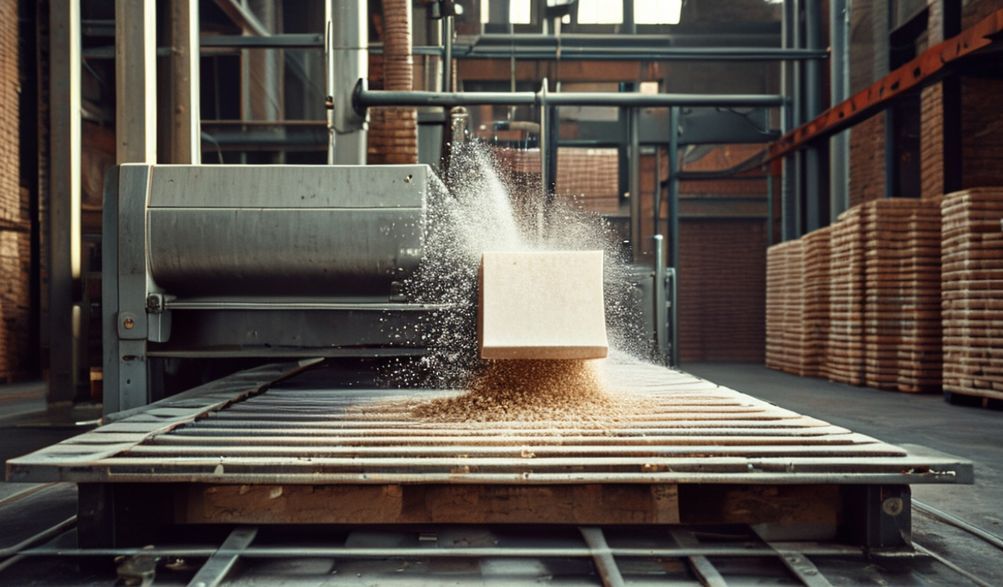
Révolutionner la production de briques : La machine à imprimer des blocs à l'usine de fabrication de briques FUDA
Depuis des siècles, l'industrie de la construction est aux prises avec un défi fondamental : se procurer des briques de qualité constante, élevée et abordable. Les dimensions incohérentes, la résistance variable et la production à forte intensité de main-d'œuvre ont entravé les projets, entraînant des retards, des dépassements de coûts et une intégrité structurelle compromise. Aujourd'hui, une solution technologique redéfinit le paysage de la fabrication des briques : la machine à imprimer les blocs.
À l'avant-garde de cette évolution industrielle se trouve l'usine de fabrication de briques FUDA. Réputée comme un leader du secteur, FUDA a bâti sa réputation sur un engagement constant à adopter des technologies avancées, non pas comme une simple mise à niveau, mais comme une philosophie centrale pour accroître l'efficacité, rehausser la qualité des produits et répondre aux énormes demandes de la construction moderne.
Cet article offre une exploration approfondie de la machine d'impression par blocs telle qu'elle est déployée chez FUDA. Nous analyserons son fonctionnement, quantifierons ses avantages tangibles et démontrerons comment elle incarne la référence en matière de fabrication de briques moderne et fiable. S'appuyant sur des informations ancrées dans les pratiques industrielles et les spécifications techniques, ce guide constitue une ressource fiable pour les constructeurs, les entrepreneurs, les promoteurs et les professionnels de la fabrication qui cherchent à comprendre la machinerie qui bâtit notre monde.
Qu'est-ce qu'une machine d'impression par blocs ? Explication de la technologie de base
Pour en apprécier l’impact, il faut d’abord comprendre la machine elle-même. Dans le contexte de la fabrication de briques, le terme « impression par blocs » dépasse son association avec les textiles. Ici, il représente un procédé sophistiqué de moulage de précision et de compactage à haute densité, où la matière première est « imprimée » en briques parfaitement formées et uniformes, avec une remarquable constance.
Définition du processus d'impression par blocs dans la fabrication de briques
Le processus de moulage par compression est une méthode de fabrication de briques ou de blocs de béton utilisant une machine qui emploie une compaction à haute pression dans un moule rigide, ou « matrice ». Une quantité précisément mesurée de matière première — typiquement un mélange de béton humide (ciment, sable, granulats) ou de terre stabilisée — est introduite dans une chambre. Un vérin hydraulique ou mécanique applique alors une pression immense, comprimant la matière dans la forme du moule. Cette action non seulement forme le bloc, mais compacte aussi densément les particules, ce qui est crucial pour la résistance du produit final. Le bloc fraîchement formé est ensuite éjecté sur une palette, prêt pour la cure.
Composantes clés d'une machine d'impression par blocs moderne
Une machine moderne d'impression par blocs est un système intégré composé de plusieurs éléments critiques :
- Système de trémie et d'alimentateur :C'est le point de départ. La trémie stocke le mélange de matières premières, et le système d'alimentation, souvent un convoyeur ou un agitateur, assure un flux constant et contrôlé vers la chambre de moulage.
- Chambre de moulage et matrices :Le cœur de la machine. La chambre abrite des matrices en acier interchangeables qui définissent la forme et la taille de la brique. Chez FUDA, une bibliothèque de matrices permet la production de divers types.
- Blocs pleins :Pour les murs porteurs maximaux.
- Blocs creux :Plus léger, avec de meilleures propriétés d'isolation.
- Briques d'emboîtement :Conçu pour s'emboîter sans mortier, accélérant ainsi la construction.
- Pavés et blocs décoratifs :Pour les applications paysagères et esthétiques.
- Système de compression hydraulique ou mécanique :Cela fournit la force. Les systèmes hydrauliques sont appréciés pour leur pression fluide, contrôlable et immense, qui peut être précisément calibrée pour différents mélanges de matériaux et densités de briques souhaitées.
- Système d'Éjection et de PalettisationUne fois compacté, le système éjecte délicatement le bloc vert (non durci) sur une palette ou une plaque d'acier. Un empileur automatisé superpose souvent plusieurs blocs sur une seule palette pour un déplacement efficace vers la zone de durcissement.
Machine à imprimer en blocs vs. Méthodes traditionnelles de fabrication de briques
Le contraste avec les méthodes plus anciennes est frappant :
- Moulage Manuel : Relies entirely on skilled labor, resulting in significant variations in size, density, and finish. Output is low, and the process is physically demanding.
- Extrusion Machines: These machines force material through a die to form a continuous column, which is then cut into bricks. While faster than manual methods, extrusion can sometimes produce bricks with less uniform density compared to the direct, omnidirectional pressure of a block print machine.
- The Block Print Advantage: It combines high automation with precision engineering. Every cycle produces a brick with near-identical dimensions and density. It dramatically reduces labor dependency, increases output exponentially, and ensures a product that meets strict engineering specifications.
Inside the FUDA Brick Making Factory: A Case Study in Efficiency
FUDA Brick Making Factory operates as a living testament to the power of strategic technological investment. Their facility is not just a collection of machines; it’s a synchronized ecosystem designed for peak performance.
FUDA’s Commitment to Technological Investment
FUDA’s philosophy is clear: consistency and scale are non-negotiable for serving large-scale commercial, industrial, and infrastructure projects. They view machinery like the block print machine not as an expense, but as the foundational investment for customer trust. By automating the core forming process, they eliminate human error from the equation, ensuring that every brick bearing the FUDA name meets an unwavering standard.
Integration into the Production Line
The block print machine is the pivotal component in a streamlined workflow:
- Préparation des matières premières : Carefully selected sand, aggregate, and cement are batched and mixed with precise water content to achieve the optimal consistency for compaction.
- Alimentation : The homogeneous mix is conveyed to the block print machine’s hopper.
- Printing/Compaction: The machine cycles automatically—filling, compacting, and ejecting bricks at a rapid, consistent pace.
- Guérison : Pallets of green blocks are moved to a controlled curing chamber, where heat and humidity are managed to allow the cement to hydrate fully, achieving its designed strength.
- Drying & Stacking: After curing, bricks are dried and then automatically stacked or packaged for shipment.
Quality Control and Output Specifications
This integrated system allows FUDA to enforce rigorous quality control. Bricks produced by their block print machines are characterized by:
- Précision dimensionnelle : Tolerances within ±1-2mm, ensuring straight walls and simplified bricklaying.
- Résistance à la compression élevée : The high-pressure compaction results in densities often exceeding 1500 kg/m³, with compressive strength reliably meeting or exceeding standards like IS 2185 (Part 1) for concrete blocks or relevant ASTM standards.
- Uniformité : Consistent color, texture, and weight across the entire production batch.
Top Advantages of Using a Block Print Machine for Brick Manufacturing
The adoption of block print technology delivers a compelling array of benefits that directly address the core challenges of construction.
Unmatched Product Consistency and Quality
This is the paramount advantage. Automated, cycle-after-cycle compression guarantees that every single brick has identical size, shape, and density. For architects, engineers, and masons, this consistency translates to predictable material usage, smoother construction processes, and structurally sound results.
High Production Speed and Scalability
While manual methods might produce a few hundred bricks per day, a single modern block print machine can produce 2,000 to 5,000 bricks per hour. This scalability is essential for FUDA to fulfill large orders and meet tight project deadlines without compromising on quality.
Significant Reduction in Labor Costs and Physical Strain
The machine shifts the role of personnel from strenuous manual labor to skilled machine operation, monitoring, and maintenance supervision. This improves worker safety, reduces long-term physical strain, and optimizes labor costs for the factory.
Material Efficiency and Waste Reduction
The precision feeding and molding process minimizes spillage and overuse. Furthermore, because the bricks are so consistent, the rejection rate due to defects plummets. This leads to direct cost savings on raw materials and promotes more sustainable manufacturing practices.
Versatility in Brick Design and Type
With a simple change of the mold die, the same block print machine can switch production from standard solid blocks to decorative pavers or interlocking landscaping bricks. This flexibility allows a factory like FUDA to cater to diverse market segments without capital investment in multiple dedicated production lines.
Key Considerations When Operating a Block Print Machine
Maximizing the return on this advanced technology requires attention to several operational factors.
Raw Material Preparation is Crucial
The block print machine is a precision tool, and its performance is directly tied to its input. Critical factors include:
* Proper Grading: Well-graded aggregates ensure optimal packing and strength.
* Accurate Ratios: Cement-sand-aggregate ratios must be strictly followed.
* Teneur en humidité : This is vital. Too dry, and the brick won’t compact properly; too wet, and it may deform upon ejection. FUDA’s automated batching systems meticulously control this variable.
Machine Maintenance for Longevity
Preventive maintenance is key to avoiding costly downtime. A basic schedule includes:
* Daily: Cleaning of the mold, hopper, and feed system; checking hydraulic fluid levels and for leaks.
* Weekly: Inspecting and tightening bolts, checking wear parts like mold liners and ram seals.
* Monthly/Annually: More thorough inspections, hydraulic fluid analysis and changes, and replacement of high-wear components as per the manufacturer’s manual.
Operator Training and Safety Protocols
A well-trained operator is the most important safety and efficiency feature. Training should cover:
* Machine startup/shutdown procedures.
* Safe operation, including lockout/tagout protocols.
* Basic troubleshooting and identification of common issues.
* Understanding the relationship between material input and machine output.
FAQ: Your Questions About Block Print Machines and FUDA Answered
Q1: What types of bricks can a block print machine at a factory like FUDA produce?
A : FUDA’s machines, through interchangeable molds, can produce a wide range, including: Solid Concrete Blocks (for foundations, load-bearing walls), Hollow Blocks (for partition walls, offering thermal/acoustic benefits), Paving Stones (for driveways, walkways), and Interlocking Bricks (for retaining walls, quick-assembly structures).
Q2: How does the block print process affect the final strength of the brick?
A : The high-pressure compaction (often measured in tons per square inch) forces particles closer together, eliminating voids and air pockets. This dense microstructure directly translates to higher compressive strength, making block-printed bricks ideal for structural applications.
Q3: Is the block print machine suitable for small-scale or startup brick yards?
A : The significant initial investment makes it most suitable for medium to large-scale production like FUDA’s. For small yards, the volume may not justify the cost. The decision hinges on a long-term ROI calculation, balancing capital expenditure against labor savings, material efficiency, and the ability to command a premium for consistent, high-quality products.
Q4: Can FUDA’s block print machines use recycled materials?
A : Yes, absolutely. Many modern block print machines are compatible with mixes incorporating industrial by-products like cendres volantes (a pozzolan) or crushed recycled concrete as partial aggregate replacements. This aligns with global trends toward sustainable construction and can improve certain properties of the final block.
Q5: How does FUDA ensure the reliability of its brick-making machinery?
A : FUDA employs a multi-pronged approach: 1) Procurement: Sourcing robust machines from reputable manufacturers known for durability. 2) Maintenance préventive : Adhering to a strict, scheduled maintenance regimen. 3) Expertise technique : Employing trained in-house technicians and maintaining relationships with equipment suppliers for specialized support. 4) Quality Inputs: Using high-grade components and raw materials to reduce machine wear.
Conclusion
The block print machine has unequivocally established itself as a cornerstone of efficient, high-quality brick production. As demonstrated by industry leaders like the FUDA Brick Making Factory, this technology is the bridge between raw material and reliable building component, ensuring consistency, strength, and scalability that manual or semi-automated methods cannot match.
Looking ahead, the evolution continues. We can expect further integration of the Internet of Things (IoT) for real-time machine monitoring and predictive maintenance, even greater automation in material handling, and continued innovation in sustainable material recipes for block printing.
For construction professionals, the lesson is clear: the integrity of a project begins with the quality of its most basic materials. Investing in—or sourcing from—manufacturers who utilize proven, precision technology like the block print machine is not just a procurement decision; it is a fundamental risk mitigation strategy. It ensures that the foundations of our buildings, homes, and infrastructure are as reliable as the engineering that designs them.
Call to Action: For your next project, specify machine-pressed, block-printed bricks to guarantee dimensional consistency and structural performance. When evaluating suppliers, prioritize those who, like FUDA, invest in advanced manufacturing technology—it is the most reliable indicator of a commitment to quality that will stand the test of time.
<