
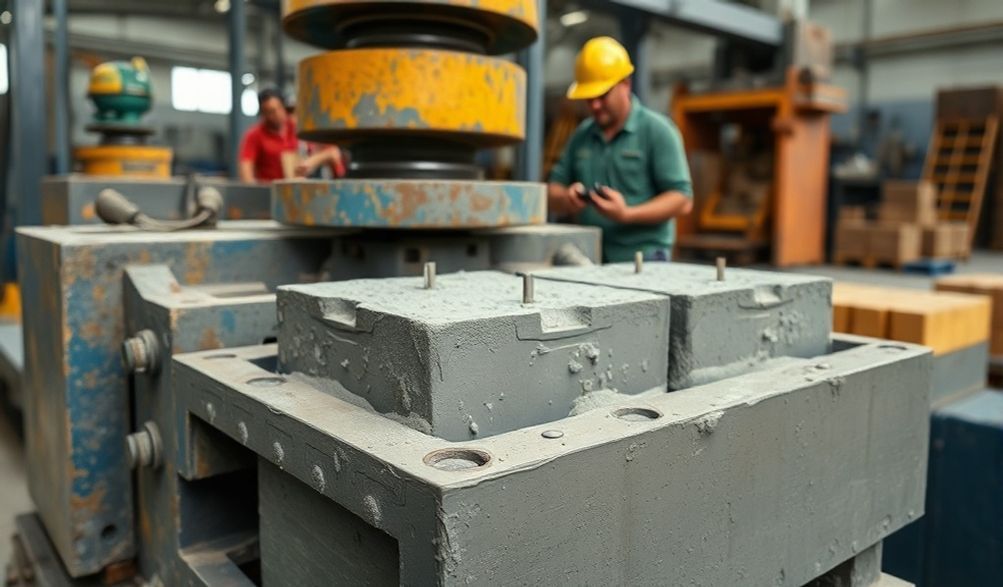
Le Guide Ultime de la Machine à Blocs 4-30A : Caractéristiques, Avantages et Fonctionnement
Introduction
Dans le monde de la fabrication de blocs de béton, l'efficacité et la fiabilité sont les fondements de la rentabilité. Pour les professionnels de la construction, les propriétaires de chantiers de blocs et les entrepreneurs qui cherchent à augmenter leur production, choisir la bonne machinerie est une décision cruciale qui a un impact sur le rendement, la qualité des produits et les résultats financiers. Ce guide complet se concentre sur un cheval de bataille de l'industrie : la4-30A Bloc-machine.
Forts de années d'expertise technique et d'expérience sur le terrain, cet article offre une analyse claire, autorisée et digne de confiance. Le 4-30A est bien plus qu'un simple équipement ; c'est une solution semi-automatique qui comble l'écart entre les machines manuelles à forte intensité de main-d'œuvre et les usines entièrement automatiques à forte intensité capitalistique. Nous allons décortiquer ses spécifications, son flux opérationnel et sa valeur économique, vous donnant ainsi tous les éléments pour prendre une décision d'investissement pleinement éclairée pour votre entreprise.
Qu'est-ce qu'une machine à blocs 4-30A ? Spécifications principales et conception
Le 4-30A est un modèle spécifique au sein d'une série largement reconnue de machines à fabriquer des blocs. Sa conception privilégie une construction robuste, une production régulière et une simplicité opérationnelle, ce qui en fait un favori pour les installations de production à petite et moyenne échelle.
Type et classification de la machine
Le 4-30A est classé comme unmachine semi-automatique stationnaire de fabrication de blocsCela signifie qu'il automatise le processus de formation des noyaux – vibration, compactage et moulage – mais nécessite qu'un opérateur effectue certaines tâches à chaque cycle, comme l'alimentation en matière première et le retrait des blocs finis. Cette classification le place parfaitement pour les entreprises prêtes à augmenter leur production au-delà des capacités manuelles, sans la complexité et le coût d'une ligne entièrement automatisée.
Décodage du numéro de modèle
Les numéros de modèles dans la machinerie industrielle sont rarement arbitraires. Bien que les spécifications puissent varier légèrement entre les fabricants, le « 4-30A » désigne généralement :
- « 4 »Le nombre de blocs de taille standard (par exemple, des blocs creux de 4 pouces) que la machine produit en un seul cycle.
- « 30 »Le temps de cycle approximatif en secondes dans des conditions optimales.
- « A »Désigne souvent la série de modèles ou une version améliorée, indiquant des améliorations par rapport à un modèle de base.
Cette convention de dénomination vous donne une compréhension immédiate et en un coup d'œil de la capacité principale de la machine : produire 4 blocs environ toutes les 30 secondes.
Spécifications physiques et techniques clés
Les chiffres exacts dépendent du fabricant, mais une machine standard de 4 à 30 A comprend généralement :
- Dimensions :Environ 2500 mm (L) x 1800 mm (l) x 2200 mm (H). Un espace suffisant pour les équipements périphériques est également requis.
- Poids :Généralement entre 2 800 et 3 500 kg, indiquant un cadre robuste et résistant aux vibrations.
- Exigences en matière d'alimentation électrique :Habituellement alimenté par un moteur électrique de 11 à 15 kW (15 à 20 HP) pour le système de vibration et un moteur distinct pour le bloc d'alimentation hydraulique.
- Système de contrôle :Fonctionne via un panneau de contrôleur logique programmable (PLC) pour le contrôle automatisé des cycles.
- Système hydraulique :Comprend une unité de puissance hydraulique avec réservoir d'huile, pompes, vannes et vérins responsables du mouvement vertical du moule et de la pression de la tête de bourrage.
Caractéristiques et composants clés de la machine 4-30A
La fiabilité et la qualité de sortie du 4-30A découlent de ses composants centraux bien conçus.
Système de moulage
C’est le cœur de la machine, où le béton est transformé en un bloc précis.
- Boîte de moulage: A heavy-duty, precision-welded steel assembly that defines the block’s external dimensions. It’s designed for easy changeover to produce different block types.
- Core Rods: These create the hollow cavities in blocks. They are mounted on a core plate and must be robust to withstand constant vibration and pressure.
- Tête de falsification : Also called the “press head,” it descends into the mold box to apply pressure on the concrete during vibration, ensuring top surface compaction and uniform density.
Vibration Mechanism
Superior compaction is non-negotiable for strong, durable blocks. The 4-30A employs a dual-vibration system:
- Table Vibration: The entire mold table vibrates at high frequency, ensuring compaction from the bottom up.
- Head Vibration: The tamper head also vibrates, compacting the concrete from the top down.
This synchronized action from both directions eliminates voids and achieves the high density required for load-bearing blocks and pavers.
Control System & Automation Level
The PLC-based control panel is the machine’s brain, offering:
- Automated Cycle Sequencing: The operator initiates a single cycle, and the PLC automatically controls the sequence: mold descent, material feed, vibration, head pressure, mold rise, and block ejection.
- Adjustable Parameters: Vibration time, pressure duration, and cycle delays can often be adjusted to fine-tune the process for different mix designs.
- Manual Override: Critical for setup, maintenance, and troubleshooting. Safety interlocks prevent operation during manual interventions.
- Fault Diagnostics: Basic models may have indicator lights, while advanced panels display error codes for quicker problem resolution.
Production Capacity and Output Expectations
Understanding real-world output is crucial for business planning. Theoretical maximums are often different from sustainable daily production.
Understanding Cycle Time and Daily Output
The “30” in 4-30A suggests a 30-second cycle time. In practice, a well-run machine with a skilled operator can achieve a cycle time of 35-45 seconds, accounting for material feeding and block removal.
Calcul de sortie :
* Par heure : (3600 seconds / 40-second cycle) * 4 blocks = ~360 blocks/hour.
* Par quart de travail de 8 heures : 360 blocks/hour * 8 hours = ~2,880 blocks.
* Per 24-Hour Day (3 shifts): Up to ~8,640 blocks.
Important: This is a sustainable estimate. Output can be higher with perfect conditions or lower during mold changes, maintenance, or with slower material handling.
Compatible Block Types and Sizes
The 4-30A’s versatility is a key selling point. With the appropriate mold, it can produce:
* Blocs creux : 4″, 6″, 8″ thickness (most common).
* Solid Blocks.
* Pavés autobloquants (for landscaping and driveways).
* Bordure de trottoir and other specialty products (may require specific mold kits).
Factors Influencing Production Rate
Maximizing output depends on more than just the machine:
* Raw Material Consistency: A well-proportioned, semi-dry concrete mix with consistent moisture content is essential. Wet or inconsistent mix causes sticking and delays.
* Pallet Quality & System: Worn or warped pallets cause block damage and machine jams. A manual or automated pallet return system drastically improves workflow.
* Operator Skill & Rhythm: An experienced, efficient operator is the most important factor in achieving target cycle times.
* Maintenance préventive : Unplanned downtime is the biggest killer of production targets. A disciplined maintenance schedule is non-negotiable.
Operational Workflow and Best Practices
Proper operation ensures safety, quality, and machine longevity.
Step-by-Step Operating Procedure
- Préparation : Ensure the machine is lubricated, the hydraulic oil level is correct, and the mold is clean and secured.
- Mix Loading: The operator places a pallet on the feeding table and shovels or uses a feeder to deposit the concrete mix into the mold box.
- Initiation du cycle : The operator presses the cycle start button on the PLC panel.
- Automated Cycle: The machine sequentially lowers the mold, activates dual vibration, lowers the tamper head for pressure, releases vibration, raises the mold, and ejects the block onto the pallet.
- Retrait de bloc : The operator (or a helper) removes the pallet with the fresh block and transfers it to the curing area, replacing it with a new empty pallet.
- Répétition : The process repeats for the next cycle.
Essential Safety Protocols
- Mandatory PPE: Safety glasses, steel-toe boots, and hearing protection.
- Sécurité des machines : Never bypass safety guards or interlocks. Keep hands clear of the mold area during automatic cycles.
- Lockout/Tagout: Always disconnect power and lock out the control panel before performing any maintenance or clearing a jam.
Routine Maintenance Checklist
Daily:
* Clean the mold box, core rods, and tamper head thoroughly after production.
* Check hydraulic oil levels and for any leaks.
* Inspect electrical connections.
* Lubricate all guide rods and moving parts as per the manual.
Weekly:
* Check and tighten all bolts and nuts, especially on the vibration frame.
* Inspect hydraulic hoses for wear.
* Check the tension of drive belts (if applicable).
Monthly:
* Change hydraulic oil and filters as recommended.
* Inspect vibration motors and mounting bolts.
* Conduct a thorough inspection of the mold box for wear or damage.
Advantages and Considerations for Your Business
A balanced view helps assess if the 4-30A is the right fit.
Primary Benefits
- Rentabilité Offers a significantly higher output than manual machines at a fraction of the cost of a fully automatic plant.
- Réduction de la dépendance à la main-d'œuvre One skilled operator can run the machine, reducing labor costs per block compared to manual operations.
- Exceptional Durability: Built with heavy-duty steel and industrial components for a long service life in harsh environments.
- Qualité de produit constante : The automated vibration and pressing cycle produces blocks with uniform density, dimensions, and strength, enhancing your market reputation.
Investment and ROI Analysis
- Coût initial : The price for a new 4-30A machine typically ranges from $18,000 to $30,000, depending on the manufacturer, configuration, and region. This does not include the cost of a mixer, loader, or pallet system.
- Période de récupération : For a business selling directly to the construction market, the payback period can often be achieved within 12-24 months based on local block prices and production volume.
- Vs. Fully Automatic: Fully automatic machines (like the 6-15 or 8-15 models) offer higher output with less labor but can cost 3-5 times more and require a more complex setup and higher skill level to maintain.
Potential Limitations & Solutions
- Need for Supporting Equipment: For optimal workflow, a concrete mixeret unbucket loader or material feeder are highly recommended. A pallet return system (even a simple roller conveyor) dramatically increases efficiency.
- Space Requirements: You need a covered production shed with a strong, level concrete floor, plus space for raw materials, block curing, and storage.
- Formation des opérateurs : Requires a dedicated, trainable operator. The machine’s efficiency is directly tied to the operator’s skill.
FAQ: Common Questions About the 4-30A Block Machine
Q1: What is the approximate price range for a new 4-30A block machine?
As noted, expect a range of $18,000 – $30,000 for the machine itself. Always request detailed quotations that include shipping, installation support, and initial spare parts.
Q2: Can one operator efficiently run this machine?
Yes, one skilled operator is sufficient to run the 4-30A cycle. However, a second person to handle pallet feeding and block removal can significantly boost overall production output by allowing the primary operator to focus solely on the machine cycle.
Q3: What concrete mix design is recommended for optimal results?
A semi-dry mix is crucial. A common starting ratio is 1 part cement, 3 parts sand, and 5 parts aggregate (1:3:5), with just enough water for cohesion (typically a water-cement ratio of 0.4-0.5). The mix should hold its shape when squeezed in your hand.
Q4: How does the 4-30A compare to a fully automatic block making machine?
The 4-30A is semi-automatic, requiring operator intervention per cycle. Fully automatic machines integrate material feeding, block ejection, and pallet handling into one continuous, computer-controlled process. They offer higher output (e.g., 6-10 blocks every 15 seconds) with minimal labor but at a much higher capital and operational complexity.
Q5: What are the most common spare parts I should keep in stock?
Always keep: vibration motor mounting bolts, hydraulic hose assemblies, O-rings and seals for the hydraulic cylinders, spare springs for the mold, and a set of replacement core rods. Your supplier can provide a recommended list.
Q6: What foundation and floor space are required for installation?
The machine must be bolted to a solid, level concrete foundation at least 300mm thick. The total floor space needed for comfortable operation, including material staging and block removal, is typically at least 10 meters in length and 6 meters in width.
Conclusion and Final Recommendations
Le4-30A Bloc-machine stands as a testament to practical, efficient engineering. It is not the cheapest nor the most advanced option, but for a business aiming to graduate from manual production to a more scalable, quality-focused operation, it represents an outstanding balance of output, investment, and control.
Success with this machine hinges on three pillars: proper installation on a solid foundation, investment in operator training, and a religious adherence to preventive maintenance. Before finalizing any purchase, we strongly advise you to consult with multiple reputable manufacturers or suppliers. Request detailed specifications, visit a working installation if possible, and clearly understand the after-sales support, warranty terms, and availability of spare parts in your region. With due diligence, the 4-30A can become the reliable, profit-generating cornerstone of your block manufacturing business for years to come.
<