
Le Guide Ultime des Machines à Fabriquer des Blocs de Béton à Emboîtement : Types, Avantages et Comment Choisir
Introduction
L'industrie mondiale de la construction est en constante évolution, poussée par une demande urgente de matériaux qui sont non seulement solides et durables, mais aussi durables et rentables à déployer. Dans ce contexte, une solution gagne régulièrement du terrain pour son mélange remarquable de simplicité et d'innovation : le bloc de béton à emboîtement. Mais le véritable élément révolutionnaire n'est pas seulement le bloc lui-même, c'est la machinerie spécialisée qui rend possible une production efficace sur site. Bienvenue dans le guide définitif surmachines à fabriquer des blocs de béton à emboîtement.
Ce guide est conçu comme une ressource complète et impartiale pour les entrepreneurs, les constructeurs, les entrepreneurs ambitieux et les chefs de projet. En puisant dans une connaissance approfondie de l'industrie, des spécifications techniques et des perspectives d'application pratique, nous démystifierons cette technologie puissante. Notre objectif est unique : vous doter d'une compréhension claire des types de machines, de leurs avantages tangibles, des critères de sélection essentiels et des considérations d'achat importantes, vous permettant ainsi de prendre une décision parfaitement éclairée pour votre projet ou votre entreprise. Il s'agit d'une ressource éducative axée sur les meilleures pratiques et les connaissances fondamentales, et non sur la promotion d'une marque spécifique, garantissant que vous receviez les informations objectives nécessaires à votre réussite.
Qu'est-ce qu'une machine à fabriquer des blocs de béton à emboîtement?
Fondamentalement, cette machine est une presse de haute précision conçue pour transformer un mélange sec de granulats, de sable et de ciment en blocs de construction structurellement solides, dotés d'une caractéristique unique : ils s'emboîtent sans mortier.
Fonction principale et sortie expliquée
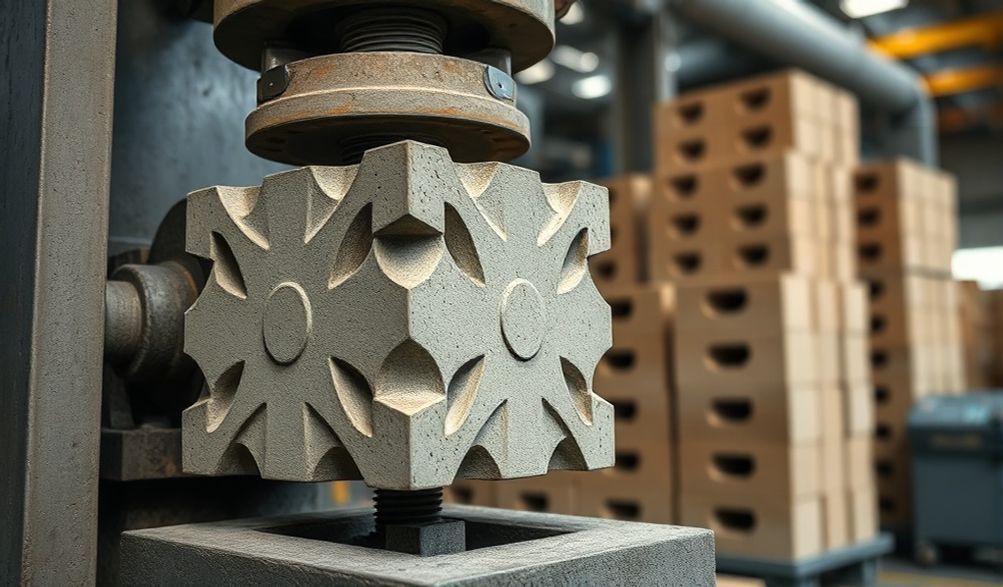
La fonction principale d'unmachine à fabriquer des blocs de béton à emboîtementconsiste à appliquer une pression immense à un béton « mélangé à sec », en le compactant dans un moule qui forme des blocs avec des designs brevetés en forme de languette-et-rainure, de type casse-tête ou géométriques sur leurs dessus et côtés. Ces designs sont la clé du système :
- L'Interverrouillage :Lorsqu'ils sont posés, les protubérances (bosses) d'un bloc s'emboîtent solidement dans les évidements (rainures) des blocs adjacents.
- Le Résultat :Un mur ou une couche de pavage stable, verrouillé mécaniquement, qui tire sa résistance de la friction et de la géométrie, à la manière d'un casse-tête tridimensionnel. Cela élimine le besoin d'un liant traditionnel tel que le mortier.
Le principe de fonctionnement de base
Bien que les conceptions varient, le processus fondamental reste cohérent pour la plupart des machines et suit une méthode de moulage à sec.
- Alimentation :Un mélange de béton sec préparé (avec juste assez d’humidité pour l’hydratation, mais sans « affaissement ») est introduit dans la boîte à moules ou la trémie de la machine.
- Compactage :Le mélange est soumis à deux forces clés :
- Vibration :Les vibrations à haute fréquence stabilisent le mélange, éliminent les poches d'air et garantissent que les coins du moule sont bien remplis.
- Pression hydraulique :Un vérin hydraulique applique ensuite une pression énorme (mesurée en tonnes) au mélange, le densifiant en une masse solide et à haute résistance.
- Moulage:L'action combinée des vibrations et de la pression façonne le mélange selon la forme précise du moule, y compris les motifs complexes d'imbrication.
- Éjection :Le bloc nouvellement formé est soulevé ou poussé hors du moule sur une palette ou au sol, prêt pour la cure.
Cette méthode de « coulage à sec » se distingue du moulage traditionnel du béton humide, permettant une manipulation immédiate des blocs et des délais de construction globaux plus rapides.
Principaux avantages de l'utilisation de blocs de verrouillage et des machines qui les fabriquent
Investir dans cette technologie, ce n’est pas seulement acheter une machine ; c’est débloquer une cascade d’avantages pour vos projets de construction ou votre modèle d’affaires.
Avantages en matière de construction et de performance
- Vitesse de construction inégalée :Sans avoir à mélanger, appliquer et attendre le séchage du mortier, la productivité de la pose de blocs peut augmenter de 200 à 300 %. Les murs montent beaucoup plus rapidement, ce qui accélère l'achèvement du projet.
- Efficacité des coûts significativeDes économies sont réalisées sur plusieurs fronts :
- Main-d'œuvre :Réduction du besoin de maçons hautement qualifiés.
- Matériaux :Élimination du mortier, du sable et du ciment pour la pose.
- TransportLa production sur site réduit les coûts et les bris associés au transport de blocs finis lourds provenant d'une usine éloignée.
- Durabilité et résistance supérieures :Les blocs emboîtables correctement fabriqués ont une très grande résistance à la compression. Leur emboîtement mécanique crée une structure flexible qui gère mieux les forces de cisaillement et les tassements que les murs rigides liés au mortier, ce qui les rend idéaux pour les murs de soutènement, les chaussées et les applications portantes.
- Durabilité inhérenteCette technologie soutient la construction écologique de plusieurs manières :
- Utilisation des matériaux :Peut incorporer des sous-produits industriels comme les cendres volantes ou les granulats recyclés.
- Perméabilité :Certains designs permettent l’infiltration de l’herbe ou de l’eau, réduisant ainsi le ruissellement.
- Reusability: Blocks can often be disassembled and reused elsewhere.
Operational and Business Advantages
- On-Demand, On-Site Production: Produce blocks exactly where they’re needed, when they’re needed. This provides ultimate control over inventory, quality, and logistics.
- Immense Design Versatility: By simply changing the mold, a single machine can produce a variety of block sizes, shapes (e.g., straight, corner, half), and even surface textures (split-face, rock-face, smooth). Color can be added to the mix or applied to the surface.
- A Tangible Business Opportunity: For entrepreneurs, a single semi-automatic or automatic machine can form the core of a profitable block manufacturing business, supplying blocks for local construction, landscaping, and infrastructure projects.
Types of Concrete Interlocking Block Making Machines
Choosing the right machine starts with understanding the landscape. They are primarily categorized by their operation method, mobility, and output.
Par méthode d'exploitation
- Machines manuelles :
- Comment ils fonctionnent : Operated entirely by human labor using a lever mechanism to apply pressure. Feeding and block removal are manual.
- Idéal pour : Very small-scale projects, DIY enthusiasts, community-led building initiatives, or pilot projects. Output is low (e.g., 100-500 blocks per day), but the cost of entry is minimal.
- Machines semi-automatiques :
- Comment ils fonctionnent : The core compaction process (vibration and hydraulics) is powered and automated. Operators manually feed raw material and remove finished blocks, often with the aid of a lever or button.
- Idéal pour : Small to medium-sized businesses, contractors with multiple projects, and medium-volume production (e.g., 1,000 – 6,000 blocks per 8-hour shift). They offer an excellent balance between productivity, cost, and flexibility.
- Machines entièrement automatiques :
- Comment ils fonctionnent : These are complete production lines. They feature automated systems for feeding raw material, mixing, conveying, compacting, curing, and even stacking/palletizing finished blocks. Controlled via PLC (Programmable Logic Controller).
- Idéal pour : Large-scale commercial block yards and industrial production facilities requiring very high, consistent output (10,000+ blocks per day). They maximize output and minimize labor but require a substantial capital investment.
By Mobility and Setup
- Plantes stationnaires : These are fixed installations, often the foundation of a block manufacturing factory. They are designed for maximum output and are not intended to be moved frequently.
- Mobile/Portable Machines: Mounted on a trailer or skid frame, these units can be towed or transported directly to a job site. This is a massive advantage for large infrastructure projects (e.g., remote road construction, large retaining walls) where transporting blocks is impractical.
By Block Output Capacity
- À petite échelle: Up to ~2,000 blocks per day. Typically manual or small semi-automatic models.
- Moyenne échelle : ~2,000 to 10,000 blocks per day. The domain of robust semi-automatic and smaller fully automatic machines.
- Large-scale Industrial: 10,000+ blocks per day. The exclusive realm of high-end fully automatic production lines and stationary plants.
Critical Factors to Consider When Choosing a Machine
Making the right choice requires a clear-eyed assessment of your needs against the machine’s capabilities. Here’s your practical checklist.
Project & Business Requirements
- Production Volume: Calculate your average daily and peak weekly block requirement. Choose a machine that can meet this with some capacity to spare—running a machine at 100% capacity constantly leads to wear.
- Spécifications du bloc List every block type you need (standard, corner, half-block, thickness). Ensure the machine and available molds can produce them all.
- Site & Resource Constraints:
- Espace : Do you have a factory shed or just an open plot? Automatic lines need more covered space.
- Pouvoir : Is three-phase electrical power available, or do you need a diesel-powered option?
- Main-d'œuvre : What is the skill level of your available workforce? A fully automatic machine may need an electrician/technician, while a semi-automatic needs diligent operators.
Machine Specifications & Features
- Capacité de pression (Tonnage) : This is critical for block strength. Higher tonnage (e.g., 150 tons vs. 50 tons) produces denser, stronger blocks suitable for load-bearing walls. For garden walls, lower pressure may suffice.
- Mold Versatility & Changeover: How easy is it to change molds? Quick-change systems save hours of downtime when switching block types. Also, check the cost and availability of additional molds from the supplier.
- Niveau d'automatisation : Honestly evaluate the trade-off. Higher automation means a higher upfront cost but lower long-term labor costs and more consistent output. Can your budget and operational style support it?
- Qualité de construction : Inspect the robustness of the frame (solid steel is best), the quality of the hydraulic pump and cylinders, and the brand/durability of the vibrator motors. A heavier machine frame generally indicates better stability and longevity.
Supplier and Support Evaluation
This step is as important as evaluating the machine itself. Your relationship with the supplier will define your long-term success.
- Research Manufacturer Reputation: Look for companies with a long track record (10+ years is a good sign). Search for reviews, ask for a client portfolio, and try to speak to existing customers.
- Service après-vente : Does the supplier offer installation, commissioning, and on-site operator training? What is their spare parts policy? A reliable local agent or service network is invaluable.
- Warranty & Documentation: Scrutinize the warranty terms. Clear, comprehensive operation and maintenance manuals in your language are a must-have.
Operational Best Practices and Maintenance Tips
Owning the machine is half the battle; operating it correctly ensures profitability and longevity. Here’s actionable guidance drawn from field experience.
Préparation des matières premières
The quality of the block is determined here. Ensuring consistent moisture in the mix is often the difference between a perfect block and a cracked one.
- Conception du mélange: A typical mix might be 1 part cement, 3-6 parts well-graded aggregate (e.g., 3/8″ crushed stone), and 2-4 parts sharp sand. The exact ratio depends on desired strength and local materials.
- Teneur en humidité : This is critical. The mix should be damp enough to hold its shape when squeezed in your hand (≈ 5-8% water by weight), but no free water should be visible. Too dry = weak blocks; too wet = blocks stick in the mold.
Routine Machine Operation Checklist
- Pre-Start: Check hydraulic oil levels, ensure all bolts are tight, clean the mold cavity and pallets.
- During Operation: Feed the hopper consistently but don’t overfill. Monitor the block ejection process—any sticking indicates a mold or mix issue. Listen for unusual noises from the hydraulics or vibrators.
- Shutdown: Clear all residual material from the mold and hopper. Park the machine in a safe position.
Essential Maintenance for Longevity
A simple, consistent maintenance routine prevents costly breakdowns.
- Daily: Clean the machine thoroughly. Check for loose parts.
- Weekly: Lubricate all moving parts as per the manual (pivots, guide rods). Inspect hydraulic hoses for leaks.
- Monthly: Check and tighten all major bolts and nuts on the frame and vibration table. Change hydraulic oil and filters as recommended by the manufacturer.
FAQ Section
Q: What is the typical cost range for an interlocking block machine?
A : The range is vast. A basic manual machine can start from \$3,000 – \$10,000. A quality semi-automatic machine typically ranges from \$15,000 to \$50,000. Fully automatic production lines can range from \$70,000 to well over \$300,000, depending on capacity and sophistication. Always factor in costs for molds, a mixer, and a pallet or curing rack system.
Q: Can these machines use recycled materials like crushed concrete or plastic?
A : Many can, especially robust machines with higher pressure. Crushed concrete is an excellent, sustainable aggregate. Some technologies allow for the inclusion of certain plastic fibers. However, the material must be clean, consistently sized, and its properties understood. Always consult with the machine manufacturer to validate your specific mix design.
Q: How much training is required to operate a semi-automatic machine?
A : Basic operational training is usually sufficient and is often provided by the supplier over a few days. The key is diligent adherence to the operational manual, understanding the raw material mix, and performing routine maintenance. Safety training around moving parts and hydraulics is non-negotiable.
Q: What is the difference between hydraulic and vibration pressure in these machines?
A : They serve complementary roles. Vibration (often from multiple high-frequency vibrators) consolidates the dry mix, causing particles to settle densely into every part of the mold. Pression hydraulique then applies a final, static, high-tonnage force that permanently compacts the mix, creating the final bond and achieving the high compressive strength of the block. The best machines effectively combine both.
Q: Are the blocks produced strong enough for load-bearing walls?
A : Absolutely. When produced with the correct cement content, proper mix design, and sufficient machine pressure, interlocking concrete blocks can achieve compressive strengths that meet or exceed ASTM C90 standards for concrete masonry units. For any specific load-bearing structural application, the block specifications should be reviewed and approved by a qualified structural engineer.
Conclusion
Selecting the ideal machine à fabriquer des blocs de béton à emboîtement is a strategic decision that hinges on a clear assessment of your project needs, output goals, and operational budget. From manual presses for community projects to fully automated lines driving an industrial business, this technology offers a pathway to faster, more economical, and notably sustainable construction.
We encourage you to use this guide as your foundational framework for evaluation. Let it inform the questions you ask and the specifications you prioritize. Your final step should involve contacting multiple reputable suppliers with your detailed requirements. Request live demonstrations, ask for samples of blocks produced by their machines, and scrutinize their service commitments. By investing time in this due diligence, you’re not just purchasing a piece of equipment—you’re investing in the future efficiency and growth of your construction endeavors or business. This technology is more than a machine; it’s a tool for building modern, resilient infrastructure, one precisely interlocked block at a time.
<