
Ang Komprehensibong Gabay sa Makina ng Paggawa ng Interlocking Block na Semento: Mga Uri, Pakinabang, at Paano Pumili
Panimula
Ang pandaigdigang industriya ng konstruksiyon ay patuloy na umuunlad, hinihimok ng isang madaliang pangangailangan para sa mga materyales na hindi lamang matibay at pangmatagalan kundi pati na rin sustainable at magastos para ipatupad. Sa gitna ng pagbabagong ito, isang solusyon ang patuloy na nakakakuha ng puwang dahil sa kahanga-hangang paghahalo ng pagiging simple at inobasyon: ang interlocking concrete block. Ngunit ang tunay na nagpapabago sa laro ay hindi lamang ang bloke mismo—ito ay ang dalubhasang makinarya na nagbibigay-daan sa episyenteng produksiyon sa mismong lugar ng proyekto. Maligayang pagdating sa tiyak na gabay tungkol samga makina sa paggawa ng interlocking block na kongkreto.
Ang gabay na ito ay binuo bilang isang komprehensibo at walang-kinikilingang sanggunian para sa mga kontratista, tagapagtayo, masisigasig na negosyante, at tagapamahala ng proyekto. Batay sa malalim na kaalaman sa industriya, teknikal na mga detalye, at mga praktikal na pananaw sa aplikasyon, aming ilalahad ang mga misteryo ng makapangyarihang teknolohiyang ito. Ang aming layunin ay iisa: bigyan kayo ng malinaw na pang-unawa sa mga uri ng makina, ang kanilang tunay na pakinabang, mahahalagang pamantayan sa pagpili, at mahalagang konsiderasyon sa pagbili, upang kayo ay mabigyan ng kapangyarihang gumawa ng ganap na may-batid na desisyon para sa inyong proyekto o negosyo. Ito ay isang pang-edukasyon na sanggunian na nakatuon sa mga pinakamahusay na pamamaraan at pangunahing kaalaman, hindi sa pagtataguyod ng anumang partikular na tatak, upang matiyak na matatanggap ninyo ang objektibong impormasyong kailangan ninyo upang magtagumpay.
Ano ang isang Concrete Interlocking Block Making Machine?
Sa puso nito, ang makinaryang ito ay isang tiyak na ininhinyerong pindaan na idinisenyo upang gawing matibay na bloke ng gusali ang tuyong pinaghalong buhangin, semento, at mga agregado, na may natatanging katangian: nagkakabit-kabit ang mga ito nang walang mortar.
Pangunahing Tungkulin at Output Ipinaliwanag
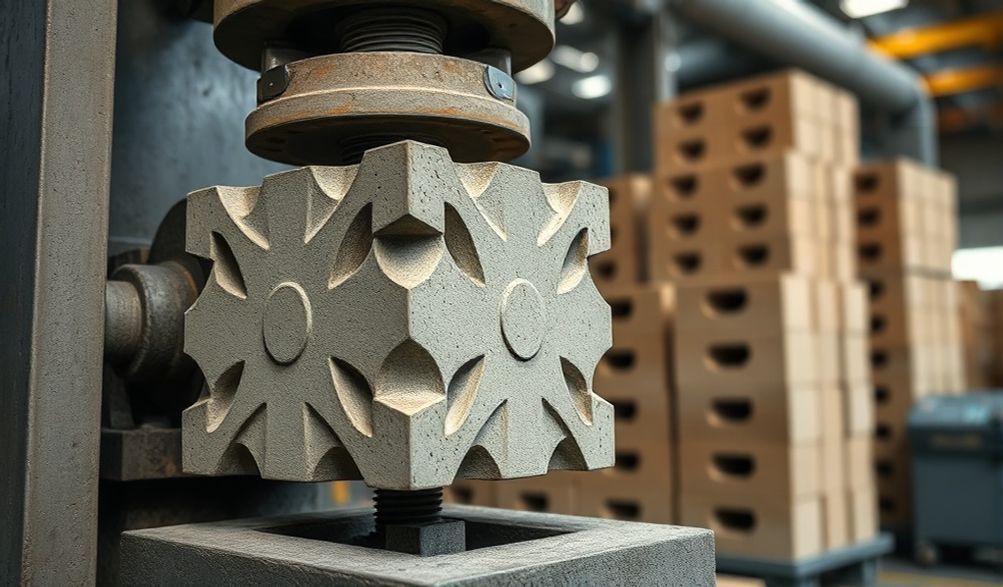
Ang pangunahing tungkulin ng isangmakina ng paggawa ng interlocking block na kongkreto ay maglapat ng napakalaking presyon sa isang “dry-mix” na kongkreto, pinipiga ito sa isang hulma na bumubuo ng mga bloke na may patented na dila-at-uka, mala-puzzle, o heometrikong disenyo sa kanilang mga tuktok at gilid. Ang mga disenyong ito ang susi sa sistema:
- Interlock:Kapag inilatag, ang mga umbok (knobs) ng isang bloke ay pumapasok nang husto sa mga uka (grooves) ng katabing mga bloke.
- Ang Resulta:Isang matatag, mekanikal na naka-lock na pader o daanan na nakukuha ang lakas nito mula sa pagkiskis at heometriya, katulad ng isang three-dimensional na jigsaw puzzle. Inaalis nito ang pangangailangan para sa tradisyunal na mortar na pantali.
Ang Pangunahing Prinsipyo ng Pagtatrabaho
Bagama't iba-iba ang mga disenyo, ang pangunahing proseso ay pare-pareho sa karamihan ng mga makina at sumusunod sa isang dry-cast na pamamaraan.
- Pagpapakain:Ang isang handa na tuyong pinaghalo ng konkreto (na may sapat na kahalumigmigan para sa hydration, ngunit walang "slump") ay inilalagay sa kahon ng hulma o hopper ng makina.
- Pagpapatigas:ang pinaghalong ay sumasailalim sa dalawang pangunahing puwersa:
- Panginginig:Ang mataas na dalas ng pag-vibrate ay tumitiyak na maayos ang pagkakabuhos ng halo, inaalis ang mga bula ng hangin, at tinitiyak na napupuno ang mga sulok ng molde.
- Presyur ng Haydroliko: A hydraulic ram then applies tremendous pressure (measured in tons) to the mix, densifying it into a solid, high-strength mass.
- Paghuhulma: The combined action of vibration and pressure forms the mix into the precise shape of the mold, including the complex interlocking patterns.
- Pag-eject: The newly formed block is lifted or pushed out of the mold onto a pallet or the ground, ready for curing.
This “dry cast” method is distinct from traditional wet concrete casting, allowing for immediate block handling and faster overall construction timelines.
Key Benefits of Using Interlocking Blocks and the Machines That Make Them
Investing in this technology isn’t just about buying a machine; it’s about unlocking a cascade of advantages for your construction projects or business model.
Construction and Performance Benefits
- Unmatched Speed of Construction: Without the need to mix, apply, and wait for mortar to cure, block-laying productivity can increase by 200-300%. Walls rise significantly faster, accelerating project completion.
- Significant Cost Efficiency: Savings are realized across multiple fronts:
- Paggawa: Reduced need for highly skilled masons.
- Mga Materyales: Elimination of mortar, sand, and cement for laying.
- Transport: On-site production cuts costs and breakage associated with transporting heavy finished blocks from a distant plant.
- Superior na Tibay at Lakas: Properly made interlocking blocks have very high compressive strength. Their mechanical interlock creates a flexible structure that can handle shear forces and settlement better than rigid mortar-bound walls, making them ideal for retaining walls, pavements, and load-bearing applications.
- Inherent Sustainability: This technology supports green building in several ways:
- Material Use: Can incorporate industrial by-products like fly ash or recycled aggregates.
- Permeability: Certain designs allow for grass or water infiltration, reducing runoff.
- Reusability: Blocks can often be disassembled and reused elsewhere.
Operational and Business Advantages
- On-Demand, On-Site Production: Produce blocks exactly where they’re needed, when they’re needed. This provides ultimate control over inventory, quality, and logistics.
- Immense Design Versatility: By simply changing the mold, a single machine can produce a variety of block sizes, shapes (e.g., straight, corner, half), and even surface textures (split-face, rock-face, smooth). Color can be added to the mix or applied to the surface.
- A Tangible Business Opportunity: For entrepreneurs, a single semi-automatic or automatic machine can form the core of a profitable block manufacturing business, supplying blocks for local construction, landscaping, and infrastructure projects.
Types of Concrete Interlocking Block Making Machines
Choosing the right machine starts with understanding the landscape. They are primarily categorized by their operation method, mobility, and output.
By Operation Method
- Manual na Makina:
- Paano sila gumagana: Operated entirely by human labor using a lever mechanism to apply pressure. Feeding and block removal are manual.
- Pinakamabuti para sa: Very small-scale projects, DIY enthusiasts, community-led building initiatives, or pilot projects. Output is low (e.g., 100-500 blocks per day), but the cost of entry is minimal.
- Semi-Automatikong Makina:
- Paano sila gumagana: The core compaction process (vibration and hydraulics) is powered and automated. Operators manually feed raw material and remove finished blocks, often with the aid of a lever or button.
- Pinakamabuti para sa: Small to medium-sized businesses, contractors with multiple projects, and medium-volume production (e.g., 1,000 – 6,000 blocks per 8-hour shift). They offer an excellent balance between productivity, cost, and flexibility.
- Ganap na Awtomatikong Makina:
- Paano sila gumagana: These are complete production lines. They feature automated systems for feeding raw material, mixing, conveying, compacting, curing, and even stacking/palletizing finished blocks. Controlled via PLC (Programmable Logic Controller).
- Pinakamabuti para sa: Large-scale commercial block yards and industrial production facilities requiring very high, consistent output (10,000+ blocks per day). They maximize output and minimize labor but require a substantial capital investment.
By Mobility and Setup
- Mga Halaman na Nakatigil: These are fixed installations, often the foundation of a block manufacturing factory. They are designed for maximum output and are not intended to be moved frequently.
- Mobile/Portable Machines: Mounted on a trailer or skid frame, these units can be towed or transported directly to a job site. This is a massive advantage for large infrastructure projects (e.g., remote road construction, large retaining walls) where transporting blocks is impractical.
By Block Output Capacity
- Maliit na sukat: Up to ~2,000 blocks per day. Typically manual or small semi-automatic models.
- Katamtamang-sukat: ~2,000 to 10,000 blocks per day. The domain of robust semi-automatic and smaller fully automatic machines.
- Large-scale Industrial: 10,000+ blocks per day. The exclusive realm of high-end fully automatic production lines and stationary plants.
Critical Factors to Consider When Choosing a Machine
Making the right choice requires a clear-eyed assessment of your needs against the machine’s capabilities. Here’s your practical checklist.
Project & Business Requirements
- Production Volume: Calculate your average daily and peak weekly block requirement. Choose a machine that can meet this with some capacity to spare—running a machine at 100% capacity constantly leads to wear.
- Block Specifications: List every block type you need (standard, corner, half-block, thickness). Ensure the machine and available molds can produce them all.
- Site & Resource Constraints:
- Kosmos: Do you have a factory shed or just an open plot? Automatic lines need more covered space.
- Kapangyarihan: Is three-phase electrical power available, or do you need a diesel-powered option?
- Paggawa: What is the skill level of your available workforce? A fully automatic machine may need an electrician/technician, while a semi-automatic needs diligent operators.
Machine Specifications & Features
- Pressure Capacity (Tonnage): This is critical for block strength. Higher tonnage (e.g., 150 tons vs. 50 tons) produces denser, stronger blocks suitable for load-bearing walls. For garden walls, lower pressure may suffice.
- Mold Versatility & Changeover: How easy is it to change molds? Quick-change systems save hours of downtime when switching block types. Also, check the cost and availability of additional molds from the supplier.
- Antas ng Automation: Honestly evaluate the trade-off. Higher automation means a higher upfront cost but lower long-term labor costs and more consistent output. Can your budget and operational style support it?
- Kalidad ng Pagkakagawa: Inspect the robustness of the frame (solid steel is best), the quality of the hydraulic pump and cylinders, and the brand/durability of the vibrator motors. A heavier machine frame generally indicates better stability and longevity.
Supplier and Support Evaluation
This step is as important as evaluating the machine itself. Your relationship with the supplier will define your long-term success.
- Research Manufacturer Reputation: Look for companies with a long track record (10+ years is a good sign). Search for reviews, ask for a client portfolio, and try to speak to existing customers.
- Serbisyong Pagkatapos ng Benta: Does the supplier offer installation, commissioning, and on-site operator training? What is their spare parts policy? A reliable local agent or service network is invaluable.
- Warranty & Documentation: Scrutinize the warranty terms. Clear, comprehensive operation and maintenance manuals in your language are a must-have.
Operational Best Practices and Maintenance Tips
Owning the machine is half the battle; operating it correctly ensures profitability and longevity. Here’s actionable guidance drawn from field experience.
Pagkukumpuni ng Hilaw na Materyal
The quality of the block is determined here. Ensuring consistent moisture in the mix is often the difference between a perfect block and a cracked one.
- Mix Design: A typical mix might be 1 part cement, 3-6 parts well-graded aggregate (e.g., 3/8″ crushed stone), and 2-4 parts sharp sand. The exact ratio depends on desired strength and local materials.
- Moisture Content: This is critical. The mix should be damp enough to hold its shape when squeezed in your hand (≈ 5-8% water by weight), but no free water should be visible. Too dry = weak blocks; too wet = blocks stick in the mold.
Routine Machine Operation Checklist
- Pre-Start: Check hydraulic oil levels, ensure all bolts are tight, clean the mold cavity and pallets.
- During Operation: Feed the hopper consistently but don’t overfill. Monitor the block ejection process—any sticking indicates a mold or mix issue. Listen for unusual noises from the hydraulics or vibrators.
- Shutdown: Clear all residual material from the mold and hopper. Park the machine in a safe position.
Essential Maintenance for Longevity
A simple, consistent maintenance routine prevents costly breakdowns.
- Daily: Clean the machine thoroughly. Check for loose parts.
- Weekly: Lubricate all moving parts as per the manual (pivots, guide rods). Inspect hydraulic hoses for leaks.
- Monthly: Check and tighten all major bolts and nuts on the frame and vibration table. Change hydraulic oil and filters as recommended by the manufacturer.
FAQ Section
Q: What is the typical cost range for an interlocking block machine?
Isalin ang teksto sa Filipino. I-output LAMANG ang isinalin na teksto. The range is vast. A basic manual machine can start from \$3,000 – \$10,000. A quality semi-automatic machine typically ranges from \$15,000 to \$50,000. Fully automatic production lines can range from \$70,000 to well over \$300,000, depending on capacity and sophistication. Always factor in costs for molds, a mixer, and a pallet or curing rack system.
Q: Can these machines use recycled materials like crushed concrete or plastic?
Isalin ang teksto sa Filipino. I-output LAMANG ang isinalin na teksto. Many can, especially robust machines with higher pressure. Crushed concrete is an excellent, sustainable aggregate. Some technologies allow for the inclusion of certain plastic fibers. However, the material must be clean, consistently sized, and its properties understood. Always consult with the machine manufacturer to validate your specific mix design.
Q: How much training is required to operate a semi-automatic machine?
Isalin ang teksto sa Filipino. I-output LAMANG ang isinalin na teksto. Basic operational training is usually sufficient and is often provided by the supplier over a few days. The key is diligent adherence to the operational manual, understanding the raw material mix, and performing routine maintenance. Safety training around moving parts and hydraulics is non-negotiable.
Q: What is the difference between hydraulic and vibration pressure in these machines?
Isalin ang teksto sa Filipino. I-output LAMANG ang isinalin na teksto. They serve complementary roles. Vibrasyon (often from multiple high-frequency vibrators) consolidates the dry mix, causing particles to settle densely into every part of the mold. Presyon ng haydroliko then applies a final, static, high-tonnage force that permanently compacts the mix, creating the final bond and achieving the high compressive strength of the block. The best machines effectively combine both.
Q: Are the blocks produced strong enough for load-bearing walls?
Isalin ang teksto sa Filipino. I-output LAMANG ang isinalin na teksto. Absolutely. When produced with the correct cement content, proper mix design, and sufficient machine pressure, interlocking concrete blocks can achieve compressive strengths that meet or exceed ASTM C90 standards for concrete masonry units. For any specific load-bearing structural application, the block specifications should be reviewed and approved by a qualified structural engineer.
Konklusyon
Selecting the ideal makina ng paggawa ng interlocking block na kongkreto is a strategic decision that hinges on a clear assessment of your project needs, output goals, and operational budget. From manual presses for community projects to fully automated lines driving an industrial business, this technology offers a pathway to faster, more economical, and notably sustainable construction.
We encourage you to use this guide as your foundational framework for evaluation. Let it inform the questions you ask and the specifications you prioritize. Your final step should involve contacting multiple reputable suppliers with your detailed requirements. Request live demonstrations, ask for samples of blocks produced by their machines, and scrutinize their service commitments. By investing time in this due diligence, you’re not just purchasing a piece of equipment—you’re investing in the future efficiency and growth of your construction endeavors or business. This technology is more than a machine; it’s a tool for building modern, resilient infrastructure, one precisely interlocked block at a time.
<