
Jagorar Cikakke na Injunan Yin Tubalan Siminti na Haɗin Kai: Nau'ikan, Fa'idodi & Yadda Ake Zaɓar
Gabatarwa
Masana'antar ginin duniya tana cikin ci gaba akai-akai, wanda ke haifar da buƙatar gaggawa na kayan da ba kawai suke da ƙarfi da dorewa ba har ma da dorewa da inganci don amfani. A cikin wannan sauyi, ɗaya mafita ya kasance yana samun ci gaba a hankali saboda kyakkyawan haɗakar saukin fahimta da ƙirƙira: tubalin simintin da ke haɗa kai. Amma ainihin abin da ke canza wasan ba kawai tubalin kansa ba ne—amma injinan ƙwararru ne waɗanda ke ba da damar samarwa a wurin, mai inganci. Barka da zuwa ga cikakken jagora akanna'urorin yin tubalan siminti masu haɗa kai.
Wannan jagora an tsara ta ne a matsayin cikakkiyar albarkatu, marar son kai, ga kwangila, magina, masu fata na kasuwanci, da manajoji na ayyuka. Ta hanyar amfani da zurfin ilimin masana'antu, cikakkun bayanan fasaha, da fahimtar aikace-aikace, za mu bayyana wannan fasaha mai ƙarfi. Manufarmu ita ce guda ɗaya: don samar muku da fahimi bayyananne game da nau'ikan injuna, fa'idodinsu na zahiri, mahimman sharuɗɗan zaɓi, da muhimman abubuwan da ake la'akari da su na siye, don ƙarfafa ku don yanke shawara cikakke don aikin ku ko kasuwancin ku. Wannan albarkatu ce ta ilimi da ke mai da hankali kan mafi kyawun ayyuka da ilimin tushe, ba don tallata wani takamaiman alama ba, don tabbatar da cewa kun karɓi bayanan da ake buƙata don nasara.
Menene Injin Yin Tubalin Interlocking na Kankare?
A cikin tsarinsa, wannan na'urar injin latsawa ce da aka ƙera daidai, wacce aka tsara don canza busassun cakuda na ginshiƙai, yashi, da siminti zuwa tubalan gini masu ƙarfi, tare da wani sifa na musamman: suna haɗuwa tare ba tare da turmi ba.
Ayyukan Cibiya da Bayanin Fitarwa
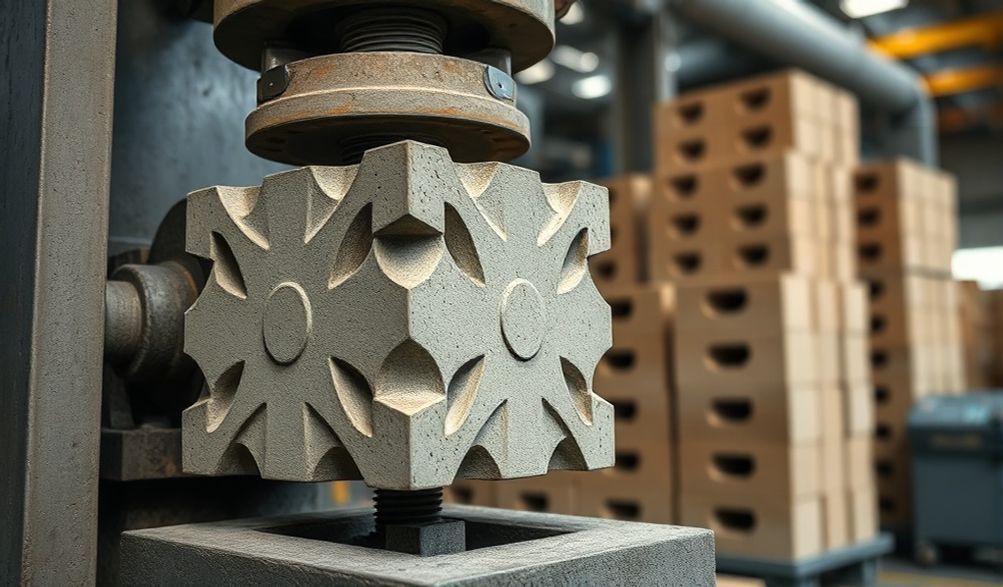
Aikin farko na aInjin yin tubalin haɗin kankareshi ne a yi amfani da matsi mai tsanani ga simintin "bushe-bushe", tare da matsar da shi cikin wani tsari da ke samar da tubalan tare da haƙori-da-tsagi, kamar wasa, ko ƙirar geometric a samansu da gefunansu. Waɗannan ƙirar su ne maɓalli ga tsarin:
- Tsarin Kulle-Kulle:Idan aka shimfiɗa, ƙullun (ƙugiya) na wani bulo suna shiga cikin aminci cikin ramukan (tsagi) na bulo na kusa.
- Sakamakon:Tsayayyen bangon ko kafaffen hanya wanda ke samun ƙarfinsa ta hanyar gogayya da lissafi, kamar wasan jigsaw mai girma uku. Wannan yana kawar da buƙatar haɗa siminti na gargajiya.
Tsarin Aiki na Asali
Ko da yake ƙira sun bambanta, ainihin tsari yana daidaitawa a yawancin injuna kuma yana bin hanyar busasshiyar ƙirar:
- Ciyarwa:An shirya busasshen simintin siminti (mai isasshen danshi don hydration, amma ba "slump" ba) ana ciyar da shi cikin akwatin ƙirar injin ko hopper.
- Ƙarfafawa:Ana sanya cakuda ga ƙarfi biyu masu mahimmanci:
- Girgiza:Girgiza mai yawa tana daidaita cakuda, tana kawar da iskar iska, kuma tana tabbatar da cewa kusurwoyin mold ɗin sun cika.
- Matsin Ruwa:Sannan ramin hydraulic yana amfani da matsi mai yawa (wanda aka auna cikin ton) akan cakuda, yana mai da shi guntu mai ƙarfi mai ƙarfi.
- Gyare-gyare:Haɗin gwiwar girgiza da matsi suna sanya cakuda cikin madaidaicin siffar ƙirar, gami da hadaddun alamu masu haɗin kai.
- Fitarwa:Sabon bulo din ana daga shi ko kuma ana tura shi daga cikin mul ɗin zuwa kan pallet ko ƙasa, shirye don gyarawa.
Wannan hanyar "simintin bushe" ta bambanta da na gargajiya na simintin jika, wanda ke ba da damar sarrafa tubalin nan take da kuma saurin gina gine-gine gaba ɗaya.
Fa'idodi Mafi Muhimmanci na Amfani da Tubalan Haɗin Kai da Injinan da Suka Kera Su
Zuba jari a wannan fasaha ba wai siyan na’ura kawai ba ne; yana kuma buɗe fa’idodi da yawa ga ayyukan gine-gine ko tsarin kasuwancin ku.
Gina Aiki da Amfanin Aiki
- Gaggauta Gina Ba Kamar Wani BaBa tare da buƙatar haɗawa, shafa, da jira don turƙumin ya warke ba, ƙarfin yin tubali na iya ƙaruwa da 200-300%. Ganuwarsi suna tashi da sauri, suna hanzarta kammala aikin.
- Muhimmin ingantaccen farashiAna samun cigaban tanadi ta fannoni da yawa:
- AikiƘaramar buƙatar ƙwararrun mason.
- Kayan aiki:Kawar da turmi, yashi, da siminti don shimfida.
- SufuriYin samar da kayan aiki a wurin yana rage tsada da lalacewa da ke tattare da jigilar manyan gidajen da aka gama daga masana'anta mai nisa.
- Ƙarfin Juriya & Ƙarfi:Tubalan da aka haɗa da kyau suna da ƙarfin matsewa mai girma sosai. Haɗin gwiwar inji ya ƙirƙiri wani tsari mai sassauƙa wanda zai iya ɗaukar ƙarfin tsagawa da daidaitawa fiye da bangon da aka ɗaure da turmi mai tauri, wanda ya sa su dace da bangon riƙewa, tituna, da amfani mai ɗaukar nauyi.
- Matsala ta DindindinWannan fasaha tana tallafawa ginin kore ta hanyoyi da yawa:
- Amfani da Kayan AikiYana iya haɗa abubuwan da aka samu daga masana'antu kamar fly ash ko aggregates da aka sake yin amfani da su.
- Permeability:Wasu ƙirarraki suna ba da damar ciyawa ko ruwan shiga, yana rage gudanar ruwa.
- Reusability: Blocks can often be disassembled and reused elsewhere.
Operational and Business Advantages
- On-Demand, On-Site Production: Produce blocks exactly where they’re needed, when they’re needed. This provides ultimate control over inventory, quality, and logistics.
- Immense Design Versatility: By simply changing the mold, a single machine can produce a variety of block sizes, shapes (e.g., straight, corner, half), and even surface textures (split-face, rock-face, smooth). Color can be added to the mix or applied to the surface.
- A Tangible Business Opportunity: For entrepreneurs, a single semi-automatic or automatic machine can form the core of a profitable block manufacturing business, supplying blocks for local construction, landscaping, and infrastructure projects.
Types of Concrete Interlocking Block Making Machines
Choosing the right machine starts with understanding the landscape. They are primarily categorized by their operation method, mobility, and output.
Ta Hanyar Aiki
- Na'urorin Hannu:
- Yadda suke aiki: Operated entirely by human labor using a lever mechanism to apply pressure. Feeding and block removal are manual.
- Mafi kyau don: Very small-scale projects, DIY enthusiasts, community-led building initiatives, or pilot projects. Output is low (e.g., 100-500 blocks per day), but the cost of entry is minimal.
- Matsin Injin Mai Ƙaramin Gudanarwa:
- Yadda suke aiki: The core compaction process (vibration and hydraulics) is powered and automated. Operators manually feed raw material and remove finished blocks, often with the aid of a lever or button.
- Mafi kyau don: Small to medium-sized businesses, contractors with multiple projects, and medium-volume production (e.g., 1,000 – 6,000 blocks per 8-hour shift). They offer an excellent balance between productivity, cost, and flexibility.
- Matsarori Masu Sarrafa Kansu Gabaɗaya:
- Yadda suke aiki: These are complete production lines. They feature automated systems for feeding raw material, mixing, conveying, compacting, curing, and even stacking/palletizing finished blocks. Controlled via PLC (Programmable Logic Controller).
- Mafi kyau don: Large-scale commercial block yards and industrial production facilities requiring very high, consistent output (10,000+ blocks per day). They maximize output and minimize labor but require a substantial capital investment.
By Mobility and Setup
- Tsire-tsire Masu Tsayawa: These are fixed installations, often the foundation of a block manufacturing factory. They are designed for maximum output and are not intended to be moved frequently.
- Mobile/Portable Machines: Mounted on a trailer or skid frame, these units can be towed or transported directly to a job site. This is a massive advantage for large infrastructure projects (e.g., remote road construction, large retaining walls) where transporting blocks is impractical.
By Block Output Capacity
- Ƙananan sikelin: Up to ~2,000 blocks per day. Typically manual or small semi-automatic models.
- Matsakaicin sikelin: ~2,000 to 10,000 blocks per day. The domain of robust semi-automatic and smaller fully automatic machines.
- Large-scale Industrial: 10,000+ blocks per day. The exclusive realm of high-end fully automatic production lines and stationary plants.
Critical Factors to Consider When Choosing a Machine
Making the right choice requires a clear-eyed assessment of your needs against the machine’s capabilities. Here’s your practical checklist.
Project & Business Requirements
- Production Volume: Calculate your average daily and peak weekly block requirement. Choose a machine that can meet this with some capacity to spare—running a machine at 100% capacity constantly leads to wear.
- Ƙayyadaddun Block: List every block type you need (standard, corner, half-block, thickness). Ensure the machine and available molds can produce them all.
- Site & Resource Constraints:
- Sarari: Do you have a factory shed or just an open plot? Automatic lines need more covered space.
- Ƙarfi: Is three-phase electrical power available, or do you need a diesel-powered option?
- Aiki What is the skill level of your available workforce? A fully automatic machine may need an electrician/technician, while a semi-automatic needs diligent operators.
Machine Specifications & Features
- Ƙarfin Matsi (Tona): This is critical for block strength. Higher tonnage (e.g., 150 tons vs. 50 tons) produces denser, stronger blocks suitable for load-bearing walls. For garden walls, lower pressure may suffice.
- Mold Versatility & Changeover: How easy is it to change molds? Quick-change systems save hours of downtime when switching block types. Also, check the cost and availability of additional molds from the supplier.
- Matsayin Sarrafa Kansa: Honestly evaluate the trade-off. Higher automation means a higher upfront cost but lower long-term labor costs and more consistent output. Can your budget and operational style support it?
- Ingancin Gina Inspect the robustness of the frame (solid steel is best), the quality of the hydraulic pump and cylinders, and the brand/durability of the vibrator motors. A heavier machine frame generally indicates better stability and longevity.
Supplier and Support Evaluation
This step is as important as evaluating the machine itself. Your relationship with the supplier will define your long-term success.
- Research Manufacturer Reputation: Look for companies with a long track record (10+ years is a good sign). Search for reviews, ask for a client portfolio, and try to speak to existing customers.
- Sabis na Bayan Sayarwa: Does the supplier offer installation, commissioning, and on-site operator training? What is their spare parts policy? A reliable local agent or service network is invaluable.
- Warranty & Documentation: Scrutinize the warranty terms. Clear, comprehensive operation and maintenance manuals in your language are a must-have.
Mafi kyawun Ayyuka da Shawarwarin Kulawa
Owning the machine is half the battle; operating it correctly ensures profitability and longevity. Here’s actionable guidance drawn from field experience.
Shirya Kayan Aiki
The quality of the block is determined here. Ensuring consistent moisture in the mix is often the difference between a perfect block and a cracked one.
- Mix Design: A typical mix might be 1 part cement, 3-6 parts well-graded aggregate (e.g., 3/8″ crushed stone), and 2-4 parts sharp sand. The exact ratio depends on desired strength and local materials.
- Danshin Ruwa: This is critical. The mix should be damp enough to hold its shape when squeezed in your hand (≈ 5-8% water by weight), but no free water should be visible. Too dry = weak blocks; too wet = blocks stick in the mold.
Routine Machine Operation Checklist
- Pre-Start: Check hydraulic oil levels, ensure all bolts are tight, clean the mold cavity and pallets.
- During Operation: Feed the hopper consistently but don’t overfill. Monitor the block ejection process—any sticking indicates a mold or mix issue. Listen for unusual noises from the hydraulics or vibrators.
- Shutdown: Clear all residual material from the mold and hopper. Park the machine in a safe position.
Essential Maintenance for Longevity
A simple, consistent maintenance routine prevents costly breakdowns.
- Kullum: Clean the machine thoroughly. Check for loose parts.
- Mako-mako: Lubricate all moving parts as per the manual (pivots, guide rods). Inspect hydraulic hoses for leaks.
- Kowane wata: Check and tighten all major bolts and nuts on the frame and vibration table. Change hydraulic oil and filters as recommended by the manufacturer.
FAQ Section
Q: What is the typical cost range for an interlocking block machine?
A: The range is vast. A basic manual machine can start from \$3,000 – \$10,000. A quality semi-automatic machine typically ranges from \$15,000 to \$50,000. Fully automatic production lines can range from \$70,000 to well over \$300,000, depending on capacity and sophistication. Always factor in costs for molds, a mixer, and a pallet or curing rack system.
Q: Can these machines use recycled materials like crushed concrete or plastic?
A: Many can, especially robust machines with higher pressure. Crushed concrete is an excellent, sustainable aggregate. Some technologies allow for the inclusion of certain plastic fibers. However, the material must be clean, consistently sized, and its properties understood. Always consult with the machine manufacturer to validate your specific mix design.
Q: How much training is required to operate a semi-automatic machine?
A: Basic operational training is usually sufficient and is often provided by the supplier over a few days. The key is diligent adherence to the operational manual, understanding the raw material mix, and performing routine maintenance. Safety training around moving parts and hydraulics is non-negotiable.
Q: What is the difference between hydraulic and vibration pressure in these machines?
A: They serve complementary roles. Girgiza (often from multiple high-frequency vibrators) consolidates the dry mix, causing particles to settle densely into every part of the mold. Matsin ruwa then applies a final, static, high-tonnage force that permanently compacts the mix, creating the final bond and achieving the high compressive strength of the block. The best machines effectively combine both.
Q: Are the blocks produced strong enough for load-bearing walls?
A: Absolutely. When produced with the correct cement content, proper mix design, and sufficient machine pressure, interlocking concrete blocks can achieve compressive strengths that meet or exceed ASTM C90 standards for concrete masonry units. For any specific load-bearing structural application, the block specifications should be reviewed and approved by a qualified structural engineer.
Ƙarshe
Selecting the ideal Injin yin tubalin haɗin kankare is a strategic decision that hinges on a clear assessment of your project needs, output goals, and operational budget. From manual presses for community projects to fully automated lines driving an industrial business, this technology offers a pathway to faster, more economical, and notably sustainable construction.
We encourage you to use this guide as your foundational framework for evaluation. Let it inform the questions you ask and the specifications you prioritize. Your final step should involve contacting multiple reputable suppliers with your detailed requirements. Request live demonstrations, ask for samples of blocks produced by their machines, and scrutinize their service commitments. By investing time in this due diligence, you’re not just purchasing a piece of equipment—you’re investing in the future efficiency and growth of your construction endeavors or business. This technology is more than a machine; it’s a tool for building modern, resilient infrastructure, one precisely interlocked block at a time.
<