
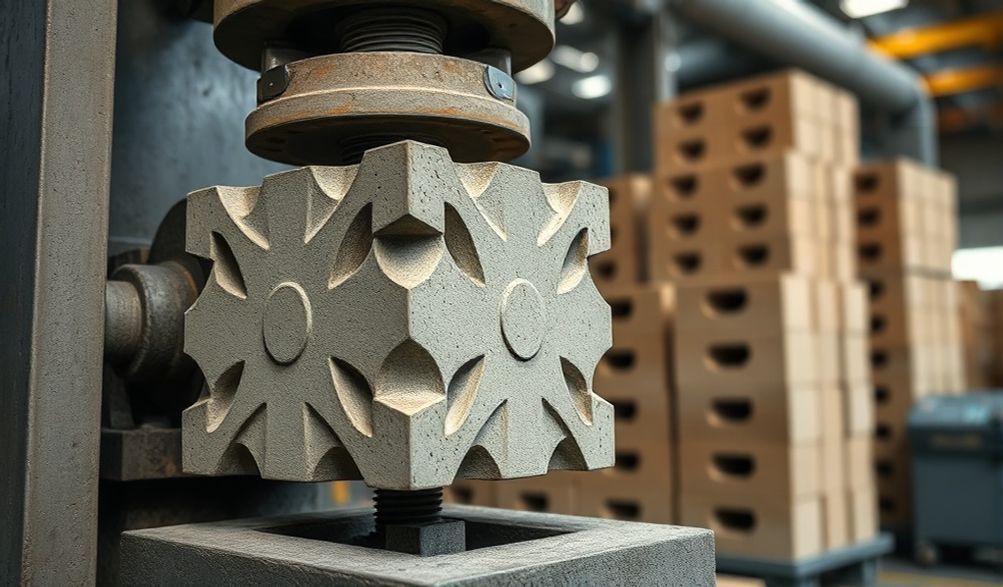
Hagaha Ugu Wanaagsan ee Makiinadaha Sameynta Buulooyinka Isku-xidhka Siman: Noocyada, Faaiidooyinka & Sida Loo Xulo
Hordhac
Warshada dhismaha caalamku waxay joogto u tahay is-beddel joogto ah, oo ay horseeddo baahida degdeg ah ee agabka aan kaliya adag oo waara lahayn, balse sidoo kale ay waaraan oo qiimo jaban in la isticmaalo. Isbeddelkan dhexdiisa, hal xal ayaa si degdeg ah ugu soo kordhayaa iyadoo loo marayo isku-dhafka uu leeyahay oo fudud oo cusboonaysiin leh: boolka simento ee isku xira. Laakiin waxa dhab ahaantii wax beddelayaa ma ahan boolka qudhiisa—waa makiinada khaasiga ah ee ka dhigaysa soo saarista goobta ee waxtarka leh. Ku soo dhawoow hagitaan go'an eemakiinad sameynta buloogo isku xirxira oo la dhiso.
Hadaan turjumo: Tilmaamahan waa ilo diyaarad ah oo loo sameeyay si loogu caawiyo khandaraatiyayaasha, dhisaayaasha, ganacsatada himilada weyn leh, iyo maareeyayaasha mashruucyada. Waxaan ka soo qaadanaynaa aqoonta qoto dheer ee warshadaha, qeexitaannada farsamada, iyo fahamka waxqabadka la taaban karo si aan uga qeexno farsamadan awood badan. Hadafkeena waa mid kaliya: inaan kuu siiyo faham cad nooca mashiinnada, faa'iidooyinkooda la taaban karo, qawaaniinta muhiimka ah ee doorashada, iyo fikradaha lagama maarmaan ah ee iibsiga, si aan kuugu xoojinno inaad go'aansho aad si sax ah ugu heshay oo ku habboon mashruucagaaga ama ganacsigaaga. Tani waa ilo waxbarasho oo diiradda saaran hababka ugu fiican iyo aqoonta aasaasiga ah, hase ahaatee ma ahan mid loogu talagalay in lagu kalsoonaado sumcad gaar ah, taasoo lagu hubinayo inaad hesho macluumaadka u baahan tahay si aad ugu liibaanto.
Waa maxay Makiinada Sameynta Boolooyinka Isku-xirka La Taabto?
Qeybta aasaasiga ah, makiinadan waa makiinad laami ah oo loo habeeyey si sax ah, waxaana loogu talagalay inay beddesho isku-darka qalalan ee dhagaxyo, ciid iyo simento guri dhismo oo qaab dhismeed leh, iyadoo leh astaan gaar ah: way isku xirxiraan iyagoon u baahnayn midaar.
Shaxda Ugu Muhiimsan iyo Soo Saarida La Sharaxay
Faaqida ugu muhiimsan ee amashiinka sameynta boolooyinka isku xirxira ee laami ahwaa in la adeegsado cadaadis weyn oo "cunno-qalalan" ah, iyadoo loo adeegsanayo qalab loogu talagalay in uu sameeyo bulooco leh qaabka afka iyo xidhidda, qaabka jigjigga, ama naqshadeynta joomatari ee dusha sare iyo dhinacyada. Naqshadahaas ayaa ah furega nidaamka:
- The Interlock:Marka la dhigayo, qodobbada (qolofyada) ee hal baras ayaa si adag ugu dhex galaya meelaha hooseeya (qolofyada) ee barasyada ku xiga.
- Natiijada:Halan qabow, darbi mekaniki ah oo la xiro ama saf darbi oo xooggiisa ka soo jeedo isku-dheellitirka iyo joomatari, sida ugu eg buug-xidhmo saddex-cabbir ah. Tani waa ka saarida baahida la xidhiidha simento caadiga ah.
Aasaaska Hawlgal ee Shaqada
Marka la eego qaab-dhismeedka, habka aasaasiga ah waa mid isku mid ah inta ugu badan mashiinnada waxaana uu raacaa habka qalabka qalalan:
- Cunto-siin:Qalabka dhismaha ama hopperka ayaa loo geliyaa isku dheggan oo qalalan oo la diyaariyay (oo leh dhegganyo ku filan oo uu ku dheganaanayo, laakiin aan "dhac" lahayn).
- Qabashada:Isku dhafka waxaa la galiyaa laba xoog oo muhiim ah:
- GariirGariirka soo noqnoqda ee sare ayaa soo dejiya isku darka, wuxuu saaraa hawo-boodhka, wuxuuna hubinayaa in geesaha qaabka la buuxiyay.
- Kuleylka Hydraulic-kaMarkabka hydraulic-ka ah ayaa markaas ku cadaadiya isku darka cadaadis aad u weyn (oo lagu qiyaaso tan), isagoo ka dhiga cuf adag oo xoog badan.
- Qaab-dhismeedka:Shaqada isku dhafka ah ee gariirka iyo cadaadiska ayaa qaabeeya isku dhafka si uu u noqdo qaabka saxda ah ee qaabka, oo ay ku jiraan qaababka isku xidhka ee adag.
- Ku bixid:Bulukeeti cusub oo la sameeyay ayaa kor loo qaadaa ama lagu riixaa qaabka dhulka ama saaxiil loo sameeyay, diyaar u ah daaweynta.
Habta "qoyan ee qalalan" ee kor ku xusan waxay ka duwan tahay habka dhaqanka ee shubista qoyan, taasoo u oggolaanaysa in si degdeg ah loo qabto bulukeeyada iyo in la dardargeliyo waqtiyada dhismaha guud.
Faa'iidooyinka Muhiimka ah ee Isticmaalka Baloogyada Isku-xiiran iyo Mashiinnada Sameeya
Ma aha oo kaliya in la iibsado mashiin marka la maalgashanayo tiknoolajiyaddan; waxay tahay in la furo faa'iidooyin badani u horseedaan mashaariicda dhismaha ama qaabka ganacsigaaga.
Construction and Performance Benefits
- Unmatched Speed of Construction: Without the need to mix, apply, and wait for mortar to cure, block-laying productivity can increase by 200-300%. Walls rise significantly faster, accelerating project completion.
- Significant Cost Efficiency: Savings are realized across multiple fronts:
- Shaqo: Reduced need for highly skilled masons.
- Qalabka: Elimination of mortar, sand, and cement for laying.
- Gaadiidka On-site production cuts costs and breakage associated with transporting heavy finished blocks from a distant plant.
- Qaniimada Sare & Xoogga Properly made interlocking blocks have very high compressive strength. Their mechanical interlock creates a flexible structure that can handle shear forces and settlement better than rigid mortar-bound walls, making them ideal for retaining walls, pavements, and load-bearing applications.
- Inherent Sustainability: This technology supports green building in several ways:
- Material Use: Can incorporate industrial by-products like fly ash or recycled aggregates.
- Permeability: Certain designs allow for grass or water infiltration, reducing runoff.
- Reusability: Blocks can often be disassembled and reused elsewhere.
Operational and Business Advantages
- On-Demand, On-Site Production: Produce blocks exactly where they’re needed, when they’re needed. This provides ultimate control over inventory, quality, and logistics.
- Immense Design Versatility: By simply changing the mold, a single machine can produce a variety of block sizes, shapes (e.g., straight, corner, half), and even surface textures (split-face, rock-face, smooth). Color can be added to the mix or applied to the surface.
- A Tangible Business Opportunity: For entrepreneurs, a single semi-automatic or automatic machine can form the core of a profitable block manufacturing business, supplying blocks for local construction, landscaping, and infrastructure projects.
Types of Concrete Interlocking Block Making Machines
Choosing the right machine starts with understanding the landscape. They are primarily categorized by their operation method, mobility, and output.
By Operation Method
- Makiinada Gacanta:
- Sida ay u shaqeeyaan: Operated entirely by human labor using a lever mechanism to apply pressure. Feeding and block removal are manual.
- Ugu Fiican: Very small-scale projects, DIY enthusiasts, community-led building initiatives, or pilot projects. Output is low (e.g., 100-500 blocks per day), but the cost of entry is minimal.
- Makiinnada Yar-otoomaatig ah:
- Sida ay u shaqeeyaan: The core compaction process (vibration and hydraulics) is powered and automated. Operators manually feed raw material and remove finished blocks, often with the aid of a lever or button.
- Ugu Fiican: Small to medium-sized businesses, contractors with multiple projects, and medium-volume production (e.g., 1,000 – 6,000 blocks per 8-hour shift). They offer an excellent balance between productivity, cost, and flexibility.
- Makiinadaha Tooska ah ee Si Fudud:
- Sida ay u shaqeeyaan: These are complete production lines. They feature automated systems for feeding raw material, mixing, conveying, compacting, curing, and even stacking/palletizing finished blocks. Controlled via PLC (Programmable Logic Controller).
- Ugu Fiican: Large-scale commercial block yards and industrial production facilities requiring very high, consistent output (10,000+ blocks per day). They maximize output and minimize labor but require a substantial capital investment.
By Mobility and Setup
- Waxyaabaha Joogtada ah ee Dhirta: These are fixed installations, often the foundation of a block manufacturing factory. They are designed for maximum output and are not intended to be moved frequently.
- Mobile/Portable Machines: Mounted on a trailer or skid frame, these units can be towed or transported directly to a job site. This is a massive advantage for large infrastructure projects (e.g., remote road construction, large retaining walls) where transporting blocks is impractical.
By Block Output Capacity
- Wax yar yar: Up to ~2,000 blocks per day. Typically manual or small semi-automatic models.
- Dhexdhexaad: ~2,000 to 10,000 blocks per day. The domain of robust semi-automatic and smaller fully automatic machines.
- Large-scale Industrial: 10,000+ blocks per day. The exclusive realm of high-end fully automatic production lines and stationary plants.
Critical Factors to Consider When Choosing a Machine
Making the right choice requires a clear-eyed assessment of your needs against the machine’s capabilities. Here’s your practical checklist.
Project & Business Requirements
- Production Volume: Calculate your average daily and peak weekly block requirement. Choose a machine that can meet this with some capacity to spare—running a machine at 100% capacity constantly leads to wear.
- Block Specifications: List every block type you need (standard, corner, half-block, thickness). Ensure the machine and available molds can produce them all.
- Site & Resource Constraints:
- Goobta: Do you have a factory shed or just an open plot? Automatic lines need more covered space.
- Awood Is three-phase electrical power available, or do you need a diesel-powered option?
- Shaqo: What is the skill level of your available workforce? A fully automatic machine may need an electrician/technician, while a semi-automatic needs diligent operators.
Machine Specifications & Features
- Xoogga Cadaadiska (Tonajka): This is critical for block strength. Higher tonnage (e.g., 150 tons vs. 50 tons) produces denser, stronger blocks suitable for load-bearing walls. For garden walls, lower pressure may suffice.
- Mold Versatility & Changeover: How easy is it to change molds? Quick-change systems save hours of downtime when switching block types. Also, check the cost and availability of additional molds from the supplier.
- Heerka Automationka: Honestly evaluate the trade-off. Higher automation means a higher upfront cost but lower long-term labor costs and more consistent output. Can your budget and operational style support it?
- Qaybta Qaab-dhismeedka Inspect the robustness of the frame (solid steel is best), the quality of the hydraulic pump and cylinders, and the brand/durability of the vibrator motors. A heavier machine frame generally indicates better stability and longevity.
Supplier and Support Evaluation
This step is as important as evaluating the machine itself. Your relationship with the supplier will define your long-term success.
- Research Manufacturer Reputation: Look for companies with a long track record (10+ years is a good sign). Search for reviews, ask for a client portfolio, and try to speak to existing customers.
- Adeegy Ka Dib Iibka: Does the supplier offer installation, commissioning, and on-site operator training? What is their spare parts policy? A reliable local agent or service network is invaluable.
- Warranty & Documentation: Scrutinize the warranty terms. Clear, comprehensive operation and maintenance manuals in your language are a must-have.
Operational Best Practices and Maintenance Tips
Owning the machine is half the battle; operating it correctly ensures profitability and longevity. Here’s actionable guidance drawn from field experience.
Diyaarinta Alaabta Aasaasiga ah
The quality of the block is determined here. Ensuring consistent moisture in the mix is often the difference between a perfect block and a cracked one.
- Mix Design: A typical mix might be 1 part cement, 3-6 parts well-graded aggregate (e.g., 3/8″ crushed stone), and 2-4 parts sharp sand. The exact ratio depends on desired strength and local materials.
- Qaddaca Qoyaanka This is critical. The mix should be damp enough to hold its shape when squeezed in your hand (≈ 5-8% water by weight), but no free water should be visible. Too dry = weak blocks; too wet = blocks stick in the mold.
Routine Machine Operation Checklist
- Pre-Start: Check hydraulic oil levels, ensure all bolts are tight, clean the mold cavity and pallets.
- During Operation: Feed the hopper consistently but don’t overfill. Monitor the block ejection process—any sticking indicates a mold or mix issue. Listen for unusual noises from the hydraulics or vibrators.
- Shutdown: Clear all residual material from the mold and hopper. Park the machine in a safe position.
Essential Maintenance for Longevity
A simple, consistent maintenance routine prevents costly breakdowns.
- Daily: Clean the machine thoroughly. Check for loose parts.
- Weekly: Lubricate all moving parts as per the manual (pivots, guide rods). Inspect hydraulic hoses for leaks.
- Monthly: Check and tighten all major bolts and nuts on the frame and vibration table. Change hydraulic oil and filters as recommended by the manufacturer.
FAQ Section
Q: What is the typical cost range for an interlocking block machine?
A: The range is vast. A basic manual machine can start from \$3,000 – \$10,000. A quality semi-automatic machine typically ranges from \$15,000 to \$50,000. Fully automatic production lines can range from \$70,000 to well over \$300,000, depending on capacity and sophistication. Always factor in costs for molds, a mixer, and a pallet or curing rack system.
Q: Can these machines use recycled materials like crushed concrete or plastic?
A: Many can, especially robust machines with higher pressure. Crushed concrete is an excellent, sustainable aggregate. Some technologies allow for the inclusion of certain plastic fibers. However, the material must be clean, consistently sized, and its properties understood. Always consult with the machine manufacturer to validate your specific mix design.
Q: How much training is required to operate a semi-automatic machine?
A: Basic operational training is usually sufficient and is often provided by the supplier over a few days. The key is diligent adherence to the operational manual, understanding the raw material mix, and performing routine maintenance. Safety training around moving parts and hydraulics is non-negotiable.
Q: What is the difference between hydraulic and vibration pressure in these machines?
A: They serve complementary roles. Gariir (often from multiple high-frequency vibrators) consolidates the dry mix, causing particles to settle densely into every part of the mold. Kuleylada haydiroolik then applies a final, static, high-tonnage force that permanently compacts the mix, creating the final bond and achieving the high compressive strength of the block. The best machines effectively combine both.
Q: Are the blocks produced strong enough for load-bearing walls?
A: Absolutely. When produced with the correct cement content, proper mix design, and sufficient machine pressure, interlocking concrete blocks can achieve compressive strengths that meet or exceed ASTM C90 standards for concrete masonry units. For any specific load-bearing structural application, the block specifications should be reviewed and approved by a qualified structural engineer.
Gabagabo
Selecting the ideal mashiinka sameynta boolooyinka isku xirxira ee laami ah is a strategic decision that hinges on a clear assessment of your project needs, output goals, and operational budget. From manual presses for community projects to fully automated lines driving an industrial business, this technology offers a pathway to faster, more economical, and notably sustainable construction.
We encourage you to use this guide as your foundational framework for evaluation. Let it inform the questions you ask and the specifications you prioritize. Your final step should involve contacting multiple reputable suppliers with your detailed requirements. Request live demonstrations, ask for samples of blocks produced by their machines, and scrutinize their service commitments. By investing time in this due diligence, you’re not just purchasing a piece of equipment—you’re investing in the future efficiency and growth of your construction endeavors or business. This technology is more than a machine; it’s a tool for building modern, resilient infrastructure, one precisely interlocked block at a time.
<