
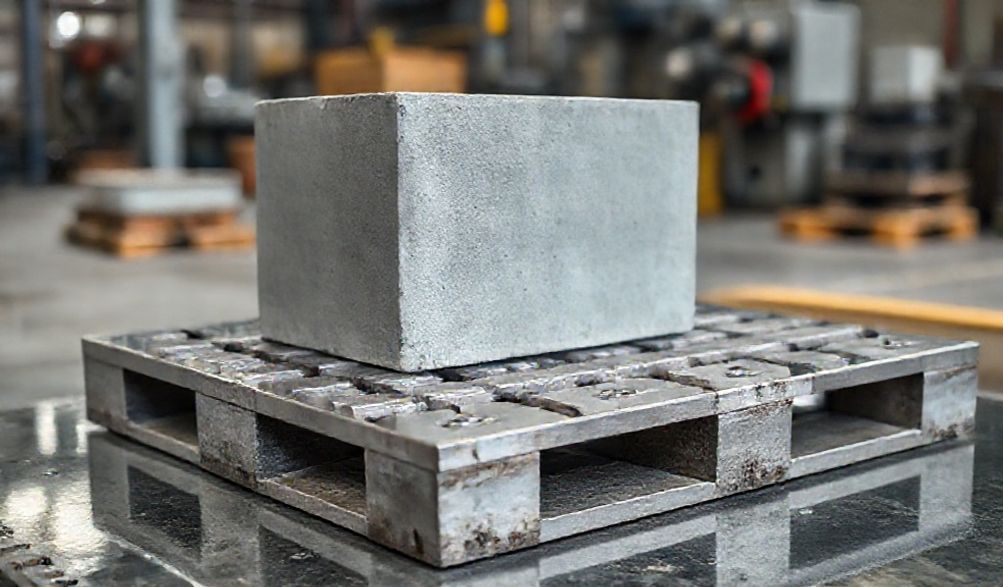
Jagorar Cikakke don Pallet ɗin Na'urorin Yin Tubali: Zaɓi, Amfani da Kulawa
Gabatarwa
Kun inganta tsarin simintin ku, kun daidaita girgizar ku, kuma kun gyaggyara tsarin ruwan karfin ku. Duk da haka, har yanzu kuna fuskantar matsalolin samarwa masu ban haushi: tubalan da ba su da daidaiton tsayi, tabo a saman da ke haifar da kin amincewa, ko lalacewar da ba a zata ba akan kalubalen ku. Kafin ku zargi injin da kansa, ku duba ƙasa. Mai laifi sau da yawa shine dandamali maras kima da ke ƙarƙashin kowane tubalin da kuke samarwa—pallet.
Ana ɗaukar pallet ɗin na'urar yin bulo a matsayin kayan amfani mai sauƙi, amma a haƙiƙa, yana da muhimmanci na musamman. Wannan jagorar ta samo asali ne daga ƙwarewar masana'antu na shekaru da yawa, wanda ya haɗa da ilimin masana'antun na'urori, ƙwararrun ma'aikatan samarwa, da injiniyoyin kayan aiki. Muna nan don canza ra'ayin ku.
Na'urar block pallet shine mahimmin farantin karfe mai motsi wanda ake gyara siminti a kai, a matse shi, kuma a fara warkar da shi. Yana zama ginshiƙin samfurin ku, yana tafiya cikin na'urar cika, matsawa, da zagayowar fitarwa kafin ya kai block ɗin da ba a gama ba zuwa wurin warkarwa.
Zaɓar da kula da ingantaccen pallet ba aikin saye na ƙari ba ne; shine saka hannun jari kai tsaye a cikin ribar masana'antar ku, ingancin samfur, da tsawon rayuwar injina. Zaɓin pallet mara kyau yana ɓata riba a ɓoye ta hanyar ɓarna, lokacin dakatarwa, da saurin lalacewa. Wannan cikakken jagora yana ba da haske mai amfani don mayar da pallets ɗin ku daga cibiyar farashi zuwa ginshiƙin ingantaccen samarwa. Idan kai mai shukar bulo ne, manajan samarwa, mai kulawa da kulawa, ko jami'in saye, bayanan masu zuwa na nufin ku ne.
Me Yadda Zabin Pallet ɗin Injin Block ɗinku Yake Da Muhimmanci Ga Samun Ribar Ku
Yin watsi da pallets ɗinku kamar ƙungiyar Formula 1 ce tana watsi da tayoyin motarsu. Su ne kawai abin da ke tsakanin injinanku da samfuran ku, kuma yanayinsu yana ƙayyade aikin. Ƙayyadaddun pallets ɗinku suna da tasiri kai tsaye, wanda za'a iya aunawa, kan ribar kasuwancin ku.
Tasiri akan Ingancin Samfura & Daidaitawa
Ingancin tubalan ku ya dogara ne da kyawun saman da aka kafa su a kai.
- Daidaiton Girma:Zaɓin pallet ya zama mahimmanci. Pallet da ya karkace ko ya lalace zai haifar da tubalan da suke da bambancin tsayi da kuma girma wanda bai dace ba. Wannan yana haifar da gazawar gwajin inganci, korafe-korafen abokan ciniki game da wahalar shimfiɗawa, da kuma ɓata samfurin.
- Siffarar Saman & Saki:Fasalin saman pallet (ƙasa mai santsi, mai ɗan ƙyalli) yana shafar yadda toshe ke fitowa bayan fitarwa kai tsaye. Saman da ya lalace ko ya yi kauri na iya haifar da mannewa, wanda zai haifar da lalacewar toshe ko lahani a saman da ake iya gani a samfurin ƙarshe.
- Hana Lalacewa:Tsage-tsage ko tabo na iya faruwa ne daga pallet. Wani wuri da ya gaji sosai ko tarin siminti yana haifar da goyon baya mara daidaituwa a lokacin matsi mai tsanani, wanda ke haifar da matsalolin damuwa da ke bayyana a matsayin tsage-tsage.
Tasiri Kai Tsaye akan Lafiyar Injini & Lokacin Aiki
Falat ɗinku suna kare mafi kyawun kadararku—na'urar bulo kanta.
- Gajeren Lokaci na LaloWani tsohon pallet mara daidaituwa yana aiki kamar yashi a ƙasan ƙirar da kuma kan matsi. Yana haifar da lalacewa da wuri akan waɗannan kayan aiki masu tsada da daidaito. Hakanan yana ƙara gogewa akan sarƙoƙin masu jigilar kaya da na nadi.
- Rashin Daidaituwa da Matsalolin Kunci.Lalacewar pallet ko lalacewar gefe shine babban dalilin toshewa a cikin ma'ajiyar pallet, mai ciyarwa, ko tsarin canja wuri. Wadannan tsayawar da ba a shirya ba suna dakatar da duka layin samarwar ku, wanda ke haifar da asarar fitarwa mai yawa da kuma matsala mai tsanani.
Farashin da ba a bayyana ba na Amfani da Pallet mara kyau
Tabbas, tanadin kuɗi na farko daga pallet mai rahusa, mara inganci, yana ɓacewa da sauri a ƙarƙashin binciken aiki.
- Ƙara Sharar Gida:Matsalolin mannewa da kuskuren girma kai tsaye suna haifar da katanga da suka karye ko kuma ba su daidaita da ma'auni ba, wanda dole ne a jefar da su.
- Kudin Kulawa Mai Girma:Sauye-sauye na kayan aiki akai-akai, kananan kayan aiki, da kayan aikin motsi na kayan aiki saboda saurin lalacewa ya zama kashe kudi mai maimaitawa.
- Sauye-sauye da yawa:Pellet ɗin da ke lalacewa a cikin watanni 6 yana da tsadar jimlar da ya fi girma fiye da pellet mai inganci wanda ke aiki na tsawon shekaru 3, idan ka yi la’akari da lokacin dakatarwa don canjawa da kuma yawan kashe kuɗi na siye.
- Ƙarfin Rashin Amfani da Wutar Lantarki:A cikin yanayin curing na tururi, pallet da aka karkata ba shi da kyautatawa da gadon curing, yana rage ƙarfin watsa zafi kuma yana iya haifar da curing mara daidaituwa.
Nau'ikan Pallet don Injin Yin Bulogi: Kayayyaki da Takamammen Bayani
Ba duk wani faranti na ƙarfe ba ne ake yi daidai. Fahimtar ilimin kayan aiki a bayan zaɓuɓɓukan pallet yana ba ka damar tantance madaidaicin kayan aiki don aikinka.
Ƙananan Fasinjoji na Karfe: Babban Ma'aikata
Waɗannan su ne mafi yawan pallets, waɗanda aka yi da faranti na ƙarfe mai ɗorewa, mai jurewa da gogewa.
- Bayani na Tipikal:An yi shi daga nau'ukan kamar Hardox 400 ko AR400, tare da kauri daga 6mm zuwa 12mm, gwargwadon girman injin da nauyin block.
- Abubuwan da suka fi kyau:Kyakkyawan jituwa tsakanin juriya da farashi mai inganci. Suna ba da kyakkyawan juriya ga buguwa da kaddarorin canja wurin zafi, wanda ya sa su dace da samar da manyan ɗumbin buhun guda na yau da kullun.
- Rashin Kyau:Yayyace suna da ƙarfin hana lalacewa, amma ba su da kariya daga gogayya kuma za su rasa daidaiton su a hankali. Hakanan suna iya lalacewa idan sun fuskanci danshi da yanayin alkali na siminti ba tare da kariya ba.
Hardened & Ground Steel Pallets: For Precision & Longevity
This is the premium choice for operations focused on minimal downtime and superior product finish.
- Tsari: After being cut to size, these pallets undergo a heat treatment (hardening) process, followed by precision grinding on large surface grinders. This creates an exceptionally hard, flat, and smooth surface.
- Mahimman Fa'idodi:
- Superior Wear Resistance: The hardened surface withstands abrasion far longer than standard steel, drastically extending service life.
- Exceptional Flatness Retention: They resist warping and dishing under cyclic loading, maintaining dimensional accuracy for your blocks over time.
- Smooth Block Release: The mirror-like ground finish provides an almost non-stick surface, reducing release agent needs and improving block bottom finish.
- Amfani Mafi Kyau: Essential for producing high-tolerance products like interlocking paving stones, architectural masonry, and any application where a perfect bottom finish is required.
Specialty & Coated Pallets
For specific environmental or production challenges, specialized pallets offer solutions.
- Galvanized or Painted Pallets: A zinc coating (galvanizing) or a robust industrial paint system provides a barrier against corrosion. This is crucial for plants in coastal/humid regions or those using accelerants or mix designs that are particularly corrosive.
- Non-Stick Coatings: Applied over steel, coatings like PTFE (Teflon) or specialized polymers create a surface to which concrete minimally adheres. These are valuable for intricate mold designs with deep ribs or for mixes that are prone to sticking, though they may wear over time and require re-coating.
Key Specifications to Specify When Ordering
Never just order a “steel plate.” Provide a detailed specification sheet to your supplier.
- Girma: Exact length, width, and thickness. Include permissible tolerances (e.g., ±0.2mm on thickness).
- Flatness Tolerance: The most critical spec. Usually expressed as a deviation over a length (e.g., “±0.5mm over any 1-meter span”).
- Siffar Fuskokin Specify “Precision Ground,” “Milled,” or “As-rolled.” For ground pallets, you may specify a surface roughness (Ra) value.
- Hardness: Define the Brinell Hardness Number (BHN). For example, AR400 has a nominal hardness of 400 BHN.
- Edge Preparation: Require all edges to be deburred, beveled, or radiused. Sharp edges are a safety hazard, damage conveyor guides, and can chip easily.
How to Select the Right Pallet for Your Machine and Product Mix
Selecting a pallet is a three-part equation: your machine’s requirements, your product’s demands, and your plant’s environment.
Matching Pallet to Machine Model
This is non-negotiable. Your block machine is engineered for a specific pallet profile.
- Consult the Manual: The manufacturer’s manual provides the exact dimensions, thickness, and maximum weight specifications. Deviating from these can void warranties and cause mechanical failure.
- Weight Matters: The machine’s pallet feeder, elevator, and turnover systems are designed for a specific weight range. A pallet that is too heavy can overload drives and cause misalignment.
Matching Pallet to Your Block Products
Different products exert different stresses on a pallet.
- Tubalan Hollow Block na Al'ada: Create a concentrated wear pattern along the outer edges of the mold. A durable, abrasion-resistant steel is key.
- Dense Pavers or Solid Blocks: Apply pressure more evenly across the entire pallet surface. Flatness retention under full-area compression is the critical factor here.
- Abrasive Mixes: If your mix contains industrial by-products like slag or certain manufactured aggregates, the abrasiveness skyrockets. This is a strong case for investing in the hardest, most wear-resistant pallet you can justify.
Evaluating Your Production Environment
The atmosphere in your plant plays a role in pallet longevity.
- Humidity & Corrosion Risk: Assess your climate and indoor humidity. If rust is a frequent sight, prioritize coated or galvanized pallets, or commit to a rigorous protective maintenance routine.
- Cleaning Processes: Do you use high-pressure water jets for cleaning? This forceful, concentrated water can accelerate corrosion if pallets are not dried and treated afterward. It can also damage non-stick coatings.
Best Practices for Pallet Maintenance & Maximizing Lifespan
A premium pallet is an investment; proper maintenance is the insurance policy. A simple, consistent routine can double or triple a pallet’s service life.
Daily & Weekly Inspection Routines
Catch problems early, before they damage blocks or the machine.
- Visual Checklist: Each shift, operators should quickly look for:
- Warping/Bowing: Sight down the length of the pallet.
- Edge Damage: Dings, curls, or cracks on the edges.
- Surface Pitting: Signs of corrosion or impact damage.
- Concrete Buildup: Residual “packing” on the surface.
- The Straightedge Test: Weekly, use a precision straightedge and a feeler gauge to check flatness. Document any pallets exceeding your flatness tolerance (e.g., >1mm gap).
Proper Cleaning Techniques
Remove concrete residue without damaging the pallet.
- Immediate Removal: Scrape off wet concrete buildup promptly before it cures.
- For Cured Residue: Use a plastic or nylon scraper. Avoid aggressive steel wire brushes, which score the surface and create grooves that promote sticking.
- Chemical Cleaners: If needed, use a mild, acidic concrete dissolver, but ensure it is compatible with your pallet’s material/coating and rinse thoroughly.
Correct Handling & Storage
Most physical damage occurs off the machine.
- Never Drop or Drag: Use designated pallet carts. Dropping pallets onto concrete floors is a surefire way to cause warping and edge damage.
- Flat, Dry Storage: When not in use, store pallets in a clean, dry area. Stack them flat on a level surface with support across their full area to prevent sagging.
When to Repair vs. Replace
Knowing when to retire a pallet saves money in the long run.
- Signs for Replacement:
- Excessive warping that cannot be corrected in a press (>3mm deviation).
- Deep grooves or scoring that affects block release.
- Severe corrosion that has pitted through the material, compromising structural integrity.
- Consider Repair/Refurbishment: For high-quality hardened pallets that have lost flatness or surface finish but are not deeply worn, professional re-grinding by a specialized workshop can be a cost-effective way to restore them to like-new condition, extending their life significantly.
Frequently Asked Questions (FAQ) About Block Machine Pallets
Q1: How often should I replace my block machine pallets?
A: There is no universal timeline. Replacement should be driven by condition, not calendar. A well-maintained hardened pallet in a low-abrasion environment could last 5+ years. A standard pallet in high-volume, abrasive production might need replacement in 12-18 months. Let your weekly inspection and flatness tests dictate the schedule.
Q2: Can I use a thicker pallet than what my machine manual specifies?
A: It is strongly discouraged without explicit written approval from the machine manufacturer. A thicker pallet may not fit in the magazine, can overload the elevator and drive mechanisms, and critically, it can alter the compression stroke distance, leading to under-compacted blocks or machine damage.
Q3: Why are my blocks sticking to the pallet?
A: Sticking is a common symptom with multiple potential causes. Diagnose in this order:
1. Pallet Surface: Is it pitted, rough, or contaminated with old buildup? Refurbish or replace.
2. Mix Design: Is the mix too wet or has a high fines content? Adjust the water-cement ratio.
3. Release Agent: Are you using one? Is it applied correctly and at the right dosage?
4. Machine Process: Is the vibration time and pressure sufficient for proper compaction and release?
Q4: Is it worth investing in more expensive hardened pallets?
A: Analyze it through Farashin Gabaɗaya Mallaka (FGM). While hardened pallets can cost 2-3x more upfront, consider:
* They last 3-5x longer than standard pallets.
* They drastically reduce downtime for pallet changes and machine wear.
* They improve product quality and reduce waste.
For high-volume or precision-focused plants, the math almost always favors hardened pallets in the long run.
Q5: How can I prevent my steel pallets from rusting?
A: A proactive approach is key:
1. Clean Thoroughly & Dry: After washing, ensure pallets are completely dry before storage.
2. Apply a Protective Film: During weekend shutdowns or extended inactivity, lightly spray or wipe pallet surfaces with a thin layer of a water-displacing, rust-inhibitive oil (ensure it’s compatible with concrete and won’t affect curing).
3. Control Storage Environment: Keep spare pallets in a dry, covered area off damp floors.
Ƙarshe
The pallet for your block making machine is far more than a simple slab of steel. It is a precision-engineered component that sits at the heart of your production quality, efficiency, and cost control. Treating it as a disposable commodity is one of the most common and costly oversights in block manufacturing.
The strategic choice is clear: prioritize quality, correct specifications, and a partnership with a reputable supplier who understands the demands of block production over the temptation of the lowest upfront cost. Your pallets should be an asset you manage, not an expense you dread.
Your Call to Action: This week, conduct a pallet audit. Pull 10-20 pallets from your line at random. Perform the straightedge test. Inspect for wear and damage. You may uncover the root cause of persistent production issues. For specific guidance, contact your machine’s OEM or consult with a trusted, specialized pallet manufacturer for a professional assessment of your needs.
By mastering the selection, use, and maintenance of your pallets, you pave the way for a smoother, more profitable, and sustainable block production operation for years to come.
<