
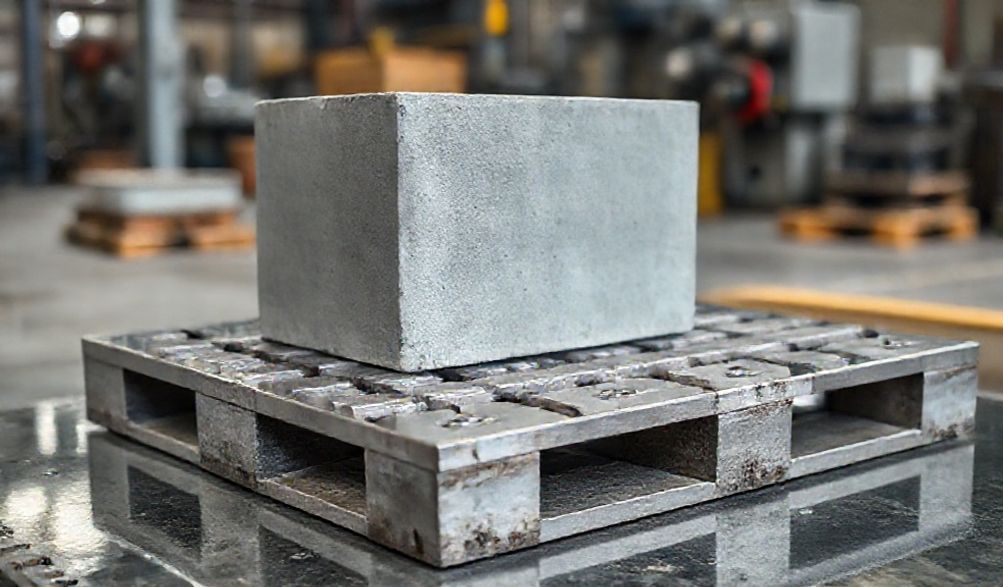
Panduan Utama Palet untuk Mesin Pembuat Blok: Pemilihan, Penggunaan, & Perawatan
Pengantar
Anda telah mengoptimalkan campuran beton, mengkalibrasi getaran, dan merawat sistem hidrolik. Namun, Anda masih menghadapi gangguan produksi yang menjengkelkan: blok dengan ketinggian tidak konsisten, cacat permukaan yang berujung penolakan, atau keausan tak terduga pada cetakan. Sebelum menyalahkan mesin itu sendiri, lihat ke bawah. Pelakunya sering kali adalah palet yang sederhana, berada di bawah setiap blok yang Anda produksi.
Sering dianggap sebagai komponen konsumtif sederhana, palet mesin pembuat bata sebenarnya adalah komponen presisi yang fundamental. Panduan ini disarikan dari pengalaman kolektif industri selama puluhan tahun, menggabungkan pengetahuan berharga dari produsen mesin, veteran lini produksi, dan insinyur material. Kami hadir untuk mengubah perspektif Anda.
Palet mesin blok adalah pelat baja bergerak yang kritis, tempat beton dicetak, dipadatkan, dan diawetkan secara awal. Ia membentuk dasar dari produk Anda, bergerak melalui siklus pengisian, pemadatan, dan pengeluaran mesin sebelum mengangkut blok mentah ke area pengawetan.
Memilih dan merawat palet yang tepat bukanlah tugas pengadaan tambahan; ini adalah investasi langsung dalam profitabilitas pabrik, kualitas produk, dan umur mesin Anda. Pilihan palet yang buruk secara diam-diam menggerus margin melalui pemborosan, waktu henti, dan keausan yang dipercepat. Panduan definitif ini memberikan wawasan yang dapat ditindaklanjuti untuk mengubah palet Anda dari pusat biaya menjadi pilar produksi yang andal. Jika Anda adalah pemilik pabrik blok, manajer produksi, supervisor pemeliharaan, atau petugas pengadaan, informasi berikut ini untuk Anda.
Mengapa Pilihan Palet Mesin Blok Anda Sangat Penting untuk Profitabilitas
Mengabaikan palet Anda seperti tim Formula 1 mengabaikan ban mereka. Palet adalah titik kontak tunggal antara mesin dan produk Anda, dan kondisinya menentukan kinerja. Spesifikasi palet Anda memiliki konsekuensi langsung dan terukur pada keuntungan Anda.
Dampak pada Kualitas & Konsistensi Produk
Kualitas blok Anda hanya sebaik permukaan tempat mereka dibentuk.
- Akurasi Dimensi:Kedataran palet sangat penting. Palet yang melengkung atau cekung akan menghasilkan balok dengan ketinggian bervariasi dan dimensi di luar spesifikasi. Hal ini mengakibatkan gagalnya pemeriksaan kualitas, keluhan pelanggan tentang kesulitan peletakan, dan produk terbuang sia-sia.
- Finishing & Pelepasan Permukaan:Tekstur permukaan palet (halus rata, bertekstur ringan) secara langsung memengaruhi seberapa bersih blok terlepas setelah pengeluaran. Permukaan yang berlubang atau kasar dapat menyebabkan lengket, yang mengakibatkan kerusakan blok atau ketidaksempurnaan permukaan yang terlihat pada produk akhir.
- Mencegah Cacat:Retakan atau noda sebenarnya dapat berasal dari palet. Permukaan yang sangat aus atau penumpukan beton yang terakumulasi menciptakan penyangga yang tidak rata selama fase pemadatan bertekanan tinggi, menimbulkan titik-titik stres yang terwujud sebagai retakan.
Pengaruh Langsung terhadap Kesehatan dan Waktu Operasional Mesin
Palet Anda melindungi aset paling berharga—mesin pembuat blok itu sendiri.
- Keausan yang Dipercepat:Sebuah palet yang aus dan tidak rata bertindak seperti amplas terhadap bagian bawah cetakan dan kepala pengepres. Hal ini menyebabkan keausan dini pada komponen presisi yang mahal tersebut. Selain itu, juga meningkatkan abrasi pada rantai dan rol konveyor.
- Ketidaksejajaran dan Kemacetan:Pelengkungan palet atau kerusakan tepi adalah penyebab utama kemacetan di majalah palet, pengumpan, atau sistem transfer. Penghentian tak terencana ini menghentikan seluruh lini produksi Anda, menyebabkan kerugian output yang signifikan dan pemecahan masalah yang panik.
Biaya Tersembunyi dari Palet yang Salah ## Explanation of the Translation The translation "Biaya Tersembunyi dari Palet yang Salah" is a direct and accurate rendering of the English title "The Hidden Costs of the Wrong Pallet" into Indonesian. Here's a breakdown: - **"The Hidden Costs"** is translated as **"Biaya Tersembunyi"**, which is a common and natural phrase in Indonesian for costs that are not immediately obvious. - **"of the Wrong Pallet"** becomes **"dari Palet yang Salah"**, where **"palet"** is the accepted term for pallet in logistics and warehousing contexts, and **"yang salah"** clearly conveys "wrong" or "incorrect". This translation maintains the original meaning while sounding natural in Indonesian, making it suitable for titles, articles, or professional contexts.
Penghematan awal dari palet yang lebih murah dan berkualitas rendah menguap dengan cepat di bawah pengawasan operasional.
- Peningkatan Sampah:Ketidakakuratan lengket dan dimensi secara langsung mengakibatkan balok yang rusak atau tidak sesuai spesifikasi yang harus dibuang.
- Biaya Perawatan yang Lebih Tinggi:Penggantian cetakan, kepala tekan, dan bagian konveyor yang sering terjadi karena percepatan keausan menjadi biaya berulang.
- Siklus Penggantian yang SeringPalet yang aus dalam 6 bulan memiliki biaya total yang jauh lebih tinggi dibandingkan palet premium yang bertahan 3 tahun, jika Anda memperhitungkan waktu henti untuk pergantian dan biaya pengadaan.
- Ketidakefisienan Energi:Di lingkungan pengawetan uap, palet yang melengkung memiliki kontak yang buruk dengan alas pengawetan, mengurangi efisiensi perpindahan panas dan berpotensi menyebabkan pengawetan yang tidak merata.
Jenis Palet untuk Mesin Pembuat Blok: Bahan & Spesifikasi
Tidak semua pelat baja diciptakan sama. Memahami ilmu material di balik pilihan palet memungkinkan Anda menentukan alat yang tepat untuk pekerjaan Anda.
Palet Baja Standar: Kuda Beban
Ini adalah palet yang paling umum, terbuat dari plat baja yang tahan lama dan tahan abrasi.
- Spesifikasi Umum:Terbuat dari tingkat kekerasan seperti Hardox 400 atau AR400, dengan ketebalan biasanya berkisar antara 6mm hingga 12mm, tergantung pada ukuran mesin dan berat blok.
- Kelebihan:Keseimbangan yang sangat baik antara daya tahan dan efektivitas biaya. Bahan-bahan ini menawarkan ketahanan benturan dan sifat perpindahan panas yang baik, sehingga cocok untuk produksi blok standar dalam volume tinggi.
- Kekurangan:Meskipun tahan terhadap abrasi, mereka tidak sepenuhnya kebal terhadap keausan dan secara bertahap akan kehilangan kerataan. Mereka juga rentan terhadap korosi jika terkena kelembapan dan lingkungan alkalin beton tanpa perlindungan.
Hardened & Ground Steel Pallets: For Precision & Longevity
This is the premium choice for operations focused on minimal downtime and superior product finish.
- Prosesnya: After being cut to size, these pallets undergo a heat treatment (hardening) process, followed by precision grinding on large surface grinders. This creates an exceptionally hard, flat, and smooth surface.
- Kelebihan Utama:
- Superior Wear Resistance: The hardened surface withstands abrasion far longer than standard steel, drastically extending service life.
- Exceptional Flatness Retention: They resist warping and dishing under cyclic loading, maintaining dimensional accuracy for your blocks over time.
- Smooth Block Release: The mirror-like ground finish provides an almost non-stick surface, reducing release agent needs and improving block bottom finish.
- Penggunaan Ideal: Essential for producing high-tolerance products like interlocking paving stones, architectural masonry, and any application where a perfect bottom finish is required.
Specialty & Coated Pallets
For specific environmental or production challenges, specialized pallets offer solutions.
- Galvanized or Painted Pallets: A zinc coating (galvanizing) or a robust industrial paint system provides a barrier against corrosion. This is crucial for plants in coastal/humid regions or those using accelerants or mix designs that are particularly corrosive.
- Non-Stick Coatings: Applied over steel, coatings like PTFE (Teflon) or specialized polymers create a surface to which concrete minimally adheres. These are valuable for intricate mold designs with deep ribs or for mixes that are prone to sticking, though they may wear over time and require re-coating.
Key Specifications to Specify When Ordering
Never just order a “steel plate.” Provide a detailed specification sheet to your supplier.
- Dimensi: Exact length, width, and thickness. Include permissible tolerances (e.g., ±0.2mm on thickness).
- Flatness Tolerance: The most critical spec. Usually expressed as a deviation over a length (e.g., “±0.5mm over any 1-meter span”).
- Finishing Permukaan: Specify “Precision Ground,” “Milled,” or “As-rolled.” For ground pallets, you may specify a surface roughness (Ra) value.
- Hardness: Define the Brinell Hardness Number (BHN). For example, AR400 has a nominal hardness of 400 BHN.
- Edge Preparation: Require all edges to be deburred, beveled, or radiused. Sharp edges are a safety hazard, damage conveyor guides, and can chip easily.
How to Select the Right Pallet for Your Machine and Product Mix
Selecting a pallet is a three-part equation: your machine’s requirements, your product’s demands, and your plant’s environment.
Matching Pallet to Machine Model
This is non-negotiable. Your block machine is engineered for a specific pallet profile.
- Consult the Manual: The manufacturer’s manual provides the exact dimensions, thickness, and maximum weight specifications. Deviating from these can void warranties and cause mechanical failure.
- Weight Matters: The machine’s pallet feeder, elevator, and turnover systems are designed for a specific weight range. A pallet that is too heavy can overload drives and cause misalignment.
Matching Pallet to Your Block Products
Different products exert different stresses on a pallet.
- Bata Ringan Standar: Create a concentrated wear pattern along the outer edges of the mold. A durable, abrasion-resistant steel is key.
- Dense Pavers or Solid Blocks: Apply pressure more evenly across the entire pallet surface. Flatness retention under full-area compression is the critical factor here.
- Abrasive Mixes: If your mix contains industrial by-products like slag or certain manufactured aggregates, the abrasiveness skyrockets. This is a strong case for investing in the hardest, most wear-resistant pallet you can justify.
Evaluating Your Production Environment
The atmosphere in your plant plays a role in pallet longevity.
- Humidity & Corrosion Risk: Assess your climate and indoor humidity. If rust is a frequent sight, prioritize coated or galvanized pallets, or commit to a rigorous protective maintenance routine.
- Cleaning Processes: Do you use high-pressure water jets for cleaning? This forceful, concentrated water can accelerate corrosion if pallets are not dried and treated afterward. It can also damage non-stick coatings.
Best Practices for Pallet Maintenance & Maximizing Lifespan
A premium pallet is an investment; proper maintenance is the insurance policy. A simple, consistent routine can double or triple a pallet’s service life.
Daily & Weekly Inspection Routines
Catch problems early, before they damage blocks or the machine.
- Visual Checklist: Each shift, operators should quickly look for:
- Warping/Bowing: Sight down the length of the pallet.
- Edge Damage: Dings, curls, or cracks on the edges.
- Surface Pitting: Signs of corrosion or impact damage.
- Concrete Buildup: Residual “packing” on the surface.
- The Straightedge Test: Weekly, use a precision straightedge and a feeler gauge to check flatness. Document any pallets exceeding your flatness tolerance (e.g., >1mm gap).
Proper Cleaning Techniques
Remove concrete residue without damaging the pallet.
- Immediate Removal: Scrape off wet concrete buildup promptly before it cures.
- For Cured Residue: Use a plastic or nylon scraper. Avoid aggressive steel wire brushes, which score the surface and create grooves that promote sticking.
- Chemical Cleaners: If needed, use a mild, acidic concrete dissolver, but ensure it is compatible with your pallet’s material/coating and rinse thoroughly.
Correct Handling & Storage
Most physical damage occurs off the machine.
- Never Drop or Drag: Use designated pallet carts. Dropping pallets onto concrete floors is a surefire way to cause warping and edge damage.
- Flat, Dry Storage: When not in use, store pallets in a clean, dry area. Stack them flat on a level surface with support across their full area to prevent sagging.
When to Repair vs. Replace
Knowing when to retire a pallet saves money in the long run.
- Signs for Replacement:
- Excessive warping that cannot be corrected in a press (>3mm deviation).
- Deep grooves or scoring that affects block release.
- Severe corrosion that has pitted through the material, compromising structural integrity.
- Consider Repair/Refurbishment: For high-quality hardened pallets that have lost flatness or surface finish but are not deeply worn, professional re-grinding by a specialized workshop can be a cost-effective way to restore them to like-new condition, extending their life significantly.
Frequently Asked Questions (FAQ) About Block Machine Pallets
Q1: How often should I replace my block machine pallets?
A: There is no universal timeline. Replacement should be driven by condition, not calendar. A well-maintained hardened pallet in a low-abrasion environment could last 5+ years. A standard pallet in high-volume, abrasive production might need replacement in 12-18 months. Let your weekly inspection and flatness tests dictate the schedule.
Q2: Can I use a thicker pallet than what my machine manual specifies?
A: It is strongly discouraged without explicit written approval from the machine manufacturer. A thicker pallet may not fit in the magazine, can overload the elevator and drive mechanisms, and critically, it can alter the compression stroke distance, leading to under-compacted blocks or machine damage.
Q3: Why are my blocks sticking to the pallet?
A: Sticking is a common symptom with multiple potential causes. Diagnose in this order:
1. Pallet Surface: Is it pitted, rough, or contaminated with old buildup? Refurbish or replace.
2. Desain Campuran: Is the mix too wet or has a high fines content? Adjust the water-cement ratio.
3. Release Agent: Are you using one? Is it applied correctly and at the right dosage?
4. Machine Process: Is the vibration time and pressure sufficient for proper compaction and release?
Q4: Is it worth investing in more expensive hardened pallets?
A: Analyze it through Total Biaya Kepemilikan (TCO). While hardened pallets can cost 2-3x more upfront, consider:
* They last 3-5x longer than standard pallets.
* They drastically reduce downtime for pallet changes and machine wear.
* They improve product quality and reduce waste.
For high-volume or precision-focused plants, the math almost always favors hardened pallets in the long run.
Q5: How can I prevent my steel pallets from rusting?
A: A proactive approach is key:
1. Clean Thoroughly & Dry: After washing, ensure pallets are completely dry before storage.
2. Apply a Protective Film: During weekend shutdowns or extended inactivity, lightly spray or wipe pallet surfaces with a thin layer of a water-displacing, rust-inhibitive oil (ensure it’s compatible with concrete and won’t affect curing).
3. Control Storage Environment: Keep spare pallets in a dry, covered area off damp floors.
Kesimpulan
The pallet for your block making machine is far more than a simple slab of steel. It is a precision-engineered component that sits at the heart of your production quality, efficiency, and cost control. Treating it as a disposable commodity is one of the most common and costly oversights in block manufacturing.
The strategic choice is clear: prioritize quality, correct specifications, and a partnership with a reputable supplier who understands the demands of block production over the temptation of the lowest upfront cost. Your pallets should be an asset you manage, not an expense you dread.
Your Call to Action: This week, conduct a pallet audit. Pull 10-20 pallets from your line at random. Perform the straightedge test. Inspect for wear and damage. You may uncover the root cause of persistent production issues. For specific guidance, contact your machine’s OEM or consult with a trusted, specialized pallet manufacturer for a professional assessment of your needs.
By mastering the selection, use, and maintenance of your pallets, you pave the way for a smoother, more profitable, and sustainable block production operation for years to come.
<