
Jagorar Cikakke na Na'urorin Yin Tubalan Ƙasa: Haɓaka Nasarar Farawar Irin Ku
Gabatarwa
Ka yi tunanin wannan: lokacin farkon bazara ne, kuma kana kewaye da tekun robobi—kwale-kwalen tsire-tsire masu rauni, tukwane da suka fashe, da tarin fakitin tantanin halitta da aka ƙaddara don zubar da shi. Ka yi hankali ka dasa tsiron ka, kawai don kallon su sun yi laushi kuma su tsaya cikin tashin hankali, suna fama da firgitar dasawa. Farashin ya ƙara yawa, sharar yana jin ba daidai ba, kuma sakamakon sau da yawa yana ban takaici. Idan wannan zagayowar yana kama da saba, ba ka kaɗai ba. Shekaru da yawa, wannan shine ma'auni, amma akwai wata hanya mafi kyau.
Shigo na injin yin tubalin ƙasa: wata ƙwaƙwalwa mai wayo, kusan ba ta da filastik wacce ke kawo sauyi ga fara shuka iri ga kowa tun daga masu lambuna na gida har zuwa masu noma na kasuwanci. Ta hanyar matsa wani takamaiman cakuda tukunya zuwa ƙananan ƙyalli masu ƙarfi, wannan na'urar mai sauƙi tana kawar da kwantena gaba ɗaya, tana haɓaka ingantaccen tsarin saiwa da kuma dasa shuke-shuke cikin sauƙi. Ita ce sirrin makamin ɗorewa da inganci da kuke nema.
Wannan cikakken jagora shi ne taswirar ku don ƙware a cikin tubalan ƙasa. Za mu zurfafa cikin yadda suke aiki, dalilin da yasa suka fi kyau, da kuma yadda zaɓa da kuma amfani da injin ku kamar ƙwararren masani. Bisa gogewar shekaru da yawa a cikin aikin noma na kasuwa da kuma bincike mai zurfi a cikin ayyukan noma na kasuwanci, an tsara wannan jagora don ceton ku lokaci, kuɗi, da damuwa yayin buɗe sabon matakin nasara a cikin lambun ku.
Menene Injin Yin Tubalan Ƙasa?
A cikinsa, makamin yin tubalan ƙasa kayan aiki ne mai sauƙi da kyau. Ya fi tulin lambu ko dibber, an ƙera shi don wani takamaiman manufa mai canzawa.
Babban Manufa: Fara Shuka Ba tare da Kwantena ba
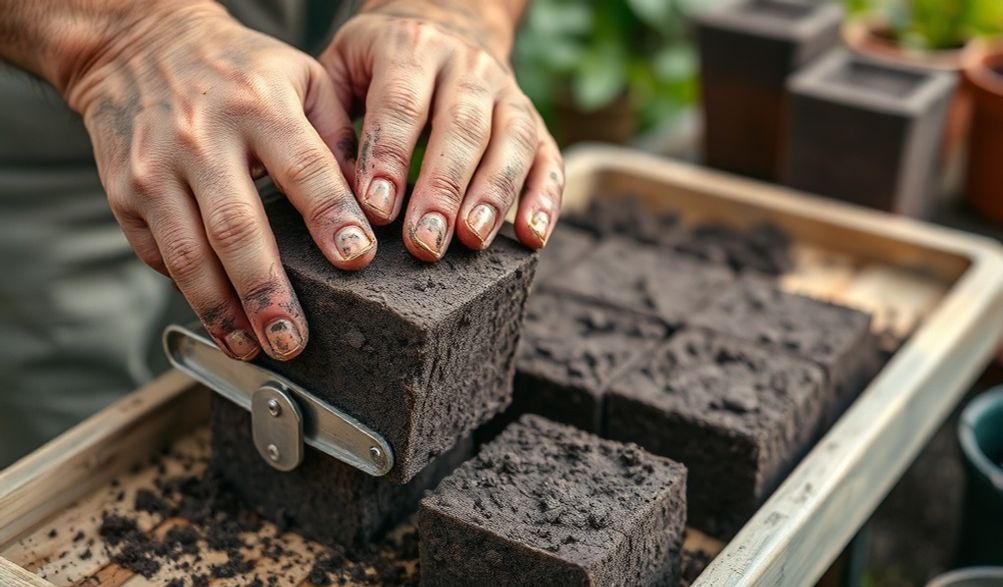
Mai yin tubalin ƙasa na'ura ce da ake riƙe da hannu ko kuma a dora a tsaye, wadda ke matsa gaurayen ƙasa mai ruwa da ruwa don yin tubalan da za su tsaya kanta. Waɗannan tubalan suna riƙe sifarsu ba tare da buƙatar kowane tukunyar roba, tire, ko kwaya da ke kewaye da su ba. Kawai sai ka matsa kayan aikin cikin gaurayen ƙasar, ka fitar da tubalin a saman wani fili mai faɗi, sannan ka sanya iri a cikin ramin da aka riga aka yi (wanda ake kira dibble). Tubalin da kansa ya zama akwati, yana haifar da ingantaccen yanayi don tsiron iri da farkon girma. Wannan tsari ya sake tunani game da yadda ake noman tsiron, yana sanya tsarin ƙasa da lafiyar tushen a gaba.
Tarihi a Takaice: Daga Lambunan Kasuwa na Turai zuwa Gidajen Zaman Kansu na Zamani
Ko da yake suna kama da sabon salo, masu toshe ƙasa suna da tushe mai zurfi a cikin aikin noma mai fa'ida, mai girma. An fara haɓaka su a cikin lambunan kasuwa na Turai—musamman a Faransa da Netherlands—inda inganci, lafiyar shuka, da sarrafa farashi suke da muhimmanci don cin gashin kasuwanci. Manoma suna buƙatar tsarin da zai samar da mafi kyawun dasawa da sauri kuma tare da ƙaramin farashin shiga.
Tun daga wannan lokacin, falsafar da kayan aikin sun tsallaka Tekun Atlantika kuma sun sami goyon baya mai kishi daga manoman kwayoyin halitta na Arewacin Amurka, masu lambun kasuwa, da masu ra'ayin mazan jiya na muhalli. A yau, suna wakiltar sauyi zuwa ga noma mara sharar gida mai inganci wanda ke amfanar mai sha'awar bayan gida da kuma ƙwararrun mai samarwa.
Faidodi Mafi Muhimmanci na Amfani da Na'urar Yin Tubalin Ƙasa
Me ya sa za ku sha wahalar yin nasu tubalan ku, alhali ana samun kayan shara na filastik a ko'ina? Fa'idodin suna da zurfi kuma suna shafar ilimin halittar shuka, tattalin arziki, da ka'idojin muhalli.
Tsire-Tsire Masu Ƙarfi da Lafiya: Fa'idar Datsa Ta Hanyar Iska
Wannan shi ne fa'ida mafi mahimmanci ta guda ɗaya. A cikin tukunyar filastik, saiƙaƙen suna girma har sai sun bugi bangon, sannan su fara zagaya kusa da akwatin. Wannan yana haifar da shuka mai ƙunƙuntaccen saiwa wanda ke fama da kafuwa bayan dasa shi.
- Air-Pruning: In a soil block, the roots grow to the exposed edges of the cube. Upon contact with the air, the root tip naturally dehydrates and stops growing (this is “air-pruning”). This signals the plant to send out more lateral roots behind that tip. The result is a dense, fibrous, and explosive root system within the block, with no circling whatsoever.
- Reduced Transplant Shock: When it’s time to plant out, you place the entire block into the ground. The roots immediately explode into the surrounding soil without any adjustment period. Plants experience little to no transplant shock, leading to faster growth and earlier harvests.
Sustainability and Cost-Effectiveness
The financial and environmental savings are substantial and compound over time.
- Drastically Reduce Plastic Waste: Imagine never buying another plastic seedling tray, cell pack, or pot. For a commercial grower starting tens of thousands of plants, this is a massive reduction in annual waste. For the home gardener, it aligns gardening with a sustainable lifestyle.
- Tanadin Ajiya Na Dogon Lokaci: While there’s an upfront cost for a quality blocker, it’s a one-time purchase. You eliminate the recurring expense of disposable containers. The soil mix ingredients (peat, coir, compost) are often more economical in bulk than buying bagged potting soil year after year.
Efficiency and Space Optimization
Soil blocks streamline your workflow and maximize valuable growing space.
- Tight Packing: Blocks can be placed shoulder-to-shoulder on a standard tray or even a wooden board. There are no wasted gaps between round pots, allowing you to fit significantly more seedlings under a single grow light or in a germination chamber.
- Workflow Speed: With practice, making blocks becomes a rapid, rhythmic process. For large-scale seeding, multi-block machines allow a single person to produce hundreds of uniform blocks per hour.
Types of Soil Block Makers: Choosing Your Tool
Not all soil blockers are created equal. Your choice depends on your scale, budget, and physical preference.
Hand-Held Blockers: For the Home Gardener
These are the most common entry point. They are simple, affordable, and effective.
- Misalai:TheJohnny’s Selected 4″ Soil Blocker or the 2″ model are industry standards.
- Abubuwan da suka fi kyau:
- Low cost and easy to store.
- Perfect for starting a few hundred plants per season.
- Simple mechanics with no moving parts to break.
- Rashin Kyau:
- Requires more physical effort (pressing into the mix).
- Slower for producing very large quantities.
Stand-Mounted and Multi-Block Machines: For Market Gardeners & Farmers
When volume is key, these ergonomic, lever-operated tools are worth the investment.
- Misalai:TheEarthWay Commercial Stand-Up Blocker or the Pro-Soil Blocker.
- Abubuwan da suka fi kyau:
- Can make 4, 5, or even 12 blocks with a single press of a lever.
- Much easier on the wrists and back for high-volume work.
- Produce incredibly consistent blocks.
- Rashin Kyau:
- Significant upfront cost.
- Requires more storage space.
- Can be overkill for a small backyard garden.
Block Size and Shape: ¾”, 2″, 4″, and Mini Blocks
Size matters. Different blockers produce different cube dimensions for specific uses.
- ¾” or “Mini” Blocks: Ideal for quick-germinating, small plants like lettuce, brassicas (kale, cabbage), and herbs. They are transplanted very young.
- 2″ Blocks: The workhorse size. Perfect for most common vegetables: tomatoes, peppers, eggplants, cucumbers, and flowers. They provide enough root space for 3-5 weeks of growth.
- 4″ Blocks: Used for long-season crops that need a longer head start, like large tomatoes, peppers, or perennial flowers. The larger soil volume supports the plant longer if weather delays transplanting.
- The Dibble: Most blockers have a central pin that creates a small indentation for the seed. For larger seeds like beans or squash, you can simply press the seed into the flat top of the block.
The Essential Soil Mix Recipe for Perfect Blocks
This is where many beginners stumble, but it’s the foundation of success. Standard bagged potting mix will not work. It lacks the specific structure needed to hold a block together.
Why Standard Potting Mix Fails
Commercial potting mixes are often too light and fluffy, relying on peat and perlite for aeration. When compressed in a blocker, they either crumble immediately or, if over-watered, turn into a dense, soggy brick that suffocates roots. A block mix needs the “wet cement” consistency—it must cohere under pressure but still be full of air pockets.
A Proven, Reliable Soil Block Recipe
After years of testing in our trial garden, this bulk recipe provides consistent, excellent results. It’s based on the classic “Fort Vee” formula used by many professional growers.
Yield: Makes approximately 2.5 cubic feet (enough for many blocks).
Ingredients (by volume):
* 3 parts Sphagnum Peat Moss or Coconut Coir: The base. Coir is a more sustainable, pH-neutral alternative to peat.
* 2 parts High-Quality, Fine-Screened Compost: Provides fertility and microbial life. It MUST be well-finished and sieved to remove sticks and chunks.
* 1 part Perlite: For crucial aeration and drainage.
* 1/2 part Garden Lime (if using peat): Peat moss is acidic. Lime balances the pH. Omit if using coir.
* 1/2 cup Base Organic Fertilizer Blend: A mix like 1 part blood meal (for nitrogen), 1 part colloidal phosphate or bone meal (for phosphorus), and 1 part greensand or kelp meal (for potassium/micronutrients).
Mixing Instructions:
1. Dry Mix: In a large tub or on a clean tarp, thoroughly combine the peat/coir, compost, and perlite.
2. Add Amendments: Sprinkle the lime (if using) and base fertilizer evenly over the pile and mix again.
3. Add Water Slowly: This is the critical step. Add warm water gradually while mixing with your hands or a hoe. Stop and test frequently.
4. The Moisture Test: Grab a handful of mix and squeeze it firmly. It should hold together in a tight ball, with a glistening appearance, and only a drop or two of water should be extractable. It should not crumble (too dry) and should not drip freely (too wet). Achieving this “wet cement” stage takes practice.
Sourcing Quality Ingredients and Pre-Mixed Alternatives
- For Coir/Peat: Look for brands like PRO-MIXkoCanna for consistent quality.
- For Compost: A high-quality, bagged compost like Coast of MainekoMalibu Compost is reliable for beginners. Avoid cheap, woody composts.
- Pre-Mixed Alternative: If mixing your own feels daunting, several companies sell pre-bagged block mix. Fort Vee Mix (from Growers Supply) is the gold standard, but it’s often sold in large, commercial quantities.
Step-by-Step Guide: Using Your Machine Like a Pro
With your mix ready, it’s time to make blocks. Follow these steps for professional results.
Preparation: Mixing, Moistening, and Setup
- Final Mix Check: Ensure your mix passes the squeeze test. Let it sit for an hour after final watering; the moisture will equalize.
- Set Up Your Station: Have a large tub of your mix, your blocker, solid-bottom trays (no holes, or line a flat with newspaper), plant labels, and seeds all within reach. Work at a comfortable waist-high table.
The Forming Technique: Dipping, Compressing, and Ejecting
- Dip: Push the blocker straight down into the mix, ensuring all chambers are fully filled. Scrape the bottom against the edge of the tub to remove excess.
- Tattara: For hand-held models, press down firmly on a solid surface (like your work table) to compact the mix. You’ll feel resistance. For stand models, pull the lever with steady pressure.
- Fitarwa: Lift and move to your tray. Press the plunger to release the blocks. They should eject cleanly and stand proud.
Troubleshooting:
* Blocks are crumbly: Mix is too dry. Add water sparingly and re-mix.
* Blocks slump or don’t eject cleanly: Mix is too wet. Add more dry ingredients (peat/coir, compost, perlite) to absorb excess moisture.
Seeding, Watering, and Germination Care
- Seeding: Place 1-2 seeds in the dibble hole. For fine seeds, no covering is needed. For larger seeds, pinch a tiny amount of mix over the hole.
- Initial Watering: Use a fine mist sprayer to gently moisten the top of the blocks. Avoid a heavy stream that will erode them.
- Bottom Watering (Going Forward): After the initial watering, always water by pouring water into the tray, allowing the blocks to wick it up from below. This encourages deep roots and preserves block integrity.
- Germination: Cover trays with a humidity dome until seeds sprout. Remove the dome immediately after germination to prevent damping-off disease. Provide strong light as soon as the first seed leaves (cotyledons) appear.
Tambayoyin da ake yawan yi (FAQ)
Q: Are soil block makers worth it for a small home garden?
A: It depends on your priorities. If you value superior plant health, want to eliminate plastic waste, and hate transplant shock, then yes—even a small 2″ hand model is a fantastic, long-term investment. If you only start a dozen tomato plants each year, the convenience of a few plastic pots might outweigh the benefits for you.
Q: My blocks are falling apart. What am I doing wrong?
A: 99% of the time, this is a moisture issue. Your mix is too dry. It must hold together when squeezed firmly. Go back to the moisture test. The other culprit can be chunky, unfinished compost. Ensure your compost is fine and soil-like.
Q: Can I use my own garden compost in the mix?
A: You can, but with major caveats. It must be fully finished, cooled, screened through a ¼” mesh, and ideally pasteurized (by solarization or baking) to kill weed seeds and pathogens. For reliability in your first season, we strongly recommend using a high-quality, bagged compost.
Q: How do I transplant blocks into the garden?
A: It’s the easiest part! Simply dig a hole slightly larger than the block and place the entire block inside. Bury it so the top of the block is just below the soil surface. Water it in. There is no root disturbance—you are literally giving the plant’s root system a head start in its new home.
Q: Where can I buy a reliable soil block maker?
A: Purchase from reputable gardening and agricultural suppliers known for quality tools. We recommend Johnny’s Selected Seeds, Fedco Seeds, Growers SolutionkoPeaceful Valley Farm Supply. Be cautious of unknown, cheap brands on generic online marketplaces; they often have poor casting quality and wear out quickly.
Ƙarshe
Adopting a soil block making machine is more than just acquiring a new garden tool; it’s embracing a fundamentally better system for growing plants. It represents a shift towards intentional, sustainable horticulture that prioritizes root health, reduces waste, and saves money in the long run. The benefits—from the air-pruned, explosive root systems to the elimination of plastic trays—are not just theoretical; they are visibly apparent in the vigor of your transplants.
Start your journey by choosing a simple hand-held model and mixing a batch of the proven soil recipe. The learning curve is short, and the rewards are immediate. You’ll be investing not only in the success of your garden but also in a practice that respects the environment. In a world of quick fixes and disposable goods, the soil block maker stands as a testament to the power of simple, smart design for a more resilient garden.
<