
Ultima Ductor ad Machinam 4-30A Trunci: Notae, Commoda, et Operatio
Introductio
In mundo caementiciorum laterum fabricandorum, efficientia et firmitas fundamenta quaestus sunt. Professionalibus aedificationis, dominis arearum laterum, et negotiatoribus qui productionem suam augere cupiunt, recta machinaria eligere consilium criticum est quod effectum, qualitatem producti, et rationem ultimam afficit. Hoc plenum ductorium in equo laboris industriae intendit:Machina laterculi.
Ex annis peritiae technicae et experientiae in campo hausta, haec scripta perspicuam, auctoritatem praebentem, et fidelem analysim praebet. 4-30A non solum instrumentum est; est solutio semiautomatica quae inter manuosas machinas labori intensivas et plantas plene automaticas capitali intensivas pontem facit. Eius specificationes, processum operandi, et valorem oeconomicum dissecabimus, ut te ad consilium collocandi pecunias plene informatum pro negotio tuo faciendum muniamus.
Quid est Machina Caudex 4-30A? Praecipuae Notae et Consilium
IV-XXXA est certum exemplar intra late agnitam seriem machinarum ad lateres faciendos. Eius structura solidam constructionem, constantem productionem, et simplicitatem operandi praefert, unde gratissima est officinis parvis ad mediocres ad producendum.
Machina Typus et Classificatio
IV-XXXA inter quattuor et triginta annos numeratur.Machina ad lateres faciendos semiautomatica, stabilisHoc significat processum formandi nucleum automatizare—vibrationem, compactionem, et formationem—sed operatoris opera in singulo cycli requirit, ut materiam crudam immittat et structuras perfectas removeat. Haec classificatio eam aptissime collocat pro negotiis quae parata sunt productionem augere ultra facultates manuales, sine complexitate et sumptu lineae plene automatizatae.
Numeri Exemplaris Explicati
Numeri exemplarium in machinis industrialibus raro fortuiti sunt. Cum specificationes inter fabricantes leviter variare possint, "4-30A" typice significat:
- IVNumerus laterum magnitudinis solitae (exempli gratia, laterum cavorum 4 unciarum) quos machina in uno cyclico efficit.
- XXXTempus circiter cycli in secundis sub condicionibus optimis.
- ASaepe designat seriem exemplaris vel versionem auctam, indicans emendationes supra exemplar fundamentale.
Hoc nomenclaturae institutum praebet statim, uno aspectu, intellegentiam machinae facultatis principalis: efficiendi quattuor structuras fere omnes triginta secundas.
Claves Physicae et Technicae Specificae
Numeri exacti a fabricatore pendent, machina autem typica 4-30A plerumque haec continet:
- Dimensiones:Circiter 2500 mm (L) x 1800 mm (W) x 2200 mm (H). Spatium satis pro instrumentis periphericis etiam requiritur.
- Pondus:Fere inter 2800 et 3500 kg, significans corpus robustum vibrationi resistens.
- Potestatis Postulata:Fere a machina electrica 11-15 kW (15-20 HP) pro systemate vibrationis et a machina separata pro copia hydraulica potentiae agitur.
- Systema Moderandi:Per tabulam Programmatilis Logicae Moderatoris (PLC) operatum ad cyclum automaticum regendum.
- Systema Hydraulicorum:Includit unitatem hydraulicam cum piscina olei, antliis, valvulis et cylindris, quae ad motum verticalem fundae et pressionem capitis tundendi pertinent.
Lineamenta et Partes Praecipuae Machinae 4-30A
Firmitas et qualitas emissionis machinae 4-30A ex eius partibus principalibus bene fabricatis oriuntur.
Ratio Formanda
Hoc est cor machinae, ubi caementum in laterem subtilem vertitur.
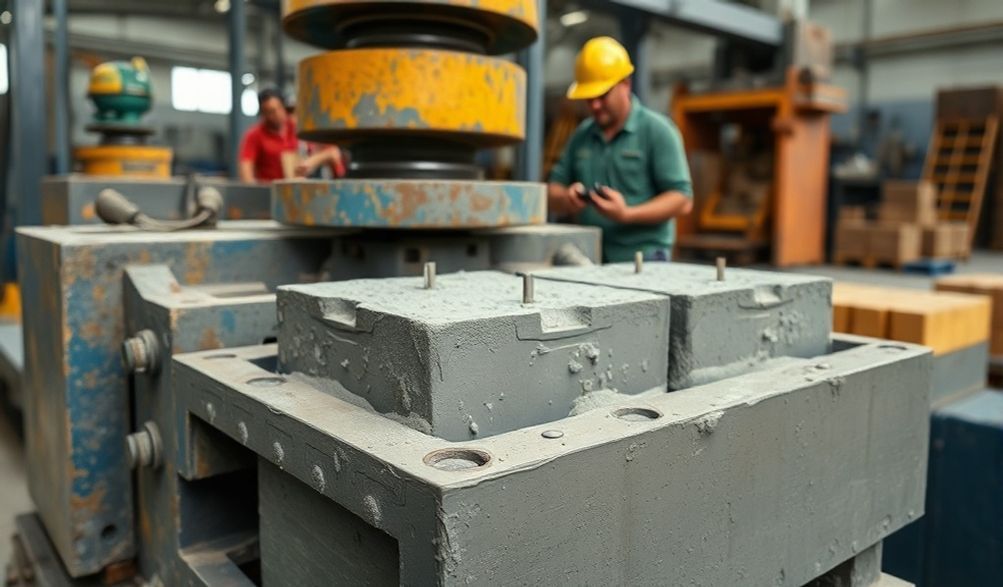
- Capsula FormatoriaConjunctio ferrea gravis oneris, subtiliter conflata, quae dimensiones externas stipitis definit. Ad facilem commutationem generum stipitum producendorum designata est.
- Nuclei VirgaeHae cavitates cavernosas in lateribus creant. In lamina nucleari fixae sunt et validae esse debent ut constantem vibrationem pressionemque sustineant.
- Caput Corruptum:Etiam caput preli vocatum, in capsulam fictilem descendit ut pressionem in concretum per vibrationem applicet, compactionem superficiei superioris et densitatem uniformem praestans.
Mechanismus vibrationis.
Compactionis superior non-negotiable est fortibus, durabilibus lateribus. 4-30A adhibetSystema geminum vibrationum.:
- Mensae Vibratio: The entire mold table vibrates at high frequency, ensuring compaction from the bottom up.
- Head Vibration: The tamper head also vibrates, compacting the concrete from the top down.
This synchronized action from both directions eliminates voids and achieves the high density required for load-bearing blocks and pavers.
Control System & Automation Level
The PLC-based control panel is the machine’s brain, offering:
- Automated Cycle Sequencing: The operator initiates a single cycle, and the PLC automatically controls the sequence: mold descent, material feed, vibration, head pressure, mold rise, and block ejection.
- Adjustable Parameters: Vibration time, pressure duration, and cycle delays can often be adjusted to fine-tune the process for different mix designs.
- Manual Override: Critical for setup, maintenance, and troubleshooting. Safety interlocks prevent operation during manual interventions.
- Fault Diagnostics: Basic models may have indicator lights, while advanced panels display error codes for quicker problem resolution.
Production Capacity and Output Expectations
Understanding real-world output is crucial for business planning. Theoretical maximums are often different from sustainable daily production.
Understanding Cycle Time and Daily Output
The “30” in 4-30A suggests a 30-second cycle time. In practice, a well-run machine with a skilled operator can achieve a cycle time of 35-45 seconds, accounting for material feeding and block removal.
Output Calculation:
* Per Horam: (3600 seconds / 40-second cycle) * 4 blocks = ~360 blocks/hour.
* Per Octo Horarum Vicem: 360 blocks/hour * 8 hours = ~2,880 blocks.
* Per 24-Hour Day (3 shifts): Up to ~8,640 blocks.
Important: This is a sustainable estimate. Output can be higher with perfect conditions or lower during mold changes, maintenance, or with slower material handling.
Compatible Block Types and Sizes
The 4-30A’s versatility is a key selling point. With the appropriate mold, it can produce:
* Lateres Cavi: 4″, 6″, 8″ thickness (most common).
* Massa Solida.
* Pavimenta Coniuncta (for landscaping and driveways).
* Crepido and other specialty products (may require specific mold kits).
Factors Influencing Production Rate
Maximizing output depends on more than just the machine:
* Raw Material Consistency: A well-proportioned, semi-dry concrete mix with consistent moisture content is essential. Wet or inconsistent mix causes sticking and delays.
* Pallet Quality & System: Worn or warped pallets cause block damage and machine jams. A manual or automated pallet return system drastically improves workflow.
* Operator Skill & Rhythm: An experienced, efficient operator is the most important factor in achieving target cycle times.
* Custodia Praeventiva: Unplanned downtime is the biggest killer of production targets. A disciplined maintenance schedule is non-negotiable.
Operational Workflow and Best Practices
Proper operation ensures safety, quality, and machine longevity.
Step-by-Step Operating Procedure
- Praeparatio: Ensure the machine is lubricated, the hydraulic oil level is correct, and the mold is clean and secured.
- Mix Loading: The operator places a pallet on the feeding table and shovels or uses a feeder to deposit the concrete mix into the mold box.
- Cyclus Initiatio The operator presses the cycle start button on the PLC panel.
- Automated Cycle: The machine sequentially lowers the mold, activates dual vibration, lowers the tamper head for pressure, releases vibration, raises the mold, and ejects the block onto the pallet.
- Blocki Remotio: The operator (or a helper) removes the pallet with the fresh block and transfers it to the curing area, replacing it with a new empty pallet.
- Iteratio: The process repeats for the next cycle.
Essential Safety Protocols
- Mandatory PPE: Safety glasses, steel-toe boots, and hearing protection.
- Securitas Machinae: Never bypass safety guards or interlocks. Keep hands clear of the mold area during automatic cycles.
- Lockout/Tagout: Always disconnect power and lock out the control panel before performing any maintenance or clearing a jam.
Routine Maintenance Checklist
Daily:
* Clean the mold box, core rods, and tamper head thoroughly after production.
* Check hydraulic oil levels and for any leaks.
* Inspect electrical connections.
* Lubricate all guide rods and moving parts as per the manual.
Weekly:
* Check and tighten all bolts and nuts, especially on the vibration frame.
* Inspect hydraulic hoses for wear.
* Check the tension of drive belts (if applicable).
Monthly:
* Change hydraulic oil and filters as recommended.
* Inspect vibration motors and mounting bolts.
* Conduct a thorough inspection of the mold box for wear or damage.
Advantages and Considerations for Your Business
A balanced view helps assess if the 4-30A is the right fit.
Primary Benefits
- Efficacia Impendiorum: Offers a significantly higher output than manual machines at a fraction of the cost of a fully automatic plant.
- Laboris Dependentia Minuta: One skilled operator can run the machine, reducing labor costs per block compared to manual operations.
- Exceptional Durability: Built with heavy-duty steel and industrial components for a long service life in harsh environments.
- Constantia Qualitatis Producti: The automated vibration and pressing cycle produces blocks with uniform density, dimensions, and strength, enhancing your market reputation.
Investment and ROI Analysis
- Sumptus Initialis: The price for a new 4-30A machine typically ranges from $18,000 to $30,000, depending on the manufacturer, configuration, and region. This does not include the cost of a mixer, loader, or pallet system.
- Tempus Reditus: For a business selling directly to the construction market, the payback period can often be achieved within 12-24 months based on local block prices and production volume.
- Vs. Fully Automatic: Fully automatic machines (like the 6-15 or 8-15 models) offer higher output with less labor but can cost 3-5 times more and require a more complex setup and higher skill level to maintain.
Potential Limitations & Solutions
- Need for Supporting Equipment: For optimal workflow, a concrete mixeretbucket loader or material feeder are highly recommended. A pallet return system (even a simple roller conveyor) dramatically increases efficiency.
- Space Requirements: You need a covered production shed with a strong, level concrete floor, plus space for raw materials, block curing, and storage.
- Exercitatio Operatoris: Requires a dedicated, trainable operator. The machine’s efficiency is directly tied to the operator’s skill.
FAQ: Common Questions About the 4-30A Block Machine
Q1: What is the approximate price range for a new 4-30A block machine?
As noted, expect a range of $18,000 – $30,000 for the machine itself. Always request detailed quotations that include shipping, installation support, and initial spare parts.
Q2: Can one operator efficiently run this machine?
Yes, one skilled operator is sufficient to run the 4-30A cycle. However, a second person to handle pallet feeding and block removal can significantly boost overall production output by allowing the primary operator to focus solely on the machine cycle.
Q3: What concrete mix design is recommended for optimal results?
A semi-dry mix is crucial. A common starting ratio is 1 part cement, 3 parts sand, and 5 parts aggregate (1:3:5), with just enough water for cohesion (typically a water-cement ratio of 0.4-0.5). The mix should hold its shape when squeezed in your hand.
Q4: How does the 4-30A compare to a fully automatic block making machine?
The 4-30A is semi-automatic, requiring operator intervention per cycle. Fully automatic machines integrate material feeding, block ejection, and pallet handling into one continuous, computer-controlled process. They offer higher output (e.g., 6-10 blocks every 15 seconds) with minimal labor but at a much higher capital and operational complexity.
Q5: What are the most common spare parts I should keep in stock?
Always keep: vibration motor mounting bolts, hydraulic hose assemblies, O-rings and seals for the hydraulic cylinders, spare springs for the mold, and a set of replacement core rods. Your supplier can provide a recommended list.
Q6: What foundation and floor space are required for installation?
The machine must be bolted to a solid, level concrete foundation at least 300mm thick. The total floor space needed for comfortable operation, including material staging and block removal, is typically at least 10 meters in length and 6 meters in width.
Conclusion and Final Recommendations
TheMachina laterculi stands as a testament to practical, efficient engineering. It is not the cheapest nor the most advanced option, but for a business aiming to graduate from manual production to a more scalable, quality-focused operation, it represents an outstanding balance of output, investment, and control.
Success with this machine hinges on three pillars: proper installation on a solid foundation, investment in operator trainingetreligious adherence to preventive maintenance. Before finalizing any purchase, we strongly advise you to consult with multiple reputable manufacturers or suppliers. Request detailed specifications, visit a working installation if possible, and clearly understand the after-sales support, warranty terms, and availability of spare parts in your region. With due diligence, the 4-30A can become the reliable, profit-generating cornerstone of your block manufacturing business for years to come.
<