
Полное руководство по ручным станкам для производства блоков с замковым соединением: стоимость, процесс и преимущества
Введение
Для строителей, лидеров сообществ и домовладельцев по всему миру мечта о доступном и долговечном строительстве часто сталкивается с суровой реальностью: стремительный рост стоимости и экологический ущерб от традиционных материалов. Обожжённые глиняные кирпичи требуют значительных энергозатрат, способствуют обезлесению, и даже их транспортировка может взвинтить бюджеты проектов до недосягаемых высот. Эта проблема особенно остро стоит в отдалённых районах и для тех, чей капитал ограничен.
Но что, если решение заключалось не просто в другом продукте, а в другом процессе — таком, который вы могли бы контролировать? Основываясь на десятилетиях инженерных усовершенствований и практического применения в области устойчивого строительства, ручная машина для производства блоков с замковым соединением представляет собой именно это. Это не умозрительная технология; это проверенный ручной пресс, который превращает местный грунт в прочные строительные блоки с замковым соединением.
Это руководство является вашим всеобъемлющим ресурсом. Независимо от того, являетесь ли вы строителем, изучающим методы экономии средств, предпринимателем, рассматривающим возможность малого бизнеса, НКО, планирующей общественный проект, или увлеченным энтузиастом DIY, мы раскроем секреты этого мощного инструмента. Мы подробно расскажем, как именно он работает, о его конкретных преимуществах, детальном пошаговом процессе производства и ключевых факторах, которые следует учесть перед инвестированием. Наша цель — предоставить достоверную и глубокую информацию, необходимую для принятия взвешенного решения, соответствующего вашему конкретному проекту и условиям.
Что такое ручная машина для производства блоков с блокировкой?
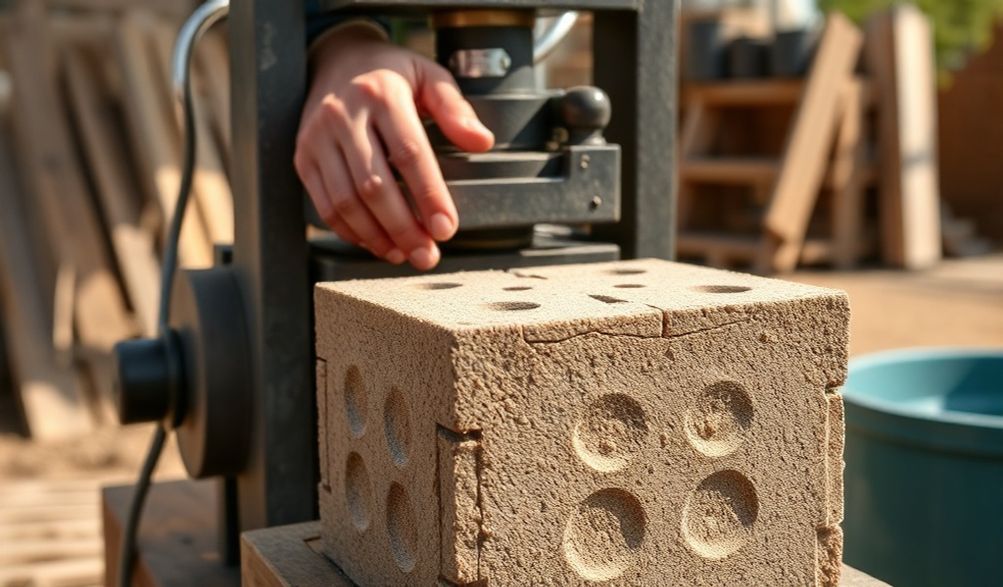
В своей основе ручная машина для производства блоков с замковым соединением — это устройство с ручным приводом, предназначенное для прессования смеси влажного грунта, песка и небольшого процента цемента в высокоплотные блоки с геометрическим замковым соединением. Она исключает необходимость обжига в печи, предлагая кардинально упрощённый путь от сырой земли до готовой строительной единицы.
Основная функция и дизайн
Машина представляет собой изящное исследование механического преимущества. Хотя конструкции различаются, основные компоненты остаются неизменными.
- Система рычагов.Длинный стальной рычаг обеспечивает необходимое усилие. Вес и сила оператора усиливаются с помощью этого простого механизма для достижения высокой степени сжатия.
- Форма/Штамп:Это полость, которая придает блоку его форму. Обычно она изготавливается из закаленной стали, чтобы выдерживать постоянное давление и истирание.
- Камера компрессии:Где загружается смесь сырья. Поршень или прессующая головка, приводимые в действие рычагом, уплотняют смесь вертикально с огромной силой.
- Взаимосвязанный дизайн ключа:Интегрированная в форму, она создает характерные выступы и пазы или шипы и полости на верхней, нижней и боковых сторонах блоков.
Процесс цикличен: заполнение, сжатие, выталкивание. На практике опытный оператор может изготовить блок менее чем за минуту.
Наука о взаимосвязанных блоках
Гениальность этой системы заключается не только в сжатии, но и в соединении. Взаимосвязанная конструкция создает механическую связь между блоками.
- Устранение миномётов:Точная, взаимосвязанная подгонка устраняет необходимость в вертикальных швах раствора. Обычно используется только тонкий горизонтальный слой раствора для обеспечения ровного ряда.
- Врождённые преимущества:Это приводит к более быстрой скорости строительства (поскольку не нужно ждать схватывания раствора), снижению зависимости от высококвалифицированных каменщиков и значительной экономии материалов.
- Структурная целостность:Взаимоблокирующий узор создает стену, которая действует как единая, гибкая матрица. Полевые наблюдения в сейсмических зонах показали, что хорошо построенные стены из взаимоблокирующихся блоков могут обладать лучшей устойчивостью к трещинам по сравнению с обычной каменной кладкой, так как взаимоблокировка допускает небольшие перемещения без катастрофического разрушения.
Основные преимущества использования ручного блочного пресса
Выбор ручного пресса — это стратегическое решение, приносящее многосторонние выгоды: от экономики и экологии до расширения прав и возможностей.
Исключительная экономическая эффективность
Финансовый аргумент убедителен, особенно для проектов малого и среднего масштаба.
- Низкие капиталовложения:По сравнению с механизированными или гидравлическими блочными установками, стоимость которых составляет десятки тысяч, качественный ручной пресс требует минимальных первоначальных вложений.
- Радикальное снижение стоимости материалов:Основной ингредиент — грунт — часто доступен на месте или локально практически бесплатно. Расход цемента минимален (обычно 5-10% по объёму).
- Текущая экономия:Исключение вертикального шва позволяет сэкономить около 30-50% затрат на раствор и связанные с ним трудовые ресурсы.
устойчивость и экологичное строительство
这项技术与绿色建筑原则完美契合。
- Использование местных материалов:利用70-90%的原位材料可大幅减少运输重型建筑材料相关的碳排放和成本。
- Низкая воплощенная энергия:При отсутствии процесса обжига потребление энергии практически сводится к затратам человеческого труда и небольшой доли цемента. Это резко контрастирует с обожжённым кирпичом, который является крупным потребителем угля или дров.
- Non-Toxic & Recyclable: The blocks are made from natural earth and stabilize with cement. At end-of-life, they can be crushed and returned to the earth or re-used as aggregate.
Empowerment and Operational Simplicity
Perhaps the most profound advantage is the shift in control it offers.
- Производство по требованию: You are no longer at the mercy of supplier schedules or market price fluctuations. Blocks can be produced as needed, on-site.
- Low Technical Barrier: Operation can be learned in a matter of hours. Training focuses more on material preparation than complex machinery operation.
- Ideal for Diverse Contexts: This makes it a tool of choice for self-help housing projects, remote community development, disaster reconstruction (as promoted by organizations like UN-Habitat), and small-scale entrepreneurial ventures.
The Step-by-Step Block Production Process
Success with a manual press hinges on process, not just the machine. Here is the proven workflow, drawn from field-tested best practices.
Stage 1: Material Selection and Preparation
This is the most critical phase. Poor materials guarantee poor blocks.
- Анализ почвы: Not all soil is suitable. You need a balanced mix of clay (as a binder), silt, and sand (for stability). Simple field tests are essential:
- Jar Test: Fill a clear jar with 1/3 soil and 2/3 water, shake vigorously, and let it settle over 24 hours. The layers will reveal the approximate proportions of sand, silt, and clay.
- Ribbon Test: Moisten a handful of soil and try to roll it into a thin ribbon. If it forms a long, flexible ribbon, it’s too clay-rich. If it crumbles immediately, it’s too sandy. A moderate ribbon that breaks is often a good sign.
- Проектирование состава смеси. A common starting formula is approximately 70% soil, 25% sand, and 5% cement by volume. The sand corrects clay-heavy soil. Moisture content is crucial: The mix must be damp enough to bind, but not wet. The “hand-squeeze test” is key—a squeezed handful should form a ball that holds its shape without crumbling or dripping water.
Stage 2: Compression and Molding
With your properly prepared mix, you move to the machine.
- Load: Fill the compression chamber evenly with the mix. Do not overfill or underfill; consistency is key for uniform block density.
- Сжать: Pull down the lever arm firmly and steadily. You will feel significant resistance as the mix compacts. Apply full pressure. Some machines require a second “locking” press.
- Выбросить: Release the lever, open any latches, and pull the lever again to raise the piston and eject the fresh “green” block onto a pallet or board.
Stage 3: Curing and Quality Control
Fresh blocks are fragile and must be handled with care.
- Курение: Stack the green blocks in a shaded area and cover them with a plastic sheet. This traps moisture and allows the cement to hydrate slowly, gaining strength. Light watering for the first 7-10 days is beneficial. Avoid rapid drying in direct sun, which causes cracking.
- Контроль качества: Perform simple tests:
- Drop Test: After 7 days, lift a block to waist height and drop it onto a firm, flat surface. A good quality block should not break or chip severely.
- Visual Inspection: Check for large cracks, crumbling edges, or uneven shapes, which indicate incorrect mix or compression.
Critical Factors Before You Buy or Use One
A balanced, authoritative guide must address practical realities. Informed preparation prevents costly mistakes.
Оценка ваших проектных требований
Ask yourself these questions first:
- What is my daily block requirement? (A manual press typically produces 80-150 blocks per 8-hour day with a crew).
- What soil types are available on or near my site? (Plan for testing and potential sand purchase).
- Is this for a single home, a community building, or a commercial block-making business? Scale dictates feasibility.
Machine Specifications and Features to Compare
Not all machines are created equal. Scrutinize these aspects:
- Block Size & Design: Common sizes are similar to standard bricks or larger (e.g., 225mm x 110mm x 75mm). Ensure the interlocking pattern is robust.
- Производственные мощности: Linked to design efficiency. Test the lever mechanics—the action should be smooth and solid.
- Качество сборки: Inspect weld points, steel thickness (especially the mold and lever), and overall finish. A heavier machine often indicates more durable steel.
- Support System: Does the supplier offer spare parts (like wear plates for the mold)? Is there technical support available?
Understanding Limitations and Challenges
Acknowledging these builds trust and sets realistic expectations:
- Labor Intensive: High-volume projects (e.g., a large school) require a significant, organized labor force.
- Soil Dependency: If your local soil is purely organic topsoil or gravel, you may need to import suitable material, affecting cost.
- Скорость производства: It cannot match the output of a fully automated electric or hydraulic machine. It is a tool for appropriate-scale projects.
Applications and Project Ideas
The versatility of interlocking blocks opens numerous doors:
- Affordable Housing and Community Projects: This is the primary application. From individual homes to clinics, schools, and community centers, the technology is championed by development organizations globally for its cost-control and community participation potential.
- Landscape and Garden Construction: A perfect pilot project. Build retaining walls, raised garden beds, compost bins, or decorative pathways. It’s a low-risk way to master the process.
- Entrepreneurial Opportunity: Starting a Small Block Yard Business: With one or two machines, you can establish a micro-enterprise, producing and selling blocks to local builders. Focus on consistent quality and educate your market on the benefits.
Раздел часто задаваемых вопросов
Q: How strong are interlocking soil blocks compared to fired bricks?
А: Compressive strength typically ranges from 3 to 7 Megapascals (MPa), which is suitable for load-bearing walls in 1-2 story buildings, as per many building codes. While high-quality fired bricks can be stronger, properly made interlocking blocks provide more than adequate strength for most low-rise residential construction. The key is proper material selection and production.
Q: Can I use pure soil from my backyard?
А: Almost certainly not. Backyard topsoil contains organic matter, which decomposes and compromises block strength. You need mineral subsoil, typically found below the top 300mm. A simple jar test will tell you if it needs sand or clay amendment.
Q: Is a foundation different for interlocking blocks?
А: Yes, and getting it right is non-negotiable. The interlocking system begins above a stable, perfectly level base. A standard concrete strip foundation or a mortared rubble trench foundation is used. The first course of blocks is then laid in a full bed of mortar on this “plinth” to create a level starting point for the dry-stack interlocking system.
Q: What is the typical cost range for a good quality manual machine?
А: Prices vary widely by region, quality, and features. As a general guide, expect a range from approximately $500 to $2,000 USD. Be wary of machines at the very bottom end; they may use inferior steel and wear out quickly. Invest in robust construction from a reputable supplier.
Q: Where can I get training on using the machine?
А: Start with your machine supplier; many offer basic training. Look for NGOs or social enterprises working in sustainable construction (e.g., organizations inspired by the Good Earth Trust or Habitat for Humanity’s techniques). Reputable online video tutorials can also provide excellent visual guidance on the process.
Заключение
The manual interlocking block making machine is far more than a simple tool; it’s an enabler of affordable, sustainable, and community-empowered construction. It shifts the focus from buying expensive materials to understanding and utilizing local resources intelligently.
Our final expert insight is this: the machine’s success is only 50% dependent on its steel and leverage. The other 50% resides in the operator’s knowledge of material science and disciplined process. The true “technology” is the holistic system of soil, water, cement, compression, and care.
Your clear next step is to move from theory to practice. Begin with a simple jar test on your site’s soil. Reach out to local suppliers to inspect machines firsthand. Connect with others who have used this technology. Consider starting with a small, non-critical project like a garden wall. This hands-on experience is invaluable. Remember, prioritize learning and preparation—your first 100 blocks are a learning process that will pave the way to successful, durable construction.
<