
Hagee Buugga oo Dhamaystiran ee Mashiinnada Sameynta Buugaagta Isku-xirka Gacanta: Qiimaha, Habka & Faaiidooyinka
Hordhac
Dhismayaal, hogamiin bulsho, iyo guryaha qaadayaasha aduunka oo dhan, riyada dhismaha jaban, oo adag, ayaa badanaa la kulma xaqiiqo daran: qiimaha korodhsan iyo kharashka deegaanka ee qalabka caadiga ah. Lebi qalalan ayaa u baahan tamar badan, waxay ka qayb qaataan burburka kaymaha, gaadiidkooda kalena wuu kordhin karaa miisaaniyada mashruuca si aan la gaari karin. Caqabadkani waa mid aad u daran gaar ahaan goobaha fog iyo kuwa leyn hantiyo yar.
Maxaa haddii xalku ahaan lahaa aanay ahayn badeeco keliya oo kale, balse ahaado hab kale—mid aad maamuli karto? Ku salaysan cilliyooyin ka badan oo la hagaajiyay injineernimada iyo codsiyada goobta ee dhismaha aan-dhimaynta lahayn, makiinadii uu gacanta ku shaqeeyo ee sameysa boolooyin isku xirxira oo gacanta lagu shaqeeyo ayaa si sax ah u matalaysa taas. Tani ma ahan teknoolojiyada la maleeyo; waa makiinad la isticmaalo gacanta oo caddayn weheliya, oo ay ka dhigto carrada la heli karo goobta boolooyin adag oo isku xira.
Halkan waa hagahaaga oo dhamaystiran. Haddii aad tahay dhismaha oo baaritaanaya habab dhimista kharashka, ganacsade oo daawanaya fursad ganacsi yar, urur aan dowli ahayn oo qorsheynaya mashruuc bulsho, ama xiisad u leh sameynta DIY, waxaan si cad ugu soo bandhigi doonnaa qalabkan awood leh. Waxaan ka hadli doonaa sida uu u shaqeeyo, faa'iidooyinkiisa la taaban karo, hab nidaam ah oo talaabo-talaabo ah oo soo saarista, iyo arrimaha muhiimka ah ee loo baahan yahay in la tixgeliyo ka hor lacag bixinta. Ujeeddadeena waa inaan siinno macluumaad lagu kalsoonaan karo oo qoto dheer, kuwaas oo aad u baahan tahay si aad u gaarto go'aansasho xogta oo ku habboon mashruucagaaga gaar ah iyo xaaladdaada.
Waa maxay Makiinada Sameynta Buugyada Isku-xirka Gacanta?
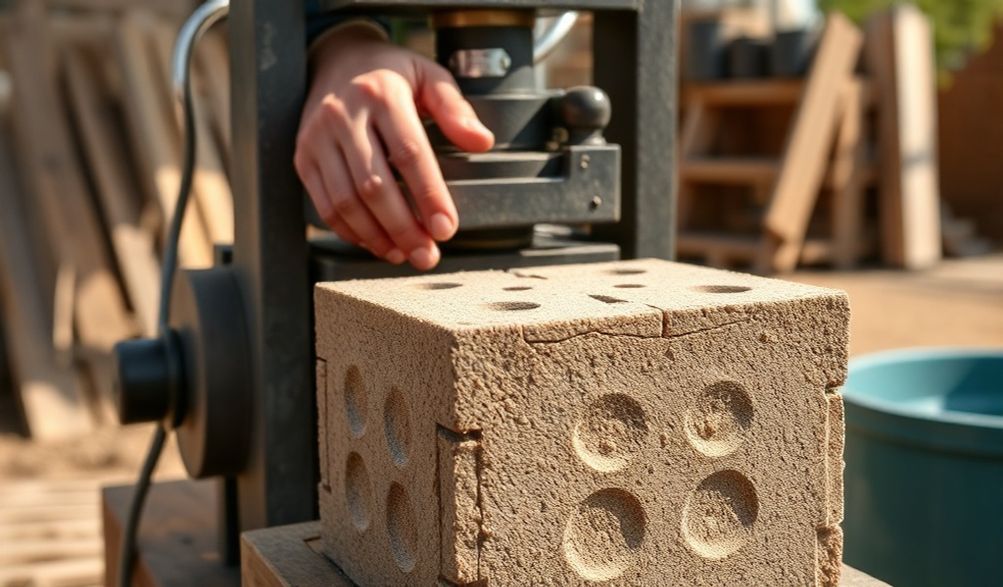
Xuddunta ahaan, makiinada gacanta ee sameysa bulooko isku xirxira waa qalab loo tacaalay dadka, loogu talagalay in lagu cufo isku dheyska dhoobada qoyan, ciidda, iyo qiyaas yar oo simento ah si loo sameeyo bulooko cufan sare leh oo qaab isku xirxiran. Waa in lagaga tagi baahida dabka kulul, iyadoo ay bixiso jid fudud oo ka dhoobo dhulka ilaa unug dhisme la dhammeeyay.
Farshaxanka iyo Hawlaha Aasaasiga ah
Makiinadu waa daraasaad qurux badan oo ku saabsan faa'iidada makaanikada. In kasta oo naqshadeyntu kala duwan tahay, qaybaha aasaasiga ah waa isku mid.
- Nidaamka FartaGacanta birta dheer oo dheer ayaa bixisa xoogga loo baahan yahay. Culeyska iyo xoogga hawl-wadeenku waxaa lagu kordhiyaa mashiinkan fudud si loo gaaro cadaadis sare.
- Qalabka Qaabista/Die:Tani waa goobada uu uuqa u sameeyo qaabkiisa. Guud ahaan waxaa laga sameeyaa birta adkaatay si ay u qabsato cadaadiska joogtada ah iyo kala jajabka.
- Qolka Cayriinta:Halkaas oo ay ku dhex jiraan isku-dhafka alaabta dabiiciga ah. Piston ama madax riixid, oo u dhaqaaqda gacan, ayaa si qoto dheer u cufiya isku-dhafka xoog weyn.
- Qaabka Furaha Isku-XidhkaQaab dhismeedka lagu daray, tani waxay abuurtaa carrabka iyo jeexjeexyada ama dhibcaha iyo godadka calaamadda u ah blocks-ka dushooda, hoostooda, iyo dhinacyada.
Habka waa wareeg: buuxi, cadaadi, soo saar. Ficil ahaan, qof shaqeeya oo khibrad leh wuxuu soo saari karaa baloog muddo daqiiqad ka yar gudahood ah.
Sayniska Baloogyada Isdhawaya
Fahamka nidaamkani ma aha oo kaliya isku-buuqa, laakiin waa isku-xirnaanta. Naqshadda isku-dhafan waxay abuurtaa xidhiidh makaanik ah oo u dhexeeya baloogyada.
- Baaritaanka RasaastaMuuqaalka saxda ah ee isku xidhani wuxuu baabi'iyaa baahida loo qabo xirmooyinka jiinka tooska ah. Kaliya sariir khafiif ah oo taallo ah ayaa inta badan la isticmaalaa si loo hubiyo koorsada siman.
- Faa'iidooyinka Dabiiciga ah This leads to faster construction speeds (as there’s no mortar to wait for), reduced dependency on highly skilled masons, and significant material savings.
- Qaabka Dhismaha: The interlocking pattern creates a wall that acts more as a unified, flexible matrix. Field observations in seismic zones have shown that well-built interlocking block walls can exhibit better crack resistance than conventional masonry, as the interlocking allows for slight movement without catastrophic failure.
Key Advantages of Using a Manual Block Press
Choosing a manual press is a strategic decision with multifaceted benefits, from economics to ecology and empowerment.
Exceptional Cost-Effectiveness
The financial case is compelling, especially for small to medium-scale projects.
- Low Capital Investment: Compared to motorized or hydraulic block plants costing tens of thousands, a high-quality manual press represents a minimal upfront cost.
- Radical Material Cost Reduction: The primary ingredient—soil—is often available on-site or locally for little to no cost. Cement usage is minimal (typically 5-10% by volume).
- Ongoing Savings: Eliminating vertical mortar saves approximately 30-50% of mortar costs and related labor.
Sustainability and Eco-Friendly Construction
This technology aligns perfectly with green building principles.
- Localized Material Use: Utilizing 70-90% in-situ materials drastically cuts the carbon emissions and cost associated with transporting heavy building materials.
- Laakiinta Tamarta Jidhka ah ee Hoosaysa: With no firing process, the energy input is virtually limited to human labor and the small cement fraction. This contrasts sharply with fired bricks, which are major consumers of coal or firewood.
- Non-Toxic & Recyclable: The blocks are made from natural earth and stabilize with cement. At end-of-life, they can be crushed and returned to the earth or re-used as aggregate.
Empowerment and Operational Simplicity
Perhaps the most profound advantage is the shift in control it offers.
- Soo-saariska la Dalbado: You are no longer at the mercy of supplier schedules or market price fluctuations. Blocks can be produced as needed, on-site.
- Low Technical Barrier: Operation can be learned in a matter of hours. Training focuses more on material preparation than complex machinery operation.
- Ideal for Diverse Contexts: This makes it a tool of choice for self-help housing projects, remote community development, disaster reconstruction (as promoted by organizations like UN-Habitat), and small-scale entrepreneurial ventures.
The Step-by-Step Block Production Process
Success with a manual press hinges on process, not just the machine. Here is the proven workflow, drawn from field-tested best practices.
Stage 1: Material Selection and Preparation
This is the most critical phase. Poor materials guarantee poor blocks.
- Soil Testing: Not all soil is suitable. You need a balanced mix of clay (as a binder), silt, and sand (for stability). Simple field tests are essential:
- Jar Test: Fill a clear jar with 1/3 soil and 2/3 water, shake vigorously, and let it settle over 24 hours. The layers will reveal the approximate proportions of sand, silt, and clay.
- Ribbon Test: Moisten a handful of soil and try to roll it into a thin ribbon. If it forms a long, flexible ribbon, it’s too clay-rich. If it crumbles immediately, it’s too sandy. A moderate ribbon that breaks is often a good sign.
- Mix Design: A common starting formula is approximately 70% soil, 25% sand, and 5% cement by volume. The sand corrects clay-heavy soil. Moisture content is crucial: The mix must be damp enough to bind, but not wet. The “hand-squeeze test” is key—a squeezed handful should form a ball that holds its shape without crumbling or dripping water.
Stage 2: Compression and Molding
With your properly prepared mix, you move to the machine.
- Load: Fill the compression chamber evenly with the mix. Do not overfill or underfill; consistency is key for uniform block density.
- Ku fidso Pull down the lever arm firmly and steadily. You will feel significant resistance as the mix compacts. Apply full pressure. Some machines require a second “locking” press.
- Ku bixi: Release the lever, open any latches, and pull the lever again to raise the piston and eject the fresh “green” block onto a pallet or board.
Stage 3: Curing and Quality Control
Fresh blocks are fragile and must be handled with care.
- Daweynta: Stack the green blocks in a shaded area and cover them with a plastic sheet. This traps moisture and allows the cement to hydrate slowly, gaining strength. Light watering for the first 7-10 days is beneficial. Avoid rapid drying in direct sun, which causes cracking.
- Tayaynta Tayo Perform simple tests:
- Drop Test: After 7 days, lift a block to waist height and drop it onto a firm, flat surface. A good quality block should not break or chip severely.
- Fiirsashada Aragga Check for large cracks, crumbling edges, or uneven shapes, which indicate incorrect mix or compression.
Critical Factors Before You Buy or Use One
A balanced, authoritative guide must address practical realities. Informed preparation prevents costly mistakes.
Assessing Your Project Requirements
Ask yourself these questions first:
- What is my daily block requirement? (A manual press typically produces 80-150 blocks per 8-hour day with a crew).
- What soil types are available on or near my site? (Plan for testing and potential sand purchase).
- Is this for a single home, a community building, or a commercial block-making business? Scale dictates feasibility.
Machine Specifications and Features to Compare
Not all machines are created equal. Scrutinize these aspects:
- Block Size & Design: Common sizes are similar to standard bricks or larger (e.g., 225mm x 110mm x 75mm). Ensure the interlocking pattern is robust.
- Wax Soo Saarka Linked to design efficiency. Test the lever mechanics—the action should be smooth and solid.
- Qaybta Qaab-dhismeedka Inspect weld points, steel thickness (especially the mold and lever), and overall finish. A heavier machine often indicates more durable steel.
- Support System: Does the supplier offer spare parts (like wear plates for the mold)? Is there technical support available?
Understanding Limitations and Challenges
Acknowledging these builds trust and sets realistic expectations:
- Shaqo Culus High-volume projects (e.g., a large school) require a significant, organized labor force.
- Soil Dependency: If your local soil is purely organic topsoil or gravel, you may need to import suitable material, affecting cost.
- Xawaaraha Soo-saarista: It cannot match the output of a fully automated electric or hydraulic machine. It is a tool for appropriate-scale projects.
Applications and Project Ideas
The versatility of interlocking blocks opens numerous doors:
- Affordable Housing and Community Projects: This is the primary application. From individual homes to clinics, schools, and community centers, the technology is championed by development organizations globally for its cost-control and community participation potential.
- Landscape and Garden Construction: A perfect pilot project. Build retaining walls, raised garden beds, compost bins, or decorative pathways. It’s a low-risk way to master the process.
- Entrepreneurial Opportunity: Starting a Small Block Yard Business: With one or two machines, you can establish a micro-enterprise, producing and selling blocks to local builders. Focus on consistent quality and educate your market on the benefits.
FAQ Section
Q: How strong are interlocking soil blocks compared to fired bricks?
A: Compressive strength typically ranges from 3 to 7 Megapascals (MPa), which is suitable for load-bearing walls in 1-2 story buildings, as per many building codes. While high-quality fired bricks can be stronger, properly made interlocking blocks provide more than adequate strength for most low-rise residential construction. The key is proper material selection and production.
Q: Can I use pure soil from my backyard?
A: Almost certainly not. Backyard topsoil contains organic matter, which decomposes and compromises block strength. You need mineral subsoil, typically found below the top 300mm. A simple jar test will tell you if it needs sand or clay amendment.
Q: Is a foundation different for interlocking blocks?
A: Yes, and getting it right is non-negotiable. The interlocking system begins above a stable, perfectly level base. A standard concrete strip foundation or a mortared rubble trench foundation is used. The first course of blocks is then laid in a full bed of mortar on this “plinth” to create a level starting point for the dry-stack interlocking system.
Q: What is the typical cost range for a good quality manual machine?
A: Prices vary widely by region, quality, and features. As a general guide, expect a range from approximately $500 to $2,000 USD. Be wary of machines at the very bottom end; they may use inferior steel and wear out quickly. Invest in robust construction from a reputable supplier.
Q: Where can I get training on using the machine?
A: Start with your machine supplier; many offer basic training. Look for NGOs or social enterprises working in sustainable construction (e.g., organizations inspired by the Good Earth Trust or Habitat for Humanity’s techniques). Reputable online video tutorials can also provide excellent visual guidance on the process.
Gabagabo
The manual interlocking block making machine is far more than a simple tool; it’s an enabler of affordable, sustainable, and community-empowered construction. It shifts the focus from buying expensive materials to understanding and utilizing local resources intelligently.
Our final expert insight is this: the machine’s success is only 50% dependent on its steel and leverage. The other 50% resides in the operator’s knowledge of material science and disciplined process. The true “technology” is the holistic system of soil, water, cement, compression, and care.
Your clear next step is to move from theory to practice. Begin with a simple jar test on your site’s soil. Reach out to local suppliers to inspect machines firsthand. Connect with others who have used this technology. Consider starting with a small, non-critical project like a garden wall. This hands-on experience is invaluable. Remember, prioritize learning and preparation—your first 100 blocks are a learning process that will pave the way to successful, durable construction.
<