
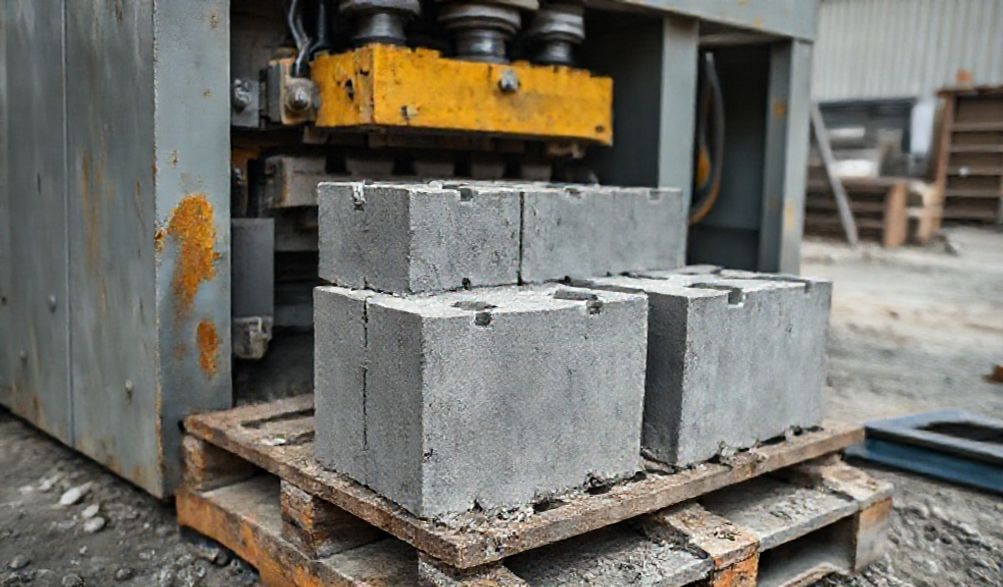
Синдер блоклар ишлаб чиқариш машиналари бўйича Ёлғиз Қўлланма: Түрлари, Нархлари ва Танлаш Усуллари
Qurilish kompaniyalari, pudratchilar yoki qurilish materiallari sanoatiga kirishni istayotgan tadbirkorlar uchun shlak bloklarining narxi va etkazib berilishi katta to'siq bo'lishi mumkin. Agar siz yuqori sifatli bloklarni talabga asosan ishlab chiqara olsangiz, ta'minot zanjirini nazorat qilsangiz va yangi daromad manbalarini ochsangiz-chi?
Ushbu qamrovli qo‘llanma sanoatdagi o‘nlab yillik tajribaga tayanib, shlak blok ishlab chiqarish mashinalari haqidagi tushunmovchiliklarni bartaraf etadi. Biz marketing jargonidan voz kechib, sizga oqilona investitsiya qilish uchun zarur bo‘lgan amaliy va ishonchli ma’lumotlarni taqdim etamiz.
Siz turli xil mashina turlari (qo'lda boshqariladigandan to'liq avtomatlashtirilgangacha), ishlab chiqarish quvvati va blok turlari kabi asosiy omillar, real xarajatlar tahlili va o'zingizning loyihangiz yoki biznes maqsadlaringiz uchun eng mos mashinani tanlash bo'yicha bosqichma-bosqich uslubni o'rganasiz.
Siz tadqiqot qilayotgan bo'lsangiz hamShamol blok yasash mashinalarikichik xo‘jalik yoki yirik tijorat o‘simligi uchun, bu qo‘llanma sizning boshlang‘ich nuqtanizdir.
Sinder blok yasash mashinasi nima? Asosiy vazifasi va afzalliklari
Asosida, shlakli blok yasash mashinasi - bu tsement va agregatlar aralashmasidan izchil, bardoshli devor bloklarini shakllantirish jarayonini avtomatlashtiradigan qurilmadir. Amalda, "shlakli blok" atamasi ko'pincha "beton blok" bilan bir xil ma'noda ishlatiladi, garchi an'anaviy shlaklar (uchuvchi kul) bugungi kunda tosh yoki qum agregatlariga qaraganda kamroq tarqalgan.
Ushbu mashinalar qanday ishlashi va ularning afzalliklarini tushunish aqlli xarid qilishga birinchi qadamdir.
Asosiy Ish Prinsipi
Jarayon, avtomatlashtirish darajasiga qarab farqlansa ham, izchil mexanik printsipga amal qiladi:
- Aralash:Sement, agregatlar (masalan, qum, shag‘al yoki maydalangan tosh) va suv yarim quruq beton aralashmasini hosil qilish uchun birlashtiriladi. Aniq nisob mustahkamlik uchun juda muhimdir.
- Qoliplash: This mix is fed into a mold cavity, which defines the block’s shape (e.g., hollow core, solid).
- Compacting (Vibration): High-frequency vibration is applied. This is the crucial step that removes air pockets and compresses the material into a dense, strong form within the mold.
- Demolding & Curing: The freshly formed, or “green,” block is ejected from the mold. It then undergoes a curing process, where it gains strength over days through controlled moisture and temperature, often in a dedicated curing chamber or rack.
Key Advantages of On-Site Block Production
Investing in your own production capability offers tangible benefits:
- Muhim xarajatlarni tejash: For bulk projects, producing blocks in-house eliminates supplier markups and can reduce material costs by 30-50%, depending on local prices.
- Complete Supply Chain Control: Never face project delays due to supplier shortages or delivery issues. Produce exactly what you need, when you need it.
- Moslashtirish Moslashuvchanligi: You can create non-standard block sizes, integrate special pigments for colored blocks, or adjust mixes for specific strength or insulation properties.
- Reduced Material Waste: Produce in batches aligned with your pace, minimizing waste from damaged deliveries or over-ordering. Some operations can even utilize on-site or local materials.
- A Clear Business Opportunity: A reliable machine can become a profit center itself, supplying blocks to other contractors, builders, or retailers in your area.
Types of Cinder Block Making Machines: From Manual to Fully Automatic
The market offers a spectrum of machines categorized by their level of automation, output, and investment. Choosing the right type is the most critical decision you’ll make.
Manual or Hand-Operated Machines
- Tavsif: These are purely mechanical, lever-operated devices. All actions—filling the mold, compacting via a hand press, and demolding—are performed by human labor.
- Eng yaxshisi: Extremely small-scale, low-budget projects like a personal garden wall, a small shed, or use in off-grid locations with no power access. They are not suitable for commercial production.
- Chiqish quvvati: Typically 100 to 500 blocks per day, heavily dependent on operator stamina.
- Expert Insight: While low-cost, the physical labor is intense, and achieving consistent block density and quality is challenging. They serve a niche but important role.
Yarim Avtomatik Mashinalar
- Tavsif: This is the most popular category for small to medium businesses. They use an electric motor to power a vibration system for effective compaction. However, feeding raw materials and removing finished blocks are manual operations. Many feature a simple hydraulic system for mold movement.
- Eng yaxshisi: Startup block manufacturing businesses, contractors undertaking several projects a year, and medium-scale housing developments. They offer an excellent balance of productivity and affordability.
- Chiqish quvvati: A robust semi-automatic machine can produce between 800 to 3,000+ standard blocks in an 8-hour shift, depending on model and crew efficiency.
- Expert Insight: Based on operational data, this tier offers the best return on investment for new entrants. The key is to ensure the vibration motor and frame are robust enough for continuous use.
To'liq Avtomat Mashinalar
- Tavsif: These are industrial production lines. They integrate computerized control panels, automatic material batching and feeding systems, conveyor belts, robotic stackers, and palletizers. Human intervention is primarily for monitoring and maintenance.
- Eng yaxshisi: Large-scale commercial block manufacturing plants supplying regional markets, or major infrastructure projects with colossal, predictable demand.
- Chiqish quvvati: Production is measured in shifts, with outputs ranging from 10,000 to over 30,000 blocks per 8-hour shift.
- Expert Insight: The capital investment is substantial, and they require significant space, stable high-power electrical connections, and skilled technicians. The payoff is unmatched volume and lower per-unit labor cost.
Mobile Block Making Machines
- Tavsif: These are production units (often semi- or fully-automatic) mounted on a trailer or truck bed. They can be towed directly to a large job site.
- Eng yaxshisi: Massive infrastructure projects like dams, highways, or remote large-scale construction where transporting thousands of finished blocks would be logistically complex and expensive.
- Chiqish quvvati: Varies, but designed for high-volume on-site production.
- Expert Insight: A common challenge we see is underestimating the site preparation needed—you still require a flat, stable base and access to bulk raw materials and power/water.
Sotib olishdan oldin hisobga olish kerak bo'lgan muhim omillar
Beyond just the machine type, several technical and commercial factors will determine your long-term success. This is where due diligence separates a wise investment from an expensive mistake.
Ishlab chiqarish quvvati va mahsulot chiqarish talablari
Don’t guess. Calculate.
1. Estimate your average daily or weekly block consumption based on project pipelines.
2. Add a 20-30% buffer for growth or unexpected demand.
3. Match this number to a machine’s realistik output, not its theoretical maximum. A machine rated for 2000 blocks/day might average 1600 after accounting for breaks, maintenance, and material loading.
Block Types and Sizes
- Ko'p qirralilik: Can the machine produce hollow blocks, solid blocks, paving stones, and interlocking blocks with simple mold changes? Mold versatility future-proofs your business.
- Mold Changeover Time: How quickly and easily can molds be swapped? In semi-automatic machines, this process should take less than 30 minutes.
- Standard vs. Custom: Ensure the machine can produce blocks meeting relevant regional standards (e.g., ASTM in the US, IS in India) for commercial sales.
Machine Power Source and Specifications
- Electric vs. Diesel/Hydraulic: Electric is most common for stationary plants. Diesel/hydraulic options are vital for sites without grid power.
- Quvvat talablari: A semi-automatic machine may require a robust 3-phase electrical connection. Verify your site’s capabilities before purchasing.
- Logistics: Consider the machine’s footprint, weight, and required ancillary space for raw material storage, mixing, and block curing.
Quality of Construction and Key Components
The machine’s build quality dictates its lifespan and uptime. Prioritize:
* Kadr: Heavy-duty steel welding that resists the constant stress of vibration.
* Titrama Tizimi: The heart of the machine. Look for reputable, branded vibration motors with adjustable frequency. Enclosed motors last longer in dusty environments.
* Moldlar: Hardened, precision-machined steel molds produce smooth, dimensionally accurate blocks and resist wear.
* Warning Sign: Excessively thin steel, poor welds, unmounted or generic “no-name” vibration motors, and loosely fitting molds are red flags for imminent breakdowns.
After-Sales Support: The Deal-Breaker
This factor is non-negotiable. A machine without support is a paperweight.
* Ehtiyot qismlar: Are wear-and-tear parts (mold liners, springs, bolts) readily available? What is the lead time?
* Texnik yordam: Does the supplier offer installation guidance, troubleshooting, and operational training? Is there a service hotline?
* Documentation: Clear, illustrated operation and maintenance manuals in your language are essential.
Understanding the Costs: Investment, Operation, and ROI
Being trustworthy means being transparent about money. Here’s a realistic breakdown.
Initial Purchase Price Ranges
- Qo'lda Boshqariladigan Mashinalar: $1,000 – $4,000 USD.
- Yarim avtomat mashinalar: $5,000 – $25,000+ USD. Price scales with capacity, build quality, and level of hydraulic assistance.
- To'liq avtomatik mashinalar: $50,000 – $300,000+ USD, depending on complexity and degree of automation.
- Mobil Mashinalar: $30,000 – $150,000+ USD.
Note: Country of manufacture, brand reputation, and shipping/import duties significantly affect final cost.
Operational and Raw Material Costs
Your ongoing costs per block will include:
* Xom ashyolar: Cement, sand, aggregate. A rough estimate is that raw materials constitute 60-70% of the production cost of a single block.
* Mehnat: For semi-auto machines, a crew of 2-4 is typical.
* Energy: Electricity for the mixer, vibrator, and (if applicable) hydraulic power pack.
* Maintenance: A small but essential budget for replacing wear parts and routine servicing.
Calculating Potential Return on Investment (ROI)
Use this simplified framework:
1. Calculate your total cost per finished, cured block (Materials + Labor + Energy + Maintenance + Machine Depreciation).
2. Research the prevailing market price for a similar quality block in your area.
3. Your gross profit per block is: Market Price - Your Cost.
4. ROI Timeframe: Divide the total machine investment cost by your estimated monthly gross profit from block sales.
Misol: If you invest $15,000 in a semi-auto machine and profit $0.20 per block, you need to sell 75,000 blocks to break even on the machine. At 2,000 blocks/month, that’s a 37.5-month (just over 3-year) ROI, excluding other business expenses. Volume is key.
Step-by-Step Guide to Choosing the Right Machine
Follow this actionable, expert-guided checklist to navigate your purchase confidently.
Step 1: Precisely Define Your Project Scope and Goals.
Are you supplying a single project, starting a side business, or launching a full-scale plant? Write down clear, measurable objectives for the first 12-24 months.
Step 2: Set a Realistic Budget (Including Hidden Costs).
Account for the machine, shipping, import duties, site preparation (foundation, power hookup), initial raw material stock, and a 10-15% contingency fund.
Step 3: Research and Shortlist Reputable Manufacturers/Suppliers.
Look for companies with a long track record, verifiable customer lists, and a strong online presence of working machines. Industry forums and trade associations are good resources.
Step 4: Request Detailed Quotes and Specifications.
Ask for a comprehensive spec sheet, not just a price. Compare vibration motor power, cycle time, hydraulic pressure, and warranty terms line-by-line.
Step 5: Seek References and, If Possible, Visit a Working Installation.
Talking to an existing user provides unparalleled insight into real-world output, reliability, and support quality. If a supplier discourages this, be wary.
Step 6: Finalize Support and Warranty Terms.
Get all support promises in writing. What does the warranty cover (parts, labor, duration)? How are spare parts priced? Clarify this before the final payment.
Frequently Asked Questions (FAQ) About Cinder Block Machines
What is the difference between a concrete block and a cinder block?
Historically, “cinder blocks” used fly ash or coal cinders as the primary aggregate, making them lighter and less strong. Modern “concrete blocks” use sand, gravel, or crushed stone, offering superior strength and durability. Today, the terms are often used interchangeably, but the material is almost always concrete.
Can I start a business with just one semi-automatic machine?
Absolutely. Many successful block yards began with a single robust semi-automatic machine. It allows you to validate demand, refine your process, and generate revenue to reinvest in scaling up. Focus on quality and reliability in your local market.
What is the curing process, and how long does it take?
Curing is the process where the cement hydrates and gains strength. Blocks must be kept moist and at a stable temperature for a minimum of 7 days to achieve sufficient strength. Full strength (28-day strength) is typically reached after 28 days under proper conditions. Steam curing chambers in automatic plants accelerate this to 24 hours or less.
How much space do I need for a small block-making operation?
For a semi-automatic setup, you need space for:
* The machine itself (~ 10′ x 10′ area).
* Raw material storage (sand, stone piles or silos).
* A mixing area.
* A large, level area for block curing and storage (can be several thousand square feet).
* Plan for at least 5,000 to 10,000 sq. ft. as a starting point.
Are there any safety precautions I should know about?
Yes. Always:
* Wear appropriate PPE: safety glasses, hearing protection (vibration is loud), gloves, and steel-toe boots.
* Ensure all machine guards are in place.
* Lock out/tag out power before performing any maintenance or clearing jams.
* Train all operators on safe material handling (cement dust, heavy molds).
Conclusion and Final Recommendations
Choosing a cinder block making machine is a significant decision that hinges on aligning the machine’s capabilities with your specific scale, budget, and long-term goals.
To reiterate the core principle: prioritize quality machinery and unparalleled after-sales support over the lowest initial price. Your long-term productivity and profitability depend on reliability and uptime.
As a final piece of expert advice: for most first-time buyers and small-to-medium business entrants, a robust, well-supported semi-automatic machine represents the optimal balance of affordability, controllable output, and operational simplicity to successfully launch and grow your venture.
Ready to take the next step? Use the step-by-step checklist in Section 5 to systematically evaluate your options. For personalized guidance, consider consulting with an independent industry expert or reaching out to shortlisted manufacturers with your specific project details and capacity requirements.
<