
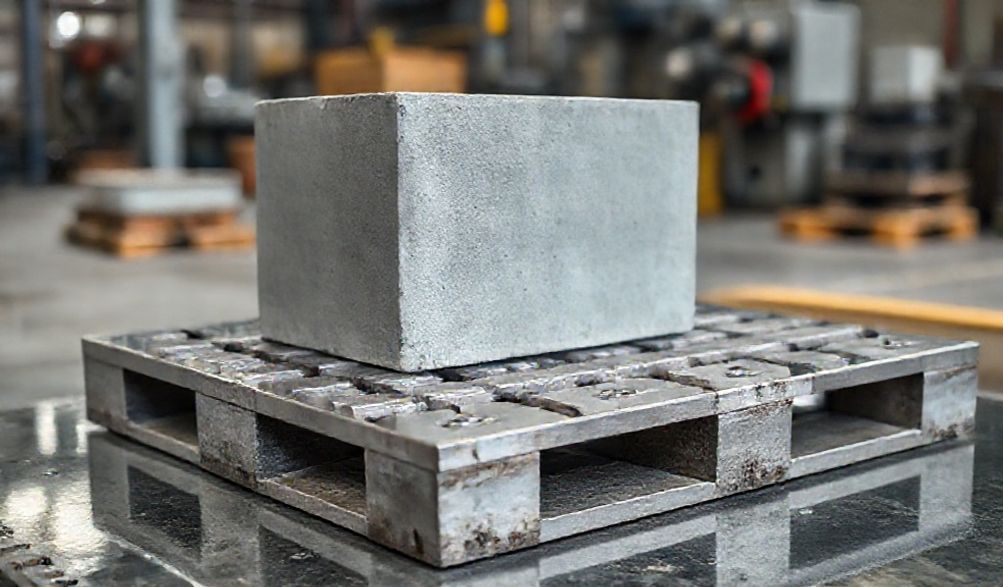
La Guía Definitiva sobre Paletas para Máquinas de Fabricación de Bloques: Selección, Uso y Mantenimiento
Introducción
Has optimizado tu mezcla de concreto, calibrado la vibración y revisado el sistema hidráulico. Aún así, enfrentas molestos contratiempos en la producción: bloques con alturas inconsistentes, defectos superficiales que generan rechazos o desgaste inesperado en el molde. Antes de culpar a la máquina en sí, mira hacia abajo. El responsable suele ser la aparentemente insignificante plataforma que sostiene cada bloque que produces: el palet.
A menudo tratado como un simple consumible, el palet para máquinas de bloques es, en realidad, un componente de precisión fundamental. Esta guía se destila de décadas de experiencia colectiva en la industria, incorporando conocimientos ganados con esfuerzo por fabricantes de máquinas, veteranos de la planta de producción e ingenieros de materiales. Estamos aquí para cambiar su perspectiva.
Una paleta de máquina de bloques es la placa de acero móvil y crítica sobre la cual se moldea, compacta y cura inicialmente el concreto. Forma la base misma de su producto, desplazándose a través de los ciclos de llenado, compactación y eyección de la máquina antes de transportar el bloque en verde al área de curado.
Elegir y mantener el palet adecuado no es una tarea de adquisición secundaria; es una inversión directa en la rentabilidad de su planta, la calidad del producto y la longevidad de la maquinaria. Una mala elección de palet erosiona silenciosamente los márgenes a través del desperdicio, el tiempo de inactividad y el desgaste acelerado. Esta guía definitiva proporciona información práctica para convertir sus palets de un centro de costos en un pilar de producción confiable. Si es propietario de una planta de bloques, gerente de producción, supervisor de mantenimiento o responsable de adquisiciones, la siguiente información es para usted.
Por qué su elección de paletas para máquinas de bloques es crucial para la rentabilidad
Ignorar tus paletas es como un equipo de Fórmula 1 ignorar sus neumáticos. Son el único punto de contacto entre tu máquina y tu producto, y su estado dicta el rendimiento. Las especificaciones de tus paletas tienen consecuencias directas y medibles en tus resultados financieros.
Impacto en la Calidad y Consistencia del Producto
La calidad de tus bloques solo es tan buena como la superficie sobre la que se forman.
- Precisión Dimensional:La planitud del palé es primordial. Un palé deformado o combado producirá bloques con alturas variables y dimensiones fuera de especificación. Esto conduce a controles de calidad fallidos, quejas de clientes por dificultades en la colocación y producto desperdiciado.
- Acabado de Superficie y Liberación:La textura de la superficie de la paleta (terreno liso, ligeramente texturizado) afecta directamente la limpieza con la que el bloque se libera después de la eyección. Una superficie picada o rugosa puede causar adherencia, lo que lleva a daños en el bloque o imperfecciones superficiales que son visibles en el producto final.
- Prevención de Defectos:Las grietas o imperfecciones pueden originarse realmente en la paleta. Una superficie severamente desgastada o la acumulación de concreto crea un soporte desigual durante la fase de compactación a alta presión, induciendo puntos de tensión que se manifiestan como grietas.
Influencia Directa en la Salud y Tiempo de Actividad de la Máquina
Tus paletas protegen tu activo más valioso: la máquina de bloques en sí.
- Desgaste Acelerado:Un palé desgastado y desigual actúa como papel de lija contra el fondo del molde y la cabeza de prensa. Esto provoca un desgaste prematuro en estos componentes costosos y de precisión. También aumenta la abrasión en las cadenas y rodillos del transportador.
- Desalineación y Atascos:El alabeo de paletas o el daño en los bordes es una causa principal de atascos en el depósito de paletas, el alimentador o los sistemas de transferencia. Estas paradas no planificadas detienen toda su línea de producción, lo que conduce a pérdidas significativas en la producción y a una frenética resolución de problemas.
Los Costos Ocultos del Palet Equivocado
Los ahorros iniciales de un palet más barato y de calidad inferior se desvanecen rápidamente bajo un escrutinio operativo.
- Aumento de los Residuos:Las adherencias y las imprecisiones dimensionales se traducen directamente en bloques rotos o fuera de especificaciones que deben desecharse.
- Mayores costos de mantenimientoEl reemplazo frecuente de moldes, cabezales de prensa y piezas de la cinta transportadora debido al desgaste acelerado se convierte en un gasto recurrente.
- Ciclos de reemplazo frecuentes:Un pallet que se desgasta en 6 meses tiene un costo total mucho más alto que un pallet premium que dura 3 años, cuando se considera el tiempo de inactividad por cambios y los gastos generales de adquisición.
- Ineficiencia Energética:En ambientes de curado con vapor, una plataforma deformada tiene un contacto deficiente con la cama de curado, lo que reduce la eficiencia de transferencia de calor y puede provocar un curado desigual.
Tipos de Palets para Máquinas de Fabricación de Bloques: Materiales y Especificaciones
No todos los aceros son iguales. Comprender la ciencia de los materiales detrás de las opciones de palets te permite especificar la herramienta adecuada para tu trabajo.
Palets de acero estándar: el caballo de batalla
Estos son los pallets más comunes, fabricados con plancha de acero duradera y resistente a la abrasión.
- Especificaciones Típicas:Fabricado con grados como Hardox 400 o AR400, con espesores que suelen oscilar entre 6 mm y 12 mm, según el tamaño de la máquina y el peso del bloque.
- Pros:Excelente equilibrio entre durabilidad y rentabilidad. Ofrecen buena resistencia al impacto y propiedades de transferencia de calor, lo que los hace adecuados para la producción de alto volumen de bloques estándar.
- Contras:Aunque son resistentes a la abrasión, no son inmunes al desgaste y perderán gradualmente la planitud. También son susceptibles a la corrosión si se exponen a la humedad y al ambiente alcalino del hormigón sin protección.
Hardened & Ground Steel Pallets: For Precision & Longevity
This is the premium choice for operations focused on minimal downtime and superior product finish.
- El Proceso: After being cut to size, these pallets undergo a heat treatment (hardening) process, followed by precision grinding on large surface grinders. This creates an exceptionally hard, flat, and smooth surface.
- Ventajas Clave:
- Superior Wear Resistance: The hardened surface withstands abrasion far longer than standard steel, drastically extending service life.
- Exceptional Flatness Retention: They resist warping and dishing under cyclic loading, maintaining dimensional accuracy for your blocks over time.
- Smooth Block Release: The mirror-like ground finish provides an almost non-stick surface, reducing release agent needs and improving block bottom finish.
- Ideal Use: Essential for producing high-tolerance products like interlocking paving stones, architectural masonry, and any application where a perfect bottom finish is required.
Specialty & Coated Pallets
For specific environmental or production challenges, specialized pallets offer solutions.
- Galvanized or Painted Pallets: A zinc coating (galvanizing) or a robust industrial paint system provides a barrier against corrosion. This is crucial for plants in coastal/humid regions or those using accelerants or mix designs that are particularly corrosive.
- Non-Stick Coatings: Applied over steel, coatings like PTFE (Teflon) or specialized polymers create a surface to which concrete minimally adheres. These are valuable for intricate mold designs with deep ribs or for mixes that are prone to sticking, though they may wear over time and require re-coating.
Key Specifications to Specify When Ordering
Never just order a “steel plate.” Provide a detailed specification sheet to your supplier.
- Dimensiones: Exact length, width, and thickness. Include permissible tolerances (e.g., ±0.2mm on thickness).
- Flatness Tolerance: The most critical spec. Usually expressed as a deviation over a length (e.g., “±0.5mm over any 1-meter span”).
- Acabado superficial: Specify “Precision Ground,” “Milled,” or “As-rolled.” For ground pallets, you may specify a surface roughness (Ra) value.
- Hardness: Define the Brinell Hardness Number (BHN). For example, AR400 has a nominal hardness of 400 BHN.
- Edge Preparation: Require all edges to be deburred, beveled, or radiused. Sharp edges are a safety hazard, damage conveyor guides, and can chip easily.
How to Select the Right Pallet for Your Machine and Product Mix
Selecting a pallet is a three-part equation: your machine’s requirements, your product’s demands, and your plant’s environment.
Matching Pallet to Machine Model
This is non-negotiable. Your block machine is engineered for a specific pallet profile.
- Consult the Manual: The manufacturer’s manual provides the exact dimensions, thickness, and maximum weight specifications. Deviating from these can void warranties and cause mechanical failure.
- Weight Matters: The machine’s pallet feeder, elevator, and turnover systems are designed for a specific weight range. A pallet that is too heavy can overload drives and cause misalignment.
Matching Pallet to Your Block Products
Different products exert different stresses on a pallet.
- Bloques Huecos Estándar: Create a concentrated wear pattern along the outer edges of the mold. A durable, abrasion-resistant steel is key.
- Dense Pavers or Solid Blocks: Apply pressure more evenly across the entire pallet surface. Flatness retention under full-area compression is the critical factor here.
- Abrasive Mixes: If your mix contains industrial by-products like slag or certain manufactured aggregates, the abrasiveness skyrockets. This is a strong case for investing in the hardest, most wear-resistant pallet you can justify.
Evaluating Your Production Environment
The atmosphere in your plant plays a role in pallet longevity.
- Humidity & Corrosion Risk: Assess your climate and indoor humidity. If rust is a frequent sight, prioritize coated or galvanized pallets, or commit to a rigorous protective maintenance routine.
- Cleaning Processes: Do you use high-pressure water jets for cleaning? This forceful, concentrated water can accelerate corrosion if pallets are not dried and treated afterward. It can also damage non-stick coatings.
Best Practices for Pallet Maintenance & Maximizing Lifespan
A premium pallet is an investment; proper maintenance is the insurance policy. A simple, consistent routine can double or triple a pallet’s service life.
Daily & Weekly Inspection Routines
Catch problems early, before they damage blocks or the machine.
- Visual Checklist: Each shift, operators should quickly look for:
- Warping/Bowing: Sight down the length of the pallet.
- Edge Damage: Dings, curls, or cracks on the edges.
- Surface Pitting: Signs of corrosion or impact damage.
- Concrete Buildup: Residual “packing” on the surface.
- The Straightedge Test: Weekly, use a precision straightedge and a feeler gauge to check flatness. Document any pallets exceeding your flatness tolerance (e.g., >1mm gap).
Proper Cleaning Techniques
Remove concrete residue without damaging the pallet.
- Immediate Removal: Scrape off wet concrete buildup promptly before it cures.
- For Cured Residue: Use a plastic or nylon scraper. Avoid aggressive steel wire brushes, which score the surface and create grooves that promote sticking.
- Chemical Cleaners: If needed, use a mild, acidic concrete dissolver, but ensure it is compatible with your pallet’s material/coating and rinse thoroughly.
Correct Handling & Storage
Most physical damage occurs off the machine.
- Never Drop or Drag: Use designated pallet carts. Dropping pallets onto concrete floors is a surefire way to cause warping and edge damage.
- Flat, Dry Storage: When not in use, store pallets in a clean, dry area. Stack them flat on a level surface with support across their full area to prevent sagging.
When to Repair vs. Replace
Knowing when to retire a pallet saves money in the long run.
- Signs for Replacement:
- Excessive warping that cannot be corrected in a press (>3mm deviation).
- Deep grooves or scoring that affects block release.
- Severe corrosion that has pitted through the material, compromising structural integrity.
- Consider Repair/Refurbishment: For high-quality hardened pallets that have lost flatness or surface finish but are not deeply worn, professional re-grinding by a specialized workshop can be a cost-effective way to restore them to like-new condition, extending their life significantly.
Frequently Asked Questions (FAQ) About Block Machine Pallets
Q1: How often should I replace my block machine pallets?
A: There is no universal timeline. Replacement should be driven by condition, not calendar. A well-maintained hardened pallet in a low-abrasion environment could last 5+ years. A standard pallet in high-volume, abrasive production might need replacement in 12-18 months. Let your weekly inspection and flatness tests dictate the schedule.
Q2: Can I use a thicker pallet than what my machine manual specifies?
A: It is strongly discouraged without explicit written approval from the machine manufacturer. A thicker pallet may not fit in the magazine, can overload the elevator and drive mechanisms, and critically, it can alter the compression stroke distance, leading to under-compacted blocks or machine damage.
Q3: Why are my blocks sticking to the pallet?
A: Sticking is a common symptom with multiple potential causes. Diagnose in this order:
1. Pallet Surface: Is it pitted, rough, or contaminated with old buildup? Refurbish or replace.
2. Diseño de Mezcla: Is the mix too wet or has a high fines content? Adjust the water-cement ratio.
3. Release Agent: Are you using one? Is it applied correctly and at the right dosage?
4. Machine Process: Is the vibration time and pressure sufficient for proper compaction and release?
Q4: Is it worth investing in more expensive hardened pallets?
A: Analyze it through Costo Total de Propiedad (CTP). While hardened pallets can cost 2-3x more upfront, consider:
* They last 3-5x longer than standard pallets.
* They drastically reduce downtime for pallet changes and machine wear.
* They improve product quality and reduce waste.
For high-volume or precision-focused plants, the math almost always favors hardened pallets in the long run.
Q5: How can I prevent my steel pallets from rusting?
A: A proactive approach is key:
1. Clean Thoroughly & Dry: After washing, ensure pallets are completely dry before storage.
2. Apply a Protective Film: During weekend shutdowns or extended inactivity, lightly spray or wipe pallet surfaces with a thin layer of a water-displacing, rust-inhibitive oil (ensure it’s compatible with concrete and won’t affect curing).
3. Control Storage Environment: Keep spare pallets in a dry, covered area off damp floors.
Conclusión
The pallet for your block making machine is far more than a simple slab of steel. It is a precision-engineered component that sits at the heart of your production quality, efficiency, and cost control. Treating it as a disposable commodity is one of the most common and costly oversights in block manufacturing.
The strategic choice is clear: prioritize quality, correct specifications, and a partnership with a reputable supplier who understands the demands of block production over the temptation of the lowest upfront cost. Your pallets should be an asset you manage, not an expense you dread.
Your Call to Action: This week, conduct a pallet audit. Pull 10-20 pallets from your line at random. Perform the straightedge test. Inspect for wear and damage. You may uncover the root cause of persistent production issues. For specific guidance, contact your machine’s OEM or consult with a trusted, specialized pallet manufacturer for a professional assessment of your needs.
By mastering the selection, use, and maintenance of your pallets, you pave the way for a smoother, more profitable, and sustainable block production operation for years to come.
<