
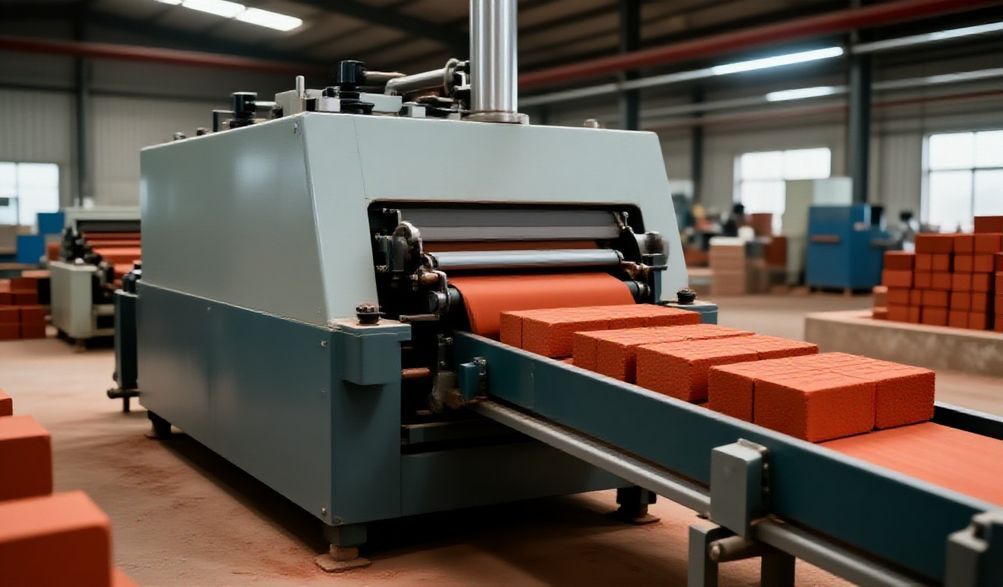
Votre Guide Ultime des Machines à Fabriquer des Briques en Argile au Punjab | Focus sur l'Usine FUDA
Introduction
La ligne d'horizon du Punjab témoigne d'une croissance fulgurante. Des centres urbains animés de Ludhiana et Amritsar aux cantons en expansion, le secteur de la construction est en plein essor. À la base même de ce progrès se trouve un composant modeste mais essentiel : la brique d'argile. Depuis des générations, la solidité et la fiabilité des structures pendjabies reposent sur des briques fabriquées localement. Cependant, l'industrie se trouve à un carrefour. Les méthodes manuelles traditionnelles, dépendantes d'une main-d'œuvre intensive et de conditions de cuisson variables, peinent à répondre aux exigences d'échelle, de régularité et de normes de qualité modernes.
Cet écart représente un défi clair pour les fabricants et les entrepreneurs : comment produire des briques en terre cuite de haute qualité de manière efficace, rentable et à un rythme compétitif ? La réponse est en train de révolutionner le paysage : les machines automatisées de fabrication de briques en terre cuite. Ce guide se penche sur cette solution moderne, en mettant particulièrement l'accent sur un leader local :Usine de fabrication de briques FUDA.
Nous allons explorer comment FUDA fait le lien entre le riche héritage de la brique en terre cuite du Punjab et les technologies de fabrication de pointe. Fondé sur une expertise industrielle et une compréhension approfondie du marché local, ce guide constitue une ressource fiable pour toute personne souhaitant investir dans uneMachine à fabriquer des briques en argile au PunjabConstruisons un avenir plus solide et plus efficace, brique par brique.
Comprendre les machines de fabrication de briques en terre cuite : types et technologies
Passer d'une production manuelle à l'automatisation n'est pas simplement une amélioration ; c'est une transformation. Il s'agit de remplacer l'inconstance par la précision et de démultiplier le potentiel grâce à une technologie fiable.
Comment les machines automatisées révolutionnent les briqueteries traditionnelles au Pendjab
Le four à briques traditionnel, bien qu'iconique, est entaché de nombreux défis :
* À forte intensité de main-d'œuvre :Fortement dépendant d'une main-d'œuvre importante et qualifiée pour le moulage, le transport et l'empilage.
* Qualité Inconstante :Le moulage manuel entraîne des variations dans la taille, la densité et la résistance des briques. La cuisson dans des fours à cloche ou des fours à tranchée de type Bull (BTK) conduit souvent à un chauffage inégal.
* Production lente :Le processus est cyclique et dépend des conditions météorologiques, en particulier la phase de séchage.
* Gaspillage plus élevé :Les taux de casse sont nettement plus élevés en raison de la manipulation manuelle et de la cuisson irrégulière.
Les machines automatisées abordent ces problèmes de front. Elles garantissent un mélange uniforme, un compactage à haute pression précis et une production constante 24 heures sur 24 et 7 jours sur 7, indépendamment des pénuries saisonnières de main-d'œuvre. Le résultat est un produit qui répond aux normes de construction modernes en matière de résistance à la compression et de précision dimensionnelle.
Types Clés de Machines à Fabriquer des Briques
Toutes les machines ne sont pas créées égales. Le bon choix dépend de votre échelle, de votre investissement et de vos objectifs d'automatisation.
- Machines de fabrication de briques de cendres volantes :Bien que notre attention se porte sur l'argile, il est important de différencier. Ces machines utilisent des cendres volantes (un sous-produit de centrale thermique), du ciment et du sable. Elles sont excellentes pour la construction écologique, mais fonctionnent sur un principe de matière première différent de celui des machines à argile pure.
- Usines de briques en terre cuite entièrement automatiques :Le summum de l'efficacité. Il s'agit de lignes de production complètes avec alimentation, mélange, convoyage, pressage et empilage automatisés des matériaux. Idéales pour les fabricants à grande échelle visant une production de 10 000+ briques par poste avec une intervention manuelle minimale.
- Machines à Briques Semi-Automatiques :Le point idéal pour de nombreuses entreprises punjabies. Elles mécanisent les processus critiques de pressage et d'éjection, mais peuvent nécessiter un alimentation manuelle du mélange ou la manipulation des briques crues. Parfait pour les opérations à moyenne échelle, équilibrant le coût initial avec des gains de productivité significatifs.
- Presses manuelles/à commande manuelle : These are mechanical presses (like the popular “Midget” or “Aswani” types) that increase the pressure of manual molding. Suitable for very small-scale, rural, or specialty brick production where investment needs to be minimal.
Composants de base et leur fonctionnement
Understanding the machine’s anatomy demystifies the process. A standard automatic clay brick machine integrates several key components:
- Alimenteur & Mélangeur : Receives and homogeneously blends clay with optimal water content, creating a pliable, consistent mix.
- Système de convoyeur : Transports the prepared clay mix to the pressing chamber without manual lifting.
- Hydraulic Press & Mold (Die): The heart of the machine. A high-pressure hydraulic ram compacts the clay into a precision-engineered steel mold. This pressure is what determines the final brick’s density and strength.
- Système d'éjection : Automatically pushes the formed “green brick” out of the mold onto a pallet or conveyor for collection.
- Panneau de commande PLC : The brain. This computerized system allows operators to set parameters like pressure, cycle time, and brick count, ensuring repeatable, error-free production.
Why Choose a Clay Brick Making Machine from Punjab’s FUDA Factory?
In a market filled with options, choosing a partner is as crucial as choosing a machine. Here’s why FUDA Brick Making Factory stands out as a leader in Punjab.
FUDA’s Legacy in Punjabi Manufacturing
FUDA isn’t just a seller; it’s a manufacturer rooted in the soil of Punjab. With years of dedicated operation, the company has built its autorité by specializing exclusively in brick and block making machinery. This deep-seated experience means FUDA understands not just engineering, but the very fabric of Punjab’s industrial needs—from the characteristics of local alluvial clay to the power infrastructure and business aspirations of local entrepreneurs.
Engineering Expertise and Machine Durability
Expertise is engineered into every machine. FUDA invests in in-house research and development to adapt to evolving market demands. Their machines are built for the rigors of continuous industrial operation, featuring:
* Robust, heavy-duty frames to withstand constant vibration.
* High-grade hydraulic components from reputable brands for reliable pressure.
* Hardened steel molds that resist wear, ensuring brick dimensional accuracy for thousands of cycles.
This focus on durability translates to lower long-term maintenance costs and higher uptime for your business.
Customization for Punjab’s Clay and Market
FUDAexpérience shines in its ability to customize. Clay from Malwa is different from clay from Doaba. FUDA technicians can calibrate machine settings—like moisture content and compression ratio—for your specific local clay. Furthermore, they offer customization for:
* Brick Size: Standard (9″x4.5″x3″), modular, jumbo, or any custom size required by architects.
* Type de brique : Solid, hollow (for reduced weight and improved insulation), or even patterned facing bricks.
* Capacité de sortie : From small semi-automatic setups to large fully automatic plants.
After-Sales Support: Training, Spares, and Service
A machine is only as good as the support behind it. FUDA establishes fiabilité through a comprehensive after-sales ecosystem:
* On-Site Installation & Commissioning: Expert engineers set up your plant for optimal operation.
* Hands-On Operator Training: They don’t just deliver a machine; they transfer knowledge on operation, daily maintenance, and safety.
* Local Spares Inventory: A dedicated inventory of critical spare parts within Punjab ensures you are not waiting for shipments from distant states, minimizing costly downtime.
* Responsive Service Network: A team of service technicians is on call to provide prompt support, ensuring your business keeps running smoothly.
Key Features to Look for in a Quality Clay Brick Machine
Whether you’re evaluating FUDA or other brands, these are the non-negotiable features that define a quality investment.
Capacité de production (briques par heure)
This is your starting point. Align capacity with your business plan:
* Small Scale: 1,000 – 2,500 bricks per hour (often semi-automatic).
* Medium Scale: 2,500 – 6,000 bricks per hour (semi or fully automatic).
* Large Scale Plant: 6,000 – 15,000+ bricks per hour (fully automatic lines).
Hydraulic System Pressure and Brick Density
C'est letechnical core of quality. Higher hydraulic pressure (measured in tons or PSI) compacts the clay particles more tightly.
* Result: Bricks with higher compressive strength (exceeding 70-100 kg/cm² easily), lower water absorption, and better frost resistance. Always ask for the machine’s maximum pressure and the tested strength of the bricks it produces.
Automation Level and Control Panel
The control system dictates ease of use and consistency.
* Look for PLC (Contrôleur Logique Programmable) systems with touchscreen interfaces. These allow for precise setting of production parameters, store recipes for different brick types, and provide fault diagnostics, drastically reducing operator error and training time.
Power Requirement and Energy Efficiency
Consider your local industrial power situation in Punjab.
* Moteurs Électriques : Cleaner, quieter, and more efficient for areas with stable grid power.
* Diesel Engine Options: Crucial for locations with frequent power cuts, ensuring uninterrupted production. Evaluate the machine’s specific power consumption (HP/KW) per thousand bricks for long-term cost efficiency.
Mold Quality and Interchangeability
The mold defines the brick. Insist on:
* Precision-Engineered Molds: Made from hardened, wear-resistant steel (e.g., EN-31) for a long lifespan and sharp brick edges.
* Easy Interchangeability: A design that allows one operator to change molds within minutes to switch between brick types, maximizing plant flexibility.
The Business Case: ROI and Setting Up Your Plant in Punjab
Investing in a brick making machine is a strategic business decision. Let’s break down the practicalities.
Investment Breakdown and Government Schemes
Your initial investment goes beyond the machine price:
* Machinery Cost: The core machine (semi or fully automatic).
* Civil Work: A covered shed for the production line, raw material storage bays, and drying areas.
* Land: Adequate space for the plant, drying yards, and stockpiling.
* Ancillaries: A tractor/pug mill for clay mixing, trolleys, and pallets.
* Astuce : Explore potential support from Punjab’s MSME or industrial policies, which may offer subsidies on machinery, interest subventions on loans, or favorable land allotments in industrial clusters.
Calculating Your Return on Investment (ROI)
A simplified model illustrates the potential. Let’s compare a semi-automatic machine with manual production.
| Factor | Manual Production (Per 10,000 Bricks) | Semi-Auto Machine (Per 10,000 Bricks) |
| :— | :— | :— |
| Main-d'œuvre requise | 25-30 persons | 8-12 persons |
| Production Time | 2-3 days | 4-6 hours |
| Key Cost Savings | Very high, recurring labor cost | Drastically reduced labor cost |
| Quality Premium | Sells at standard market rate | Can command a 10-15% premium for consistent, high-strength bricks |
| Wastage | High (15-20%) | Low (5-7%) |
ROI Calculation: The significant savings in labor, time, and wastage, combined with the ability to produce and sell more high-quality bricks daily, typically allows the machine to pay for itself within 12 to 24 months, depending on scale and market rates.
Ideal Plant Layout and Space Requirements
Efficiency is also about layout. A well-planned plant (approx. 1-2 acres for medium scale) should have a logical flow:
1. Raw Material Yard: Where clay is weathered and stored.
2. Production Shed: Houses the machine, mixer, and conveyor.
3. Green Brick Drying Area: A covered, ventilated space for initial drying before firing.
4. Kiln Area: For setting up a Hoffman Kiln, Tunnel Kiln, or using a clamp.
5. Finished Goods Storage: For cooled, fired bricks before dispatch.
Sourcing Raw Materials: Clay in Punjab
Punjab is endowed with good alluvial clay. Expert insight for sourcing:
* Test the Clay: Simple tests include checking plasticity, shrinkage on drying, and presence of harmful salts like sulfates.
* Preparation is Key: Clay must be “weathered” by exposure to rain and sun for weeks to improve plasticity. It should then be properly crushed and mixed to a uniform consistency before feeding into the machine.
* FUDA’s Advantage: Their experience allows them to advise on optimal preparation techniques for your specific clay source.
FAQs: Clay Bricks Making Machines in Punjab
Q1: What is the approximate price range for a FUDA clay brick making machine in Punjab?
A: Prices vary significantly based on automation level and capacity. A basic semi-automatic machine can start from several lakhs, while a high-capacity fully automatic plant can run into crores. We advise contacting FUDA for a detailed, customized quote based on your desired output, brick type, and automation needs. Remember, the focus should be on long-term value and ROI, not just the initial price tag.
Q2: Can the machine produce different types and sizes of bricks?
A: Absolutely. By changing the mold/die, a single FUDA machine can produce various bricks—standard solid bricks, hollow blocks for partition walls, and even decorative paving bricks. They offer a wide range of standard mold sizes and can fabricate custom molds to your specifications.
Q3: What kind of after-sales service and warranty does FUDA provide?
A: FUDA typically offers a comprehensive warranty (e.g., 12 months) on major components like the hydraulic system and mainframe. Their commitment extends beyond warranty with readily available technical support, a robust spare parts supply chain within Punjab, and a responsive service team to ensure minimal operational disruption.
Q4: How much manpower is required to operate a semi-automatic vs. fully automatic plant?
A: This is a key differentiator. A fully automatic line, with automated handling from mixing to stacking, may require only 3-5 personnel for supervision and handling. A semi-automatic line, which might involve manual feeding or brick handling, typically requires 8-12 people. Both represent a massive reduction compared to traditional methods.
Q5: Is training provided for machine operation and maintenance?
A: Yes, comprehensively. FUDA provides mandatory on-site training for your operators and maintenance staff. This covers safe startup/shutdown procedures, daily maintenance routines, basic troubleshooting for common issues, and best practices for optimal brick quality and machine longevity.
Conclusion
The evolution from manual kilns to automated brick making is not merely a trend; it’s an essential strategic move for anyone serious about the brick manufacturing business in Punjab. It’s an investment in unparalleled consistency, scalable production, and superior product quality that the modern construction market demands.
Throughout this guide, one partner has consistently exemplified the blend of local insight and technical prowess needed to succeed: Usine de fabrication de briques FUDA. They represent more than a machinery supplier; they are a true business partner invested in your success—from customizing a machine for your local clay to supporting you with training and service long after the sale.
If you are ready to transform your brick production, boost your profitability, and build a future-proof business, the next step is clear.
Contact FUDA Brick Making Factory today for a personalized consultation, a live machine demonstration at their facility, and a detailed project report tailored to your specific location and business goals in Punjab. Discover the power of partnering with a local expert for your Machine à fabriquer des briques en argile au Punjab.
<