
Gid Konplè sou Machin pou Fè Blòk Entèbloke Manyèl: Pri, Pwosesis ak Avantaj
Entwodiksyon
Pou bòs mason, lidè kominotè, ak pwopriyetè kay atravè lemond, rèv pou konstriksyon abòdab ak dirab souvan fè fas ak yon reyalite difisil: pri ki monte anpil ak enpak anviwònman materyèl konvansyonèl yo. Brik tè kwit mande anpil enèji, kontribye nan deforestasyon, epi transpò yo sèlman ka fè bidjè pwojè yo depase limit yo. Defi sa a patikilyèman grav nan zòn izole ak pou moun ki gen kapital limite.
Men sa ki ta si solisyon an pa t jis yon lòt pwodwi, men yon lòt pwosesis—yon pwosesis ou ta ka kontwole? Baze sou plizyè deseni nan amelyorasyon jeni ak aplikasyon nan teren nan konstriksyon dirab, machin pou fè blòk entèloke manyèl la reprezante egzakteman sa. Sa a se pa teknoloji espesilatif; se yon pres manyèl ki deja pwouve, ki transfòme tè lokal ki disponib an blòk konstriksyon solid ak entèloke.
Gid sa a sèvi kòm resous konplè ou. Kit ou se yon mason k ap eksplore metòd pou ekonomize, yon antreprenè k ap gade yon opòtinite ti biznis, yon ONG k ap planifye yon pwojè kominotè, oswa yon pasyone brikole dedye, nou pral demistifye zouti pwisan sa a. Nou pral kouvri egzakteman ki jan li fonksyone, benefis konkrè li yo, yon pwosesis pwodiksyon detaye, etap pa etap, ak faktè enpòtan pou konsidere anvan ou envesti. Objektif nou se bay enfòmasyon serye ak apwofondi ou bezwen pou pran yon desizyon ki klè pou pwojè ak kontèks espesifik ou.
Kisa yon Machin pou Fè Blòk Entèbloke Manyèl?
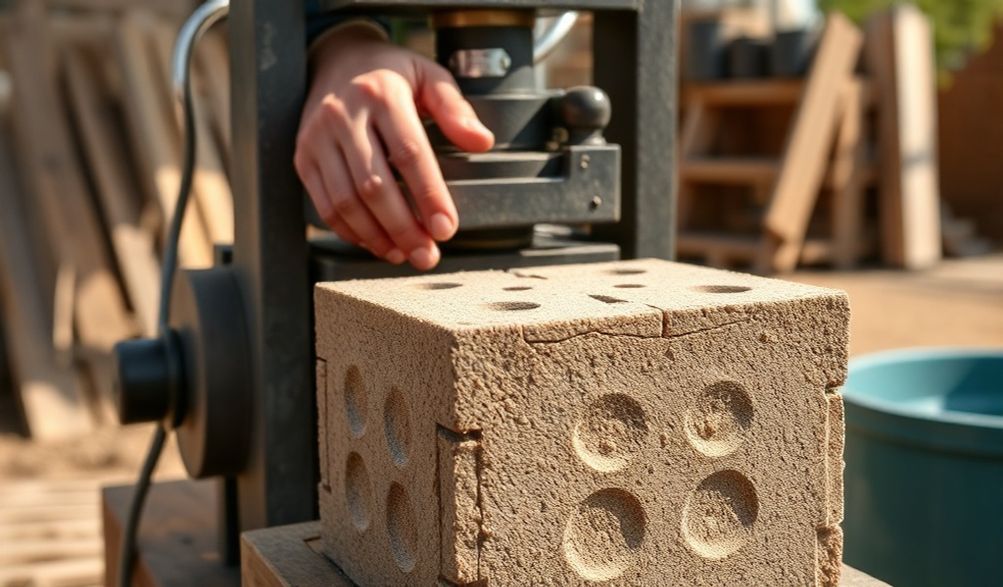
Nan fondasyon li, yon machin pou fè blòk entèbloke manyèl se yon aparèy ki mache ak fòs moun, ki fèt pou konprese yon melanj tè imid, sab, ak yon ti pousantaj siman an blòk dansite wo, ki gen fòm jewometrik pou yo ka entèbloke. Li evite nesesite pou pase yo nan fou pou kwit, sa ki bay yon chemen ki senplifye anpil soti nan tè natirèl rive nan inite konstriksyon fini.
Fonksyon ak Desen Debaz
Machin nan se yon etid elegant nan avantaj mekanik. Pandan ke desen yo varye, eleman fondamantal yo rete konsistan:
- Sistèm Levye:Yon bra levye asye long bay fòs ki nesesè a. Pwa ak fòs operatè a ogmante atravè machin senp sa a pou reyalize yon gwo konpresyon.
- Moule/Matris:Sa se kavite a ki bay blòk la fòm li. Li anjeneral fèt ak asye trete pou reziste a presyon ak abrazyon konstan.
- Chanm Konpresyon:Kote melanj matyè premyè a chaje. Yon piston oswa tèt prens, ki kondwi pa levye a, konpakte melanj la vètikalman ak yon fòs imans.
- Konsepsyon Kle Entèbloke:Entegre nan moul la, sa kreye lang ak ran oswa pye ak kavite sou tèt, anba, ak kote blòk yo.
Pwosesis la siklik: ranpli, konprese, ekspilsyon. An pratik, yon operatè ki gen ladrès ka pwodwi yon blòk nan mwens pase yon minit.
Syans Blòk Antre-loke yo
Jeniyalite sistèm nan pa sitouman nan konpresyon, men nan koneksyon. Desen an ki mare ansanm kreye yon lyen mekanik ant blòk yo.
- Eliminasyon Mòtye:Fòm presizyon ak entèbloke a elimine nesesite pou jwenti mòtye vètikal. Se sèlman yon kouch mens, orizontal mòtye ki anjeneral itilize pou asire yon kou nivo.
- Avantaj Enkòpore:Sa mennen nan vitès konstriksyon pi rapid (paske pa gen mòtye pou tann), rediksyon nan depandans sou mason ki gen anpil konpetans, ak ekonomi materyèl enpòtan.
- Entegrite Estriktirèl:Mòd ki anmele a kreye yon miraj ki aji plis tankou yon matris inifye ak fleksib. Obsèvasyon sou teren nan zòn sismik yo montre ke miray blòk anmele ki byen bati ka montre pi bon rezistans kont fant pase masonri konvansyonèl yo, paske anmeleman an pèmèt yon ti mouvman san echèk katastwofik.
Prensipal Avantaj Itilizasyon Yon Pres Blòk Manyèl
Chwazi yon près manyèl se yon desizyon estratejik ki gen anpil benefis, soti nan ekonomi rive nan ekoloji ak otonòm.
Ekselans nan Pri-efikasite
Ka finansye a se yon bagay ki difisil pou reziste, sitou pou pwojè ki nan ti oswa mwayen gwosè.
- Envestisman Kapital Faible:Konpare ak plant blòk motè oswa idwolik ki koute dè dizèn de milye dola, yon pres manyèl kalite siperyè reprezante yon depans inisyal minim.
- Rediksyon Egzijans Pri Materyèl Radikal The primary ingredient—soil—is often available on-site or locally for little to no cost. Cement usage is minimal (typically 5-10% by volume).
- Ongoing Savings: Eliminating vertical mortar saves approximately 30-50% of mortar costs and related labor.
Sustainability and Eco-Friendly Construction
This technology aligns perfectly with green building principles.
- Localized Material Use: Utilizing 70-90% in-situ materials drastically cuts the carbon emissions and cost associated with transporting heavy building materials.
- Low Embodied Energy: With no firing process, the energy input is virtually limited to human labor and the small cement fraction. This contrasts sharply with fired bricks, which are major consumers of coal or firewood.
- Non-Toxic & Recyclable: The blocks are made from natural earth and stabilize with cement. At end-of-life, they can be crushed and returned to the earth or re-used as aggregate.
Empowerment and Operational Simplicity
Perhaps the most profound advantage is the shift in control it offers.
- Pwodiksyon Sou-Demann You are no longer at the mercy of supplier schedules or market price fluctuations. Blocks can be produced as needed, on-site.
- Low Technical Barrier: Operation can be learned in a matter of hours. Training focuses more on material preparation than complex machinery operation.
- Ideal for Diverse Contexts: This makes it a tool of choice for self-help housing projects, remote community development, disaster reconstruction (as promoted by organizations like UN-Habitat), and small-scale entrepreneurial ventures.
The Step-by-Step Block Production Process
Success with a manual press hinges on process, not just the machine. Here is the proven workflow, drawn from field-tested best practices.
Stage 1: Material Selection and Preparation
This is the most critical phase. Poor materials guarantee poor blocks.
- Tès Tè a: Not all soil is suitable. You need a balanced mix of clay (as a binder), silt, and sand (for stability). Simple field tests are essential:
- Jar Test: Fill a clear jar with 1/3 soil and 2/3 water, shake vigorously, and let it settle over 24 hours. The layers will reveal the approximate proportions of sand, silt, and clay.
- Ribbon Test: Moisten a handful of soil and try to roll it into a thin ribbon. If it forms a long, flexible ribbon, it’s too clay-rich. If it crumbles immediately, it’s too sandy. A moderate ribbon that breaks is often a good sign.
- Melanj konsepsyon an A common starting formula is approximately 70% soil, 25% sand, and 5% cement by volume. The sand corrects clay-heavy soil. Moisture content is crucial: The mix must be damp enough to bind, but not wet. The “hand-squeeze test” is key—a squeezed handful should form a ball that holds its shape without crumbling or dripping water.
Stage 2: Compression and Molding
With your properly prepared mix, you move to the machine.
- Load: Fill the compression chamber evenly with the mix. Do not overfill or underfill; consistency is key for uniform block density.
- Konprese: Pull down the lever arm firmly and steadily. You will feel significant resistance as the mix compacts. Apply full pressure. Some machines require a second “locking” press.
- Ekspilsyon: Release the lever, open any latches, and pull the lever again to raise the piston and eject the fresh “green” block onto a pallet or board.
Stage 3: Curing and Quality Control
Fresh blocks are fragile and must be handled with care.
- Gerizon: Stack the green blocks in a shaded area and cover them with a plastic sheet. This traps moisture and allows the cement to hydrate slowly, gaining strength. Light watering for the first 7-10 days is beneficial. Avoid rapid drying in direct sun, which causes cracking.
- Kontwòl Kalite: Perform simple tests:
- Drop Test: After 7 days, lift a block to waist height and drop it onto a firm, flat surface. A good quality block should not break or chip severely.
- Enspeksyon vizyèl: Check for large cracks, crumbling edges, or uneven shapes, which indicate incorrect mix or compression.
Critical Factors Before You Buy or Use One
A balanced, authoritative guide must address practical realities. Informed preparation prevents costly mistakes.
Evalye Kondisyon Pwojè Ou
Ask yourself these questions first:
- What is my daily block requirement? (A manual press typically produces 80-150 blocks per 8-hour day with a crew).
- What soil types are available on or near my site? (Plan for testing and potential sand purchase).
- Is this for a single home, a community building, or a commercial block-making business? Scale dictates feasibility.
Machine Specifications and Features to Compare
Not all machines are created equal. Scrutinize these aspects:
- Block Size & Design: Common sizes are similar to standard bricks or larger (e.g., 225mm x 110mm x 75mm). Ensure the interlocking pattern is robust.
- Kapasite Pwodiksyon: Linked to design efficiency. Test the lever mechanics—the action should be smooth and solid.
- Kalite Konstriksyon: Inspect weld points, steel thickness (especially the mold and lever), and overall finish. A heavier machine often indicates more durable steel.
- Support System: Does the supplier offer spare parts (like wear plates for the mold)? Is there technical support available?
Understanding Limitations and Challenges
Acknowledging these builds trust and sets realistic expectations:
- Labor Intensive: High-volume projects (e.g., a large school) require a significant, organized labor force.
- Soil Dependency: If your local soil is purely organic topsoil or gravel, you may need to import suitable material, affecting cost.
- Vitès Pwodiksyon: It cannot match the output of a fully automated electric or hydraulic machine. It is a tool for appropriate-scale projects.
Applications and Project Ideas
The versatility of interlocking blocks opens numerous doors:
- Affordable Housing and Community Projects: This is the primary application. From individual homes to clinics, schools, and community centers, the technology is championed by development organizations globally for its cost-control and community participation potential.
- Landscape and Garden Construction: A perfect pilot project. Build retaining walls, raised garden beds, compost bins, or decorative pathways. It’s a low-risk way to master the process.
- Entrepreneurial Opportunity: Starting a Small Block Yard Business: With one or two machines, you can establish a micro-enterprise, producing and selling blocks to local builders. Focus on consistent quality and educate your market on the benefits.
FAQ Section
Q: How strong are interlocking soil blocks compared to fired bricks?
A: Compressive strength typically ranges from 3 to 7 Megapascals (MPa), which is suitable for load-bearing walls in 1-2 story buildings, as per many building codes. While high-quality fired bricks can be stronger, properly made interlocking blocks provide more than adequate strength for most low-rise residential construction. The key is proper material selection and production.
Q: Can I use pure soil from my backyard?
A: Almost certainly not. Backyard topsoil contains organic matter, which decomposes and compromises block strength. You need mineral subsoil, typically found below the top 300mm. A simple jar test will tell you if it needs sand or clay amendment.
Q: Is a foundation different for interlocking blocks?
A: Yes, and getting it right is non-negotiable. The interlocking system begins above a stable, perfectly level base. A standard concrete strip foundation or a mortared rubble trench foundation is used. The first course of blocks is then laid in a full bed of mortar on this “plinth” to create a level starting point for the dry-stack interlocking system.
Q: What is the typical cost range for a good quality manual machine?
A: Prices vary widely by region, quality, and features. As a general guide, expect a range from approximately $500 to $2,000 USD. Be wary of machines at the very bottom end; they may use inferior steel and wear out quickly. Invest in robust construction from a reputable supplier.
Q: Where can I get training on using the machine?
A: Start with your machine supplier; many offer basic training. Look for NGOs or social enterprises working in sustainable construction (e.g., organizations inspired by the Good Earth Trust or Habitat for Humanity’s techniques). Reputable online video tutorials can also provide excellent visual guidance on the process.
Konklizyon
The manual interlocking block making machine is far more than a simple tool; it’s an enabler of affordable, sustainable, and community-empowered construction. It shifts the focus from buying expensive materials to understanding and utilizing local resources intelligently.
Our final expert insight is this: the machine’s success is only 50% dependent on its steel and leverage. The other 50% resides in the operator’s knowledge of material science and disciplined process. The true “technology” is the holistic system of soil, water, cement, compression, and care.
Your clear next step is to move from theory to practice. Begin with a simple jar test on your site’s soil. Reach out to local suppliers to inspect machines firsthand. Connect with others who have used this technology. Consider starting with a small, non-critical project like a garden wall. This hands-on experience is invaluable. Remember, prioritize learning and preparation—your first 100 blocks are a learning process that will pave the way to successful, durable construction.
<