
Manuale Intercludendi Laterum Machinarum Fabricandorum Plenus Ductor: Impensa, Processus, Commoda
Introductio
Aedificatoribus, ducibus communitatis, et dominis domorum per orbem terrarum, somnium constructionis parvi pretii ac durabilis saepe cum aspera veritate confligit: sumptus eximius et impensa environmentalis materiae usitatae. Lateres cocti magnam energiam exigunt, deforestationem adiuvant, et eorum sola vectura sumptus operis ultra captum augere potest. Haec provisio praesertim acuta est in regionibus remotis et iis qui capitale circumscriptum habent.
Sed quid si solutio non tantum diversum opus esset, sed diversus processus—quem ipse regere posses? Ex decenniis subtilitatis machinalis et applicationis in campis aedificationis sustinendae, machina manualis ad formandos lateres inter se cohaerentes id ipsum repraesentat. Haec non est technologia coniecturalis; probatum est instrumentum manu actum quod terram localem in firmos lateres aedificandos inter se cohaerentes convertit.
Hic dux est tibi universa subsidia. Sive structor es qui rationes impensas minuendi exploras, sive negotiator qui parvae occasioni negotii adspicis, sive NGO quae consilium communitatis disponit, sive studiosus peritus qui ipse facere amat, nos hoc validum instrumentum clarum faciemus. Docebimus prorsus quomodo operetur, eius fructus solidos, processum productionis singillatim ac gradatim, et momenta quae ponderanda sunt antequam colloces. Propositum nostrum est praebere certam et penitus informationem quam requiris ut consilium certum capias pro tuo proprio incepto et condicione.
Quid est Machina Manualis Fabricandi Lateres Interclusos?
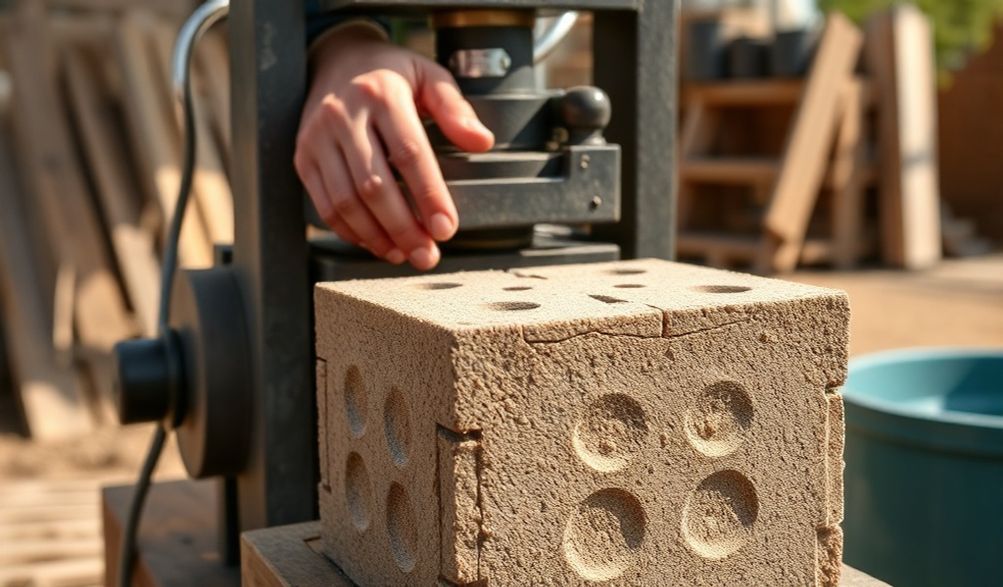
In sua essentia, machina manualis ad lateres coniungendos fabricandos est instrumentum viribus humanis actum, quod mixturam umidae terrae, harenae, et parvae partis caementi in densissimos lateres geometrico nexu coniungendos comprimere destinatur. Hoc ignem fornacem effugit, viam simplicissimam ab cruda terra ad perfectum aedificii elementum praebens.
Munus Praecipuum et Consilium
Machina est elegans studium in commoditate mechanica. Cum formae varient, fundamentales partes constant:
- Machina Vectis:Longum ferreum vectis brachium necessariam vim praebet. Pondus et vis operatoris per hanc simplicem machinam amplificantur ut alta compressio efficiatur.
- Forma/FormaHic est cavus qui massae suam formam dat. Vulgo ex chalybe indurato conficitur ut constantem pressuram et abrasionem sustineat.
- Camerae CompressionisUbi materia cruda mixta oneratur. Piston vel caput pressorium, vecte actum, mixturam ingenti vi verticaliter comprimit.
- Clavis Internexa Conformatio:In forma insertum, hoc linguas et canales seu clavos et cavos insignes laterum summo imoque lateribusque efficit.
Processus cyclicus est: imple, comprime, eice. In usu, peritus artifex laterem intra minorem efficere potest.
Scientia Laterum Internexorum
Hoc systematis ingenium non in compressione solum, sed in nexu consistit. Coniuncta fabrica vinculum mechanicum inter latera efficit.
- Mortarium Abolitio:Exacta et arcta coniunctio opus verticalium commissurarum caementi excludit. Solum tenue stratum caementi horizontale plerumque adhibetur ut ordinem aequatum efficiat.
- Innata Beneficia:Hoc ad celeriores constructionis celeritates ducit (quia caementum non est quod exspectetur), ad minorem dependentiam artificum peritorum, et ad significantes materiae compendia.
- Integritas StructuraeTextus inter se nexilis murum efficit, qui magis ut matrix unita et flexilis fungitur. Observationes campi in zonibus seismicis demonstraverunt, muros bene constructos e lateribus inter se nexis melius resistentiam rimarum praebere posse quam structuram murariam traditam, quia inter se nexus motum levem sine calamitosa ruina sinit.
Praecipuae Utilitates Manualis Preli Latericii
Manualem prelum eligere est consilium prudens cum multis commodis, ab oeconomicis ad oecologicis et libertati.
Summa utilitatis sumptuum.
Causa pecuniaria valida est, praesertim in consiliis mediocris et parvi moduli.
- Exiguum capitale collocatum:Prētiō mōtōriīs vel hydraulīs plantīs plantārium decem mīlium constantibus comparāta, pressiō manus magnae bonitātis minimam initiālem expensam repraesentat.
- Reductio sumptuum materialium radicalis. The primary ingredient—soil—is often available on-site or locally for little to no cost. Cement usage is minimal (typically 5-10% by volume).
- Ongoing Savings: Eliminating vertical mortar saves approximately 30-50% of mortar costs and related labor.
Sustainability and Eco-Friendly Construction
This technology aligns perfectly with green building principles.
- Localized Material Use: Utilizing 70-90% in-situ materials drastically cuts the carbon emissions and cost associated with transporting heavy building materials.
- Humilis Energia Corporata: With no firing process, the energy input is virtually limited to human labor and the small cement fraction. This contrasts sharply with fired bricks, which are major consumers of coal or firewood.
- Non-Toxic & Recyclable: The blocks are made from natural earth and stabilize with cement. At end-of-life, they can be crushed and returned to the earth or re-used as aggregate.
Empowerment and Operational Simplicity
Perhaps the most profound advantage is the shift in control it offers.
- Ex Imperio Productio: You are no longer at the mercy of supplier schedules or market price fluctuations. Blocks can be produced as needed, on-site.
- Low Technical Barrier: Operation can be learned in a matter of hours. Training focuses more on material preparation than complex machinery operation.
- Ideal for Diverse Contexts: This makes it a tool of choice for self-help housing projects, remote community development, disaster reconstruction (as promoted by organizations like UN-Habitat), and small-scale entrepreneurial ventures.
The Step-by-Step Block Production Process
Success with a manual press hinges on process, not just the machine. Here is the proven workflow, drawn from field-tested best practices.
Stage 1: Material Selection and Preparation
This is the most critical phase. Poor materials guarantee poor blocks.
- Terrae Probatio: Not all soil is suitable. You need a balanced mix of clay (as a binder), silt, and sand (for stability). Simple field tests are essential:
- Jar Test: Fill a clear jar with 1/3 soil and 2/3 water, shake vigorously, and let it settle over 24 hours. The layers will reveal the approximate proportions of sand, silt, and clay.
- Ribbon Test: Moisten a handful of soil and try to roll it into a thin ribbon. If it forms a long, flexible ribbon, it’s too clay-rich. If it crumbles immediately, it’s too sandy. A moderate ribbon that breaks is often a good sign.
- Compositio Mixturae: A common starting formula is approximately 70% soil, 25% sand, and 5% cement by volume. The sand corrects clay-heavy soil. Moisture content is crucial: The mix must be damp enough to bind, but not wet. The “hand-squeeze test” is key—a squeezed handful should form a ball that holds its shape without crumbling or dripping water.
Stage 2: Compression and Molding
With your properly prepared mix, you move to the machine.
- Load: Fill the compression chamber evenly with the mix. Do not overfill or underfill; consistency is key for uniform block density.
- Comprime. Pull down the lever arm firmly and steadily. You will feel significant resistance as the mix compacts. Apply full pressure. Some machines require a second “locking” press.
- Eice: Release the lever, open any latches, and pull the lever again to raise the piston and eject the fresh “green” block onto a pallet or board.
Stage 3: Curing and Quality Control
Fresh blocks are fragile and must be handled with care.
- Sanatio: Stack the green blocks in a shaded area and cover them with a plastic sheet. This traps moisture and allows the cement to hydrate slowly, gaining strength. Light watering for the first 7-10 days is beneficial. Avoid rapid drying in direct sun, which causes cracking.
- Qualitatis Moderatio: Perform simple tests:
- Drop Test: After 7 days, lift a block to waist height and drop it onto a firm, flat surface. A good quality block should not break or chip severely.
- Inspectio Visualis: Check for large cracks, crumbling edges, or uneven shapes, which indicate incorrect mix or compression.
Critical Factors Before You Buy or Use One
A balanced, authoritative guide must address practical realities. Informed preparation prevents costly mistakes.
Aestimatio Requisitorum Operis Tui
Interroga te primum haec quaestiones:
- What is my daily block requirement? (A manual press typically produces 80-150 blocks per 8-hour day with a crew).
- What soil types are available on or near my site? (Plan for testing and potential sand purchase).
- Is this for a single home, a community building, or a commercial block-making business? Scale dictates feasibility.
Machine Specifications and Features to Compare
Not all machines are created equal. Scrutinize these aspects:
- Block Size & Design: Common sizes are similar to standard bricks or larger (e.g., 225mm x 110mm x 75mm). Ensure the interlocking pattern is robust.
- Productio Capacitas: Linked to design efficiency. Test the lever mechanics—the action should be smooth and solid.
- Structurae Qualitas: Inspect weld points, steel thickness (especially the mold and lever), and overall finish. A heavier machine often indicates more durable steel.
- Support System: Does the supplier offer spare parts (like wear plates for the mold)? Is there technical support available?
Understanding Limitations and Challenges
Acknowledging these builds trust and sets realistic expectations:
- Labor Intensive: High-volume projects (e.g., a large school) require a significant, organized labor force.
- Soil Dependency: If your local soil is purely organic topsoil or gravel, you may need to import suitable material, affecting cost.
- Celeritas Productionis It cannot match the output of a fully automated electric or hydraulic machine. It is a tool for appropriate-scale projects.
Applications and Project Ideas
The versatility of interlocking blocks opens numerous doors:
- Affordable Housing and Community Projects: This is the primary application. From individual homes to clinics, schools, and community centers, the technology is championed by development organizations globally for its cost-control and community participation potential.
- Landscape and Garden Construction: A perfect pilot project. Build retaining walls, raised garden beds, compost bins, or decorative pathways. It’s a low-risk way to master the process.
- Entrepreneurial Opportunity: Starting a Small Block Yard Business: With one or two machines, you can establish a micro-enterprise, producing and selling blocks to local builders. Focus on consistent quality and educate your market on the benefits.
FAQ Sectio
Q: How strong are interlocking soil blocks compared to fired bricks?
A: Compressive strength typically ranges from 3 to 7 Megapascals (MPa), which is suitable for load-bearing walls in 1-2 story buildings, as per many building codes. While high-quality fired bricks can be stronger, properly made interlocking blocks provide more than adequate strength for most low-rise residential construction. The key is proper material selection and production.
Q: Can I use pure soil from my backyard?
A: Almost certainly not. Backyard topsoil contains organic matter, which decomposes and compromises block strength. You need mineral subsoil, typically found below the top 300mm. A simple jar test will tell you if it needs sand or clay amendment.
Q: Is a foundation different for interlocking blocks?
A: Yes, and getting it right is non-negotiable. The interlocking system begins above a stable, perfectly level base. A standard concrete strip foundation or a mortared rubble trench foundation is used. The first course of blocks is then laid in a full bed of mortar on this “plinth” to create a level starting point for the dry-stack interlocking system.
Q: What is the typical cost range for a good quality manual machine?
A: Prices vary widely by region, quality, and features. As a general guide, expect a range from approximately $500 to $2,000 USD. Be wary of machines at the very bottom end; they may use inferior steel and wear out quickly. Invest in robust construction from a reputable supplier.
Q: Where can I get training on using the machine?
A: Start with your machine supplier; many offer basic training. Look for NGOs or social enterprises working in sustainable construction (e.g., organizations inspired by the Good Earth Trust or Habitat for Humanity’s techniques). Reputable online video tutorials can also provide excellent visual guidance on the process.
Conclusio.
The manual interlocking block making machine is far more than a simple tool; it’s an enabler of affordable, sustainable, and community-empowered construction. It shifts the focus from buying expensive materials to understanding and utilizing local resources intelligently.
Our final expert insight is this: the machine’s success is only 50% dependent on its steel and leverage. The other 50% resides in the operator’s knowledge of material science and disciplined process. The true “technology” is the holistic system of soil, water, cement, compression, and care.
Your clear next step is to move from theory to practice. Begin with a simple jar test on your site’s soil. Reach out to local suppliers to inspect machines firsthand. Connect with others who have used this technology. Consider starting with a small, non-critical project like a garden wall. This hands-on experience is invaluable. Remember, prioritize learning and preparation—your first 100 blocks are a learning process that will pave the way to successful, durable construction.
<