
Повний посібник з ручних машин для виробництва блоків з замком: Вартість, процес та переваги
Вступ
Для будівельників, громадських лідерів та власників житла по всьому світу мрія про доступне та міцне будівництво часто стикається з суворою реальністю: стрімке зростання вартості та екологічна шкода від традиційних матеріалів. Випалені глиняні цеглини вимагають значної кількості енергії, сприяють знелісненню, а їх транспортування може збільшити бюджет проекту до неприйнятних розмірів. Ця проблема особливо гостро стоїть у віддалених районах та для тих, хто має обмежений капітал.
Але що, якщо рішення полягає не лише в іншому продукті, а в іншому процесі — такому, яким ви можете керувати? Заснована на десятиліттях інженерного вдосконалення та практичного застосування в екологічному будівництві, ручна машина для виробництва блоків із замковою системою є саме таким рішенням. Це не гіпотетична технологія; це перевірений ручний прес, який перетворює місцевий ґрунт на міцні будівельні блоки, що з'єднуються між собою.
Цей посібник є вашим всебічним ресурсом. Незалежно від того, чи ви будівельник, який досліджує економічні методи, підприємець, що шукає можливості для малого бізнесу, громадська організація, яка планує соціальний проект, чи відданий ентузіаст, що любить робити все своїми руками, ми розкриємо таємниці цього потужного інструменту. Ми детально розглянемо, як він працює, його конкретні переваги, покроковий процес виробництва та ключові фактори, які варто врахувати перед інвестуванням. Наша мета — надати достовірну та глибоку інформацію, необхідну для прийняття обґрунтованого рішення щодо вашого конкретного проекту та контексту.
Що таке ручна машина для виготовлення блоків з блокуванням?
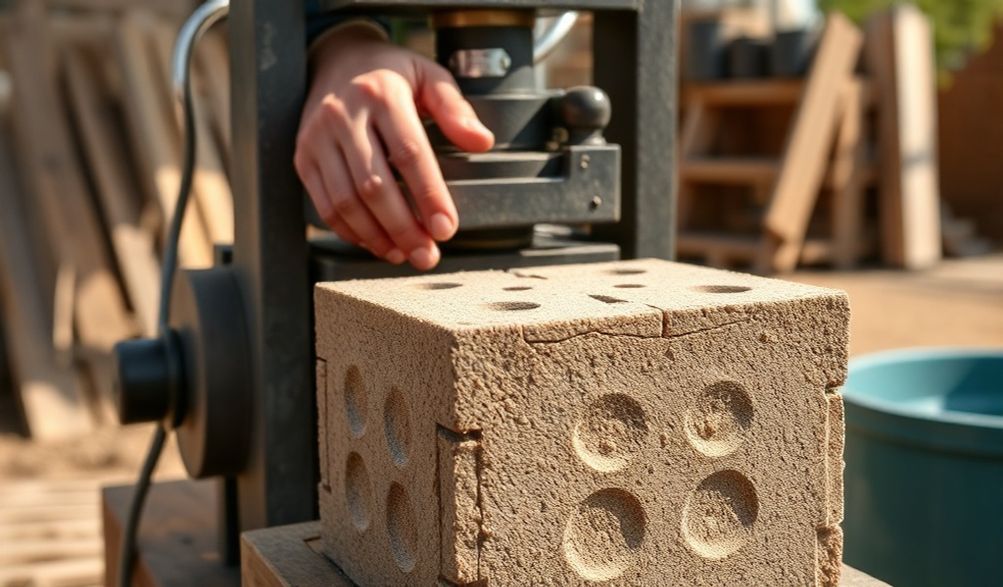
У своїй основі, ручна машина для виробництва блоків із замком — це пристрій з ручним приводом, призначений для ущільнення суміші вологої ґрунту, піску та невеликої частки цементу у високощільні блоки з геометричним замковим з'єднанням. Вона усуває необхідність у випалі в печах, пропонуючи кардинально спрощений шлях від сирої землі до готової будівельної одиниці.
Основна функція та дизайн
Машина є витонченим дослідженням механічної переваги. Хоча конструкції різняться, основні компоненти залишаються незмінними:
- Система важелів:Довге сталеве плече важеля забезпечує необхідну силу. Вага та зусилля оператора посилюються за допомогою цього простого механізму для досягнення високого стиснення.
- Форма/Штамп:Це порожнина, яка надає блоку його форму. Зазвичай її виготовляють із загартованої сталі, щоб витримувати постійний тиск і зношування.
- Камера стиснення:Там, де завантажується суміш сировини. Поршень або пресова головка, що приводиться в дію важілем, ущільнює суміш вертикально з величезною силою.
- Дизайн замка з взаємним блокуванням:Вбудовані в форму, це створює характерні пази та гребені або шипи та заглиблення на верхній, нижній та бічних сторонах блоків.
Процес циклічний: наповнення, пресування, виштовхування. На практиці досвідчений оператор може виготовити блок менш ніж за хвилину.
Наука про блоки, що зчіплюються
Геніальність цієї системи полягає не лише в стисненні, а й у з'єднанні. Взаємозчеплена конструкція створює механічний зв'язок між блоками.
- Ліквідація мінометів:Точне, взаємозчеплене прилягання усуває необхідність у вертикальних швах розчину. Зазвичай використовується лише тонкий горизонтальний шар розчину для забезпечення рівного ряду.
- Вроджені переваги:Це призводить до прискорення темпів будівництва (оскільки не потрібно чекати на затвердіння розчину), зменшення залежності від висококваліфікованих каменярів та значної економії матеріалів.
- Структурна цілісність:Взаємозамкова структура створює стіну, яка діє більше як єдина, гнучка матриця. Польові спостереження в сейсмічних зонах показали, що добре побудовані стіни з блоків, що зчіплюються, можуть демонструвати кращу стійкість до тріщин, ніж звичайна кладка, оскільки зчеплення дозволяє незначне зміщення без катастрофічного руйнування.
Основні переваги використання ручного блочного преса
Вибір ручного преса — це стратегічне рішення з багатогранними перевагами, від економіки до екології та розширення можливостей.
Виняткова економічна ефективність
Фінансовий аргумент є переконливим, особливо для проектів малого та середнього масштабу.
- Низькі капітальні інвестиції:У порівнянні з автоматизованими або гідравлічними установками для виробництва блоків вартістю в десятки тисяч, якісний ручний прес становить мінімальні початкові витрати.
- Радикальне зниження вартості матеріалів:Основний інгредієнт — ґрунт — часто доступний на місці або локально за мінімальну ціну чи безкоштовно. Використання цементу мінімальне (зазвичай 5-10% за об'ємом).
- Ongoing Savings: Eliminating vertical mortar saves approximately 30-50% of mortar costs and related labor.
Sustainability and Eco-Friendly Construction
This technology aligns perfectly with green building principles.
- Localized Material Use: Utilizing 70-90% in-situ materials drastically cuts the carbon emissions and cost associated with transporting heavy building materials.
- Low Embodied Energy: With no firing process, the energy input is virtually limited to human labor and the small cement fraction. This contrasts sharply with fired bricks, which are major consumers of coal or firewood.
- Non-Toxic & Recyclable: The blocks are made from natural earth and stabilize with cement. At end-of-life, they can be crushed and returned to the earth or re-used as aggregate.
Empowerment and Operational Simplicity
Perhaps the most profound advantage is the shift in control it offers.
- Виробництво за запитом: You are no longer at the mercy of supplier schedules or market price fluctuations. Blocks can be produced as needed, on-site.
- Low Technical Barrier: Operation can be learned in a matter of hours. Training focuses more on material preparation than complex machinery operation.
- Ideal for Diverse Contexts: This makes it a tool of choice for self-help housing projects, remote community development, disaster reconstruction (as promoted by organizations like UN-Habitat), and small-scale entrepreneurial ventures.
The Step-by-Step Block Production Process
Success with a manual press hinges on process, not just the machine. Here is the proven workflow, drawn from field-tested best practices.
Stage 1: Material Selection and Preparation
This is the most critical phase. Poor materials guarantee poor blocks.
- Тестування ґрунту: Not all soil is suitable. You need a balanced mix of clay (as a binder), silt, and sand (for stability). Simple field tests are essential:
- Jar Test: Fill a clear jar with 1/3 soil and 2/3 water, shake vigorously, and let it settle over 24 hours. The layers will reveal the approximate proportions of sand, silt, and clay.
- Ribbon Test: Moisten a handful of soil and try to roll it into a thin ribbon. If it forms a long, flexible ribbon, it’s too clay-rich. If it crumbles immediately, it’s too sandy. A moderate ribbon that breaks is often a good sign.
- Mix Design: A common starting formula is approximately 70% soil, 25% sand, and 5% cement by volume. The sand corrects clay-heavy soil. Moisture content is crucial: The mix must be damp enough to bind, but not wet. The “hand-squeeze test” is key—a squeezed handful should form a ball that holds its shape without crumbling or dripping water.
Stage 2: Compression and Molding
With your properly prepared mix, you move to the machine.
- Load: Fill the compression chamber evenly with the mix. Do not overfill or underfill; consistency is key for uniform block density.
- Стиснути: Pull down the lever arm firmly and steadily. You will feel significant resistance as the mix compacts. Apply full pressure. Some machines require a second “locking” press.
- Викинути: Release the lever, open any latches, and pull the lever again to raise the piston and eject the fresh “green” block onto a pallet or board.
Stage 3: Curing and Quality Control
Fresh blocks are fragile and must be handled with care.
- Лікування: Stack the green blocks in a shaded area and cover them with a plastic sheet. This traps moisture and allows the cement to hydrate slowly, gaining strength. Light watering for the first 7-10 days is beneficial. Avoid rapid drying in direct sun, which causes cracking.
- Контроль якості: Perform simple tests:
- Drop Test: After 7 days, lift a block to waist height and drop it onto a firm, flat surface. A good quality block should not break or chip severely.
- Visual Inspection: Check for large cracks, crumbling edges, or uneven shapes, which indicate incorrect mix or compression.
Critical Factors Before You Buy or Use One
A balanced, authoritative guide must address practical realities. Informed preparation prevents costly mistakes.
Оцінка вимог вашого проекту
Ask yourself these questions first:
- What is my daily block requirement? (A manual press typically produces 80-150 blocks per 8-hour day with a crew).
- What soil types are available on or near my site? (Plan for testing and potential sand purchase).
- Is this for a single home, a community building, or a commercial block-making business? Scale dictates feasibility.
Machine Specifications and Features to Compare
Not all machines are created equal. Scrutinize these aspects:
- Block Size & Design: Common sizes are similar to standard bricks or larger (e.g., 225mm x 110mm x 75mm). Ensure the interlocking pattern is robust.
- Виробнича потужність: Linked to design efficiency. Test the lever mechanics—the action should be smooth and solid.
- Якість збірки: Inspect weld points, steel thickness (especially the mold and lever), and overall finish. A heavier machine often indicates more durable steel.
- Support System: Does the supplier offer spare parts (like wear plates for the mold)? Is there technical support available?
Understanding Limitations and Challenges
Acknowledging these builds trust and sets realistic expectations:
- Labor Intensive: High-volume projects (e.g., a large school) require a significant, organized labor force.
- Soil Dependency: If your local soil is purely organic topsoil or gravel, you may need to import suitable material, affecting cost.
- Швидкість виробництва: It cannot match the output of a fully automated electric or hydraulic machine. It is a tool for appropriate-scale projects.
Applications and Project Ideas
The versatility of interlocking blocks opens numerous doors:
- Affordable Housing and Community Projects: This is the primary application. From individual homes to clinics, schools, and community centers, the technology is championed by development organizations globally for its cost-control and community participation potential.
- Landscape and Garden Construction: A perfect pilot project. Build retaining walls, raised garden beds, compost bins, or decorative pathways. It’s a low-risk way to master the process.
- Entrepreneurial Opportunity: Starting a Small Block Yard Business: With one or two machines, you can establish a micro-enterprise, producing and selling blocks to local builders. Focus on consistent quality and educate your market on the benefits.
FAQ Section
Q: How strong are interlocking soil blocks compared to fired bricks?
А: Compressive strength typically ranges from 3 to 7 Megapascals (MPa), which is suitable for load-bearing walls in 1-2 story buildings, as per many building codes. While high-quality fired bricks can be stronger, properly made interlocking blocks provide more than adequate strength for most low-rise residential construction. The key is proper material selection and production.
Q: Can I use pure soil from my backyard?
А: Almost certainly not. Backyard topsoil contains organic matter, which decomposes and compromises block strength. You need mineral subsoil, typically found below the top 300mm. A simple jar test will tell you if it needs sand or clay amendment.
Q: Is a foundation different for interlocking blocks?
А: Yes, and getting it right is non-negotiable. The interlocking system begins above a stable, perfectly level base. A standard concrete strip foundation or a mortared rubble trench foundation is used. The first course of blocks is then laid in a full bed of mortar on this “plinth” to create a level starting point for the dry-stack interlocking system.
Q: What is the typical cost range for a good quality manual machine?
А: Prices vary widely by region, quality, and features. As a general guide, expect a range from approximately $500 to $2,000 USD. Be wary of machines at the very bottom end; they may use inferior steel and wear out quickly. Invest in robust construction from a reputable supplier.
Q: Where can I get training on using the machine?
А: Start with your machine supplier; many offer basic training. Look for NGOs or social enterprises working in sustainable construction (e.g., organizations inspired by the Good Earth Trust or Habitat for Humanity’s techniques). Reputable online video tutorials can also provide excellent visual guidance on the process.
Висновок
The manual interlocking block making machine is far more than a simple tool; it’s an enabler of affordable, sustainable, and community-empowered construction. It shifts the focus from buying expensive materials to understanding and utilizing local resources intelligently.
Our final expert insight is this: the machine’s success is only 50% dependent on its steel and leverage. The other 50% resides in the operator’s knowledge of material science and disciplined process. The true “technology” is the holistic system of soil, water, cement, compression, and care.
Your clear next step is to move from theory to practice. Begin with a simple jar test on your site’s soil. Reach out to local suppliers to inspect machines firsthand. Connect with others who have used this technology. Consider starting with a small, non-critical project like a garden wall. This hands-on experience is invaluable. Remember, prioritize learning and preparation—your first 100 blocks are a learning process that will pave the way to successful, durable construction.
<