
Panduan Lengkap Mesin Pembuat Blok Interlocking Manual: Biaya, Proses, & Manfaat
Pengantar
Bagi para pembangun, pemimpin komunitas, dan pemilik rumah di seluruh dunia, impian akan konstruksi yang terjangkau dan tahan lama sering berbenturan dengan realitas keras: biaya yang melambung tinggi dan dampak lingkungan dari bahan konvensional. Batu bata tanah liat bakar membutuhkan energi yang signifikan, berkontribusi pada deforestasi, dan transportasinya saja dapat menggembungkan anggaran proyek hingga tak terjangkau. Tantangan ini terutama terasa akut di daerah terpencil dan bagi mereka dengan modal terbatas.
Namun bagaimana jika solusinya bukan hanya produk yang berbeda, tetapi proses yang berbeda—yang bisa Anda kendalikan? Berdasarkan penyempurnaan teknik selama puluhan tahun dan penerapan di lapangan dalam konstruksi berkelanjutan, mesin pembuat blok interlock manual mewakili hal itu persis. Ini bukan teknologi spekulatif; melainkan alat press manual yang terbukti, mengubah tanah lokal yang tersedia menjadi blok bangunan kokoh yang saling mengunci.
Panduan ini menjadi sumber daya komprehensif Anda. Baik Anda seorang pembangun yang mengeksplorasi metode penghematan biaya, pengusaha yang mengincar peluang bisnis kecil, LSM yang merencanakan proyek komunitas, atau penggemar DIY yang berdedikasi, kami akan mengungkap alat yang kuat ini. Kami akan membahas secara tepat cara kerjanya, manfaat nyatanya, proses produksi langkah demi langkah yang terperinci, serta faktor-faktor kritis yang perlu dipertimbangkan sebelum berinvestasi. Tujuan kami adalah menyediakan informasi yang tepercaya dan mendalam yang Anda butuhkan untuk membuat keputusan yang tepat untuk proyek dan konteks spesifik Anda.
Apa itu Mesin Pembuat Blok Interlocking Manual?
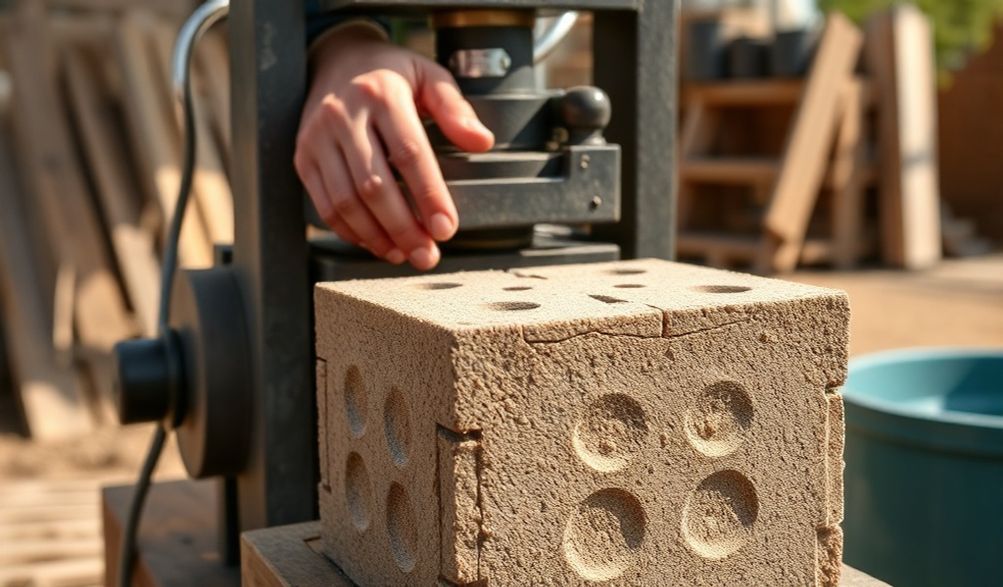
Pada intinya, mesin pembuat blok interlocking manual adalah perangkat bertenaga manusia yang dirancang untuk memadatkan campuran tanah lembap, pasir, dan sedikit semen menjadi blok berdensitas tinggi dengan bentuk geometris yang saling mengunci. Alat ini menghilangkan kebutuhan pembakaran dalam tungku, menawarkan jalur yang sangat disederhanakan dari bahan tanah mentah menjadi unit bangunan jadi.
Fungsi Inti dan Desain
Mesin ini merupakan kajian elegan tentang keunggulan mekanis. Meski desainnya bervariasi, komponen dasarnya tetap konsisten:
- Sistem Pengungkit:Sebuah lengan tuas baja panjang memberikan gaya yang diperlukan. Berat dan gaya operator diperkuat melalui mesin sederhana ini untuk mencapai kompresi tinggi.
- Cetakan/Die:Ini adalah rongga yang memberikan bentuk pada balok. Biasanya terbuat dari baja yang dikeraskan untuk menahan tekanan dan abrasi yang konstan.
- Ruang Kompresi:Tempat campuran bahan baku dimuat. Sebuah piston atau kepala penekan, yang digerakkan oleh tuas, memadatkan campuran secara vertikal dengan gaya yang sangat besar.
- Desain Kunci Saling Mengunci:Terintegrasi ke dalam cetakan, ini menciptakan lidah dan alur atau tonjolan dan rongga khas balok di bagian atas, bawah, dan samping.
Prosesnya bersifat siklik: isi, tekan, keluarkan. Dalam praktiknya, operator yang terampil dapat menghasilkan satu balok dalam waktu kurang dari satu menit.
Ilmu di Balik Balok Penyambung
Kecerdasan sistem ini tidak hanya terletak pada kompresi, tetapi pada koneksi. Desain yang saling mengunci menciptakan ikatan mekanis antar balok.
- Penghapusan Mortir:Pemasangan yang presisi dan saling mengunci menghilangkan kebutuhan akan sambungan mortar vertikal. Hanya lapisan mortar horizontal tipis yang biasanya digunakan untuk memastikan barisan bata tetap rata.
- Manfaat Bawaan:Hal ini menghasilkan kecepatan konstruksi yang lebih cepat (karena tidak perlu menunggu mortar mengering), ketergantungan yang berkurang pada tukang batu yang sangat terampil, dan penghematan material yang signifikan.
- Integritas Struktural:Pola interlocking menciptakan dinding yang lebih berfungsi sebagai matriks fleksibel yang bersatu. Pengamatan lapangan di zona seismik menunjukkan bahwa dinding blok interlocking yang dibangun dengan baik dapat menunjukkan ketahanan retak yang lebih baik dibandingkan pasangan bata konvensional, karena interlocking memungkinkan pergerakan kecil tanpa kegagalan katastropik.
Keuntungan Utama Menggunakan Manual Block Press
Memilih mesin press manual adalah keputusan strategis dengan berbagai manfaat, mulai dari aspek ekonomi hingga ekologi serta pemberdayaan.
Keunggulan Biaya yang Luar Biasa
Kasus finansialnya menarik, terutama untuk proyek skala kecil hingga menengah.
- Investasi Modal Rendah:Dibandingkan dengan pabrik blok bermotor atau hidrolik yang harganya puluhan ribu, mesin press manual berkualitas tinggi mewakili biaya awal yang minimal.
- Pengurangan Biaya Bahan Baku yang Radikal: The primary ingredient—soil—is often available on-site or locally for little to no cost. Cement usage is minimal (typically 5-10% by volume).
- Ongoing Savings: Eliminating vertical mortar saves approximately 30-50% of mortar costs and related labor.
Sustainability and Eco-Friendly Construction
This technology aligns perfectly with green building principles.
- Localized Material Use: Utilizing 70-90% in-situ materials drastically cuts the carbon emissions and cost associated with transporting heavy building materials.
- Energi Terwujud Rendah: With no firing process, the energy input is virtually limited to human labor and the small cement fraction. This contrasts sharply with fired bricks, which are major consumers of coal or firewood.
- Non-Toxic & Recyclable: The blocks are made from natural earth and stabilize with cement. At end-of-life, they can be crushed and returned to the earth or re-used as aggregate.
Empowerment and Operational Simplicity
Perhaps the most profound advantage is the shift in control it offers.
- Produksi Atas Permintaan: You are no longer at the mercy of supplier schedules or market price fluctuations. Blocks can be produced as needed, on-site.
- Low Technical Barrier: Operation can be learned in a matter of hours. Training focuses more on material preparation than complex machinery operation.
- Ideal for Diverse Contexts: This makes it a tool of choice for self-help housing projects, remote community development, disaster reconstruction (as promoted by organizations like UN-Habitat), and small-scale entrepreneurial ventures.
The Step-by-Step Block Production Process
Success with a manual press hinges on process, not just the machine. Here is the proven workflow, drawn from field-tested best practices.
Stage 1: Material Selection and Preparation
This is the most critical phase. Poor materials guarantee poor blocks.
- Pengujian Tanah: Not all soil is suitable. You need a balanced mix of clay (as a binder), silt, and sand (for stability). Simple field tests are essential:
- Jar Test: Fill a clear jar with 1/3 soil and 2/3 water, shake vigorously, and let it settle over 24 hours. The layers will reveal the approximate proportions of sand, silt, and clay.
- Ribbon Test: Moisten a handful of soil and try to roll it into a thin ribbon. If it forms a long, flexible ribbon, it’s too clay-rich. If it crumbles immediately, it’s too sandy. A moderate ribbon that breaks is often a good sign.
- Desain Campuran: A common starting formula is approximately 70% soil, 25% sand, and 5% cement by volume. The sand corrects clay-heavy soil. Moisture content is crucial: The mix must be damp enough to bind, but not wet. The “hand-squeeze test” is key—a squeezed handful should form a ball that holds its shape without crumbling or dripping water.
Stage 2: Compression and Molding
With your properly prepared mix, you move to the machine.
- Load: Fill the compression chamber evenly with the mix. Do not overfill or underfill; consistency is key for uniform block density.
- Kompres: Pull down the lever arm firmly and steadily. You will feel significant resistance as the mix compacts. Apply full pressure. Some machines require a second “locking” press.
- Keluarkan: Release the lever, open any latches, and pull the lever again to raise the piston and eject the fresh “green” block onto a pallet or board.
Stage 3: Curing and Quality Control
Fresh blocks are fragile and must be handled with care.
- Menyembuhkan: Stack the green blocks in a shaded area and cover them with a plastic sheet. This traps moisture and allows the cement to hydrate slowly, gaining strength. Light watering for the first 7-10 days is beneficial. Avoid rapid drying in direct sun, which causes cracking.
- Kontrol Kualitas: Perform simple tests:
- Drop Test: After 7 days, lift a block to waist height and drop it onto a firm, flat surface. A good quality block should not break or chip severely.
- Visual Inspection: Check for large cracks, crumbling edges, or uneven shapes, which indicate incorrect mix or compression.
Critical Factors Before You Buy or Use One
A balanced, authoritative guide must address practical realities. Informed preparation prevents costly mistakes.
Menilai Persyaratan Proyek Anda
Ask yourself these questions first:
- What is my daily block requirement? (A manual press typically produces 80-150 blocks per 8-hour day with a crew).
- What soil types are available on or near my site? (Plan for testing and potential sand purchase).
- Is this for a single home, a community building, or a commercial block-making business? Scale dictates feasibility.
Machine Specifications and Features to Compare
Not all machines are created equal. Scrutinize these aspects:
- Block Size & Design: Common sizes are similar to standard bricks or larger (e.g., 225mm x 110mm x 75mm). Ensure the interlocking pattern is robust.
- Kapasitas Produksi: Linked to design efficiency. Test the lever mechanics—the action should be smooth and solid.
- Kualitas Pembuatan: Inspect weld points, steel thickness (especially the mold and lever), and overall finish. A heavier machine often indicates more durable steel.
- Support System: Does the supplier offer spare parts (like wear plates for the mold)? Is there technical support available?
Understanding Limitations and Challenges
Acknowledging these builds trust and sets realistic expectations:
- Labor Intensive: High-volume projects (e.g., a large school) require a significant, organized labor force.
- Soil Dependency: If your local soil is purely organic topsoil or gravel, you may need to import suitable material, affecting cost.
- Kecepatan Produksi: It cannot match the output of a fully automated electric or hydraulic machine. It is a tool for appropriate-scale projects.
Applications and Project Ideas
The versatility of interlocking blocks opens numerous doors:
- Affordable Housing and Community Projects: This is the primary application. From individual homes to clinics, schools, and community centers, the technology is championed by development organizations globally for its cost-control and community participation potential.
- Landscape and Garden Construction: A perfect pilot project. Build retaining walls, raised garden beds, compost bins, or decorative pathways. It’s a low-risk way to master the process.
- Entrepreneurial Opportunity: Starting a Small Block Yard Business: With one or two machines, you can establish a micro-enterprise, producing and selling blocks to local builders. Focus on consistent quality and educate your market on the benefits.
Bagian FAQ
Q: How strong are interlocking soil blocks compared to fired bricks?
A: Compressive strength typically ranges from 3 to 7 Megapascals (MPa), which is suitable for load-bearing walls in 1-2 story buildings, as per many building codes. While high-quality fired bricks can be stronger, properly made interlocking blocks provide more than adequate strength for most low-rise residential construction. The key is proper material selection and production.
Q: Can I use pure soil from my backyard?
A: Almost certainly not. Backyard topsoil contains organic matter, which decomposes and compromises block strength. You need mineral subsoil, typically found below the top 300mm. A simple jar test will tell you if it needs sand or clay amendment.
Q: Is a foundation different for interlocking blocks?
A: Yes, and getting it right is non-negotiable. The interlocking system begins above a stable, perfectly level base. A standard concrete strip foundation or a mortared rubble trench foundation is used. The first course of blocks is then laid in a full bed of mortar on this “plinth” to create a level starting point for the dry-stack interlocking system.
Q: What is the typical cost range for a good quality manual machine?
A: Prices vary widely by region, quality, and features. As a general guide, expect a range from approximately $500 to $2,000 USD. Be wary of machines at the very bottom end; they may use inferior steel and wear out quickly. Invest in robust construction from a reputable supplier.
Q: Where can I get training on using the machine?
A: Start with your machine supplier; many offer basic training. Look for NGOs or social enterprises working in sustainable construction (e.g., organizations inspired by the Good Earth Trust or Habitat for Humanity’s techniques). Reputable online video tutorials can also provide excellent visual guidance on the process.
Kesimpulan
The manual interlocking block making machine is far more than a simple tool; it’s an enabler of affordable, sustainable, and community-empowered construction. It shifts the focus from buying expensive materials to understanding and utilizing local resources intelligently.
Our final expert insight is this: the machine’s success is only 50% dependent on its steel and leverage. The other 50% resides in the operator’s knowledge of material science and disciplined process. The true “technology” is the holistic system of soil, water, cement, compression, and care.
Your clear next step is to move from theory to practice. Begin with a simple jar test on your site’s soil. Reach out to local suppliers to inspect machines firsthand. Connect with others who have used this technology. Consider starting with a small, non-critical project like a garden wall. This hands-on experience is invaluable. Remember, prioritize learning and preparation—your first 100 blocks are a learning process that will pave the way to successful, durable construction.
<