
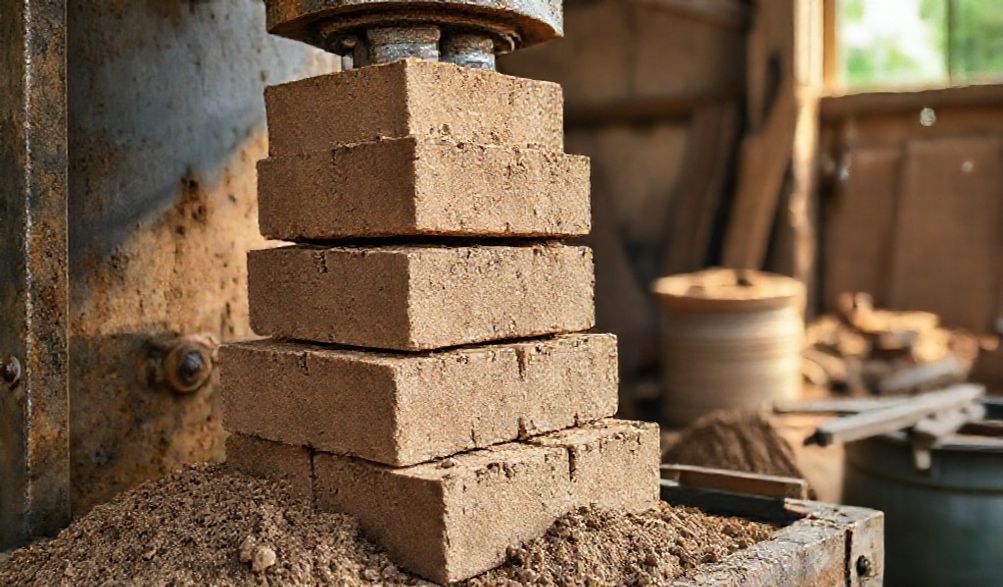
O Guia Definitivo para Máquinas de Fabricação de Tijolos de Solo: Construa de Forma Sustentável e Economize Custos
Imagine construir edifícios duráveis e ecológicos usando a própria terra sob seus pés. Isso não é um retorno a métodos primitivos, mas um salto para um futuro mais inteligente e responsável. Por milênios, civilizações, dos romanos ao Vale do Indo, construíram estruturas duradouras com solo. Hoje, a modernamáquinas para fabricação de tijolos de solotransformar essa sabedoria ancestral em uma solução escalável, acessível e eficiente para construtores, desenvolvedores, agricultores e eco-empreendedores modernos.
Seja seu objetivo reduzir os custos de materiais de construção em até 50%, embarcar em um projeto de construção verdadeiramente sustentável ou iniciar um negócio viável de manufatura em pequena escala, dominar esta tecnologia é o primeiro passo crucial. Este guia foi projetado para ser seu recurso abrangente. Sintetizamos décadas de princípios de engenharia, experiência prática de campo com várias máquinas e as melhores práticas comprovadas do setor para fornecer informações confiáveis e acionáveis. Vamos além do exagero e das alegações de marketing para oferecer a você um entendimento claro e confiante.
Aqui está o que abordaremos: como funcionam essas máquinas inovadoras, seus benefícios convincentes, os diferentes tipos disponíveis para atender à sua escala, os fatores críticos para escolher o modelo certo e um passo a passo realista de todo o processo operacional, desde o solo até a parede finalizada.
O que é uma Máquina de Fabricar Tijolos de Solo e Como Funciona?
Em sua essência, uma máquina de fazer tijolos de solo é uma ferramenta de empoderamento. Ela permite que você transforme um recurso localmente disponível — o solo — em um material de construção padronizado e de alta qualidade.
Definição Central
Uma máquina de fabricar tijolos de solo é um dispositivo projetado para comprimir uma mistura específica de solo (geralmente subsolo), uma pequena porcentagem de um estabilizante como cimento ou cal, e água em tijolos ou blocos uniformes de alta densidade. O diferencial principal em relação à fabricação tradicional de tijolos é que esses tijolos adquirem sua resistência através da compactação e estabilização química.nãoatravés da queima em um forno de alta intensidade energética. Os produtos resultantes são conhecidos como Blocos de Terra Comprimida Estabilizada (BTCs) ou Blocos de Solo Estabilizado.
A Ciência da Estabilização
Por que adicionar cimento ou cal? Esta é a engenharia por trás da simplicidade. O solo sozinho, quando compactado, tem coesão, mas pode erodir com a água e perder resistência. Um estabilizador (geralmente 5-10% de cimento Portland ou 5-15% de cal) age como um agente ligante.
- Ele liga quimicamente as partículas do solo.
- Ela reduz drasticamente a suscetibilidade do tijolo a danos causados pela água.
- Ele fornece resistência à compressão consistente e confiável que atende ou supera muitos materiais de construção convencionais.
Este processo de estabilização é o que torna os tijolos suficientemente duráveis para estruturas permanentes e de suporte de carga em diversos climas.
O Processo Mecânico – Passo a Passo
A operação, independentemente do tipo de máquina, segue uma sequência lógica de quatro etapas:
-
Preparação de Materiais:A base de um bom tijolo. O solo é primeiro peneirado para remover pedras, raízes e matéria orgânica. Em seguida, é misturado com a porcentagem exata de estabilizador e água suficiente para atingir o teor de umidade ideal — geralmente úmido, não encharcado. A homogeneidade é fundamental.
-
Compactação:É aqui que a máquina faz sua mágica. A mistura preparada é alimentada em uma câmara de molde de aço. Um êmbolo ou pistão então aplica uma pressão imensa — frequentemente medida em toneladas — para comprimir a mistura. Essa compactação de alta pressão elimina bolsas de ar e alinha as partículas, criando uma matriz densa e resistente.
-
Ejeção:Uma vez comprimido, o tijolo recém-formado é ejetado do molde para uma palete ou para o chão. Com máquinas manuais, isso envolve levantar uma alavanca; com máquinas automáticas, é uma parte contínua do ciclo.
-
Cura:A fase mais paciente, porém vital. Os tijolos são cuidadosamente empilhados, mantidos úmidos (geralmente cobrindo-os com lona plástica) e deixados para curar por um período, tipicamente 28 dias para estabilização com cimento. Durante a cura, o estabilizante hidrata-se e adere completamente, permitindo que o tijolo atinja sua resistência projetada.
Principais Benefícios do Uso de uma Máquina de Tijolos de Solo
A adoção da tecnologia de tijolo de solo não se trata apenas de fabricar tijolos; trata-se de adotar um sistema com vantagens multifacetadas.
Custo-Eficiência Excepcional
O argumento econômico é poderoso. Seu principal material-prima — o solo — geralmente está disponível no local ou próximo, a um custo mínimo. Em comparação com tijolos de argila queimada ou blocos de concreto, você elimina os enormes custos de energia da queima em fornos e reduz a necessidade de materiais transportados.
- Redução do Custo de Materiais:Até 50-60% de economia em materiais de vedação são comuns.
- Baixo Custo Operacional: Machines, especially manual ones, have minimal energy requirements.
- High-Profit Potential: For entrepreneurs, the low input cost versus the market value of finished bricks creates an attractive business model.
Champion of Sustainability
This is where soil bricks truly shine, offering one of the lowest carbon footprints of any building material.
- Local & Natural: Utilizes locally sourced soil, drastically reducing transportation emissions.
- Baixa Energia Incorporada: No high-temperature firing required.
- Minimal Waste: Production waste is near zero, and bricks are often biodegradable or reusable.
- Building Performance: Soil bricks have excellent thermal mass, naturally regulating indoor temperature by absorbing heat during the day and releasing it at night, reducing heating and cooling energy needs.
Durability and Performance
Don’t mistake “earth” for “weak.” Properly made CSEBs are robust construction materials.
- Alta Resistência à Compressão: Ranging from 5 to 10+ MPa, they are more than adequate for multi-story, load-bearing walls.
- Excelente Resistência ao Fogo: They are inherently non-combustible, offering superior fire safety.
- Moisture Buffering: They naturally absorb and release ambient humidity, contributing to healthier indoor air quality.
- Estabilidade Dimensional: Precision machines produce uniform blocks that simplify and speed up construction.
Empowerment and Accessibility
The technology democratizes construction. It enables decentralized production, reducing dependency on large, centralized factories and long supply chains.
- Community Projects: Ideal for NGO-led housing, school, or clinic constructions.
- Local Entrepreneurship: Empowers individuals to start small manufacturing businesses.
- Self-Reliance: Allows landowners to build their own homes using resources from their own land.
Types of Soil Brick Making Machines: Choosing Your Workhorse
Selecting the right machine is pivotal. Your choice should be dictated by your project scale, budget, and labor availability.
Manual Press Machines (e.g., Cinva Ram style)
The entry point into the world of soil brick making.
- Melhor Para: Individual homeowners, small-scale DIY projects, NGOs with community labor, training workshops, and ultra-low-budget startups.
- Prós:
- Investimento inicial muito baixo.
- No electricity required—fully human-powered.
- Highly portable and simple to maintain.
- Rugged and long-lasting with minimal moving parts.
- Contras:
- Labor-intensive; output depends heavily on operator stamina.
- Low production rate (typically 100-300 bricks per day).
- Brick quality can vary slightly with operator consistency.
Semi-Automatic / Electric Machines
The sweet spot for small to medium enterprises and dedicated construction projects.
- Melhor Para: Small brick-making businesses, medium-sized housing developments, farm building projects, and higher-volume production needs.
- Prós:
- Excellent balance between output, cost, and automation.
- Significantly reduces physical labor compared to manual presses.
- Produces highly consistent, quality bricks due to mechanical compression.
- Higher output (can range from 500 to 2,000+ bricks per day).
- Contras:
- Requires a reliable electricity connection or generator.
- Higher upfront cost than manual presses.
- More complex components require basic technical maintenance.
Fully Automatic Hydraulic Machines
The industrial-grade solution for maximum output.
- Melhor Para: Large-scale commercial brick production yards, industrial operations, and municipal projects requiring very high volumes.
- Prós:
- Very high, consistent output (thousands of bricks per day).
- Superior brick density and uniformity.
- Minimal manual labor required—often just feeding material and stacking bricks.
- Can integrate with automated mixers and conveyors.
- Contras:
- Alto investimento de capital.
- Requires robust, three-phase power supply.
- Complex machinery necessitates more sophisticated maintenance and technical support.
Mobile vs. Stationary Units
An additional consideration is mobility. Trailer-mounted machines are fantastic for on-site production, eliminating brick transportation costs entirely for large builds. Stationary units are for fixed factory or yard setups, optimized for continuous production in one location.
Fatores Críticos a Considerar Antes de Comprar
Avoid costly mistakes by carefully evaluating these key areas before purchasing.
Soil Suitability Analysis
This is the non-negotiable first step. Not all soil is suitable. The ideal soil is a “loam” with a balanced mix of clay (15-30%), silt, and sand.
- Simple Field Test (The Jar Test): Fill a clear jar 1/3 with soil, add water, shake vigorously, and let it settle for 24 hours. The layers will show the approximate proportions of sand, silt, and clay.
- Professional Testing: For large projects, a lab test for particle size distribution and stabilizer compatibility is a wise investment.
Capacidade de Produção e Produção
Be realistic. Match the machine’s practical, sustained output (not the peak theoretical number) to your daily brick requirements. Consider curing space and stacking labor, which can become bottlenecks faster than the machine’s speed.
Brick Size and Design Flexibility
- Tamanhos Padrão: Most machines offer molds for common sizes (e.g., 230x110x75 mm).
- Designs Entrelaçados: Many machines produce specially shaped bricks that lock together without mortar, speeding up construction and saving material.
- Moldes Personalizados: Check if the supplier can provide custom molds for unique architectural features.
Build Quality and After-Sales Support
The machine is a long-term asset. Inspect:
* Construção da Estrutura: Heavy-duty steel is essential for withstanding constant pressure.
* Qualidade do Molde: Hardened steel molds resist wear and ensure dimensional accuracy.
* Support: Does the supplier offer installation guidance, manuals, training videos, and—critically—access to spare parts?
Custo Total de Propriedade
Look beyond the machine’s price tag. Your full startup budget should include:
* Soil screening and mixing equipment.
* Pallets or boards for curing.
* Space for drying and storage.
* Labor costs.
* A contingency fund for maintenance and spare parts.
The Operational Workflow: From Soil to Finished Wall
Understanding the end-to-end process ensures smooth operations.
Phase 1: Site and Material Preparation
Success is built here. Source soil from beneath the topsoil layer. Conduct your soil test, then establish the correct stabilizer ratio through small test batches. Use a mechanical mixer (pan, rotary, or concrete mixer) to achieve a perfectly uniform blend. Consistency in the mix is consistency in the brick.
Phase 2: Brick Production & Quality Control
During production, maintain a steady workflow. Operate the machine according to its manual—consistent fill volume and pressure are key. Implement simple quality control:
* Periodically weigh a brick.
* Measure its dimensions.
* Perform a simple drop test (a well-made brick shouldn’t break when dropped from waist height onto a hard surface).
* Stack bricks neatly on pallets for easy moving to the curing area.
Phase 3: Curing and Construction
Curing is not drying. Bricks must be kept moist for the stabilizer to react fully. Spray them with water and cover with plastic for 14-28 days. When building:
* Use a strong, damp-proof course or plinth.
* Use a mortar compatible with the bricks (often a soil-cement slurry).
* Protect finished walls with a good overhanging roof and, if desired, a breathable plaster.
Perguntas Frequentes (FAQ)
Q: What is the typical compressive strength of a soil-cement brick?
A: With suitable soil and 5-10% cement content, compressive strengths of 5 to 10 MPa (approximately 700 to 1500 psi) are standard. This exceeds the strength of many traditional fired clay bricks and is perfectly suitable for constructing 2-3 story load-bearing buildings.
Q: Can I use pure soil without any stabilizer?
A: For durable, weather-resistant structural bricks in most climates, a stabilizer is essential. Unstabilized earth bricks (like adobe) are possible but require very arid climates and thick, protective plasters to survive rain. Stabilization is the key to modern, reliable earth construction.
Q: How does the cost compare to traditional clay bricks or concrete blocks?
A: Material costs are typically 30-50% lower. The total project savings depend on labor, scale, and local prices for conventional materials. The return on investment for the machine itself can be very quick for a production business, often within a few projects.
Q: Are buildings made with these bricks safe and legal?
A: Absolutely. Stabilized Soil Blocks are recognized in the building codes of many countries, including India, Kenya, and others. For any structural project, it is imperative to check your local building regulations and have plans approved by a qualified structural engineer familiar with earth construction.
Q: What is the maintenance like for the machine?
A: Maintenance is generally straightforward. It involves regular cleaning to prevent material buildup, lubrication of all moving parts, and periodic inspection of wear items like mold liners, piston seals, and, for hydraulic machines, fluid levels and hoses. Manual presses require almost no maintenance beyond keeping them clean and rust-free.
Conclusão
Soil brick making machines represent more than just a piece of equipment; they represent a paradigm shift towards economical, sustainable, and resilient construction. They empower you to transform the abundant resource underfoot into high-quality, durable building blocks.
Your path to success is clear: begin by understanding your soil, precisely define the scale and needs of your project, and then carefully match those needs to the appropriate type of machine. Let your requirements drive the decision, not just the initial price tag.
Embracing this technology is a step toward creating buildings that are not only cost-effective but also have a low environmental impact and promote local self-reliance. Ready to explore further? Your next step is to conduct a simple soil test on your site and begin researching reputable machine suppliers with strong testimonials and support. The foundation for your next project could literally come from the ground you stand on.
<