
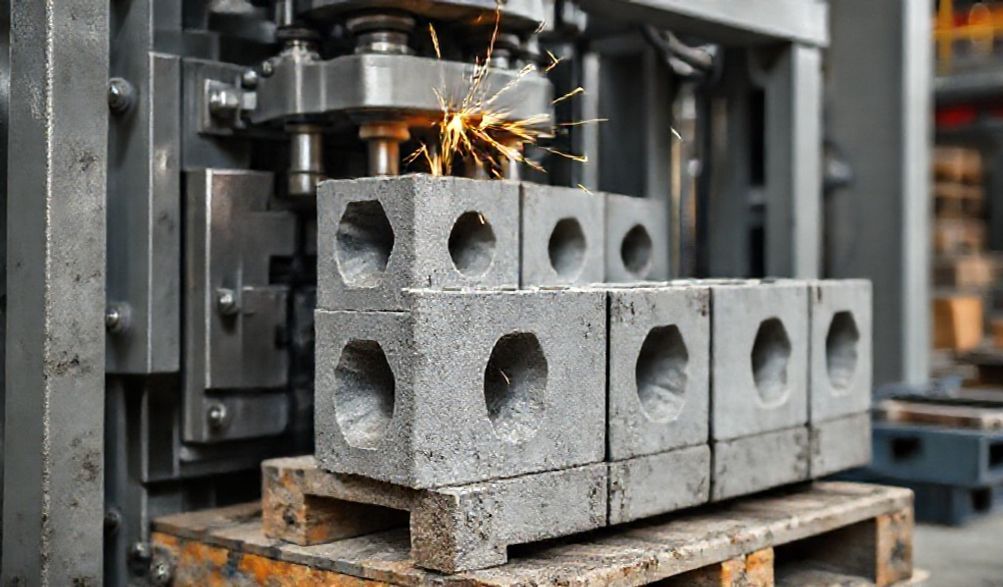
Hướng Dẫn Toàn Diện Về Máy Sản Xuất Gạch Bê Tông Rỗng: Lựa Chọn, Vận Hành & Chi Phí
Giới thiệu
Ngành xây dựng toàn cầu đang chạy đua không ngừng để cân bằng giữa chi phí, tốc độ và độ bền vững. Trọng tâm của thách thức này nằm ở một nhu cầu cơ bản: vật liệu xây dựng giá cả phải chăng và đáng tin cậy. Đó là lúc khối bê tông rỗng khiêm tốn xuất hiện—một nền tảng của công trình xây gạch hiện đại, mang lại độ bền chắc, hiệu quả nhiệt và tiết kiệm vật liệu. Nhưng đằng sau mỗi khối chất lượng cao và đồng đều là một cỗ máy được thiết kế cho độ chính xác và năng suất. Đối với các nhà xây dựng, nhà thầu và doanh nhân, việc lựa chọn đúng máy sản xuất khối bê tông rỗng không chỉ là một giao dịch mua bán; đó là một khoản đầu tư then chốt cho tương lai các dự án hoặc doanh nghiệp của bạn.
Hướng dẫn toàn diện này được xây dựng từ nền tảng để trở thành nguồn tài nguyên đáng tin cậy của bạn. Chúng tôi đã tổng hợp các thông số kỹ thuật ngành, nguyên lý cốt lõi của cơ khí chế tạo, và những phương pháp vận hành tối ưu đúc kết từ thực tiễn, nhằm loại bỏ những thông tin quảng cáo gây nhiễu. Các phân tích ở đây được rút ra từ thông số thiết kế máy móc trong thực tế, nghiên cứu điển hình dây chuyền sản xuất, và quy trình bảo trì đã định hình nên thành công trong sản xuất xây dựng.
Mục đích của chúng tôi rất rõ ràng: trang bị cho bạn một khuôn khổ toàn diện, đáng tin cậy để hiểu, lựa chọn và vận hành máy sản xuất gạch bê tông rỗng. Dù bạn đang đánh giá một dự án quy mô nhỏ hay mở rộng một nhà máy lớn, hướng dẫn này sẽ giúp đảm bảo khoản đầu tư của bạn được thông suốt, quy trình sản xuất hiệu quả và kết quả đạt được mang lại lợi nhuận.
Chúng ta sẽ tìm hiểu về:
* Cơ chế cơ bản và lợi ích của việc sản xuất gạch block rỗng.
* Phân tích chi tiết các loại máy móc—từ máy thủ công đến máy tự động hoàn toàn.
* Các tính năng quan trọng cần xem xét kỹ trước khi mua.
* Các biện pháp thực hành tốt nhất về vận hành và bảo trì để tối đa hóa tuổi thọ máy móc.
* Một phân tích chi phí và lợi tức đầu tư minh bạch để củng cố kế hoạch kinh doanh của bạn.
Máy làm gạch block rỗng bê tông
Trước khi đi sâu vào thông số kỹ thuật và nhà cung cấp, điều quan trọng là phải hiểu những máy móc này làm gì và tại sao sản phẩm của chúng lại có giá trị lớn trong xây dựng hiện đại.
Máy sản xuất gạch rỗng bê tông là gì?
Máy sản xuất gạch ống bê tông là một hệ thống cơ giới hóa được thiết kế để tự động hóa quá trình đúc bê tông thành các khối rỗng tiêu chuẩn. Nó thay thế các phương pháp thủ công không đồng nhất và tốn nhiều lao động bằng quy trình đảm bảo tính đồng nhất, mật độ và độ bền kết cấu thông qua rung động và áp lực được kiểm soát.
Quy trình sản xuất cốt lõi thường tuân theo các giai đoạn sau:
1. Cho ăn: Raw materials (cement, sand, aggregates) are loaded into a hopper.
2. Pha trộn: Materials are blended with water to achieve a homogeneous, semi-dry concrete mix.
3. Đúc khuôn The mix is fed into a mold cavity on a vibrating table.
4. Nén chặt: High-frequency vibration, often combined with hydraulic or mechanical pressure, removes air pockets and densely compacts the concrete.
5. Đẩy & Đóng rắn: The newly formed block is ejected onto a pallet or the ground to begin the critical curing process, where it gains strength.
Why Hollow Blocks? Advantages in Modern Construction
The design of hollow blocks isn’t arbitrary; it delivers tangible engineering and economic benefits that drive their popularity in load-bearing masonry and infill walls.
- Material Efficiency & Cost-Effectiveness: The hollow cores reduce the volume of concrete required per block, lowering material costs and the overall dead load on a structure.
- Cách nhiệt và cách âm: The air pockets within the blocks create natural barriers to heat and sound, contributing to energy-efficient and quieter buildings.
- Hiệu Suất Xây Dựng The voids provide convenient channels for running electrical conduits, plumbing pipes, and reinforcement bars, significantly speeding up the construction process.
- Giảm tải trọng kết cấu: Their lighter weight compared to solid blocks allows for lighter, more economical foundation designs.
Các Thành Phần Cốt Lõi và Cách Chúng Hoạt Động
Understanding the key components demystifies the machine and aids in troubleshooting and purchasing decisions.
- Hộp chứa & Cơ cấu cấp liệu: The entry point for raw materials, often equipped with a measuring system for consistent batch sizes.
- Máy trộn: Blends cement, aggregates, and water to the precise consistency required for optimal compaction.
- Khuôn (hoặc Khuôn mẫu): The heart of the machine. This interchangeable steel box defines the block’s size and shape (e.g., 4″, 6″, 8″ blocks). Its quality dictates block finish and longevity.
- Vibrating Table & Press: A motor generates high-frequency vibration transmitted to the mold. In more advanced machines, a hydraulic press applies simultaneous downward pressure. This synergy is critical for achieving high-density, strong blocks.
- Hệ Thống Điều Khiển: Ranges from simple lever-operated mechanisms to programmable logic controllers (PLCs) that automate the entire cycle, ensuring repeatability.
- Máy cấp/Băng tải Pallet Supplies pallets for the blocks to be cured on (stationary plants) or moves blocks away from the machine.
Types of Concrete Hollow Block Making Machines
The market offers solutions for every scale of operation. Your choice fundamentally impacts your production capacity, labor needs, and capital investment.
Máy Thủ Công vs. Máy Bán Tự Động vs. Máy Tự Động Hoàn Toàn
| Tính năng | Máy Thủ Công | Máy Bán Tự Động | Máy Tự Động Hoàn Toàn |
| :— | :— | :— | :— |
| Năng lực sản xuất | Low (200-500 blocks/day) | Medium (1000-3000 blocks/8hr shift) | High (5000-20,000+ blocks/8hr shift) |
| Yêu cầu lao động | High (4-6 people) | Moderate (2-3 people) | Low (1-2 people for monitoring) |
| Đầu tư ban đầu | Low | Medium | High |
| Automation Level | Human-powered operation, manual mixing. | Mechanized vibration and compaction; manual material feeding and block removal. | Fully automated cycle from feeding to block stacking; PLC-controlled. |
| Ideal Use Case | Very small projects, remote sites with no power. | Small-to-medium businesses, startups, block yards. | Large-scale block manufacturing plants, high-volume infrastructure projects. |
Hướng dẫn A startup or small contractor might begin with a robust semi-automatic model to balance cost and output. A large developer or dedicated block supplier would prioritize the productivity and consistency of a fully automatic plant setup.
Máy Sản Xuất Gạch Block Cố Định
These are the workhorses of fixed-location block manufacturing plants.
- Mô tả: Heavy-duty, high-output machines installed on a solid concrete foundation. They produce blocks on pallets, which are then moved to curing racks or chambers via forklift or conveyor systems.
- Ưu điểm:
- Highest production output and consistency.
- Superior block density and finish due to powerful, stable vibratory presshệ thống.
- Can be integrated into automated production lines.
- Nhược điểm:
- Requires significant space for the machine, curing area, and storage.
- Higher initial capital investment.
- Requires pallets, which add to operational cost and logistics.
Mobile Block Making Machines (Egg-Laying Type)
These machines bring production directly to the job site.
- Mô tả: As the machine operates, it moves forward on rails or wheels, depositing (“laying”) freshly molded blocks directly onto a level ground surface, much like a chicken laying eggs.
- Ưu điểm:
- Eliminates the need for pallets, reducing a major cost component.
- Ideal for on-site production, cutting transport costs for blocks.
- Generally lower initial purchase price than stationary plants.
- Nhược điểm:
- More labor-intensive for block handling and ground preparation.
- Production output is typically lower and more weather-dependent.
- Block quality can be more variable due to less controlled curing conditions.
Key Features to Consider When Buying
Looking beyond the basic type, these features will determine your long-term satisfaction and profitability.
Công Suất Sản Xuất (Khối Mỗi Giờ)
Don’t just look at the peak “blocks per hour” rating. Assess the sustainable 8-hour shift output. Calculate your required capacity based on:
* Project Demand: Average blocks needed per day/week for your contracts.
* Business Plan: Sales targets for a block manufacturing business.
* Future Growth: Consider a machine with 20-30% extra capacity to handle growth without immediate reinvestment.
Block Size and Mold Customization
- Kích Thước Tiêu Chuẩn: Ensure the machine can produce the most in-demand sizes in your market (e.g., 4″, 6″, 8″ thick blocks).
- Khuôn có thể thay thế lẫn nhau: The ability to quickly swap molds is essential for product diversification. Check the cost and availability of additional molds for pavers, curbstones, or solid blocks.
- Chất Lượng Khuôn Opt for hardened steel molds. They resist wear longer, ensuring consistent block dimensions and a smooth finish over thousands of cycles.
Power Source: Electric, Diesel, or Hybrid?
- Điện: Cleaner, quieter, and lower operating cost per hour. Requires a stable, high-capacity power grid.
- Đi-ê-zen Offers complete independence from the grid, crucial for remote sites or regions with frequent power cuts. Higher fuel and maintenance costs.
- Lai tạo: Offers flexibility to switch between power sources, providing a valuable backup but at a higher purchase price.
Mức độ tự động hóa và hệ thống điều khiển
Higher automation directly impacts:
* Tính nhất quán PLC systems ensure every block receives identical vibration and pressure.
* Waste Reduction: Precise material measurement minimizes spillage and rejects.
* Labor Skill Requirement: A fully automatic machine reduces physical labor but requires basic technical skills for monitoring and troubleshooting.
Machine Durability and After-Sales Support
This is the most critical factor for đáng tin cậy in your investment.
- Chất Lượng Xây Dựng: Inspect the frame and critical components. Are they made from heavy-duty, reinforced steel? Thin-gauge steel will flex and wear quickly.
- Bảo hành: A reputable supplier will offer a clear, comprehensive warranty (e.g., 1 year on the machine, 6 months on wear parts).
- Hỗ trợ sau bán hàng: This is non-negotiable. Verify:
- Availability of spare parts locally or via fast shipping.
- Provision of detailed operation and maintenance manuals.
- Access to technical support (phone, online, or in-person).
- A common oversight is choosing a cheap machine from a supplier with no local presence, leading to catastrophic downtime when a simple part fails.
Operating and Maintaining Your Machine for Longevity
Your machine’s performance and lifespan are directly tied to how you operate and care for it.
The Production Process: Step-by-Step
- Chuẩn bị nguyên liệu thô: Use clean, well-graded aggregates. A common starting mix ratio is 1 part cement : 6 parts sand : 4 parts gravel (aggregate). Water should be added to achieve a semi-dry mix that holds its shape when squeezed.
- Operation Cycle: The operator feeds the mix into the machine, initiates the cycle (vibration + compaction), and the block is ejected onto a pallet or the ground.
- Chữa bệnh: This is where blocks gain strength. Keep blocks moist and under cover (e.g., with plastic sheeting) for at least 7 days. Steam curing in a chamber can accelerate this to 24 hours for high-strength blocks.
Essential Safety Protocols
- Đào tạo: Never allow untrained personnel to operate the machine.
- Thiết bị Bảo hộ Cá nhân (PPE) Mandatory use of safety glasses, gloves, steel-toe boots, and hearing protection.
- Machine Guards: Ensure all moving parts, especially the vibration mechanism and press, are properly guarded. Lock-out/tag-out procedures must be followed for any maintenance.
Routine Maintenance Checklist
Preventive maintenance is far cheaper than emergency repairs.
- Hàng ngày: Clean the machine thoroughly at the end of each shift. Check for loose bolts and nuts. Inspect the hydraulic system for leaks.
- Hàng tuần: Lubricate all moving parts as per the manual. Check the oil level in the vibration motor and hydraulic tank. Inspect mold liners for wear.
- Monthly: Tighten all major structural bolts. Check the alignment of the feeding system and conveyor. Test safety interlocks.
Troubleshooting Common Issues
- Poor Block Strength: Usually caused by incorrect water-cement ratio (too much water), insufficient vibration time, or weak concrete mix. Re-calibrate your mix and compaction cycle.
- Surface Cracks: Often due to improper curing (drying too quickly) or excessive vibration. Ensure blocks are kept moist and adjust vibration duration.
- Machine Jams: Caused by overfilling the mold, overly wet concrete, or foreign objects in the mix. Stop the machine, clear the obstruction, and adjust feeding.
Cost Analysis and Return on Investment (ROI)
A clear financial picture separates a hopeful venture from a viable business.
Breaking Down the Investment Cost
- Machine Price: Ranges from ~$5,000 for a basic manual machine to over $100,000 for a high-end fully automatic line.
- Auxiliary Costs: Don’t forget: cost of additional molds ($500-$2,000 each), installation/commissioning fees, and the initial stockpile of raw materials.
Operational Costs: Raw Materials, Labor, and Power
To find your cost per block, track:
* Material Cost: (Cement + Sand + Aggregate) per block.
* Labor Cost: Wages allocated per block produced.
* Utilities & Depreciation: Power/fuel consumption and machine depreciation per block.
* Ví dụ: If total costs sum to $0.50 per block and you sell it for $0.80, your gross profit margin is $0.30 per block.
Calculating Your Potential ROI
Use this simplified framework:
ROI Timeframe = Total Investment / (Monthly Profit from Block Sales)
Factors dramatically affecting ROI:
* Local Market Demand & Pricing: What is the selling price in your area?
* Hiệu quả hoạt động: Can you achieve the machine’s rated output with minimal downtime?
* Quy mô: Higher production spreads fixed costs (like labor) over more blocks, increasing profit margin.
A well-run semi-automatic operation in a market with good demand can often see a full return on investment within 12-24 months.
Các Câu Hỏi Thường Gặp (FAQ)
Q1: What is the average production capacity of a standard block making machine?
A: Capacity varies wildly. A small semi-automatic machine may produce 1,000-2,000 blocks in an 8-hour shift, while a large fully automatic plant can produce 10,000+. The key is to discuss “sustainable daily output” with your supplier, not peak theoretical capacity.
Q2: Can I produce different block sizes and designs with one machine?
A: Absolutely, through interchangeable molds. This is a major advantage. However, each mold is a separate purchase, and changing molds requires time (from 30 minutes to a few hours), which temporarily halts production.
Q3: What is the ideal concrete mix ratio for strong hollow blocks?
A: A reliable starting point is a 1:6:4 ratio (Cement: Sand: 3/8″ Gravel). However, the “ideal” ratio depends on the quality and properties of your local sand and aggregates. We strongly recommend conducting trial mixes and compression tests to optimize for your specific materials and machine.
Q4: How much space is required to set up a block manufacturing plant?
A: Consider three zones:
1. Production Shed: To house the machine (~300-500 sq. ft.).
2. Curing Area: A covered, level space 4-5 times larger than the production shed for blocks to gain strength.
3. Raw Material & Finished Block Storage: Additional open or covered space.
A micro plant might need 2,000 sq. ft., while a serious operation requires 10,000+ sq. ft.
Q5: How do I choose a reliable machine supplier?
A: This is the most critical step for your đáng tin cậy and success.
* Check History & Reputation: How long has the company been in business? Search for independent reviews or complaints.
* Request Client References: Ask for contacts of past buyers, preferably in your region, and call them.
* Verify Quality Certifications: Do they have ISO or other relevant manufacturing quality certifications?
* Inspect Warranty & Support Terms: Are they clear, fair, and in writing? Is there a local service agent?
* Visit if Possible: If feasible, visit the supplier’s factory or a client’s working plant to see the machine in action. The quality of assembly and customer service will be evident.
Conclusion
Choosing and operating a concrete hollow block making machine is a significant technical and financial decision. The path to success lies in carefully matching the machine type—be it manual, semi-automatic, or fully automatic—to your specific production needs and budget. Prioritizing build quality, mold versatility, and, above all, the after-sales support from your supplier will protect your investment for years to come.
Remember, understanding the true operational costs, from raw materials to preventive maintenance, is just as important as the purchase price. This guide has provided the factual information and operational framework to ground your research.
Your Call to Action: Use this guide as a checklist when evaluating machines and speaking with suppliers. Demand detailed demonstrations, scrutinize warranty documents, and always start with a solid business and production plan. With thorough preparation, your investment in a concrete hollow block making machine can become a cornerstone of your construction efficiency or business growth.
<