
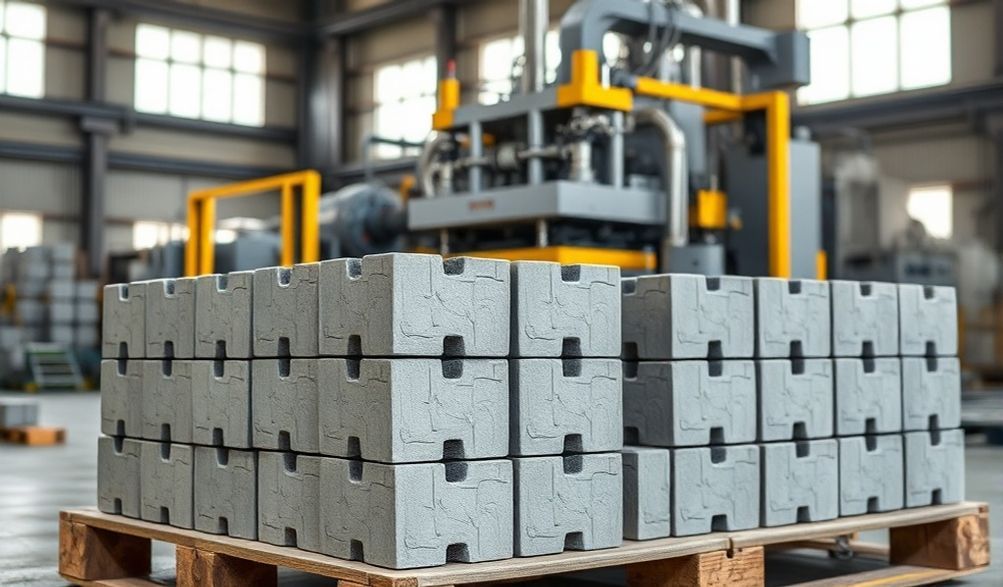
Jou Uiteindelike Gids vir die Aankoop van 'n Betonblokmaakmasjien te Koop (2024)
Inleiding
Bou jy 'n winsgewende konstruksiebesigheid of brei jy jou produksievermoë uit? Die regte betonblokmasjien is jou belangrikste belegging. Dit is die enjin van jou operasie, wat jou uitset, produkgehalte en uiteindelik jou wins bepaal. Tog kan die navigering deur die groot mark van masjiene te koop 'n ontmoedigende taak wees, gevul met tegniese jargon en beduidende finansiële belange.
Hierdie omvattende 2024-gids, wat op dekades se bedryfsondervinding steun, sal as jou betroubare padkaart dien. Ons sal deur die kompleksiteit sny om jou te help om presies te verstaan waarna jy moet soek in 'nbetonblokmasjien te koopJy sal leer hoe om masjientipes by jou spesifieke doelwitte te pas, prysfaktore te ontleed, vervaardigers met 'n kritiese oog te evalueer en duur algemene valstrikke te vermy. Teen die einde sal jy toegerus wees om 'n ingeligte, selfversekerde aankoopbesluit te neem wat jou groei vir jare daarna sal aanvuur.
Verstaan Betonblokmaakmasjiene: Tipes en Toepassings
Voordat jy in spesifikasies en pryse duik, is dit noodsaaklik om die fundamentele kategorieë van beskikbare masjiene te verstaan. Die regte keuse hang af van jou produksieskaal, begroting en arbeidstrategie.
Handmatig vs. Semi-outomaties vs. Volledig Outomatiese Blokmasjiene
Die vlak van outomatisering is die primêre onderskeidingsfaktor in blokmasjiene, wat direk uitset, arbeidskoste en aanvanklike belegging beïnvloed.
-
Handblokmaakmasjiene:
- Operasie:Heeltemal mens-aangedrewe. Operateurs vul die vorm met die hand, druk die beton saam (dikwels deur middel van 'n hefboom), en haal die blok uit die vorm.
- Arbeid & Uitset:Hoë arbeidsintensiteit, baie lae uitset (tipies 100-500 blokke per dag). Geskik vir 1-2 operateurs.
- Kundige Aanbeveling:Ideal vir baie kleinskaalse beginondernemings, gemeenskapsprojekte, of in afgeleë gebiede met lae kragbeskikbaarheid en kapitaal. Hulle is 'n lae-risiko instappunt maar nie vir kommersiële volume-produksie nie.
-
Semi-Automatiese Blokmaakmasjiene:
- Operasie:Meganiseer die kernverdigtingsproses (deur middel van vibrasie en hidrouliese druk), maar vereis handmatige toevoer van roumateriaal en verwydering/palletisering van voltooide blokke.
- Arbeid & Uitset:Matige arbeidsvereiste (2-4 persone), goeie uitset (1 000 tot 6 000+ blokke per 8-uur-skof, afhangende van model).
- Kundige Aanbeveling:Die ideale keuse vir die meeste klein tot mediumgrootte ondernemings (KMO's). Hulle bied 'n uitstekende balans tussen bekostigbaarheid, verbeterde produksietempo en blokkwaliteit konsekwentheid. Perfek vir besighede wat wil opskaal vanaf handmatige bedrywighede.
-
Ten vol outomatiese Blokvervaardigingsmasjiene:
- Operasie:Heeltemal outomaties via PLC (Programmable Logic Controller) stelsels. Hulle beskik oor outomatiese materiaaltoevoer, vorming, verdigting, uitharding en stapeling. Dikwels deel van 'n volledige produksielyn.
- Arbeid & Uitset:Minimale arbeid (vir toesig en instandhouding), baie hoë uitset (8 000 tot 20 000+ blokke per skof).
- Kundige Aanbeveling:Gereserveer vir grootskaalse kommersiële aanlegte en hoëvolume kontrakte. Die aansienlike kapitaalinvestering word geregverdig deur ongeëwenaarde doeltreffendheid, laer per-eenheid koste, en voortreflike konsekwentheid. Vereis betroubare krag en meer gesofistikeerde instandhouding.
Stasionele Blokmasjiene teenoor Mobiele Blokmasjiene
Hierdie onderskeid hou verband met die masjien se mobiliteit en installasievoetspoor.
-
Stilstaande Blokmaakmasjiene:
- Dit is vaste installasies, tipies gemonteer op 'n soliede betonfundering in 'n fabriek of toegewyde werf.
- Hulle is oor die algemeen robuuster, kragtiger en in staat tot hoër produksievolumes.
- Aansoek:Die standaard keuse vir permanente blokvervaardigingsaanlegte wat 'n streeksmark voorsien.
-
Mobiele Blokmaakmasjiene (of “Eierlêers”):
- Hierdie eenhede word op wiele of 'n sleepwa gemonteer. Hulle produseer blokke direk op die grond of op 'n betonblad, en beweeg dan vorentoe om die volgende groep te lê.
- Hulle is eenvoudiger, benodig dikwels minder fondamentwerk, en is hoogs draagbaar.
- Aansoek:Uitstekend vir terreinproduksie vir groot konstruksieprojekte (bv. die bou van 'n behuisingskompleks) waar die vervoer van blokke duur is. Dit skakel vervoerskade en -koste uit.
Sleutelprodukte: Wat Kan Jy Vervaardig?
Jou besigheidsmoontlikhede word nie beperk tot standaardblokke nie. Masjienbuigsaamheid, bepaal deur sy vormsisteem, definieer jou produk katalogus.
- Holblokke:Die mees algemene produk vir konstruksie, wat 'n uitstekende sterkte-tot-gewig-verhouding en isolasie bied.
- Soliede Blokke:Gebruik vir swaarder lasdraende toepassings en plaveisel.
- Paaie en Inlegpaaie:Vir opritte, looppaaie en patio's. 'n Hoë-aanvraagmark in landskap- en munisipale werk.
- Randstene & RandsteneEssensieel vir padkonstruksie- en landskapprojekte.
- Spesiale Vorms:Slotblokke vir keerwande, skoorsteenblokke en dekoratiewe tuinbou-eenhede.
Kundige Insig:Wanneer 'n evaluering van 'nbetonblokmasjien te koop, navraag doen oor die vorms se verenigbaarheid en koste. 'n Masjien wat vinnige vormveranderinge moontlik maak met 'n wye reeks beskikbare vormontwerpe, stel jou in staat om met markvereistes te draai en uiteenlopende inkomstestrome te benut.
Kritieke Faktore om te Oorweeg Voordat Jy Koop
Gewapen met 'n begrip van masjientipes, moet jy nou indelf in die besonderhede wat 'n wyse belegging van 'n duur fout skei.
Produksiekapasiteit & Uitsetvereistes
Don’t just look at the “maximum” output in a brochure. Think practically.
- Cycles per Hour & Blocks per Cycle: Multiply these figures to get the theoretical hourly output. A machine with a 10-second cycle time producing 4 blocks per cycle can theoretically make 1,440 blocks per hour.
- Real-World Calculation: Deduct time for mold changes, maintenance breaks, material loading delays, and operator shifts. A realistic daily output is often 70-80% of the theoretical maximum.
- Pas by Doelwitte: Align the machine’s realistic output with your current orders and projected growth for the next 3-5 years. Buying slightly more capacity than you need today is often smarter than outgrowing a machine too quickly.
Machine Specifications & Technical Details
These are the nuts and bolts that determine performance and longevity.
- Druk (Tonnasie): Higher compaction pressure (measured in tons) generally produces denser, stronger blocks. For standard hollow blocks, machines range from 50 to 400+ tons.
- Kragvereistes: Manuals may need no power, while semi-automatics often use a standard 3-phase motor (e.g., 380V/50Hz or 440V/60Hz). Verify your local power supply.
- Vibrasie Stelsel: This is critical for compacting the concrete and releasing air bubbles. Look for durable, high-frequency vibrators mounted effectively within the mold table.
- Beheerstelsel: From simple relay logic to touch-screen PLCs. More advanced controls offer precision, diagnostic tools, and easier operation.
- Trust Factor: Always ask about the availability of technical manuals, wiring diagrams, and spare parts lists. A supplier’s reluctance to provide these is a major red flag.
Quality of Construction & Key Components
This is where “you get what you pay for” becomes starkly real.
- Raam & Struktuur: The frame should be made from heavy-duty, reinforced steel plate to withstand constant vibration and pressure without warping.
- Hidrouliese Stelsel: The heart of an automatic machine. Look for reputable component brands (e.g., Bosch Rexroth, Parker, Yuken) and a well-designed, accessible system with proper filtration and cooling.
- Skimmels: These are high-wear items. They should be made from hardened, high-chrome steel for longevity and precise block dimensions.
- Authoritative Benchmark: Reputable manufacturers will often build to recognized standards (like ISO) and can provide material certificates for critical components. Don’t hesitate to ask for them.
Space, Logistics, and Foundation Needs
A machine isn’t just the machine itself.
- Factory Space: You need space for the machine, raw material storage (aggregates, cement), a mixing area, a curing area, and finished product storage. Include space for forklift movement.
- Foundation: Most stationary machines require a solid, level concrete foundation of specified thickness to absorb vibrations. The supplier should provide detailed foundation drawings.
- Logistics: Consider the machine’s shipping dimensions and weight. Do you have access for a delivery truck? Do you need a crane or heavy forklift for unloading and placement?
Navigating the Market: Cost, Suppliers, and Selection
This is the phase where due diligence separates successful buyers from regretful ones.
Concrete Block Making Machine Price Ranges
Prices vary astronomically based on the factors we’ve discussed. Here’s a transparent 2024 overview:
- Handmatige Masjiene: $1,000 – $5,000 USD.
- Halfoutomatiese Masjiene: $8,000 – $50,000+ USD. A robust, mid-capacity model for SME production typically starts around $15,000-$25,000.
- Fully Automatic Machines / Production Lines: $50,000 – $300,000+ USD. Single-pallet fully automatic machines start around $50k-$80k, while large multi-pallet lines with full automation can reach several hundred thousand.
Critical Expertise Note: The initial purchase price is just one part of the Total Cost of Ownership (TCO). A cheaper, poorly supported machine can cost far more in downtime, repair costs, and lost production than a higher-quality, well-supported alternative.
How to Choose a Reputable Manufacturer or Supplier
Your relationship with the supplier is as important as the machine itself. Use this checklist:
- Company History & Reputation: How long have they been in business? Search for their brand name online alongside keywords like “review,” “problem,” or “service.” A 10+ year track record is a good sign.
- Quality Evidence: Do they have quality management certifications (ISO)? Can they provide test reports or videos of the machine in operation? Will they share material certificates for key parts?
- After-Sales Support Structure: This is non-negotiable. Do they have technical support staff? What is the warranty period and what does it cover? Is there a stock of commonly needed spare parts? Do they offer installation supervision and operator training?
- Transparency & References: A trustworthy supplier will be proud to connect you with previous customers in your region or a similar industry. They should also be open to a factory visit or a live video tour of their production facility.
- Red Flags: Extremely low prices, pressure to pay via insecure methods, vague company addresses, inability to communicate clearly in your language, and no physical contact details.
New vs. Used Concrete Block Making Machines
A used machine can be a great value—or a money pit.
- New Machine Pros: Full warranty, latest technology, customized to your needs, reliable performance from day one.
- Used Machine Pros: Lower upfront cost, potential for faster delivery, depreciation already absorbed.
- Used Machine Inspection Checklist:
- Hours/Cycles: Check the machine’s service hour meter or get an estimate of total production cycles.
- Physical Inspection: Look for cracks in the frame, signs of weld repairs, hydraulic oil leaks, and excessive wear on molds and vibrators.
- Test Run: Altyd insist on seeing the machine under power, producing blocks. Listen for unusual noises in the hydraulics or vibrations.
- Documentation: Request the original manuals, part lists, and maintenance history.
Maximizing Your Investment: Operation and Beyond
Your new machine is the centerpiece, but its success depends on the ecosystem around it.
Essential Auxiliary Equipment
Rarely does a machine work in isolation. Consider these for an efficient line:
- Betonmenger: A pan mixer or planetary mixer ensures a consistent, homogenous mix, which is vital for block quality.
- Vervoerstelsel: Transports mixed concrete to the machine hopper, saving labor and time.
- Palletvoer-/Sirkulasiestelsel: Automatic systems move pallets in and out of the machine, crucial for high-output automation.
- Block Curing System: This can be a simple rack system in a sheltered yard or a sophisticated steam curing chamber for faster strength gain.
- Forklift or Block Clamp: Essential for handling raw materials and moving stacks of finished blocks.
Raw Material Considerations for Optimal Blocks
The machine can only form what you feed it.
- Mix Design: A proper ratio of cement, sand, aggregate (gravel or crushed stone), and water is critical. The water-cement ratio directly affects strength.
- Aggregate Size: Must be compatible with your mold dimensions—typically between 5mm and 10mm for standard blocks.
- Consistency is Key: Variations in raw material quality or moisture content will lead to inconsistent block density and strength, causing production issues and customer complaints.
The Importance of After-Sales Support
The sale is the beginning of the relationship, not the end.
- Installasie & Inbedryfstelling: Professional setup ensures the machine is level, calibrated, and operating safely from the start.
- Omvattende Opleiding: Operators must be trained not just on how to run the machine, but on basic troubleshooting, daily maintenance, and safety protocols.
- Warranty & Long-Term Support: Understand the response time for technical queries. How quickly can they ship a critical spare part? A supplier with a strong support network is investing in your long-term success.
Frequently Asked Questions (FAQ)
Q: What is the average cost of a concrete block making machine for sale?
A: As detailed above, there’s no single “average.” Prices range from around $1,000 for a basic manual model to well over $200,000 for a high-capacity, fully automatic production line. Your final cost depends on automation level, capacity, brand, and included support.
Q: How many blocks can a standard machine produce per day?
A: Output varies dramatically. A halfoutomatiese masjien might produce 2,000 to 6,000 standard hollow blocks in an 8-hour shift. A fully automatic single-pallet machine can produce 8,000 to 15,000, while large multi-pallet lines can exceed 20,000 blocks per day.
Q: Can one machine produce different block types and sizes?
A: Yes, absolutely. This is achieved through verwisselbare vorms. However, factor in the cost of additional molds and the time required for mold changeover, which can temporarily halt production.
Q: What kind of power supply is needed?
A: It depends entirely on the machine. Small manuals may need none. Semi-automatic and automatic machines almost always require a three-phase industrial power supply (commonly 380V/50Hz or 440V/60Hz). Always confirm the exact voltage and power (kW) requirements with the supplier before purchase.
Q: How do I ensure I’m choosing a trustworthy supplier?
A: Follow the checklist in the guide: verify their business history, ask for quality certifications, demand details on after-sales service and spare parts, and always request customer references or a factory visit. A reputable company will be transparent and eager to prove its credibility.
Conclusion
Purchasing a betonblokmasjien te koop is a pivotal decision that hinges on careful planning and informed selection. We’ve walked through the essential pillars: defining your production needs and scale, understanding the core differences between manual, semi-automatic, and automatic systems, and prioritizing durable construction and robust after-sales support over price alone.
Remember, this machine is a long-term partner in your business growth. The most cost-effective choice isn’t the cheapest sticker price, but the machine—backed by a reputable supplier—that delivers reliable, efficient production for years with minimal downtime. Thorough research and partnering with experienced, trustworthy experts are the true foundations of your success in the block manufacturing industry.
Ready to take the next step? Browse our curated selection of verified, high-performance concrete block making machines for sale, or contact our team of technical experts today for a free, no-obligation consultation tailored to your project goals.
<