
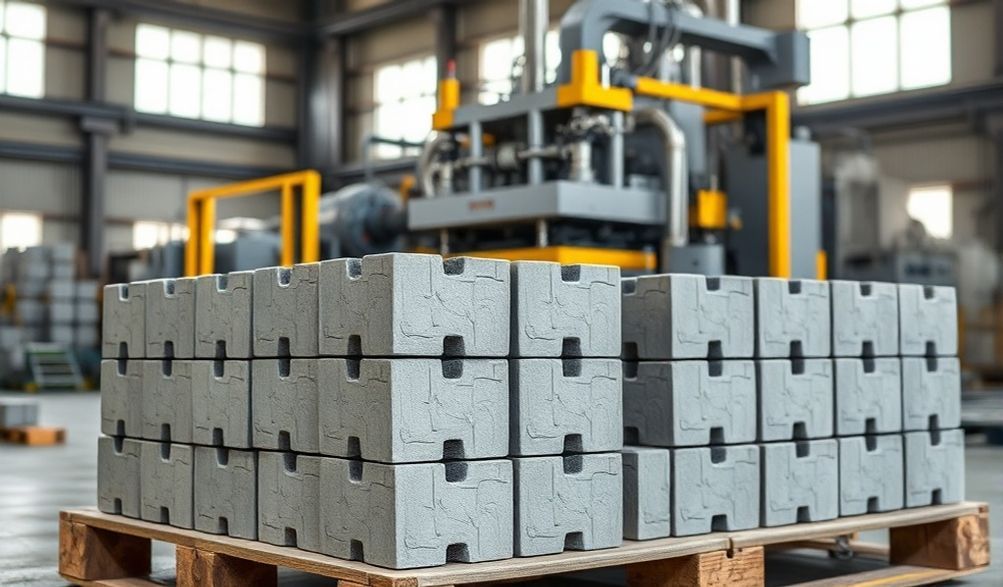
Ваше полное руководство по покупке машины для производства бетонных блоков (2024)
Введение
Строите прибыльный строительный бизнес или расширяете производственные мощности? Правильная машина для производства бетонных блоков — ваше самое важное вложение. Это двигатель вашей деятельности, определяющий объем выпуска, качество продукции и, в конечном счете, вашу прибыль. Однако ориентироваться на обширном рынке продаваемых машин может быть непростой задачей, наполненной техническими терминами и значительными финансовыми рисками.
Это всеобъемлющее руководство 2024 года, основанное на десятилетиях отраслевого опыта, станет вашим надежным планом действий. Мы поможем разобраться во всех сложностях, чтобы вы точно понимали, на что обращать внимание при выбореМашина для производства бетонных блоков на продажуВы узнаете, как подбирать типы оборудования под ваши конкретные задачи, расшифровывать факторы ценообразования, критически оценивать производителей и избегать распространённых дорогостоящих ошибок. В итоге вы будете готовы принять обоснованное и уверенное решение о покупке, которое будет способствовать вашему росту на долгие годы.
Понимание машин для производства бетонных блоков: типы и области применения
Прежде чем перейти к техническим характеристикам и ценам, важно разобраться в основных категориях доступного оборудования. Правильный выбор зависит от масштабов производства, бюджета и стратегии использования рабочей силы.
Ручные против полуавтоматических против полностью автоматических станков для производства блоков
Уровень автоматизации является основным отличительным фактором в блочных машинах, напрямую влияя на производительность, затраты на рабочую силу и первоначальные инвестиции.
-
Ручные станки для производства блоков:
- Операция:Полностью ручной труд. Операторы вручную заполняют форму, уплотняют бетон (часто с помощью рычага) и извлекают блок из формы.
- Труд и выпуск продукции:Высокая трудоемкость, очень низкая производительность (обычно 100-500 блоков в день). Подходит для 1-2 операторов.
- Экспертная рекомендация:Идеально подходят для очень небольших стартапов, общественных проектов или удаленных районов с низкой доступностью электроэнергии и капитала. Они представляют собой точку входа с низким уровнем риска, но не подходят для коммерческого объемного производства.
-
Полуавтоматические станки для производства блоков:
- Операция:Механизирует процесс уплотнения ядра (с помощью вибрации и гидравлического давления), но требует ручной подачи сырья и удаления/паллетирования готовых блоков.
- Труд и выпуск продукции:Умеренные требования к рабочей силе (2-4 человека), хорошая производительность (от 1 000 до 6 000+ блоков за 8-часовую смену, в зависимости от модели).
- Экспертная рекомендация:Идеальный вариант для большинства малых и средних предприятий. Они обеспечивают оптимальный баланс между доступной стоимостью, повышенной скоростью производства и стабильным качеством блоков. Идеально подходят для компаний, стремящихся перейти от ручных операций к масштабированию.
-
Полностью автоматические машины для производства блоков:
- Операция:Полностью автоматизированы с помощью систем ПЛК (программируемых логических контроллеров). Они оснащены автоматической подачей материала, формованием, уплотнением, отверждением и укладкой. Часто являются частью полной производственной линии.
- Труд и выпуск продукции:Минимальные трудозатраты (на надзор и обслуживание), очень высокая производительность (от 8 000 до 20 000+ блоков за смену).
- Экспертная рекомендация:Предназначено для крупных коммерческих предприятий и контрактов с большими объёмами. Значительные капиталовложения оправданы непревзойдённой эффективностью, более низкой себестоимостью единицы продукции и превосходной стабильностью результатов. Требует надёжного энергоснабжения и более сложного технического обслуживания.
Стационарные станки для производства блоков против мобильных станков для производства блоков
Это различие связано с мобильностью машины и занимаемой ею площадью.
-
Стационарные станки для производства блоков:
- Это стационарные установки, обычно смонтированные на прочном бетонном фундаменте на заводе или специальной площадке.
- Обычно они более прочные, мощные и способны на более высокие объемы производства.
- Заявка:Стандартный выбор для заводов по производству блоков, поставляющих продукцию на региональный рынок.
-
Мобильные станки для производства блоков (или "яйцеклады"):
- Эти агрегаты устанавливаются на колеса или прицеп. Они производят блоки непосредственно на земле или бетонной плите, а затем продвигаются вперед для укладки следующей партии.
- 它们更简单,通常需要较少的地基工程,且便携性高。
- Заявка:Отлично подходит для производства на месте для крупных строительных проектов (например, строительство жилого комплекса), где транспортировка блоков дорогостояща. Они исключают транспортные повреждения и затраты.
Ключевые продукты: что вы можете производить?
Ваш бизнес-потенциал не ограничивается стандартными блоками. Универсальность оборудования, определяемая его формовочной системой, формирует ваш ассортимент продукции.
- Пустотелые блоки:Наиболее распространенный продукт для строительства, обладающий отличным соотношением прочности и веса, а также теплоизоляцией.
- Сплошные блоки:用于承受较重载荷和铺设。
- Тротуарная плитка и брусчатка:Для подъездных дорог, пешеходных дорожек и патио. Высоковостребованный рынок в сфере ландшафтного дизайна и муниципальных работ.
- Бордюрные камни и поребрики: Незаменимо для дорожного строительства и проектов по благоустройству территорий.
- Специальные формы:Зацепляющиеся блоки для подпорных стен, блоки для дымоходов и декоративные элементы ландшафтного дизайна.
Экспертное мнение:При оценкеМашина для производства бетонных блоков на продажуузнать о совместимости и стоимости пресс-форм. Машина, позволяющая быстро менять пресс-формы с широким спектром доступных конструкций, даёт возможность адаптироваться к рыночным требованиям и получать разнообразные источники дохода.
Ключевые факторы, которые следует учесть перед покупкой
Вооружившись пониманием типов машин, вы теперь должны углубиться в детали, которые отличают разумную инвестицию от дорогостоящей ошибки.
Производственные мощности и требования к объему выпуска
Don’t just look at the “maximum” output in a brochure. Think practically.
- Cycles per Hour & Blocks per Cycle: Multiply these figures to get the theoretical hourly output. A machine with a 10-second cycle time producing 4 blocks per cycle can theoretically make 1,440 blocks per hour.
- Real-World Calculation: Deduct time for mold changes, maintenance breaks, material loading delays, and operator shifts. A realistic daily output is often 70-80% of the theoretical maximum.
- Matching to Goals: Align the machine’s realistic output with your current orders and projected growth for the next 3-5 years. Buying slightly more capacity than you need today is often smarter than outgrowing a machine too quickly.
Machine Specifications & Technical Details
These are the nuts and bolts that determine performance and longevity.
- Давление (Тоннаж): Higher compaction pressure (measured in tons) generally produces denser, stronger blocks. For standard hollow blocks, machines range from 50 to 400+ tons.
- Требования к питанию: Manuals may need no power, while semi-automatics often use a standard 3-phase motor (e.g., 380V/50Hz or 440V/60Hz). Verify your local power supply.
- Вибросистема: This is critical for compacting the concrete and releasing air bubbles. Look for durable, high-frequency vibrators mounted effectively within the mold table.
- Система управления: From simple relay logic to touch-screen PLCs. More advanced controls offer precision, diagnostic tools, and easier operation.
- Trust Factor: Always ask about the availability of technical manuals, wiring diagrams, and spare parts lists. A supplier’s reluctance to provide these is a major red flag.
Quality of Construction & Key Components
This is where “you get what you pay for” becomes starkly real.
- Каркас и структура: The frame should be made from heavy-duty, reinforced steel plate to withstand constant vibration and pressure without warping.
- Гидравлическая система: The heart of an automatic machine. Look for reputable component brands (e.g., Bosch Rexroth, Parker, Yuken) and a well-designed, accessible system with proper filtration and cooling.
- Плесень: These are high-wear items. They should be made from hardened, high-chrome steel for longevity and precise block dimensions.
- Authoritative Benchmark: Reputable manufacturers will often build to recognized standards (like ISO) and can provide material certificates for critical components. Don’t hesitate to ask for them.
Space, Logistics, and Foundation Needs
A machine isn’t just the machine itself.
- Factory Space: You need space for the machine, raw material storage (aggregates, cement), a mixing area, a curing area, and finished product storage. Include space for forklift movement.
- Foundation: Most stationary machines require a solid, level concrete foundation of specified thickness to absorb vibrations. The supplier should provide detailed foundation drawings.
- Logistics: Consider the machine’s shipping dimensions and weight. Do you have access for a delivery truck? Do you need a crane or heavy forklift for unloading and placement?
Navigating the Market: Cost, Suppliers, and Selection
This is the phase where due diligence separates successful buyers from regretful ones.
Concrete Block Making Machine Price Ranges
Prices vary astronomically based on the factors we’ve discussed. Here’s a transparent 2024 overview:
- Ручные станки: $1,000 – $5,000 USD.
- Полуавтоматические станки: $8,000 – $50,000+ USD. A robust, mid-capacity model for SME production typically starts around $15,000-$25,000.
- Fully Automatic Machines / Production Lines: $50,000 – $300,000+ USD. Single-pallet fully automatic machines start around $50k-$80k, while large multi-pallet lines with full automation can reach several hundred thousand.
Critical Expertise Note: The initial purchase price is just one part of the Total Cost of Ownership (TCO). A cheaper, poorly supported machine can cost far more in downtime, repair costs, and lost production than a higher-quality, well-supported alternative.
How to Choose a Reputable Manufacturer or Supplier
Your relationship with the supplier is as important as the machine itself. Use this checklist:
- Company History & Reputation: How long have they been in business? Search for their brand name online alongside keywords like “review,” “problem,” or “service.” A 10+ year track record is a good sign.
- Quality Evidence: Do they have quality management certifications (ISO)? Can they provide test reports or videos of the machine in operation? Will they share material certificates for key parts?
- After-Sales Support Structure: This is non-negotiable. Do they have technical support staff? What is the warranty period and what does it cover? Is there a stock of commonly needed spare parts? Do they offer installation supervision and operator training?
- Transparency & References: A trustworthy supplier will be proud to connect you with previous customers in your region or a similar industry. They should also be open to a factory visit or a live video tour of their production facility.
- Red Flags: Extremely low prices, pressure to pay via insecure methods, vague company addresses, inability to communicate clearly in your language, and no physical contact details.
New vs. Used Concrete Block Making Machines
A used machine can be a great value—or a money pit.
- New Machine Pros: Full warranty, latest technology, customized to your needs, reliable performance from day one.
- Used Machine Pros: Lower upfront cost, potential for faster delivery, depreciation already absorbed.
- Used Machine Inspection Checklist:
- Hours/Cycles: Check the machine’s service hour meter or get an estimate of total production cycles.
- Physical Inspection: Look for cracks in the frame, signs of weld repairs, hydraulic oil leaks, and excessive wear on molds and vibrators.
- Test Run: Всегда insist on seeing the machine under power, producing blocks. Listen for unusual noises in the hydraulics or vibrations.
- Documentation: Request the original manuals, part lists, and maintenance history.
Maximizing Your Investment: Operation and Beyond
Your new machine is the centerpiece, but its success depends on the ecosystem around it.
Essential Auxiliary Equipment
Rarely does a machine work in isolation. Consider these for an efficient line:
- Бетономешалка: A pan mixer or planetary mixer ensures a consistent, homogenous mix, which is vital for block quality.
- Конвейерная система: Transports mixed concrete to the machine hopper, saving labor and time.
- Паллетный питатель/Система циркуляции: Automatic systems move pallets in and out of the machine, crucial for high-output automation.
- Block Curing System: This can be a simple rack system in a sheltered yard or a sophisticated steam curing chamber for faster strength gain.
- Forklift or Block Clamp: Essential for handling raw materials and moving stacks of finished blocks.
Raw Material Considerations for Optimal Blocks
The machine can only form what you feed it.
- Проектирование состава смеси. A proper ratio of cement, sand, aggregate (gravel or crushed stone), and water is critical. The water-cement ratio directly affects strength.
- Aggregate Size: Must be compatible with your mold dimensions—typically between 5mm and 10mm for standard blocks.
- Consistency is Key: Variations in raw material quality or moisture content will lead to inconsistent block density and strength, causing production issues and customer complaints.
The Importance of After-Sales Support
The sale is the beginning of the relationship, not the end.
- Установка и ввод в эксплуатацию: Professional setup ensures the machine is level, calibrated, and operating safely from the start.
- Комплексное обучение: Operators must be trained not just on how to run the machine, but on basic troubleshooting, daily maintenance, and safety protocols.
- Warranty & Long-Term Support: Understand the response time for technical queries. How quickly can they ship a critical spare part? A supplier with a strong support network is investing in your long-term success.
Frequently Asked Questions (FAQ)
Q: What is the average cost of a concrete block making machine for sale?
А: As detailed above, there’s no single “average.” Prices range from around $1,000 for a basic manual model to well over $200,000 for a high-capacity, fully automatic production line. Your final cost depends on automation level, capacity, brand, and included support.
Q: How many blocks can a standard machine produce per day?
А: Output varies dramatically. A полуавтоматическая машина might produce 2,000 to 6,000 standard hollow blocks in an 8-hour shift. A fully automatic single-pallet machine can produce 8,000 to 15,000, while large multi-pallet lines can exceed 20,000 blocks per day.
Q: Can one machine produce different block types and sizes?
А: Yes, absolutely. This is achieved through interchangeable molds. However, factor in the cost of additional molds and the time required for mold changeover, which can temporarily halt production.
Q: What kind of power supply is needed?
А: It depends entirely on the machine. Small manuals may need none. Semi-automatic and automatic machines almost always require a three-phase industrial power supply (commonly 380V/50Hz or 440V/60Hz). Always confirm the exact voltage and power (kW) requirements with the supplier before purchase.
Q: How do I ensure I’m choosing a trustworthy supplier?
А: Follow the checklist in the guide: verify their business history, ask for quality certifications, demand details on after-sales service and spare parts, and always request customer references or a factory visit. A reputable company will be transparent and eager to prove its credibility.
Заключение
Purchasing a Машина для производства бетонных блоков на продажу is a pivotal decision that hinges on careful planning and informed selection. We’ve walked through the essential pillars: defining your production needs and scale, understanding the core differences between manual, semi-automatic, and automatic systems, and prioritizing durable construction and robust after-sales support over price alone.
Remember, this machine is a long-term partner in your business growth. The most cost-effective choice isn’t the cheapest sticker price, but the machine—backed by a reputable supplier—that delivers reliable, efficient production for years with minimal downtime. Thorough research and partnering with experienced, trustworthy experts are the true foundations of your success in the block manufacturing industry.
Ready to take the next step? Browse our curated selection of verified, high-performance concrete block making machines for sale, or contact our team of technical experts today for a free, no-obligation consultation tailored to your project goals.
<